
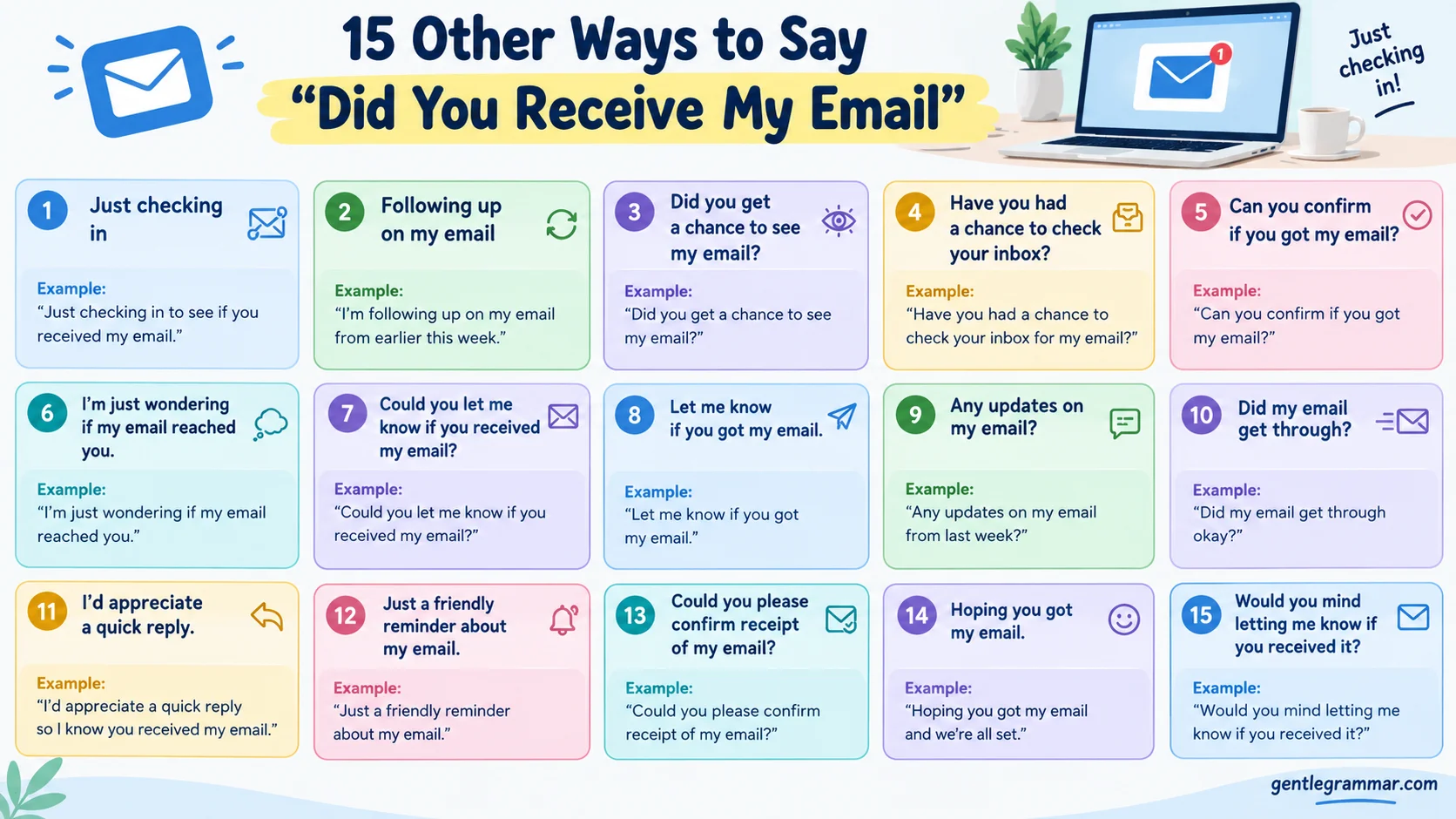
Other Ways to Say “Did You Receive My Email” can help you choose polite wording for a follow-up when you need a clear, respectful response today.
In professional settings, communication can make a real difference in how your messages are understood. When I choose to send a follow-up, I remind myself to check whether the email was received or read without sounding blunt, overly direct, or off-putting. A polite, considerate, and courteous phrase can help someone feel more at ease, especially when following up with a client, manager, colleague, or professor. Instead of asking, “did you receive my email,” I often use natural, human-sounding alternatives that sound respectful and show empathy.
In formal and informal contexts, the best option can vary depending on the situations and urgency. A timely response can be crucial when project progress, decision-making, or meeting preparations are needed, but a softer approach can prevent a pushy, awkward, or repetitive impression. These alternative ways to ask whether an email was sent, received, or unnoticed are designed to make following up more comfortable. In modern work scenarios, swift yet respectful phrases can create smoother conversations, stronger working relationships, and better interaction with colleagues and clients.
What Does “Did You Receive My Email” Mean?
“Did You Receive My Email” is a question asking whether another person received an email that you previously sent. The speaker usually wants confirmation that the message successfully reached the recipient, although the question can sometimes also imply, “Did you see or read the email?” The phrase is commonly used when a response has not arrived or when the sender wants to make sure an important message was not missed. It is clear and direct, but its tone depends heavily on the relationship between the sender and recipient and the surrounding conversation.
Common Situations Where “Did You Receive My Email” Is Used
People use “Did You Receive My Email” in many everyday and professional situations. You might ask it when following up with a coworker, teacher, customer, client, friend, or family member. At work, it can be useful when an email contains an important document, deadline, request, or appointment detail. In personal communication, you may use it when you are unsure whether your message reached someone.
The phrase is especially useful when you need a clear confirmation. However, an alternative may be preferable when you want to sound less direct, more formal, more conversational, or more considerate. For example, “Have you had a chance to see my email?” focuses more on whether the person has noticed the message rather than simply whether it technically arrived.
Is It Professional or Polite to Say “Did You Receive My Email”?
Yes, “Did You Receive My Email” can be professional and polite, particularly when used in a neutral tone. It is straightforward without being inherently rude. However, because it asks directly for confirmation, it can sound somewhat businesslike or direct in certain contexts. A softer expression may work better when contacting a senior colleague, client, professor, or someone you do not know well.
The wording also matters when you are following up repeatedly. If several reminders have already been sent, “Could you confirm you received my email?” may sound more purposeful, while “Just checking that my email came through” can feel more relaxed. The best choice depends on your relationship with the recipient and the reason for following up.
Advantages and Disadvantages of Saying “Did You Receive My Email”?
Advantages
The main advantage is clarity. The recipient immediately understands that you are asking whether a particular email reached them. The wording is also short, familiar, and suitable for both spoken and written communication. In a workplace setting, its directness can be helpful when you need confirmation about an important message.
Disadvantages
The phrase can sometimes feel more direct than necessary, especially if the recipient is busy or if there is a less urgent reason for following up. It also focuses primarily on receipt rather than whether the person has actually opened, read, or considered the message. If you want to sound warmer, more patient, or more formal, another expression may communicate your intention more effectively.
Synonyms for “Did You Receive My Email”
- Did you get my email?
- Did you receive my message?
- Did my email come through?
- Have you received my email?
- Have you had a chance to see my email?
- Were you able to receive my email?
- Could you confirm you received my email?
- Can you confirm receipt of my email?
- I wanted to check that my email reached you.
- I’m checking whether you received my email.
- Just checking that my email came through.
- I’m following up to see if you received my email.
- Did you happen to see my email?
- Have you seen the email I sent?
- Could you let me know if you received my email?
1. Did You Get My Email?
Meaning
“Did You Get My Email?” is a casual and natural way to ask whether someone received an email. It communicates essentially the same basic idea as “Did You Receive My Email,” but “get” makes the expression sound more conversational.
Definition
Did You Get My Email? means: “Did the email I sent reach you or appear in your inbox?”
Detailed Explanation
This expression is especially common in everyday spoken English and informal writing. It feels lighter and less formal than “Did You Receive My Email?” Because “get” is a very common conversational verb, it works naturally with friends, coworkers you know well, and family members. For a formal client or official correspondence, a more polished alternative may be preferable.
Scenario Examples
Scenario: You sent a friend an email containing travel details.
Example: “Did you get my email about our hotel booking?”
Scenario: You are speaking with a coworker about a document you sent earlier.
Example: “Did you get my email with the updated file?”
Best Use
Best for casual conversation, texting, friendly emails, and informal workplace communication.
Tone
Tone: Casual, friendly, direct. It sounds relaxed because “get” is common in everyday English.
2. Did You Receive My Message?
Meaning
“Did You Receive My Message?” broadens the question from email specifically to a message in general. It can refer to an email, text, direct message, or another written communication depending on context.
Definition
Did You Receive My Message? means: “Did the message I sent reach you?”
Detailed Explanation
This wording is useful when you do not want to emphasize the specific communication channel. It can sound slightly more neutral and polished than “Did You Get My Email?” The word “message” also works well when communication may have happened through several platforms. However, if you specifically need confirmation about an email, mentioning the email directly can be clearer.
Scenario Examples
Scenario: You sent someone a message through a communication platform.
Example: “Did you receive my message about tomorrow’s meeting?”
Scenario: You are unsure whether a personal message reached someone.
Example: “Did you receive my message? I wanted to make sure you saw it.”
Best Use
Best for personal communication, workplace messages, online communication, and situations where the channel is not important.
Tone
Tone: Neutral, polite, and versatile. It is less casual than “Did you get my email?” without sounding stiff.
3. Did My Email Come Through?
Meaning
“Did My Email Come Through?” asks whether an email successfully arrived. It has a natural conversational feel and is often used when there may have been a delivery or technical concern.
Definition
Did My Email Come Through? means: “Did my email successfully reach your inbox?”
Detailed Explanation
This expression focuses more strongly on delivery than on reading. It is particularly natural when you suspect there may have been an internet, email-server, attachment, or delivery issue. The phrase is informal but widely understood. It is a good choice when you want to check receipt without making the question sound overly serious.
Scenario Examples
Scenario: You sent an email with a large attachment and are unsure whether it arrived.
Example: “Did my email come through with the presentation attached?”
Scenario: You experienced an email problem earlier.
Example: “I sent it again just in case. Did my email come through this time?”
Best Use
Best for casual workplace conversations, everyday emails, and technical or delivery-related follow-ups.
Tone
Tone: Conversational, friendly, and practical. It sounds less formal than “Can you confirm receipt of my email?”
4. Have You Received My Email?
Meaning
“Have You Received My Email?” is a slightly more polished and formal alternative to “Did You Receive My Email?” It asks whether the recipient has received the email at any point up to now.
Definition
Have You Received My Email? means: “Has the email I sent reached you?”
Detailed Explanation
The present perfect tense gives this version a somewhat more formal feel, especially in professional communication. It works well when you are following up on an email and want to sound courteous without being overly wordy. The phrase still asks about receipt rather than whether the recipient has read or acted on the email.
Scenario Examples
Scenario: You sent an important document to a client.
Example: “Have you received my email with the revised proposal?”
Scenario: You are following up with a colleague.
Example: “Have you received my email regarding Friday’s schedule?”
Best Use
Best for professional emails, client communication, workplace follow-ups, and polite written communication.
Tone
Tone: Professional, polite, and direct. It is a natural choice when you want slightly more formality.
5. Have You Had a Chance to See My Email?
Meaning
“Have You Had a Chance to See My Email?” is a softer follow-up that asks whether the recipient has had an opportunity to notice or review the message.
Definition
Have You Had a Chance to See My Email? means: “Have you been able to look at the email I sent?”
Detailed Explanation
Unlike a direct receipt question, this expression recognizes that the recipient may simply be busy. It avoids sounding as though you are demanding an immediate response. The phrase is particularly useful when the email has already been delivered and your real concern is whether the person has noticed it. It can therefore sound more considerate than a simple request for confirmation.
Scenario Examples
Scenario: A busy coworker has not responded to a non-urgent request.
Example: “Have you had a chance to see my email about the project timeline?”
Scenario: You sent a teacher a question several days ago.
Example: “Have you had a chance to see my email regarding the assignment?”
Best Use
Best for professional communication, school, workplace follow-ups, and polite reminders.
Tone
Tone: Considerate, patient, and polite. It gives the recipient room to respond without feeling pressured.
6. Were You Able to Receive My Email?
Meaning
“Were You Able to Receive My Email?” politely asks whether the recipient was able to receive the message.
Definition
Were You Able to Receive My Email? means: “Did you successfully receive the email I sent?”
Detailed Explanation
This wording emphasizes whether there was any difficulty receiving the email. “Were you able to” makes the question slightly softer than a blunt yes-or-no request. It can be useful when technical problems, spam filters, attachments, or other delivery concerns are possible. Although grammatical and understandable, it is somewhat more formal and deliberate than everyday expressions such as “Did you get my email?”
Scenario Examples
Scenario: You are unsure whether a client received an attachment.
Example: “Were you able to receive my email with the contract attached?”
Scenario: Someone mentioned having trouble with their inbox.
Example: “Were you able to receive my email after the system was restored?”
Best Use
Best for professional communication, technical situations, customer communication, and formal follow-ups.
Tone
Tone: Polite, careful, and professional. The wording suggests genuine concern about successful delivery.
7. Could You Confirm You Received My Email?
Meaning
“Could You Confirm You Received My Email?” directly asks the recipient to confirm receipt.
Definition
Could You Confirm You Received My Email? means: “Please let me know whether you received the email I sent.”
Detailed Explanation
This expression is more action-oriented than the original phrase because it explicitly asks for confirmation. It is particularly useful when knowing that the message arrived is important. “Could you” softens the request and keeps it courteous. It is therefore well suited to professional settings where a clear acknowledgment is needed.
Scenario Examples
Scenario: You send a client an important document.
Example: “Could you confirm you received my email with the signed agreement?”
Scenario: You send instructions to a team.
Example: “Could you confirm you received my email about the updated procedures?”
Best Use
Best for business emails, client communication, important documents, and workplace correspondence.
Tone
Tone: Professional, respectful, and direct. It clearly requests acknowledgment while remaining courteous.
8. Can You Confirm Receipt of My Email?
Meaning
“Can You Confirm Receipt of My Email?” is a formal business expression asking the recipient to acknowledge that the email arrived.
Definition
Can You Confirm Receipt of My Email? means: “Can you confirm that you received my email?”
Detailed Explanation
This version uses the formal noun “receipt”, which gives it a more official tone. It is appropriate when you need a clear record or acknowledgment of communication. Compared with everyday expressions, it can sound more businesslike and less conversational. In a friendly personal message, it may feel unnecessarily formal.
Scenario Examples
Scenario: You sent an official document to a business contact.
Example: “Can you confirm receipt of my email and the attached invoice?”
Scenario: You need acknowledgment of an administrative request.
Example: “Can you confirm receipt of my email regarding the application?”
Best Use
Best for formal emails, administrative communication, business correspondence, and official requests.
Tone
Tone: Formal, professional, and precise. “Receipt” gives the expression an official quality.
9. I Wanted to Check That My Email Reached You.
Meaning
“I Wanted to Check That My Email Reached You” is a gentler way of checking delivery without directly demanding confirmation.
Definition
I Wanted to Check That My Email Reached You means: “I wanted to make sure the email I sent arrived successfully.”
Detailed Explanation
This wording sounds less abrupt because it begins by explaining why you are following up. “Reached you” focuses on successful delivery while avoiding the more transactional feel of “confirm receipt.” It is useful when you want your follow-up to sound thoughtful and respectful. The expression can work particularly well when maintaining a warm professional relationship.
Scenario Examples
Scenario: You sent information to a colleague and have not heard back.
Example: “I wanted to check that my email reached you before I resend the documents.”
Scenario: You sent an important personal message.
Example: “I wanted to check that my email reached you. There’s no rush to reply.”
Best Use
Best for polite follow-ups, professional emails, personal communication, and situations where you want a softer approach.
Tone
Tone: Warm, considerate, and polite. It feels less demanding than a direct confirmation request.
10. I’m Checking Whether You Received My Email.
Meaning
“I’m Checking Whether You Received My Email” explicitly states that you are following up to verify receipt.
Definition
I’m Checking Whether You Received My Email means: “I am following up to find out if my email reached you.”
Detailed Explanation
This expression is straightforward but slightly more explanatory than the original question. It can be useful when you want the recipient to understand that the purpose of your message is simply verification. It avoids sounding impatient because it describes the reason for contacting them. The wording fits professional situations particularly well.
Scenario Examples
Scenario: You are following up after sending a work request.
Example: “I’m checking whether you received my email about the meeting arrangements.”
Scenario: You sent a customer important information.
Example: “I’m checking whether you received my email with the updated account details.”
Best Use
Best for professional follow-ups, customer communication, workplace emails, and straightforward written communication.
Tone
Tone: Professional, neutral, and purposeful. It explains the intention clearly without adding unnecessary emotion.
11. Just Checking That My Email Came Through.
Meaning
“Just Checking That My Email Came Through” is a light and informal follow-up asking whether the email arrived.
Definition
Just Checking That My Email Came Through means: “I’m simply making sure my email arrived successfully.”
Detailed Explanation
The word “just” makes the follow-up feel less demanding. “Came through” is conversational and emphasizes successful delivery rather than whether the recipient has read the content. This expression is useful when you want to send a quick reminder without making the recipient feel pressured. It is generally more suitable for familiar or moderately informal relationships than highly formal correspondence.
Scenario Examples
Scenario: You sent a coworker a file earlier in the day.
Example: “Just checking that my email came through with the spreadsheet.”
Scenario: You are following up with a friend.
Example: “Just checking that my email came through—I wasn’t sure if it sent.”
Best Use
Best for friendly emails, informal workplace messages, personal communication, and quick follow-ups.
Tone
Tone: Casual, friendly, and low-pressure. The wording makes the request feel easygoing.
12. I’m Following Up to See If You Received My Email.
Meaning
“I’m Following Up to See If You Received My Email” explicitly identifies the communication as a follow-up to an earlier email.
Definition
I’m Following Up to See If You Received My Email means: “I am contacting you again to check whether you received my previous email.”
Detailed Explanation
This is especially useful when some time has passed since the original message. The phrase “following up” is common in professional communication and signals that the new message relates to an earlier one. It can be used without sounding accusatory or impatient. If your real goal is to receive a response rather than simply confirm delivery, you may want to mention the specific request as well.
Scenario Examples
Scenario: A prospective client has not responded to your earlier message.
Example: “I’m following up to see if you received my email about our services.”
Scenario: You sent an application-related email.
Example: “I’m following up to see if you received my email regarding my application.”
Best Use
Best for business emails, job-related communication, customer follow-ups, professional networking, and formal reminders.
Tone
Tone: Professional, courteous, and purposeful. “Following up” gives the message a businesslike structure.
13. Did You Happen to See My Email?
Meaning
“Did You Happen to See My Email?” asks whether the person noticed or viewed the email, but the phrase “happen to” makes the question softer.
Definition
Did You Happen to See My Email? means: “Did you happen to notice or read the email I sent?”
Detailed Explanation
This expression is subtly different from asking whether an email was received. Someone may have received an email without actually seeing it, so “see” focuses more on awareness or attention. The phrase “happen to” makes the question sound less demanding and more casual. It works particularly well when you do not want the recipient to feel criticized for not responding.
Scenario Examples
Scenario: You sent a coworker a non-urgent question.
Example: “Did you happen to see my email about next week’s schedule?”
Scenario: You are reminding a friend about information you sent.
Example: “Did you happen to see my email with the photos?”
Best Use
Best for casual workplace communication, friendly emails, personal messages, and gentle reminders.
Tone
Tone: Friendly, soft, and non-demanding. “Happen to” reduces the pressure behind the question.
14. Have You Seen the Email I Sent?
Meaning
“Have You Seen the Email I Sent?” asks whether the recipient has noticed or viewed the email you previously sent.
Definition
Have You Seen the Email I Sent? means: “Have you noticed or looked at the email I sent you?”
Detailed Explanation
This alternative is closer to asking whether the person has seen the content than whether the email technically arrived. That distinction makes it useful when delivery is probably not the issue and you simply want to know whether the recipient has noticed the message. It sounds natural in both spoken and written English. The wording is relatively neutral and does not automatically demand a reply.
Scenario Examples
Scenario: You are speaking with a coworker about a previous message.
Example: “Have you seen the email I sent about the new deadline?”
Scenario: You sent a friend information they need for an event.
Example: “Have you seen the email I sent with the address?”
Best Use
Best for everyday conversation, workplace communication, personal emails, and situations where seeing the message matters more than technical delivery.
Tone
Tone: Neutral, conversational, and direct. It is natural without sounding overly formal.
15. Could You Let Me Know If You Received My Email?
Meaning
“Could You Let Me Know If You Received My Email?” politely asks the recipient to provide confirmation.
Definition
Could You Let Me Know If You Received My Email? means: “Please tell me whether my email reached you.”
Detailed Explanation
This expression is one of the more courteous ways to request confirmation because “could you let me know” makes the request less abrupt. It is especially useful when you need an answer but want to maintain a respectful tone. Unlike “Did You Receive My Email?”, it frames the communication as a polite request rather than a direct question alone. It works well in professional relationships where courtesy matters.
Scenario Examples
Scenario: You send a client a document that requires confirmation.
Example: “Could you let me know if you received my email with the attached proposal?”
Scenario: You are contacting a school administrator.
Example: “Could you let me know if you received my email regarding the enrollment documents?”
Best Use
Best for professional emails, customer communication, formal requests, school correspondence, and polite follow-ups.
Tone
Tone: Polite, respectful, professional, and gentle. The wording asks for confirmation without sounding demanding.
FAQs:
What is another way to say “Did You Receive My Email”?
There are several natural alternatives, depending on your tone. “Did you get my email?” is casual, while “Have you received my email?” is more polished. For a professional request, “Could you confirm you received my email?” is clear and courteous.
What does “Did You Receive My Email” mean?
“Did You Receive My Email” means “Did the email I sent reach you?” It is normally used to check whether an email was successfully received. Depending on the context, the sender may also be asking whether the recipient has noticed or seen the message.
Is “Did You Receive My Email” professional?
Yes. “Did You Receive My Email” is professional and acceptable in many workplace situations. It is direct and clear, though expressions such as “Have you had a chance to see my email?” can sound softer when the recipient may simply be busy.
What is a more polite way to say “Did You Receive My Email”?
A polite alternative is “Could you let me know if you received my email?” This wording turns the question into a courteous request for confirmation. “I wanted to check that my email reached you” is another warm option.
Which alternative works best in formal communication?
For formal communication, “Can you confirm receipt of my email?” provides a particularly precise and businesslike tone. “Could you confirm you received my email?” is also appropriate when you want to remain professional while sounding slightly more conversational.
Conclusion:
Choosing the right wording can make a simple follow-up feel clear, respectful, and appropriate for the relationship. “Did You Receive My Email” is a perfectly useful expression, but the best alternative depends on what you actually want to communicate. If you only need to check delivery, “Did my email come through?” works naturally. If you want to acknowledge the recipient’s busy schedule, “Have you had a chance to see my email?” is gentler. For formal situations, “Could you confirm you received my email?” or “Can you confirm receipt of my email?” provides clearer business language.
The important point is to consider tone, context, and intention before choosing your wording. Similar expressions may ask about the same email while communicating different levels of formality, warmth, and urgency.
