
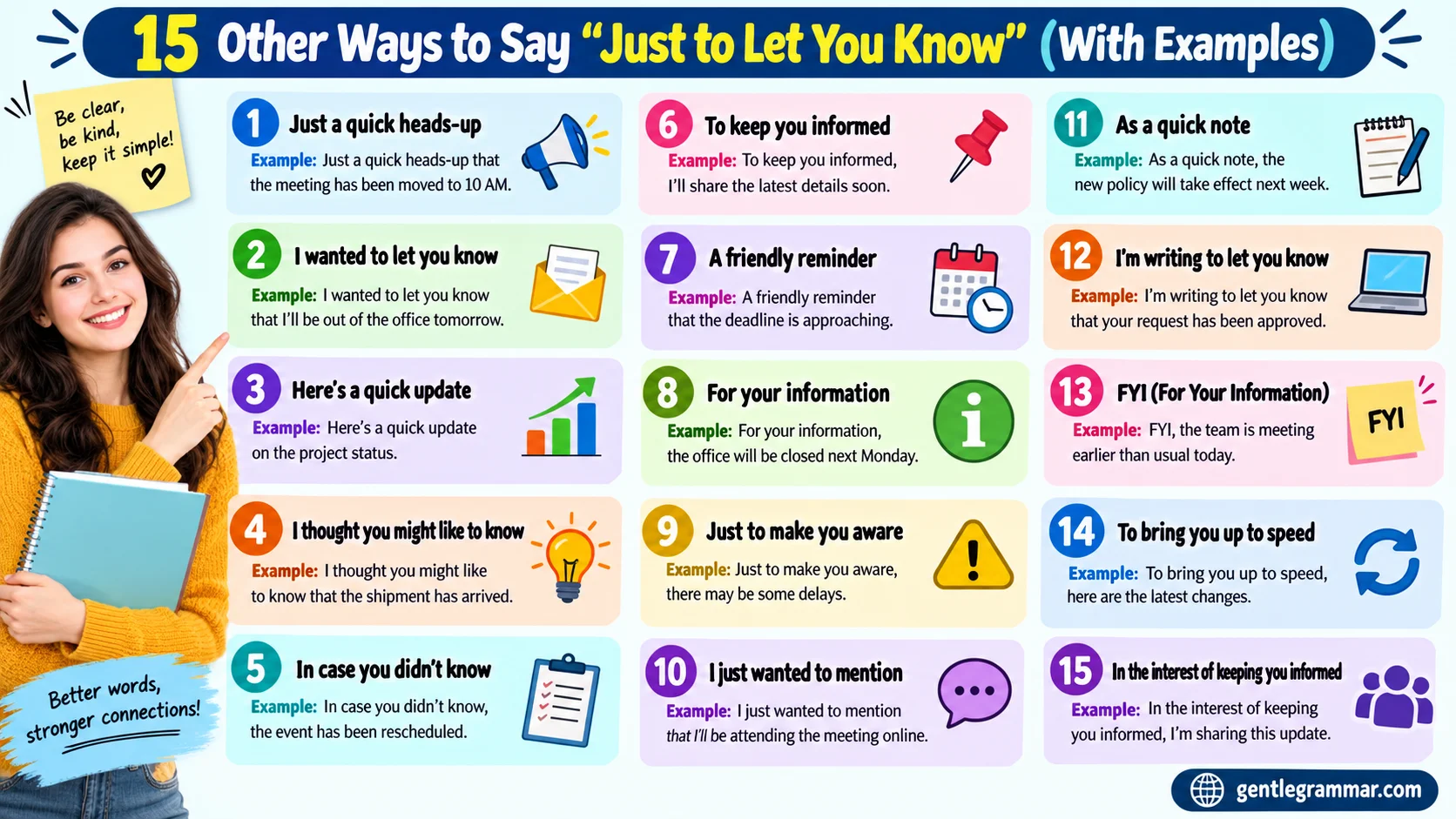
Other Ways to Say “Just to Let You Know” gives you natural choices for sharing updates clearly, politely, and confidently in everyday English.
The common phrase just to let you know is widely used to share updates, give information, offer reminders, or flag something in a polite, neutral, and considerate way. It works well in spoken English, written English, professional emails, academic writing, customer communication, business emails, workplace messages, and everyday conversations.
In different situations, you may need a formal, friendly, direct, soft, or gentle expression to communicate with clarity and confidence. When you want to let someone know something relevant, you can introduce information with a soft tone instead of sounding serious or demanding. For your information, the meeting has moved, while quick heads up or heads up sounds more friendly and casual in casual communication.
What Does “Just to Let You Know” Mean?
“Just to let you know” is a common expression used when someone wants to give another person information or an update without necessarily asking them to do anything. It often introduces information that may be useful, relevant, or worth knowing, such as a change in plans, a reminder, an announcement, or a small update. The word “just” can soften the statement and make it sound less forceful. For example, “Just to let you know, the meeting has been moved to Friday” simply informs the listener about a change. Depending on context and tone, the phrase can sound casual, friendly, polite, or professional.
Common Situations Where “Just to Let You Know” Is Used
People commonly use this phrase in everyday conversation, text messages, emails, workplace communication, and personal messages. A friend might say, “Just to let you know, I’ll be there around eight,” while a coworker might write, “Just to let you know, the report has been submitted.” It is especially useful when the information is important enough to share but does not require an urgent response.
The phrase can also appear in customer communication, school messages, and other routine updates. Someone may want an alternative when they need to sound more formal, more concise, more reassuring, or more direct. The best wording depends on the relationship between the speakers and the importance of the information.
Is It Professional or Polite to Say “Just to Let You Know”?
Yes, “just to let you know” is generally polite and acceptable in professional communication, especially in emails, workplace conversations, and routine updates. It has a relatively soft and non-confrontational quality because it frames the message as information rather than a demand. However, in highly formal writing, a more direct expression such as “I’m writing to inform you” may sound more appropriate.
The phrase is also very natural in casual communication. With friends and family, alternatives such as “I wanted to give you a heads-up” or “I thought you should know” may feel more conversational. The original expression is flexible, but the surrounding words and situation determine its exact tone.
Advantages and Disadvantages of Saying “Just to Let You Know”
Advantages
One major advantage is its versatility. The phrase can introduce good news, neutral information, reminders, schedule changes, or minor concerns. It also tends to sound polite and non-demanding, making it useful when you want to inform someone without putting pressure on them. Its familiarity means most English speakers immediately understand what the speaker intends.
Disadvantages
The main limitation is that it can become repetitive or formulaic, particularly in frequent workplace emails. In some situations, “just” may also make a message sound unnecessarily hesitant or less direct. For formal announcements, a more precise phrase may communicate the purpose of the message more effectively. Choosing an alternative can therefore add clarity, confidence, or emotional warmth when needed.
Synonym for “Just to Let You Know”
- I wanted to let you know
- I thought you should know
- I wanted to inform you
- I’m writing to let you know
- I wanted to give you a heads-up
- For your information
- Please be aware that
- I’d like to bring to your attention
- I wanted to keep you updated
- I thought I’d mention
- Just a quick update
- I wanted to make you aware
- I’m reaching out to let you know
- Please note that
- I wanted to keep you in the loop
1. I Wanted to Let You Know
Meaning
“I wanted to let you know” means that you are intentionally giving someone information. It is one of the closest and most natural alternatives to “just to let you know.”
Definition
A polite expression used to introduce information or an update that the speaker feels is worth sharing.
Detailed Explanation
This expression sounds slightly more personal and intentional than “just to let you know.” The word “wanted” suggests that the speaker chose to communicate because the information matters. It works particularly well in emails and personal messages because it feels considerate without being overly formal.
Scenario Examples
Scenario: You need to tell a friend about a change in your plans.
Example: “I wanted to let you know that I’ll be arriving a little later tonight.”
Scenario: You are updating a coworker about a completed task.
Example: “I wanted to let you know that I’ve finished the presentation.”
Best Use
Best for emails, friendly messages, workplace updates, and personal communication.
Tone
Tone: Warm, polite, and natural. It feels personal without sounding overly casual.
2. I Thought You Should Know
Meaning
“I thought you should know” means you believe the other person would benefit from having certain information.
Definition
An expression used to share information because it is relevant or potentially important to the listener.
Detailed Explanation
This phrase can carry slightly more weight than “just to let you know.” It suggests that the information is important enough that the recipient ought to be aware of it. It works well for personal matters, changes, concerns, and information that could affect someone’s decisions.
Scenario Examples
Scenario: A friend tells you that someone has changed the dinner location.
Example: “I thought you should know that they moved dinner to the restaurant downtown.”
Scenario: You hear useful information about a work project.
Example: “I thought you should know that the deadline has been extended.”
Best Use
Best for personal communication, important updates, and situations where the recipient genuinely needs the information.
Tone
Tone: Considerate, direct, and sometimes slightly serious. The wording implies that the information deserves attention.
3. I Wanted to Inform You
Meaning
“I wanted to inform you” means you are deliberately providing someone with information.
Definition
A relatively formal expression for communicating information to another person.
Detailed Explanation
This phrase is more formal than “just to let you know” and is common in professional or official communication. It can sound polished when discussing appointments, decisions, procedures, or organizational matters. In casual conversation, however, it may feel unnecessarily formal.
Scenario Examples
Scenario: A company needs to notify a customer about a schedule change.
Example: “I wanted to inform you that your appointment has been rescheduled.”
Scenario: An employee gives a manager a formal update.
Example: “I wanted to inform you that the requested documents are now available.”
Best Use
Best for professional emails, formal notices, customer communication, and official updates.
Tone
Tone: Formal, respectful, and professional. It creates more distance than the original phrase.
4. I’m Writing to Let You Know
Meaning
“I’m writing to let you know” directly tells the reader why you are sending a written message.
Definition
A professional expression used to introduce information in an email, letter, or written notice.
Detailed Explanation
This wording is particularly useful when the purpose of a message is simply to communicate an update. It is more structured than “just to let you know” and fits naturally into workplace correspondence. Because it explicitly refers to writing, it is less suitable for ordinary spoken conversation.
Scenario Examples
Scenario: A school contacts a parent about an upcoming event.
Example: “I’m writing to let you know that the parent meeting will take place next Tuesday.”
Scenario: A business communicates a service update.
Example: “I’m writing to let you know that our office will be closed on Monday.”
Best Use
Best for emails, letters, formal notices, and professional written communication.
Tone
Tone: Professional, clear, and courteous. It immediately establishes the purpose of the message.
5. I Wanted to Give You a Heads-Up
Meaning
“I wanted to give you a heads-up” means you want to warn or prepare someone by giving them information in advance.
Definition
An informal expression meaning to give someone advance notice about something.
Detailed Explanation
This expression is more casual than “just to let you know” and is especially common in spoken English and friendly messages. It often suggests that the information could affect the person or that they may want to prepare for it. Because “heads-up” is informal, it is generally better suited to relaxed professional environments or personal communication than formal letters.
Scenario Examples
Scenario: A coworker warns you that construction may cause noise.
Example: “I wanted to give you a heads-up that there’ll be some drilling tomorrow morning.”
Scenario: You tell a friend about a change in plans.
Example: “Just wanted to give you a heads-up—we’re leaving earlier than planned.”
Best Use
Best for texting, casual conversation, friendly workplace communication, and advance warnings.
Tone
Tone: Friendly, casual, and helpful. It feels conversational rather than formal.
6. For Your Information
Meaning
“For your information” indicates that you are providing information for someone to know or reference.
Definition
A phrase used to supply information that may be useful or relevant to the recipient.
Detailed Explanation
This expression is concise and commonly used in written communication. It can be neutral, but depending on context, it may sound somewhat formal or abrupt. In some situations, particularly during disagreements, “for your information” can sound defensive or corrective, so surrounding wording matters.
Scenario Examples
Scenario: You attach a document for a colleague.
Example: “For your information, I’ve attached the updated schedule.”
Scenario: You provide a customer with background information.
Example: “For your information, our return policy has recently been updated.”
Best Use
Best for emails, reports, business correspondence, and informational messages.
Tone
Tone: Neutral, concise, and somewhat formal. It works best when the purpose is simply to provide relevant information.
7. Please Be Aware That
Meaning
“Please be aware that” tells someone to pay attention to a particular fact, condition, or possible change.
Definition
A polite but direct expression used to draw attention to important information.
Detailed Explanation
This alternative is more direct than “just to let you know.” It is useful when the information could affect what someone does next or when you want to make sure they notice a particular condition. Because it can sound serious, it is less suitable for trivial updates.
Scenario Examples
Scenario: A business warns customers about a temporary closure.
Example: “Please be aware that the building will be closed for maintenance tomorrow.”
Scenario: A teacher gives students an important reminder.
Example: “Please be aware that late assignments may receive a reduced grade.”
Best Use
Best for professional communication, notices, policies, instructions, and important reminders.
Tone
Tone: Polite, serious, and direct. It signals that the information deserves attention.
8. I’d Like to Bring to Your Attention
Meaning
“I’d like to bring to your attention” means that you want someone to notice or consider a particular matter.
Definition
A formal expression used to highlight information, an issue, or a matter requiring attention.
Detailed Explanation
This phrase is considerably more formal than “just to let you know.” It is appropriate when you want to emphasize something specific rather than simply provide a casual update. It can be useful in business correspondence, formal requests, and professional discussions, but it may sound stiff in everyday conversation.
Scenario Examples
Scenario: An employee points out a problem in a report.
Example: “I’d like to bring to your attention a discrepancy in the latest figures.”
Scenario: A customer service representative highlights a policy.
Example: “I’d like to bring to your attention the updated cancellation policy.”
Best Use
Best for formal emails, business communication, official correspondence, and professional complaints or observations.
Tone
Tone: Formal, respectful, and serious. It gives the information a greater sense of importance.
9. I Wanted to Keep You Updated
Meaning
“I wanted to keep you updated” means you are sharing new information so someone remains informed about an ongoing situation.
Definition
An expression used to provide progress information or maintain communication about a developing matter.
Detailed Explanation
Unlike “just to let you know,” this phrase usually suggests that there has been an ongoing process or previous conversation. It works especially well when updates are expected over time. The expression feels cooperative and reassuring rather than merely informational.
Scenario Examples
Scenario: You are updating a client about a project.
Example: “I wanted to keep you updated on the progress of the website redesign.”
Scenario: You tell a family member about a developing plan.
Example: “I wanted to keep you updated—we’ve decided to leave on Saturday instead.”
Best Use
Best for project updates, customer communication, workplace messages, and ongoing personal situations.
Tone
Tone: Helpful, reassuring, and professional. It suggests continued communication.
10. I Thought I’d Mention
Meaning
“I thought I’d mention” means you decided to bring up a piece of information, usually without making it sound especially urgent.
Definition
A conversational phrase used to casually introduce a detail or observation.
Detailed Explanation
This is a softer and more relaxed expression than “please be aware that.” It works particularly well when the information is useful but not urgent or highly significant. The phrase sounds natural in conversation and informal writing.
Scenario Examples
Scenario: You remind a friend about something they might have forgotten.
Example: “I thought I’d mention that your favorite café is offering discounts this week.”
Scenario: You add a useful detail during a discussion.
Example: “I thought I’d mention that Sarah already sent the documents.”
Best Use
Best for casual conversation, friendly emails, texts, and informal workplace communication.
Tone
Tone: Casual, gentle, and understated. It avoids making the information sound more important than it is.
11. Just a Quick Update
Meaning
“Just a quick update” introduces a brief piece of new information about a situation.
Definition
A concise expression used to announce a short progress report or change.
Detailed Explanation
This phrase emphasizes that the information will be brief and focused. It is particularly natural in emails, workplace chats, and project communication. It does not necessarily mean the information is unimportant; rather, it tells the recipient that the message will be short.
Scenario Examples
Scenario: A manager sends a project update.
Example: “Just a quick update: the launch has been moved to Thursday.”
Scenario: You message someone about travel plans.
Example: “Just a quick update—we’ve arrived safely.”
Best Use
Best for emails, workplace messaging, project updates, and short personal messages.
Tone
Tone: Concise, friendly, and practical. It signals that the recipient can expect a brief message.
12. I Wanted to Make You Aware
Meaning
“I wanted to make you aware” means you want someone to know about a particular fact, situation, or concern.
Definition
A professional expression used to ensure that someone knows about relevant information.
Detailed Explanation
This wording is more deliberate and formal than “just to let you know.” It is useful when the information has some significance and you want to make sure it is noticed. It can also sound more serious when introducing a concern or potential problem.
Scenario Examples
Scenario: An employee tells a supervisor about a scheduling issue.
Example: “I wanted to make you aware of a conflict with next week’s schedule.”
Scenario: A business informs a customer about a service limitation.
Example: “We wanted to make you aware that some features may be temporarily unavailable.”
Best Use
Best for professional emails, workplace communication, customer service, and important notifications.
Tone
Tone: Professional, respectful, and measured. It draws attention to information without sounding overly forceful.
13. I’m Reaching Out to Let You Know
Meaning
“I’m reaching out to let you know” means you are contacting someone specifically to provide information.
Definition
A polite expression used to introduce the purpose of contacting someone, especially in written communication.
Detailed Explanation
This phrase is common in professional emails and customer communication. It emphasizes the act of making contact rather than simply announcing information. It can be useful when communicating with someone you do not know well, although repeated use in business writing can sometimes sound formulaic.
Scenario Examples
Scenario: A company contacts a customer about an order.
Example: “I’m reaching out to let you know that your order has been shipped.”
Scenario: A professional contacts a colleague about a meeting.
Example: “I’m reaching out to let you know that tomorrow’s meeting will start at 10 a.m.”
Best Use
Best for professional emails, customer communication, networking, and workplace correspondence.
Tone
Tone: Polite, professional, and courteous. It creates a respectful opening for a message.
14. Please Note That
Meaning
“Please note that” asks the reader to pay attention to specific information.
Definition
A concise expression used to highlight a fact, condition, instruction, or important detail.
Detailed Explanation
This phrase is more direct than “just to let you know” and works particularly well when the information needs to be noticed. It is common in professional writing, instructions, policies, announcements, and customer messages. Because it is direct, it can sound less personal than “I wanted to let you know.”
Scenario Examples
Scenario: A company explains a payment requirement.
Example: “Please note that payment must be received before the order is processed.”
Scenario: A school announces a schedule change.
Example: “Please note that Friday’s class will begin at 9 a.m.”
Best Use
Best for formal emails, instructions, notices, policies, and professional communication.
Tone
Tone: Clear, professional, and direct. It tells the reader that the following information deserves attention.
15. I Wanted to Keep You in the Loop
Meaning
“I wanted to keep you in the loop” means you want someone to remain informed about what is happening.
Definition
An informal expression meaning to keep someone informed about an ongoing situation or development.
Detailed Explanation
This phrase emphasizes inclusion and continued communication. It is especially useful when several people are involved in a project, plan, or decision and you want someone to know what is happening. It is more conversational than “I wanted to keep you updated” and is usually unsuitable for highly formal writing.
Scenario Examples
Scenario: A coworker updates a teammate about a project.
Example: “I wanted to keep you in the loop about the changes to the launch plan.”
Scenario: You update a friend who is involved in your plans.
Example: “I wanted to keep you in the loop—we’re now thinking of going on Sunday instead.”
Best Use
Best for workplace conversations, team communication, friendly emails, and personal messages.
Tone
Tone: Friendly, collaborative, and informal. It suggests that the recipient is part of the conversation or process.
FAQs:
What is another way to say “Just to Let You Know”?
Natural alternatives include “I wanted to let you know,” “I thought you should know,” “I wanted to keep you updated,” and “I thought I’d mention.” The best choice depends on the situation. For example, “I wanted to let you know” is broadly useful, while “I wanted to give you a heads-up” is more casual.
What does “Just to Let You Know” mean?
“Just to let you know” means to give someone information or an update without necessarily asking them to take action. It is commonly used for reminders, changes, announcements, and everyday updates.
Is “Just to Let You Know” professional?
Yes. “Just to let you know” can be professional and polite, particularly in routine emails and workplace communication. For more formal situations, expressions such as “I wanted to inform you” or “I’m writing to let you know” may be more suitable.
What is a more polite way to say “Just to Let You Know”?
There is no single universally more polite option because politeness depends on context. “I wanted to let you know” is a warm and courteous choice, while “Please note that” is appropriate when you need to draw attention to specific information.
Which alternative works best in formal communication?
For formal communication, “I wanted to inform you,” “I’m writing to let you know,” “Please note that,” and “I’d like to bring to your attention” can work well. The choice depends on whether you are simply informing someone, emphasizing an important detail, or drawing attention to a particular issue.
Conclusion:
Choosing the right expression can make a simple update feel more natural, respectful, and appropriate to the situation. “Just to let you know” remains a useful phrase because it is flexible and easy to understand, but changing your wording can help you communicate with greater precision. A friendly conversation may call for “I thought I’d mention” or “I wanted to give you a heads-up,” while a formal email may benefit from “I wanted to inform you” or “Please note that.” The key is to consider your relationship with the reader, the importance of the information, and the tone you want to create. When you choose your words thoughtfully, even a short message can feel clearer and more considerate.
