
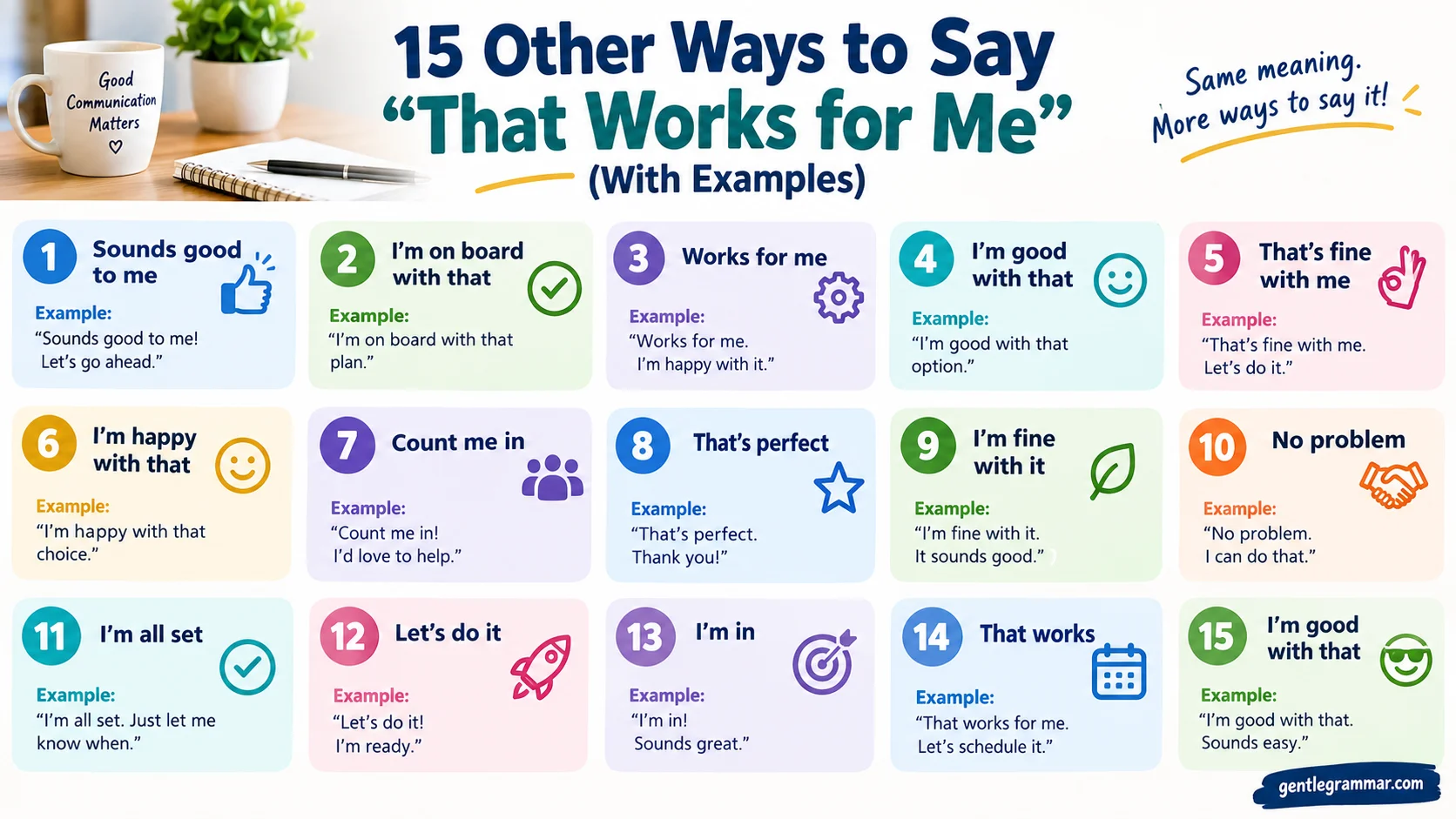
Other Ways to Say “That Works for Me” can help your writing sound more natural, clear, and confident when the same phrase becomes repetitive.
This commonly used phrase is simple, polite, flexible, and versatile, and people use it to show agreement, confirm a plan, accept a suggestion, or show understanding. For example, “let’s meet at 3 p.m.” can be answered with a phrase that confirms the time is acceptable. You may hear it in everyday English, casual conversations, text messages, friendly chats, a meeting, or an email.
However, using the same phrase in every situation can sound repetitive, flat, or overused. From my experience editing business emails and student essays, I often see repeated phrases that are not wrong, but need more variation. Using natural alternatives, phrase alternatives, and simple swaps can make your writing more natural, confident, polished, and intentional without changing the meaning.
What Does “That Works for Me” Mean?
“That Works for Me” means that a suggested plan, arrangement, time, idea, or option is acceptable or suitable for you. When someone proposes something and you respond with this phrase, you are usually saying that you can agree to it or that it fits your needs. For example, if a colleague suggests meeting at 3 p.m., saying “That Works for Me” means that 3 p.m. is convenient and acceptable for you. The phrase can also communicate flexibility because it often suggests that you are willing to proceed with the option without needing changes.
The expression is generally positive and cooperative, although the exact feeling depends on context and tone of voice. It can mean anything from a simple “I can do that” to a warmer “I’m happy with that arrangement.” Because it is fairly neutral, speakers sometimes choose a different expression when they want to show stronger enthusiasm, greater politeness, or a more specific reason why the suggestion suits them.
Common Situations Where “That Works for Me” Is Used
“That Works for Me” is common in everyday conversation, texting, workplace communication, scheduling, and personal communication. You might use it when agreeing to a meeting time, accepting a restaurant choice, confirming plans with a friend, or responding to a proposed arrangement.
In professional settings, the phrase can be useful when discussing meetings, deadlines, schedules, appointments, or project arrangements. For example, a colleague might suggest a Friday deadline, and you could respond that it works for you. In casual communication, the phrase can be even more relaxed: a friend suggests meeting after work, and you simply confirm that the timing suits you.
People may look for alternatives when they have used the phrase repeatedly or when they want to express a more specific feeling. “That Works for Me” does not always communicate enthusiasm, warmth, or formality on its own, so another expression may better match the intended message.
Is It Professional or Polite to Say “That Works for Me”?
Yes. “That Works for Me” is generally polite, cooperative, and professionally acceptable, particularly when discussing schedules, plans, or practical arrangements. It is not overly formal, however, so it works especially well in ordinary workplace conversations, emails, chats, and discussions with colleagues.
The phrase can sound casual and straightforward in friendly conversation and neutral and professional in many work situations. For a highly formal letter or particularly respectful communication, a more formal expression may be preferable. Similarly, if you want to communicate enthusiasm rather than simple acceptance, something warmer such as “I’m happy with that” may express your feeling more clearly.
Advantages and Disadvantages of Saying “That Works for Me”
Advantages
The main advantage of “That Works for Me” is its simplicity. It quickly communicates agreement without unnecessary explanation. It is also flexible enough to discuss schedules, plans, arrangements, ideas, and practical solutions. The phrase has a cooperative tone, making it useful when two people are trying to find an option that suits everyone.
Another benefit is that it does not usually sound overly enthusiastic or overly formal. This makes it a useful neutral expression when you are comfortable with a suggestion but do not need to express strong excitement.
Disadvantages
The phrase can sometimes be too neutral when you want to show genuine enthusiasm or appreciation. “That Works for Me” may communicate acceptance without making it clear whether you are excited, pleased, or simply willing to agree.
It can also be less useful when you want to explain why something is suitable. In those situations, a more specific phrase such as “That fits my schedule” can provide clearer information. Choosing an alternative based on tone and context can therefore make your communication more precise.
Synonym for“That Works for Me”
- That suits me
- That’s fine with me
- I’m good with that
- I’m okay with that
- That’s acceptable to me
- I can work with that
- That fits my schedule
- That’s convenient for me
- I’m happy with that
- I’m on board with that
- I’m comfortable with that
- That sounds good to me
- I can make that work
- That arrangement suits me
- I’m fine with that
1. That suits me
Meaning
“That suits me” means that a particular option, plan, or arrangement is suitable or convenient for you. It is especially useful when discussing times, schedules, or arrangements.
Definition
That suits me: An expression used to say that something is suitable, convenient, or appropriate for your needs.
Detailed Explanation
This expression is close in meaning to “That Works for Me,” but it emphasizes suitability rather than simply saying you can accept something. It can sound slightly more polished and deliberate, particularly in British English. It is useful when you want to communicate that a proposal genuinely fits your circumstances. It works naturally in both personal and professional conversations.
Scenario Examples
Scenario: A colleague suggests a meeting time.
Example: “Thursday afternoon suits me perfectly.”
Scenario: A friend suggests a restaurant close to your home.
Example: “That location suits me, so let’s go with it.”
Best Use
Use “That suits me” when discussing schedules, locations, plans, or arrangements that fit your needs.
Tone
Tone: Polite, practical, and moderately formal.
It sounds cooperative without being overly enthusiastic.
2. That’s fine with me
Meaning
“That’s fine with me” means that you accept or have no objection to a particular suggestion or arrangement.
Definition
That’s fine with me: A phrase used to express acceptance or agreement with something proposed.
Detailed Explanation
This is a very natural everyday alternative to “That Works for Me.” It usually communicates comfortable acceptance rather than strong enthusiasm. Depending on the speaker’s tone, it can sound warm and agreeable or simply neutral. Because “fine” can sometimes imply that something is merely acceptable, it may not be the best choice when you want to show excitement.
Scenario Examples
Scenario: Your friend asks whether you want to meet at 6 p.m.
Example: “Six o’clock is fine with me.”
Scenario: A family member asks whether you are comfortable changing dinner plans.
Example: “That’s fine with me. We can eat a little later.”
Best Use
Use it in casual conversation, texts, personal messages, and ordinary workplace communication.
Tone
Tone: Casual, agreeable, and neutral.
It communicates acceptance without making the response sound overly enthusiastic.
3. I’m good with that
Meaning
“I’m good with that” means “I agree with that” or “I’m comfortable accepting that option.”
Definition
I’m good with that: An informal expression of agreement or acceptance.
Detailed Explanation
This phrase is particularly common in spoken English and casual digital communication. It sounds relaxed and conversational rather than formal. Compared with “That Works for Me,” it places the focus slightly more on your personal approval of the proposal. It is a natural choice when talking with friends, family, or familiar colleagues.
Scenario Examples
Scenario: A friend proposes watching a particular movie.
Example: “You want to watch that one? I’m good with that.”
Scenario: A coworker suggests dividing the project responsibilities in a certain way.
Example: “I’m good with that division of the work.”
Best Use
Use it for casual conversations, texting, team chats, and friendly workplace communication.
Tone
Tone: Relaxed, friendly, and informal.
It feels natural when the conversation is conversational rather than formal.
4. I’m okay with that
Meaning
“I’m okay with that” communicates that you accept something or do not object to it.
Definition
I’m okay with that: An informal phrase meaning that you are willing to accept or agree to something.
Detailed Explanation
This expression is straightforward and widely understood. It can be slightly less enthusiastic than “That Works for Me” because “okay” often signals tolerance or acceptance rather than excitement. It is useful when you want to make it clear that a suggestion does not cause a problem. Your tone matters because a flat delivery can make it sound reluctant.
Scenario Examples
Scenario: Your friend wants to change the meeting place.
Example: “The new café is fine. I’m okay with that.”
Scenario: A teammate suggests moving a discussion to the afternoon.
Example: “I’m okay with that if everyone else is available.”
Best Use
Use it in casual conversation, texting, group discussions, and informal workplace communication.
Tone
Tone: Casual, neutral, and accepting.
It works well when you want to show that something is acceptable without expressing strong excitement.
5. That’s acceptable to me
Meaning
“That’s acceptable to me” means that you consider a proposal satisfactory or suitable enough to accept.
Definition
That’s acceptable to me: A formal or neutral expression indicating that you agree to or accept a particular option.
Detailed Explanation
This phrase is more formal and deliberate than “That Works for Me.” It is appropriate when the focus is on whether something meets your requirements rather than whether you personally like it. Because “acceptable” can sound somewhat businesslike, it may feel too stiff in a friendly conversation. It is best reserved for situations where precise, professional wording is useful.
Scenario Examples
Scenario: Two parties are discussing a practical arrangement.
Example: “The revised payment schedule is acceptable to me.”
Scenario: A formal discussion involves several proposed changes.
Example: “The updated terms are acceptable to me.”
Best Use
Use it in formal communication, business discussions, negotiations, and professional writing.
Tone
Tone: Formal, precise, and reserved.
It communicates acceptance without adding unnecessary emotion.
6. I can work with that
Meaning
“I can work with that” means that you can adapt to, use, or proceed with a proposed option.
Definition
I can work with that: An expression showing that a suggested arrangement is practical enough for you to proceed.
Detailed Explanation
This phrase emphasizes flexibility and practicality. Rather than simply saying you agree, you are indicating that you can adjust your plans or work within the suggested arrangement. It is especially useful in professional or problem-solving situations. The expression can therefore sound more collaborative than a simple statement of acceptance.
Scenario Examples
Scenario: A client cannot meet your preferred deadline but offers another date.
Example: “Friday afternoon is later than I expected, but I can work with that.”
Scenario: A colleague has limited resources for a project.
Example: “We have fewer people available this week, but I can work with that.”
Best Use
Use it in workplace communication, project discussions, negotiations, and practical problem-solving.
Tone
Tone: Flexible, cooperative, and practical.
It suggests that you are willing to adapt rather than demanding your preferred option.
7. That fits my schedule
Meaning
“That fits my schedule” specifically means that a proposed time or appointment works within your existing plans.
Definition
That fits my schedule: A phrase used to say that a particular time or arrangement is compatible with your schedule.
Detailed Explanation
Unlike the broader “That Works for Me,” this expression is specifically connected to time and availability. It gives the listener useful information about why you can accept the suggestion. It sounds natural in professional scheduling and everyday planning. Because it is specific, it is not normally appropriate for ideas or arrangements unrelated to time.
Scenario Examples
Scenario: A client offers two possible appointment times.
Example: “Tuesday at 10 a.m. fits my schedule.”
Scenario: A friend suggests a weekend activity.
Example: “Saturday morning fits my schedule better.”
Best Use
Use it for meetings, appointments, deadlines, classes, interviews, and scheduling conversations.
Tone
Tone: Clear, practical, and professional.
It gives a specific reason for your agreement.
8. That’s convenient for me
Meaning
“That’s convenient for me” means that something is easy or suitable for you given your circumstances.
Definition
That’s convenient for me: An expression indicating that an option causes little difficulty and fits your needs.
Detailed Explanation
This phrase highlights convenience rather than general agreement. It is particularly useful when discussing times, locations, travel arrangements, or other practical details. It can sound slightly more formal than “That Works for Me,” especially in professional communication. However, it does not necessarily communicate enthusiasm; it mainly says that the arrangement is easy for you.
Scenario Examples
Scenario: Someone offers to meet near your workplace.
Example: “Meeting there would be convenient for me.”
Scenario: A customer suggests a delivery time.
Example: “Friday morning would be convenient for me.”
Best Use
Use it in professional emails, appointments, scheduling, customer communication, and practical arrangements.
Tone
Tone: Polite, practical, and professional.
It focuses on ease and suitability.
9. I’m happy with that
Meaning
“I’m happy with that” means that you are pleased or satisfied with the proposed option.
Definition
I’m happy with that: An expression showing positive acceptance or satisfaction with something.
Detailed Explanation
This phrase generally communicates more positive feeling than “That Works for Me.” It tells the other person that you are not merely able to accept the proposal—you are pleased with it. It works well when someone has made an effort to find an arrangement that satisfies you. In some contexts, it can sound warmer and more appreciative.
Scenario Examples
Scenario: A designer presents a revised version of a project.
Example: “The updated layout looks great. I’m happy with that.”
Scenario: Your friend confirms the final travel plan.
Example: “I’m happy with that plan. Let’s book it.”
Best Use
Use it in personal communication, workplace discussions, creative projects, and situations where you want to express satisfaction.
Tone
Tone: Warm, positive, and agreeable.
It shows genuine satisfaction rather than simple acceptance.
10. I’m on board with that
Meaning
“I’m on board with that” means that you support, agree with, or are willing to participate in a plan or idea.
Definition
I’m on board with that: An informal expression of support or agreement with a proposal.
Detailed Explanation
This expression goes beyond practical acceptance and can suggest active support. It is particularly natural when discussing ideas, plans, projects, or decisions involving several people. It may sound more enthusiastic than “That Works for Me” because it suggests that you are willing to participate. However, it is fairly informal and may not fit highly formal writing.
Scenario Examples
Scenario: Your team proposes a new way to organize a project.
Example: “I’m on board with that approach.”
Scenario: Friends agree on a plan for a weekend trip.
Example: “I’m on board with that. Let’s make the reservations.”
Best Use
Use it in team discussions, casual workplace conversations, group planning, and friendly communication.
Tone
Tone: Enthusiastic, collaborative, and informal.
It suggests active agreement rather than passive acceptance.
11. I’m comfortable with that
Meaning
“I’m comfortable with that” means that you feel at ease accepting or proceeding with a proposal.
Definition
I’m comfortable with that: A phrase used to express that an option feels acceptable and does not cause concern.
Detailed Explanation
This expression focuses on personal comfort and confidence rather than convenience alone. It is useful when a decision may involve uncertainty, responsibility, boundaries, or personal preferences. It can sound thoughtful and measured in professional settings. Because it refers to your comfort level, it may be less suitable when you simply want to confirm a meeting time.
Scenario Examples
Scenario: A colleague asks whether you are comfortable taking responsibility for part of a project.
Example: “Yes, I’m comfortable with that responsibility.”
Scenario: Someone proposes changing an established arrangement.
Example: “I’ve considered it, and I’m comfortable with that change.”
Best Use
Use it in professional discussions, personal boundaries, decisions, agreements, and sensitive conversations.
Tone
Tone: Calm, thoughtful, and respectful.
It communicates personal acceptance without sounding overly casual.
12. That sounds good to me
Meaning
“That sounds good to me” means that a proposed idea or plan seems appealing, suitable, or agreeable.
Definition
That sounds good to me: A friendly expression used to show approval of a suggestion.
Detailed Explanation
This is one of the most natural conversational alternatives to “That Works for Me.” It often carries a little more enthusiasm and warmth, especially when responding to an invitation or idea. The phrase works particularly well when you are reacting to something someone has just suggested. It is usually more conversational than formal.
Scenario Examples
Scenario: A friend suggests a new restaurant.
Example: “Thai food at seven? That sounds good to me.”
Scenario: A colleague proposes a plan for finishing a project.
Example: “We can review it together tomorrow morning. That sounds good to me.”
Best Use
Use it in casual conversations, friendly emails, texts, invitations, and everyday workplace communication.
Tone
Tone: Friendly, positive, and conversational.
It shows approval while keeping the exchange relaxed.
13. I can make that work
Meaning
“I can make that work” means that you are willing and able to adjust your plans so that a proposed arrangement becomes possible.
Definition
I can make that work: An expression showing that you can accommodate a particular plan despite possible inconvenience or adjustment.
Detailed Explanation
This phrase communicates flexibility and willingness to adapt. It can be especially useful when the proposed option is not necessarily your first choice but you can rearrange things to accommodate it. That makes it slightly different from “That Works for Me,” which can suggest that the option already fits naturally. The expression often sounds reassuring because it tells the other person that you will find a way to accommodate the plan.
Scenario Examples
Scenario: A meeting is moved to a less convenient time.
Example: “Three o’clock is a little tight, but I can make that work.”
Scenario: A friend changes the day of a planned outing.
Example: “I can’t do Friday, but I can make Saturday work.”
Best Use
Use it for scheduling, workplace coordination, personal plans, and situations requiring flexibility.
Tone
Tone: Flexible, cooperative, and reassuring.
It suggests willingness to make adjustments.
14. That arrangement suits me
Meaning
“That arrangement suits me” means that a particular agreement, plan, or setup is suitable for you.
Definition
That arrangement suits me: A phrase indicating that a proposed arrangement fits your needs or circumstances.
Detailed Explanation
This expression is more specific than “That Works for Me” because it refers directly to an arrangement or agreed setup. It can sound polished and composed, making it suitable for professional conversations as well as some formal personal communication. It is particularly useful when discussing ongoing plans rather than a single suggestion. Because it is somewhat formal, it may sound less natural in quick texts between close friends.
Scenario Examples
Scenario: Two people are discussing a shared work schedule.
Example: “Working remotely on Mondays suits me.”
Scenario: A service provider proposes a particular appointment arrangement.
Example: “That arrangement suits me, so we can proceed.”
Best Use
Use it in professional communication, scheduling, agreements, and discussions about ongoing arrangements.
Tone
Tone: Polished, practical, and moderately formal.
It emphasizes the suitability of the arrangement.
15. I’m fine with that
Meaning
“I’m fine with that” means that you accept something and do not have a problem with it.
Definition
I’m fine with that: An informal expression used to communicate acceptance or a lack of objection.
Detailed Explanation
This phrase is very common in everyday English and is close to “That Works for Me.” It usually communicates neutral acceptance, although the speaker’s tone can make it sound warmer or more reluctant. It is useful when someone asks whether a change or suggestion causes a problem. For stronger enthusiasm, another expression may be clearer.
Scenario Examples
Scenario: A friend asks whether you mind changing the meeting place.
Example: “The new location is fine. I’m fine with that.”
Scenario: A coworker asks whether you can use a different document format.
Example: “I’m fine with that. Send me the updated version.”
Best Use
Use it in casual conversation, texting, informal workplace communication, and everyday discussions.
Tone
Tone: Casual, neutral, and accepting.
It signals that you have no objection without necessarily expressing excitement.
FAQs:
What is another way to say “That Works for Me”?
Natural alternatives include “That suits me,” “That’s fine with me,” “I’m good with that,” “I can work with that,” and “That sounds good to me.” The best choice depends on whether you want to emphasize convenience, acceptance, flexibility, or enthusiasm.
What does “That Works for Me” mean?
“That Works for Me” means that a suggested plan, option, time, or arrangement is suitable or acceptable to you. It is commonly used when confirming that you agree with a proposal or can accommodate it.
Is “That Works for Me” professional?
Yes. “That Works for Me” is generally professional enough for ordinary workplace communication, especially when discussing schedules and arrangements. It is conversational rather than highly formal, so a more formal expression may be preferable in official or particularly formal writing.
What is a more polite way to say “That Works for Me”?
“That suits me,” “That’s convenient for me,” and “I’m comfortable with that” can sound especially polite depending on the context. For professional communication, choose the phrase that accurately reflects whether you mean convenience, agreement, or personal comfort.
Which alternative works best in formal communication?
There is no single alternative that fits every formal situation. “That’s acceptable to me” can suit formal discussions where acceptance is the main point, while “That’s convenient for me” works well for scheduling. The most appropriate wording depends on the specific context and the meaning you want to communicate.
Conclusion:
Choosing an alternative to “That Works for Me” is not simply about replacing one phrase with another. The best expression depends on what you actually want tocommunicate—acceptance, convenience, enthusiasm, flexibility, comfort, or active support. “That suits me” can emphasize suitability, while “I can make that work” highlights flexibility. In contrast, “I’m happy with that” communicates satisfaction.
“That sounds good to me” adds a friendly, positive feeling.The important thing is to consider your relationship with the listener, the setting, and the tone you want your words to create. A small change in wording can make an ordinary response feel more precise and natural. When you understand these differences, you can use “That Works for Me” confidently while also knowing when another expression better matches your meaning.
