
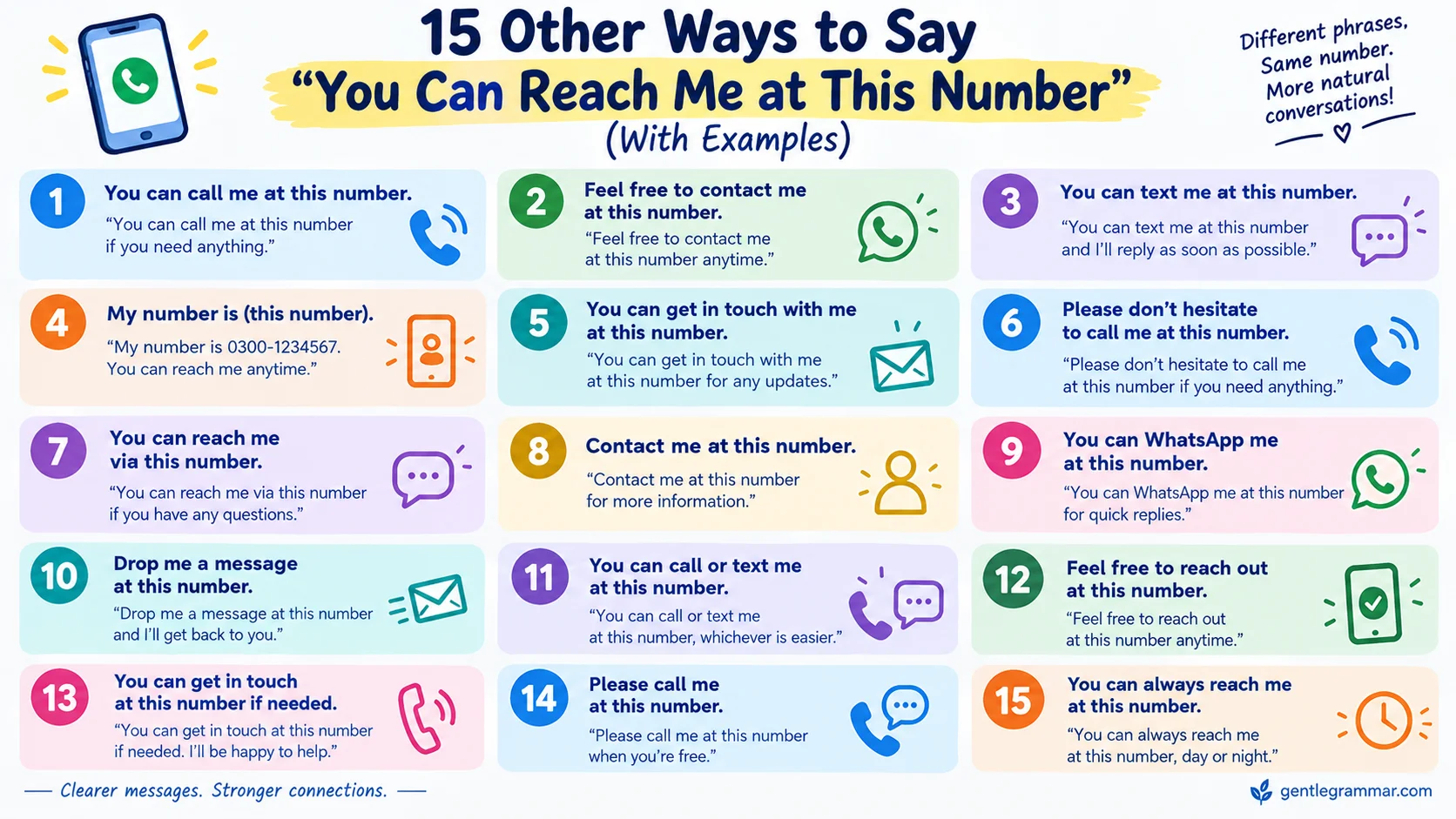
When I finish a work meeting with a new client or share my phone number with a colleague, I want to make it easy for them to contact me.
The phrase “You can reach me at this number” is a clear and polite way to share contact details. It tells another person that the telephone number I have provided is an appropriate way to reach me. This simple sentence is common in emails, business messages, applications, invitations, customer service exchanges, networking, and everyday communication.
Its meaning, correct usage, grammar, and sentence structure are useful for learning English. However, the wording you choose can influence your message and the way you sound. The right alternative depends on the context, audience, purpose, and communication channel. For example, a professional email may need neutral wording, while a message to a friend can sound warm, friendly, relaxed, or casual.
What Does “You Can Reach Me at This Number” Mean?
“You Can Reach Me at This Number” means that someone can contact you by calling or, depending on the context, messaging the phone number you have provided. The phrase tells the other person where to direct their communication if they need to speak with you, ask a question, or follow up about something. It is commonly used when exchanging contact details in conversations, emails, business messages, and personal correspondence.
The expression is generally direct, helpful, and polite. It does not necessarily mean that you are available at every hour; it simply identifies a way to contact you. If you want to emphasize your availability, you might mention when you can answer calls. If you want a more formal tone, you can refer to your contact number or invite the recipient to contact you using the details provided.
Common Situations Where “You Can Reach Me at This Number” Is Used
This phrase works well when sharing a phone number with someone who may need to contact you later. In everyday conversation, you might give it to a new acquaintance or someone arranging a meeting. In a text message, it can help clarify which number to use for future communication.
In the workplace, the expression is useful for coordinating appointments, responding to clients, and exchanging contact information with colleagues. It can also appear in emails to customers, service providers, teachers, or other professional contacts. People sometimes prefer alternatives because they want to sound more formal, make their availability clear, or avoid repeating the same wording in several messages. The best expression depends on whether the recipient is a friend, colleague, customer, or someone you have not met before.
Is It Professional or Polite to Say “You Can Reach Me at This Number”?
Yes, “You Can Reach Me at This Number” is both polite and professionally acceptable in most situations. It sounds approachable and straightforward, making it suitable for routine business emails, customer communication, and personal messages. The phrase is not overly formal, but it is respectful enough for many workplace interactions. Its direct wording helps the recipient understand how to contact you without unnecessary explanation.
For a more formal email, you could write, “Please feel free to contact me at the number provided.” If you are communicating with a close friend, “Give me a call at this number” may sound more relaxed. When sharing your number for a specific purpose, such as arranging an appointment, a phrase like “You can call me directly at this number” may be clearer. Remember that politeness also depends on context: explaining your availability and respecting the other person’s time can make your message more considerate.
Advantages and Disadvantages of Saying “You Can Reach Me at This Number”
Advantages
The phrase is clear, practical, and easy to understand. It tells the recipient exactly how to contact you and works in both personal and professional settings. It also sounds friendly without being overly casual. Because it does not require complicated vocabulary, it is especially useful for English learners and people who want to write straightforward messages.
Disadvantages
The wording can feel slightly repetitive if you use it in every email or conversation. It also does not specify whether you prefer a phone call, a text message, or contact during particular hours. In a highly formal message, a more polished expression may fit better. If availability matters, the phrase may need an additional detail, such as the best time to call. These are contextual limitations, not reasons to avoid the expression altogether.
Synonyms for“You Can Reach Me at This Number”
- You Can Contact Me at This Number
- Feel Free to Call Me at This Number
- You Can Call Me Directly at This Number
- Please Contact Me at the Number Provided
- You Can Get in Touch With Me at This Number
- Reach Out to Me at This Number
- You Can Give Me a Call at This Number
- I’m Available at This Number
- You Can Contact Me on My Mobile
- Please Feel Free to Reach Me by Phone
- You Can Call Me on This Number
- Here’s the Best Number to Reach Me
- You Can Contact Me Using the Number Below
- I Can Be Reached at This Number
- For Further Communication, Please Call Me at This Number
1. You Can Contact Me at This Number
Meaning
This expression means that someone can get in touch with you using the phone number you have shared. It is a close alternative to the original phrase and works when you want to communicate clearly without sounding too casual.
Definition
A polite statement inviting someone to contact you through a specific telephone number.
Detailed Explanation
“You Can Contact Me at This Number” is suitable for both professional and personal communication. The word contact is slightly broader than call because it can refer to different ways of communicating, depending on the details provided. The phrase sounds neutral, courteous, and practical. It is a useful choice when you want to keep your message professional without making it overly formal.
Scenario Examples
Scenario 1: Workplace email
Example: If you need any additional information, you can contact me at this number.
Scenario 2: Personal communication
Example: Here are my contact details. You can contact me at this number whenever you need to talk.
Scenario 3: Customer service
Example: For questions about your appointment, you can contact me at this number.
Best Use
Use this expression in business emails, customer communication, appointment arrangements, and everyday messages when you want clear, neutral wording.
Tone
Tone: Professional, polite, straightforward.
It gives the recipient a clear way to reach you without sounding demanding or overly familiar.
2. Feel Free to Call Me at This Number
Meaning
This phrase invites someone to call you whenever they need to speak with you. It communicates openness and friendliness, making the recipient feel comfortable initiating a conversation.
Definition
A friendly invitation to make a phone call without feeling hesitant.
Detailed Explanation
Adding “Feel Free” makes the sentence warmer and less direct than simply telling someone where to contact you. It suggests that the recipient is welcome to call, although it does not guarantee that you will answer immediately. This wording is particularly helpful when building a professional relationship or exchanging numbers with someone new. If your availability is limited, mention a suitable time to avoid confusion.
Scenario Examples
Scenario 1: Helping a colleague
Example: If you have questions about the report, feel free to call me at this number.
Scenario 2: Meeting someone new
Example: It was nice meeting you today. Feel free to call me at this number if you want to catch up.
Scenario 3: Offering assistance
Example: If you need help setting everything up, feel free to call me at this number.
Best Use
Use this expression in friendly work emails, networking messages, personal conversations, and helpful follow-ups.
Tone
Tone: Warm, welcoming, considerate.
The invitation makes communication feel voluntary and comfortable rather than like an instruction.
3. You Can Call Me Directly at This Number
Meaning
This expression tells someone that they can call you personally using the number provided. The word “directly” emphasizes a straightforward connection rather than contacting an intermediary.
Definition
An instruction indicating that a person may phone you without going through someone else.
Detailed Explanation
This alternative is especially useful when the recipient might otherwise contact a receptionist, colleague, or general office number. It makes the preferred communication route clear and can save time when a quick conversation is needed. Compared with the original phrase, it places greater emphasis on making a direct phone call. It is less suitable when you want to invite text messages as well as calls.
Scenario Examples
Scenario 1: Coordinating a project
Example: If anything changes before the meeting, you can call me directly at this number.
Scenario 2: Arranging a service visit
Example: If the technician needs directions, they can call me directly at this number.
Scenario 3: Professional introduction
Example: For any urgent questions regarding the proposal, you can call me directly at this number.
Best Use
Choose this phrase for work coordination, urgent questions, appointments, and situations where direct communication matters.
Tone
Tone: Professional, direct, confident.
It communicates accessibility while making the preferred contact method unmistakable.
4. Please Contact Me at the Number Provided
Meaning
This expression politely directs someone to use a phone number that has already been shared. It is useful when the number appears elsewhere in an email, form, document, or message.
Definition
A courteous request to communicate using the telephone number supplied.
Detailed Explanation
The phrase sounds more formal than “You Can Reach Me at This Number.” The word please softens the request, while “the number provided” avoids repeating the actual digits. It works especially well in business correspondence and administrative communication. However, it may sound less personal than a direct invitation, particularly when messaging a close friend.
Scenario Examples
Scenario 1: Business email
Example: Should you require further clarification, please contact me at the number provided.
Scenario 2: Appointment confirmation
Example: If you need to reschedule your appointment, please contact me at the number provided in your booking details.
Scenario 3: Formal correspondence
Example: For questions concerning your application, please contact me at the number provided on the form.
Best Use
Use this expression in formal emails, application forms, appointment instructions, and administrative correspondence.
Tone
Tone: Formal, respectful, professional.
It is appropriate when you want to give clear instructions while maintaining a courteous manner.
5. You Can Get in Touch With Me at This Number
Meaning
This phrase means that someone can communicate with you through the phone number you have shared. It emphasizes establishing contact rather than focusing exclusively on making a phone call.
Definition
A conversational expression inviting someone to contact you using a particular number.
Detailed Explanation
“Get in touch” is a natural English expression used for starting or continuing communication. It sounds slightly more conversational than “contact me” and often feels friendly without being too informal. Depending on the situation, the recipient may understand it as an invitation to call or otherwise communicate through the number. If you specifically want a phone call, using “call me” removes that ambiguity.
Scenario Examples
Scenario 1: Networking
Example: It was great discussing your ideas. You can get in touch with me at this number if you would like to continue the conversation.
Scenario 2: Personal message
Example: Save my number so you can get in touch with me whenever you need anything.
Scenario 3: Freelance work
Example: If you would like to discuss the project further, you can get in touch with me at this number.
Best Use
This phrase works well for networking, freelance communication, friendly introductions, and general follow-ups.
Tone
Tone: Friendly, approachable, conversational.
Its relaxed wording encourages further communication without creating pressure.
6. Reach Out to Me at This Number
Meaning
“Reach Out to Me at This Number” invites someone to initiate communication through your phone number. It emphasizes taking the first step to make contact.
Definition
An invitation for someone to contact you using the number you have shared.
Detailed Explanation
The expression “reach out” is common in modern workplace English and personal communication. It often sounds collaborative because it encourages the recipient to start a conversation when needed. It can be used for questions, support, or future discussions, although it is not as specific as “call me.” In formal writing, “please contact me” may sound more traditional and precise.
Scenario Examples
Scenario 1: Professional collaboration
Example: If you would like to discuss the next phase, reach out to me at this number.
Scenario 2: Offering support
Example: If you have any concerns after the session, reach out to me at this number.
Scenario 3: Following a conversation
Example: Let me know if you need more information, and reach out to me at this number.
Best Use
Choose this phrase for team communication, collaborative projects, professional networking, and supportive messages.
Tone
Tone: Approachable, supportive, modern.
It suggests that the recipient is welcome to start a conversation whenever a genuine need arises.
7. You Can Give Me a Call at This Number
Meaning
This expression tells someone that they can phone you using the number provided. It is a relaxed alternative that sounds natural in ordinary conversation.
Definition
A casual invitation to telephone someone.
Detailed Explanation
“Give me a call” is a familiar conversational expression that sounds less formal than “contact me.” It is especially suitable when you already have a friendly relationship with the recipient or want your message to feel easygoing. Unlike the broader word contact, the phrase specifically suggests a phone call. In a formal business letter, a more neutral alternative may be preferable.
Scenario Examples
Scenario 1: Talking to a friend
Example: I will be free this evening, so you can give me a call at this number.
Scenario 2: Arranging a visit
Example: Give me a call at this number when you arrive, and I will come downstairs.
Scenario 3: Informal work communication
Example: If you run into any problems with the presentation, you can give me a call at this number.
Best Use
Use this expression in text messages, friendly conversations, informal workplace communication, and everyday arrangements.
Tone
Tone: Casual, friendly, relaxed.
The familiar wording makes the invitation sound natural rather than like a formal instruction.
8. I’m Available at This Number
Meaning
This expression indicates that the phone number is a suitable way to contact you. It can also suggest that you are available for communication, depending on the context.
Definition
A statement identifying a telephone number through which someone can be contacted.
Detailed Explanation
“I’m Available at This Number” is concise, but its meaning can depend on the surrounding message. It may refer to your contact details or suggest that you are currently reachable. Unlike the original phrase, it does not explicitly tell the recipient to call. If you want to make your availability clear, specify the relevant hours or circumstances. This distinction is important in professional communication, where people may interpret availability as a commitment to respond.
Scenario Examples
Scenario 1: Providing work contact details
Example: I’m available at this number during regular business hours if you need to discuss the schedule.
Scenario 2: Arranging a consultation
Example: I’m available at this number this afternoon if you would like to confirm the details.
Scenario 3: Coordinating an event
Example: I’m available at this number on the day of the event for any last-minute questions.
Best Use
Use it when availability is relevant, especially for consultations, event coordination, and work-related arrangements. Add a time frame when necessary.
Tone
Tone: Neutral, helpful, businesslike.
It communicates accessibility, but adding details can prevent confusion about when you can respond.
9. You Can Contact Me on My Mobile
Meaning
This phrase tells someone to use your mobile phone to contact you. It is particularly useful when you want to distinguish your personal mobile number from an office or landline number.
Definition
An invitation to contact someone through their mobile phone.
Detailed Explanation
The expression is natural in many varieties of English, particularly British English. In American English, “on my cell phone” is generally more familiar than “on my mobile.” The phrase identifies the device or type of number rather than necessarily specifying the digits. If you have already shared several contact options, this wording helps the recipient understand which one you prefer.
Scenario Examples
Scenario 1: Work and personal numbers
Example: I am usually away from my desk, so you can contact me on my mobile.
Scenario 2: Planning a meeting
Example: If you cannot find the conference room, contact me on my mobile when you arrive.
Scenario 3: Sharing updated contact details
Example: I no longer use my old office line, but you can contact me on my mobile.
Best Use
Use this expression when distinguishing between mobile and office numbers, especially in workplace arrangements and travel coordination.
Tone
Tone: Practical, neutral, conversational.
It identifies the preferred device without sounding overly formal or personal.
10. Please Feel Free to Reach Me by Phone
Meaning
This expression politely invites someone to contact you by telephone whenever they need to communicate. It emphasizes permission and courtesy rather than simply providing a number.
Definition
A polite invitation to initiate telephone communication without hesitation.
Detailed Explanation
This wording combines the welcoming phrase “feel free” with the specific communication method “by phone.” It works well when you want to sound considerate and professional. Unlike the original expression, it does not refer to a particular number, so the number should already be available or included nearby. It is also slightly more formal than “give me a call,” making it suitable for many workplace relationships.
Scenario Examples
Scenario 1: Email to a client
Example: If you have any questions about the quotation, please feel free to reach me by phone.
Scenario 2: Academic communication
Example: If you need clarification about the assignment, please feel free to reach me by phone during office hours.
Scenario 3: Professional follow-up
Example: Should you wish to discuss the proposal in more detail, please feel free to reach me by phone.
Best Use
Choose this phrase for client emails, academic communication, consultations, and polite professional follow-ups.
Tone
Tone: Courteous, professional, welcoming.
It invites communication respectfully without making the recipient feel obligated to call.
11. You Can Call Me on This Number
Meaning
This expression tells someone that the number you have provided can be used to telephone you. It is a direct alternative that is especially natural in British and other varieties of English.
Definition
A straightforward statement identifying the telephone number someone should use to call you.
Detailed Explanation
The phrase communicates essentially the same practical message as the original expression but specifically mentions a call. In British English, “call me on this number” is a common construction. American speakers more often say “call me at this number,” although both versions are understandable. This alternative is useful when you want to remove uncertainty about whether you are inviting a call or a text message.
Scenario Examples
Scenario 1: Giving someone your number
Example: Here is my new number. You can call me on this number from now on.
Scenario 2: Arranging a pickup
Example: Once your train arrives, you can call me on this number, and I will meet you outside.
Scenario 3: Following up on a request
Example: If you have not received the confirmation email, you can call me on this number.
Best Use
Use this expression in spoken English, personal messages, routine arrangements, and straightforward work communication.
Tone
Tone: Direct, neutral, friendly.
Its simplicity makes it easy to understand, particularly when a telephone call is the intended method of contact.
12. Here’s the Best Number to Reach Me
Meaning
This expression introduces the phone number you prefer people to use when contacting you. It suggests that the number is the most convenient or reliable contact option.
Definition
A statement presenting the preferred telephone number for reaching someone.
Detailed Explanation
This wording is especially useful when you have more than one phone number or want to direct someone away from an outdated contact. It sounds natural and helpful because it focuses on making communication easier. Unlike the original phrase, it introduces the number itself rather than simply explaining how to use it. The word “best” should reflect your genuine preference, such as a number you check regularly.
Scenario Examples
Scenario 1: Exchanging contact details
Example: I have a work line and a personal line, but here’s the best number to reach me.
Scenario 2: Updating a client
Example: My office number has changed, so here’s the best number to reach me for future questions.
Scenario 3: Organizing a family event
Example: In case anything changes on Saturday, here’s the best number to reach me.
Best Use
Use this expression when sharing a preferred number, updating contact information, or helping someone choose between several contact options.
Tone
Tone: Helpful, practical, conversational.
It makes your preference clear without sounding demanding.
13. You Can Contact Me Using the Number Below
Meaning
This phrase directs the recipient to a telephone number written below the sentence. It is especially useful in emails, forms, notices, and other written communication.
Definition
An instruction to use the phone number displayed underneath the message.
Detailed Explanation
The words “the number below” make this expression particularly effective in written messages where the phone number follows immediately. It avoids repeating the number and creates a clear connection between the instruction and the contact details. The wording is slightly more structured than the original phrase, so it fits administrative and professional writing well. It is less suitable for spoken conversation unless the number has been written or displayed somewhere.
Scenario Examples
Scenario 1: Business email
Example: If you would like to discuss the delivery schedule, you can contact me using the number below.
Scenario 2: Service announcement
Example: For assistance with your booking, you can contact me using the number below.
Scenario 3: Formal invitation
Example: Please let me know if you have any questions about the event. You can contact me using the number below.
Best Use
Choose this expression for emails, contact forms, written notices, service information, and professional documents where the number appears underneath.
Tone
Tone: Clear, professional, informative.
It connects the instructions to the displayed contact details in a simple, organized way.
14. I Can Be Reached at This Number
Meaning
This expression means that the specified phone number is a way to contact you. It presents your availability in a slightly more formal, less conversational manner.
Definition
A formal statement identifying a telephone number through which someone can reach a person.
Detailed Explanation
“I Can Be Reached at This Number” uses a passive construction, which shifts attention toward the contact method rather than the person initiating communication. This makes it useful in formal correspondence, business documents, and professional introductions. It is similar in meaning to the original phrase but sounds a little more reserved. Although the wording suggests that contact is possible, it does not necessarily mean you are available at all times.
Scenario Examples
Scenario 1: Professional correspondence
Example: If you require any further details, I can be reached at this number during office hours.
Scenario 2: Travel arrangements
Example: While I am attending the conference, I can be reached at this number for urgent matters.
Scenario 3: Formal introduction
Example: For questions about the scheduled interview, I can be reached at this number.
Best Use
Use this expression in formal emails, business correspondence, professional documents, and situations requiring a more reserved style.
Tone
Tone: Formal, composed, professional.
The passive construction places emphasis on accessibility and suits situations where a neutral, polished style is preferred.
15. For Further Communication, Please Call Me at This Number
Meaning
This expression invites someone to telephone you if additional communication is needed. It is particularly suitable when you expect a follow-up conversation about an existing matter.
Definition
A formal invitation to continue a discussion by calling a specified telephone number.
Detailed Explanation
This phrase is more formal and purpose-driven than the original wording. “For further communication” signals that the recipient may need to continue an existing discussion, rather than simply contact you for any reason. It works well for professional follow-ups, arrangements, and matters requiring clarification. However, it can sound unnecessarily stiff in a casual conversation, where “Give me a call if you need anything” would feel more natural.
Scenario Examples
Scenario 1: Business proposal
Example: For further communication regarding the proposal, please call me at this number.
Scenario 2: Appointment arrangements
Example: If you need to discuss any changes to your appointment, please call me at this number.
Scenario 3: Service follow-up
Example: For further communication about your service request, please call me at this number during business hours.
Best Use
Choose this expression for formal follow-ups, business matters, service arrangements, and professional correspondence when an additional conversation may be necessary.
Tone
Tone: Formal, respectful, purposeful.
It makes the next step clear and works best when the conversation has a specific subject or purpose.
FAQs:
What is another way to say “You Can Reach Me at This Number”?
A natural alternative is “You Can Contact Me at This Number.” It is clear, polite, and suitable for professional emails, personal messages, and everyday conversations. If you want a warmer expression, “Feel Free to Call Me at This Number” is also a good choice.
What does “You Can Reach Me at This Number” mean?
It means someone can contact you using the phone number you have shared. The phrase usually suggests a phone call, although the broader idea of reaching someone can include other communication methods depending on the context. It does not automatically mean you are available around the clock.
Is “You Can Reach Me at This Number” professional?
Yes, the expression is professional, polite, and straightforward. It works well in routine workplace communication, client emails, and business introductions. For more formal correspondence, “Please Contact Me at the Number Provided” may sound more appropriate.
What is a more polite way to say “You Can Reach Me at This Number”?
“Please Feel Free to Reach Me by Phone” is a courteous alternative. It invites the recipient to contact you without making the message sound demanding. You can also mention suitable calling hours when you want to be considerate of the other person’s time.
Which alternative works best in formal communication?
“Please Contact Me at the Number Provided” is an excellent option for formal emails, business documents, and administrative messages. It sounds respectful and direct without being overly familiar. If you want to emphasize your own availability, “I Can Be Reached at This Number” is another suitable choice.
Conclusion:
Choosing the right alternative to “You Can Reach Me at This Number” helps you communicate your contact details clearly while matching the situation. A friendly message to a friend may call for relaxed wording, whereas a client email or formal document may benefit from a more polished expression. Phrases such as “You Can Contact Me at This Number,” “Feel Free to Call Me at This Number,” and “Please Contact Me at the Number Provided” each offer a slightly different tone.
Remember that similar expressions are not always interchangeable. Some specifically invite a phone call, while others emphasize general contact, availability, or professional courtesy. Consider your relationship with the recipient, the purpose of your message, and the communication method you prefer. Most importantly, choose wording that feels natural, respectful, and clear so the other person knows how to contact you without confusion.
