
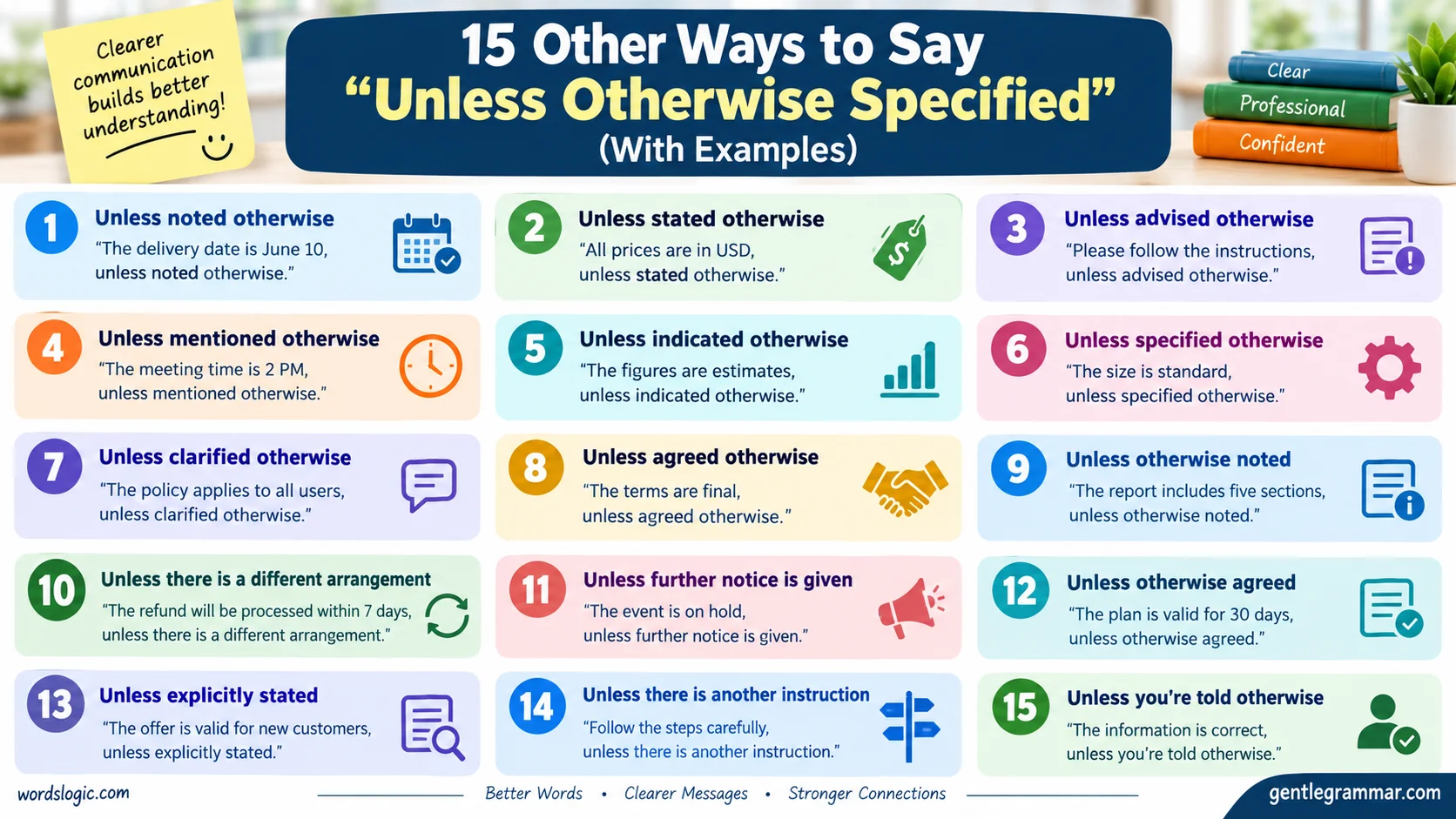
For clear rules, Other Ways to Say “Unless Otherwise Specified” can help make formal instructions precise, natural, and easier for every audience.
In my experience, unless otherwise specified is useful when a rule has a general application but allows an exception. A formal notice, for example, may explain that the Governor General sends birthday greetings to Canadians who are 90 years of age or older, while couples celebrating an anniversary of 50 years or more may receive greetings. His Majesty.
The King sends greetings to Canadians who are 100 years of age or older and couples celebrating 60 years or more. If a birthday or anniversary has already taken place, the message can be backdated up to 6 months by The King, or up to 12 months by the Governor General. Details such as age, years, date, past, and months help make the wording more precise, easier to understand, and friendly for the audience.
What Does “Unless Otherwise Specified” Mean?
“Unless otherwise specified” means except when a different instruction, condition, or detail has been given. It establishes a general rule while leaving room for an exception. For example, “Meetings will begin at 9:00 a.m. unless otherwise specified” means that 9:00 a.m. is the normal meeting time, but a different time may be announced for a particular meeting. The phrase is commonly used when specific instructions can override a general rule.
The wording is generally understood as a formal way of saying “unless something different is stated.” It does not necessarily mean that an exception exists; instead, it tells the reader that the stated rule applies unless another specification, instruction, or condition changes it. The exact nuance depends on the surrounding context.
Common Situations Where “Unless Otherwise Specified” Is Used
“Unless otherwise specified” is especially common in rules, policies, instructions, contracts, manuals, schedules, forms, and professional communication. It allows writers to state one general condition without repeating every possible exception.
For example, a company handbook might say, “Employees should submit requests electronically unless otherwise specified.” A teacher may write, “Assignments should be submitted online unless otherwise specified.” A product manual could state, “Store the device at room temperature unless otherwise specified.”
The phrase can also appear in emails, notices, and everyday written communication, although simpler wording may be easier for a general audience. When the reader may not be familiar with formal language, expressions such as “unless stated otherwise” or “unless noted otherwise” can feel more direct.
Is It Professional or Polite to Say “Unless Otherwise Specified”?
Yes. “Unless otherwise specified” is generally professional, neutral, and formal. It is particularly appropriate when writing policies, procedures, technical instructions, legal or administrative documents, and workplace materials. It sounds precise because it clearly separates the normal rule from possible exceptions.
The phrase is less common in relaxed conversation because it has a somewhat formal and procedural tone. In a casual message, “unless we say otherwise,” “unless stated otherwise,” or “unless the instructions say otherwise” may sound more natural. The best wording depends on the audience and the level of formality required.
Advantages and Disadvantages of Saying “Unless Otherwise Specified”
Advantages
A major advantage is precision. The phrase makes it clear that a general rule applies but can be changed by a specific instruction. It is also concise, which makes it useful in policies and documents where the same exception principle may apply repeatedly. Its formal tone can help instructions sound consistent and authoritative without being emotional.
Disadvantages
The main limitation is formality. Some readers may find “unless otherwise specified” more complicated than necessary, particularly when a simpler expression would communicate the same idea. It can also sound somewhat impersonal or bureaucratic in casual communication. If the writer actually knows the exception, stating the exception directly is often clearer than relying on a general phrase.
Synonyms for “Unless Otherwise Specified”
- Unless Otherwise Stated
- Unless Stated Otherwise
- Unless Otherwise Indicated
- Unless Otherwise Noted
- Unless Specifically Stated
- Unless Explicitly Stated Otherwise
- Unless Indicated Otherwise
- Unless the Instructions Say Otherwise
- Unless Otherwise Instructed
- Except Where Otherwise Specified
- Except as Otherwise Specified
- Unless the Context Indicates Otherwise
- Unless Expressly Provided Otherwise
- Unless Specifically Noted
- Unless a Different Instruction Is Given
1. Unless Otherwise Stated
Meaning
“Unless otherwise stated” means unless a different condition or instruction has been mentioned. It is extremely close in meaning to “unless otherwise specified” and is one of the most natural replacements.
Definition
Unless otherwise stated means that the general information or rule applies unless something different is stated elsewhere.
Detailed Explanation
This expression is slightly more focused on what has been stated or written than on what has been formally specified. It works particularly well in documents, policies, instructions, articles, and professional communication. Because it is concise and familiar, it can sound a little less technical than “unless otherwise specified.” Use it when another statement may provide an exception to the general rule.
Scenario Examples
Scenario: A company explains its standard working hours.
Example: “Office hours are 9:00 a.m. to 5:00 p.m. unless otherwise stated.”
Scenario: A teacher gives general assignment instructions.
Example: “All assignments should be submitted by Friday, unless otherwise stated.”
Scenario: A document contains a general rule.
Example: “All measurements are given in centimeters, unless otherwise stated.”
Best Use
Best for formal writing, policies, instructions, reports, educational materials, and professional emails.
Tone
Tone: Professional, neutral, clear. It feels formal without being unnecessarily complicated.
2. Unless Stated Otherwise
Meaning
“Unless stated otherwise” means unless a different instruction, fact, or condition has been stated. It tells the reader that the normal information applies unless another statement changes it.
Definition
Unless stated otherwise means that something remains true or applies except when a different statement is provided.
Detailed Explanation
This phrase is natural in both professional and general written English. It has essentially the same logical structure as “unless otherwise stated,” but its word order can make it feel slightly more conversational. It is useful when you want to emphasize that an exception must be stated clearly. It works well when the reader is expected to consult surrounding instructions or information.
Scenario Examples
Scenario: A website gives delivery information.
Example: “Orders are shipped within two business days, unless stated otherwise.”
Scenario: A school provides examination instructions.
Example: “Students should use black ink, unless stated otherwise.”
Scenario: A report explains its measurement system.
Example: “All figures are in U.S. dollars, unless stated otherwise.”
Best Use
Best for documents, websites, school instructions, reports, emails, and general professional writing.
Tone
Tone: Clear, neutral, moderately formal. It is easy for most readers to understand.
3. Unless Otherwise Indicated
Meaning
“Unless otherwise indicated” means unless another instruction, sign, label, or piece of information shows something different.
Definition
Unless otherwise indicated means that the stated rule applies unless a different condition is indicated or communicated.
Detailed Explanation
This alternative is particularly useful when the exception may be shown through a label, symbol, note, schedule, or other indication. It can sound slightly more formal than everyday alternatives. The phrase is common in instructions and informational materials because “indicated” can cover more than a direct written statement. Choose it when the reader may learn about an exception through something that is displayed or marked.
Scenario Examples
Scenario: A restaurant menu provides general information.
Example: “Prices include tax, unless otherwise indicated.”
Scenario: A technical manual uses symbols to identify exceptions.
Example: “The standard setting is 50 Hz, unless otherwise indicated.”
Scenario: A website displays special conditions beside individual products.
Example: “Delivery is available nationwide, unless otherwise indicated.”
Best Use
Best for technical documents, menus, product information, notices, instructions, and formal writing.
Tone
Tone: Formal, precise, informative. “Indicated” gives the phrase a slightly technical feel.
4. Unless Otherwise Noted
Meaning
“Unless otherwise noted” means unless a different detail or exception has been mentioned in a note or accompanying information.
Definition
Unless otherwise noted means that the normal rule applies unless another detail is specifically noted.
Detailed Explanation
This expression is particularly natural when information appears alongside notes, footnotes, captions, instructions, or explanatory comments. It is concise and widely understandable. Compared with “unless otherwise specified,” it can sound a little more focused on written notes or accompanying information. It is useful when readers are expected to check the surrounding material for exceptions.
Scenario Examples
Scenario: A recipe contains special instructions.
Example: “Bake the cookies for 12 minutes, unless otherwise noted.”
Scenario: A report contains several footnotes.
Example: “All dates refer to the current fiscal year, unless otherwise noted.”
Scenario: A product catalog contains individual exceptions.
Example: “All items include standard packaging, unless otherwise noted.”
Best Use
Best for reports, catalogs, articles, recipes, tables, footnotes, and informational documents.
Tone
Tone: Neutral, professional, concise. It is formal enough for documents but remains easy to understand.
5. Unless Specifically Stated
Meaning
“Unless specifically stated” means unless a different condition is clearly and directly stated.
Definition
Unless specifically stated means that something applies unless an exception is clearly mentioned.
Detailed Explanation
This expression emphasizes specificity. It suggests that a general assumption should remain in place unless someone explicitly identifies a different arrangement. It is useful when ambiguity could cause confusion and the writer wants readers to pay attention to direct exceptions. Unlike the broader “unless otherwise specified,” it highlights the importance of an exception being specifically stated.
Scenario Examples
Scenario: A company explains its refund policy.
Example: “Refunds are processed within five business days, unless specifically stated in the agreement.”
Scenario: A teacher gives general classroom rules.
Example: “Students may use calculators, unless specifically stated otherwise for a particular test.”
Scenario: A workplace policy establishes a general procedure.
Example: “Requests should be submitted through the online portal, unless specifically stated in your department’s instructions.”
Best Use
Best for policies, instructions, agreements, workplace communication, and situations where clarity about exceptions matters.
Tone
Tone: Direct, precise, professional. It places emphasis on clear exceptions.
6. Unless Explicitly Stated Otherwise
Meaning
“Unless explicitly stated otherwise” means unless a different condition is directly and unmistakably stated.
Definition
It means that the general rule applies unless an exception is clearly expressed in specific words.
Detailed Explanation
This wording is stronger than a simple “unless stated otherwise” because explicitly emphasizes that the exception should be clear rather than implied. It is useful when the writer wants to avoid readers making assumptions about unstated exceptions. The phrase has a formal and careful quality, so it fits situations where precision is especially important. It may be unnecessarily formal for a casual conversation.
Scenario Examples
Scenario: A company explains access permissions.
Example: “All employees may access the shared folder unless explicitly stated otherwise by their manager.”
Scenario: A contract contains general conditions.
Example: “The standard payment terms apply unless explicitly stated otherwise in the agreement.”
Scenario: A course provides general grading rules.
Example: “Late submissions receive the standard deduction unless explicitly stated otherwise by the instructor.”
Best Use
Best for formal policies, agreements, contracts, workplace rules, academic instructions, and detailed procedures.
Tone
Tone: Formal, precise, firm. The word explicitly makes the requirement for a clear exception especially strong.
7. Unless Indicated Otherwise
Meaning
“Unless indicated otherwise” means unless another condition is shown or communicated.
Definition
It means that the stated information applies unless a different condition is indicated somewhere in the relevant material.
Detailed Explanation
This phrase is closely related to “unless otherwise indicated,” but its structure can fit naturally into different sentence patterns. It is useful when an exception may be shown, marked, identified, or communicated rather than simply written as a sentence. The wording has a formal quality but is not excessively difficult. It works especially well in informational and technical contexts.
Scenario Examples
Scenario: A chart explains its units.
Example: “Temperatures are shown in Celsius, unless indicated otherwise.”
Scenario: A product page provides general shipping information.
Example: “Standard delivery takes three to five days, unless indicated otherwise.”
Scenario: A form contains special instructions.
Example: “Complete all fields, unless indicated otherwise on the form.”
Best Use
Best for forms, charts, product information, technical instructions, notices, and professional documents.
Tone
Tone: Formal, informative, neutral. It is suitable when information may be visually or verbally indicated.
8. Unless the Instructions Say Otherwise
Meaning
“Unless the instructions say otherwise” means unless the instructions provide a different direction.
Definition
It means that the normal procedure should be followed unless the relevant instructions tell you to do something different.
Detailed Explanation
This is a more plain-English and reader-friendly alternative to “unless otherwise specified.” It directly identifies the source of the exception: the instructions. That makes it particularly helpful when the audience is following a procedure, assignment, recipe, manual, or set of directions. It is less formal than many of the other alternatives and can therefore feel more natural to everyday readers.
Scenario Examples
Scenario: A teacher gives students a general assignment rule.
Example: “Submit your work as a PDF unless the instructions say otherwise.”
Scenario: Someone follows a recipe.
Example: “Preheat the oven to 180°C unless the instructions say otherwise.”
Scenario: A technician follows a repair procedure.
Example: “Disconnect the power before opening the unit unless the instructions say otherwise.”
Best Use
Best for instructions, schoolwork, manuals, procedures, recipes, and practical directions.
Tone
Tone: Clear, practical, friendly. It avoids the bureaucratic feel of more formal wording.
9. Unless Otherwise Instructed
Meaning
“Unless otherwise instructed” means unless someone with relevant authority gives a different instruction.
Definition
It means that a person should follow the normal procedure unless they are given different directions.
Detailed Explanation
This alternative focuses on instructions from a person or authority rather than on a written specification. It is especially useful when someone is expected to follow a standard procedure but may receive individual directions. The expression can sound formal and somewhat authoritative. It is not always interchangeable with “unless otherwise specified,” because “instructed” implies an instruction or direction rather than simply a stated detail.
Scenario Examples
Scenario: Employees receive a standard workplace procedure.
Example: “Please report to the main office at 8:30 a.m. unless otherwise instructed.”
Scenario: A student follows a teacher’s general classroom procedure.
Example: “Use the assigned seating plan unless otherwise instructed.”
Scenario: A technician follows a standard process.
Example: “Restart the system after installation unless otherwise instructed by the support team.”
Best Use
Best for workplace procedures, school instructions, technical tasks, official directions, and situations involving an authority or supervisor.
Tone
Tone: Professional, direct, authoritative. It clearly signals that another instruction may override the standard procedure.
10. Except Where Otherwise Specified
Meaning
“Except where otherwise specified” means except in situations where a different condition has been specifically provided.
Definition
It means that a general rule applies except in particular cases where another specification exists.
Detailed Explanation
This phrase has a distinctly formal and legal or administrative style. It is useful when the writer is describing a rule that applies broadly but has defined exceptions. Compared with “unless otherwise specified,” the word except draws more attention to the cases that fall outside the general rule. It may sound too formal for casual messages, but it can be appropriate in policies and formal documentation.
Scenario Examples
Scenario: A policy describes standard eligibility requirements.
Example: “All applicants must provide proof of identity, except where otherwise specified in the application guidelines.”
Scenario: A technical document explains standard settings.
Example: “The device operates at 220 volts, except where otherwise specified on the product label.”
Scenario: An institutional policy describes general procedures.
Example: “Requests are reviewed within ten working days, except where otherwise specified by the relevant department.”
Best Use
Best for policies, regulations, administrative documents, contracts, technical documentation, and formal writing.
Tone
Tone: Formal, precise, administrative. It is appropriate when describing structured rules and exceptions.
11. Except as Otherwise Specified
Meaning
“Except as otherwise specified” means except when another specification establishes a different condition.
Definition
It means that the stated rule applies unless a separate specification creates an exception or different requirement.
Detailed Explanation
This is a highly formal expression that often appears in legal, contractual, regulatory, and technical language. It is similar to “except where otherwise specified,” but its structure focuses more directly on a separate specification or provision. The wording is precise but can feel unnecessarily complicated in everyday communication. Use it when the surrounding document already uses formal terminology.
Scenario Examples
Scenario: A contract establishes standard payment terms.
Example: “Invoices are payable within 30 days, except as otherwise specified in the agreement.”
Scenario: A technical specification contains different requirements for individual components.
Example: “All components must meet the standard dimensions, except as otherwise specified.”
Scenario: A formal policy establishes a general process.
Example: “Applications are reviewed in order of receipt, except as otherwise specified by the policy.”
Best Use
Best for contracts, formal policies, regulations, specifications, and technical documents.
Tone
Tone: Highly formal, precise, institutional. It is usually unnecessary in casual or conversational English.
12. Unless the Context Indicates Otherwise
Meaning
“Unless the context indicates otherwise” means unless the surrounding information suggests a different meaning or condition.
Definition
It means that the normal interpretation applies unless the context provides evidence of an exception or different meaning.
Detailed Explanation
This expression differs from many alternatives because the possible exception does not have to be directly stated. Instead, the context itself may make another interpretation appropriate. That makes it useful when discussing language, instructions, definitions, or information whose meaning depends on surrounding details. It should not be used when an exception must be explicitly stated.
Scenario Examples
Scenario: A language guide explains how a word is normally understood.
Example: “The term refers to the singular form unless the context indicates otherwise.”
Scenario: A policy uses a general term with context-dependent meanings.
Example: “References to ‘the company’ include its subsidiaries unless the context indicates otherwise.”
Scenario: An academic text explains an interpretation.
Example: “The author uses the term in its ordinary sense unless the context indicates otherwise.”
Best Use
Best for academic writing, legal interpretation, language discussions, formal documents, and context-dependent explanations.
Tone
Tone: Formal, analytical, careful. It highlights the importance of surrounding information.
13. Unless Expressly Provided Otherwise
Meaning
“Unless expressly provided otherwise” means unless a different arrangement or condition is specifically provided in the relevant document or rule.
Definition
It means that the general provision applies unless another provision clearly establishes an exception.
Detailed Explanation
This is one of the most formal alternatives on the list. The word expressly emphasizes that the exception must be clearly established, while provided suggests that the exception appears in a rule, agreement, policy, or other formal document. It is therefore not a natural replacement in everyday conversation. It is most appropriate when discussing formal provisions where exact wording matters.
Scenario Examples
Scenario: A contract establishes a general payment requirement.
Example: “Payment is due within 30 days unless expressly provided otherwise in this agreement.”
Scenario: A formal policy contains different provisions for certain cases.
Example: “The standard procedure applies unless expressly provided otherwise by the policy.”
Scenario: An institutional document defines a general rule.
Example: “Access is restricted to authorized users unless expressly provided otherwise.”
Best Use
Best for contracts, policies, regulations, legal-style documents, and formal provisions.
Tone
Tone: Highly formal, precise, legalistic. It emphasizes that an exception must be clearly established.
14. Unless Specifically Noted
Meaning
“Unless specifically noted” means unless a particular exception or detail has been clearly mentioned.
Definition
It means that the general information applies unless a different detail is specifically noted.
Detailed Explanation
This expression is concise and focuses on a particular written note or detail. It is especially useful when information is presented in tables, schedules, lists, reports, or instructions containing individual notes. Compared with “unless otherwise specified,” it sounds slightly less formal and more straightforward. It is not ideal when the exception comes from a spoken instruction or an unstated contextual implication.
Scenario Examples
Scenario: A report contains individual notes beneath a table.
Example: “All amounts are shown in thousands, unless specifically noted.”
Scenario: A product catalog contains special item descriptions.
Example: “All products include standard packaging, unless specifically noted.”
Scenario: A schedule contains occasional changes.
Example: “Classes begin at 9:00 a.m., unless specifically noted on the schedule.”
Best Use
Best for reports, tables, schedules, catalogs, articles, notes, and informational documents.
Tone
Tone: Neutral, professional, concise. It is straightforward without sounding overly legalistic.
15. Unless a Different Instruction Is Given
Meaning
“Unless a different instruction is given” means unless someone provides directions that change the normal procedure or requirement.
Definition
It means that the standard instruction remains in effect until a different instruction is provided.
Detailed Explanation
This is a plain-English alternative that makes the logic especially easy to follow. It clearly identifies the possibility of a new or different direction rather than a different specification, note, or contextual meaning. It works well when people are expected to follow procedures and may later receive updated instructions. Because it is longer than “unless otherwise instructed,” it is best used when maximum clarity matters more than brevity.
Scenario Examples
Scenario: A manager gives employees a standard procedure.
Example: “Please use the main entrance unless a different instruction is given.”
Scenario: A teacher provides general examination directions.
Example: “Write your answers in blue or black ink unless a different instruction is given.”
Scenario: A customer receives standard installation directions.
Example: “Follow the setup guide in order unless a different instruction is given by the technician.”
Best Use
Best for instructions, workplace communication, school settings, procedures, customer guidance, and practical directions.
Tone
Tone: Clear, practical, neutral. It prioritizes understanding over formal brevity.
FAQs:
What is another way to say “unless otherwise specified”?
A common alternative is “unless otherwise stated.” Other options include “unless stated otherwise,” “unless otherwise indicated,” and “unless otherwise noted.” The best choice depends on whether the exception is stated, indicated, noted, or provided through instructions.
What does “unless otherwise specified” mean?
“Unless otherwise specified” means the general rule applies unless a different condition or instruction is given. It is commonly used to allow for exceptions without repeating them throughout a document.
Is “unless otherwise specified” professional?
Yes. “Unless otherwise specified” has a professional and formal tone. It is especially common in policies, procedures, technical documents, contracts, instructions, and workplace communication.
What is a more polite way to say “unless otherwise specified”?
The phrase is already neutral and polite, but a more reader-friendly option can be “unless stated otherwise” or “unless the instructions say otherwise.” The latter is particularly useful when communicating with a general audience because it uses simpler language.
Which alternative works best in formal communication?
For general formal communication, “unless otherwise stated” or “unless otherwise indicated” can work naturally. In highly formal contractual or policy language, expressions such as “except as otherwise specified” or “unless expressly provided otherwise” may fit better, depending on the document and its terminology.
Conclusion:
Choosing an alternative to “unless otherwise specified” is mainly a matter of context, clarity, and tone. Expressions such as “unless otherwise stated” and “unless otherwise noted” are useful when a written exception exists, while “unless the instructions say otherwise” is easier to understand in practical directions. More formal expressions such as “except as otherwise specified” or “unless expressly provided otherwise” are better suited to structured policies and formal documents.
The important point is that similar phrases are not always interchangeable. Consider whether the exception is stated, noted, indicated, instructed, or provided, and choose wording that accurately reflects the situation. The right expression should make the rule easier to understand, not simply make it sound more formal.
