
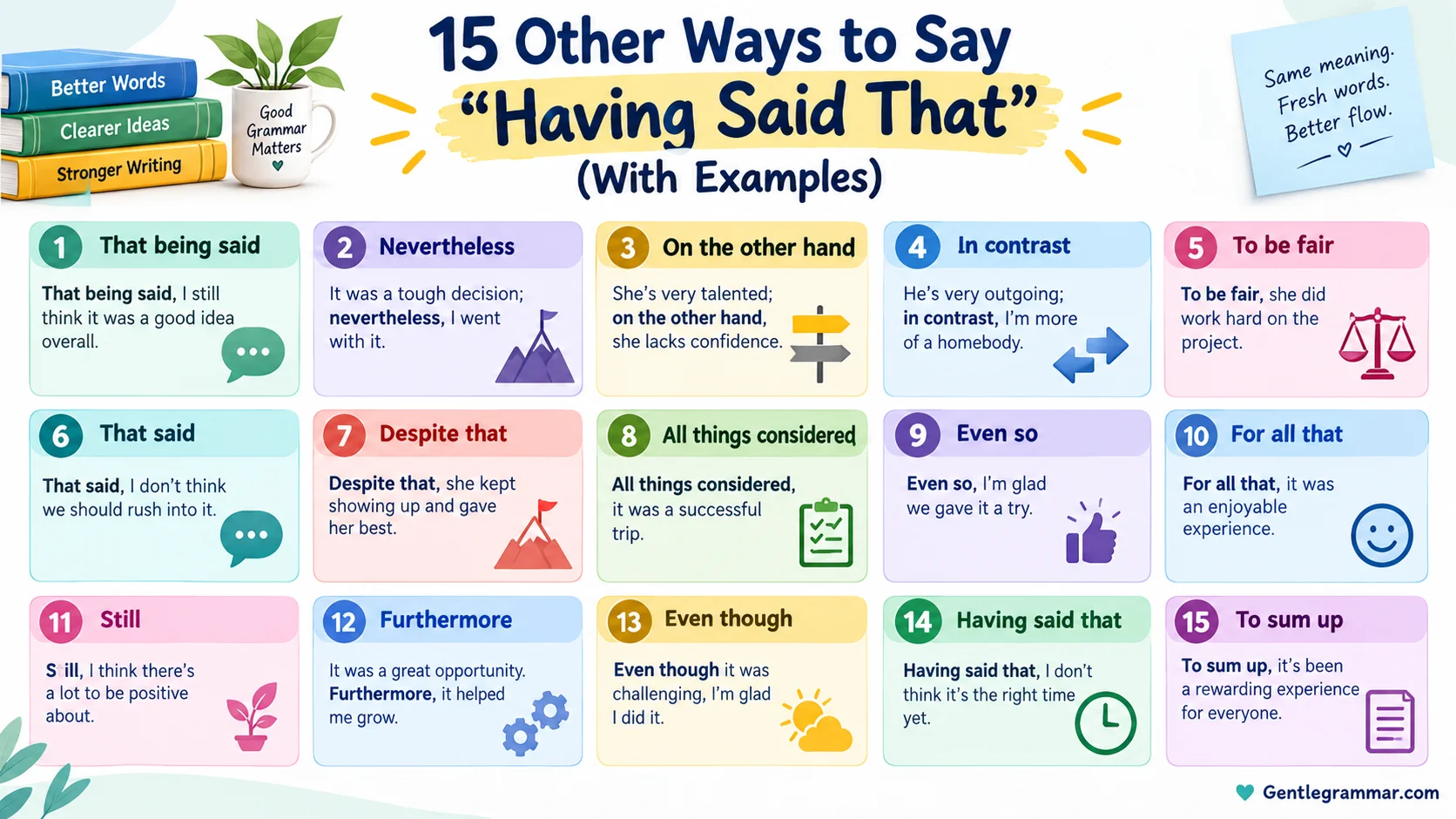
Other Ways to Say “Having Said That” can make formal writing and everyday communication sound more natural, especially when you need smooth transitions to introduce contrast or shift ideas gently.
In professional settings, phrases such as however, that said, even so, on the other hand, and all the same help keep a message clear, polished, and balanced. I often use these alternatives in client reports, emails, and presentations because they improve clarity, tone control, and structured expression without sounding harsh or abrupt. They also help guide readers through ideas while maintaining a professional, human-like flow.
The real challenge is picking the right one for the correct register and writing situation, rather than choosing from a long list of synonyms in a thesaurus. Nevertheless may suit an academic paper, while that said works well in conversational business, and but feels more casual. When I review a draft or section, I consider the right wording, sentence, idea, and purpose before choosing an expression.
What Does “Having Said That” Mean?
“Having said that” is a transitional expression used to introduce a statement that contrasts with, qualifies, or adds an important exception to something said immediately before it. It usually means “despite what I just said” or “although that previous point is true.” For example, you might say, “The hotel is expensive. Having said that, the service is excellent.” The speaker accepts that the hotel is expensive but wants to add another point that changes or balances the overall impression.
The phrase does not necessarily mean that the first statement was wrong. Instead, it signals a shift in perspective. It is especially useful when you want to sound balanced rather than simply rejecting your previous point. Depending on the context, “having said that” can sound conversational, thoughtful, measured, or moderately formal.
Common Situations Where “Having Said That” Is Used
“Having said that” appears in many forms of communication because it helps speakers and writers connect two related but contrasting ideas. In everyday conversation, someone might use it after giving an opinion and then acknowledging an exception. For example, a person could say, “I don’t usually enjoy horror movies. Having said that, I really liked this one.”
The expression also works well in workplace communication. A manager might explain a concern about a proposal and then mention a positive feature: “The timeline is quite ambitious. Having said that, the project could be completed with additional support.” This creates a more balanced tone.
In emails, reports, essays, reviews, and other formal writing, the phrase can help introduce a qualification without making the writer sound overly rigid. It can also appear in social media posts, personal messages, and discussions when someone wants to acknowledge another side of an issue.
People often look for alternatives when they want their wording to sound less repetitive, more formal, more concise, softer, or more conversational.
Is It Professional or Polite to Say “Having Said That”?
Yes. “Having said that” is generally polite and professional, especially when it is used to acknowledge one point before presenting another. It does not normally sound rude or confrontational. Instead, it can show that you are considering more than one side of an issue.
The expression is also fairly natural in spoken English, so it does not feel excessively formal. In a business email or report, however, you may sometimes prefer alternatives such as “that said,” “nevertheless,” “however,” or “even so,” depending on the exact relationship between the ideas.
The main consideration is context. If you use “having said that” too frequently, it can become repetitive. Also, it should introduce a genuine contrast, qualification, or change in emphasis. Using it between two unrelated statements can make the writing feel forced.
Advantages and Disadvantages of Saying “Having Said That”
Advantages
One major advantage of “having said that” is that it creates a smooth transition between two ideas. It allows you to acknowledge a previous statement without completely abandoning it. This makes your communication sound balanced and thoughtful.
The phrase is also flexible. It works in conversations, emails, reviews, articles, presentations, and personal messages. It can introduce a mild disagreement, an exception, a positive point after criticism, or an important qualification.
Another benefit is that it helps avoid unnecessarily strong language. Instead of saying, “That’s wrong,” you can acknowledge the earlier point and then explain another perspective. This can make disagreement feel less confrontational.
Disadvantages
The main limitation is repetition. If a speaker or writer uses “having said that” several times in a conversation or article, the transition can start to feel predictable.
It may also be slightly longer than alternatives such as “that said” or “however.” In concise professional writing, a shorter transition may communicate the same relationship more efficiently.
Finally, “having said that” does not fit every type of contrast. Sometimes you need a phrase that shows a stronger concession, a direct contradiction, or a completely different perspective. In those cases, a more precise expression may be better.
Synonyms for “Having Said That”
- That said
- However
- Nevertheless
- Nonetheless
- Even so
- Still
- Yet
- At the same time
- On the other hand
- Despite that
- Although that is true
- While that’s true
- Be that as it may
- All the same
- With that in mind
1. That Said
Meaning
“That said” means that the previous statement is acknowledged, but another point needs to be considered. It is one of the closest and most natural alternatives to “having said that.”
Definition
That said is a transitional phrase used to introduce a contrasting, qualifying, or balancing statement after a previous point.
Detailed Explanation
“That said” has almost the same basic function as “having said that,” but it is shorter and more concise. It is especially common in modern professional writing, reviews, essays, and thoughtful conversation. The expression can make your writing feel polished without sounding overly formal. Because it is brief, it is also useful when you want to avoid a long transition.
Scenario Examples
Scenario: You are reviewing a restaurant and want to mention a positive feature after criticizing the prices.
Example: “The menu is a little expensive. That said, the portions are generous.”
Scenario: You are discussing a colleague’s performance.
Example: “She still needs to improve her presentation skills. That said, her research is excellent.”
Scenario: You are giving a friend advice.
Example: “The job would mean a longer commute. That said, the salary is much better.”
Best Use
Use “that said” in professional communication, essays, reviews, emails, conversations, and general writing. It is particularly useful when you want a concise replacement for “having said that.”
Tone
Tone: Balanced, polished, neutral
It sounds thoughtful without being unnecessarily formal.
2. However
Meaning
“However” introduces a contrast or qualification between two ideas. It can often replace “having said that,” although its grammatical position and relationship to the surrounding sentence may differ.
Definition
However is an adverb used to show that the next statement contrasts with or qualifies a previous statement.
Detailed Explanation
“However” is broader than “having said that.” It does not always mean “despite what I just said” in exactly the same conversational way. It simply signals contrast. This makes it extremely useful in formal and academic writing. It is also more direct and compact, especially when used at the beginning of a sentence.
Scenario Examples
Scenario: You are explaining why a product may not suit everyone.
Example: “The device is affordable. However, its battery life is limited.”
Scenario: You are writing a work email.
Example: “We can complete the first stage this week. However, the final review will require more time.”
Scenario: You are discussing someone’s decision.
Example: “I understand why you made that choice. However, I think there was another option.”
Best Use
Use “however” in professional writing, academic work, formal emails, reports, presentations, and everyday conversation.
Tone
Tone: Professional, direct, neutral
It clearly marks a contrast and often sounds more formal than “having said that.”
3. Nevertheless
Meaning
“Nevertheless” means that something remains true or important despite what was just mentioned.
Definition
Nevertheless is a formal transition used to introduce a statement that remains valid despite a previous difficulty, limitation, or opposing fact.
Detailed Explanation
“Nevertheless” is stronger and more formal than “having said that” in many contexts. It is particularly useful when the second statement represents something that continues to be true despite an obstacle. It often has a determined or deliberate quality. Because of its formal tone, it works especially well in reports, essays, and professional writing.
Scenario Examples
Scenario: A project experienced delays but still achieved its main objective.
Example: “The launch was delayed by two weeks. Nevertheless, the team completed the project successfully.”
Scenario: You are discussing a difficult course.
Example: “The classes are demanding. Nevertheless, I have learned a great deal.”
Scenario: You are writing a formal assessment.
Example: “The evidence is limited. Nevertheless, the findings deserve further consideration.”
Best Use
Use “nevertheless” in formal writing, academic work, professional reports, analytical writing, and serious discussions.
Tone
Tone: Formal, determined, measured
It emphasizes that the second point still stands despite the previous circumstance.
4. Nonetheless
Meaning
“Nonetheless” means “despite that” or “even so.” It introduces a point that remains valid after acknowledging something that might seem to contradict it.
Definition
Nonetheless is a formal transitional word used to introduce a statement that remains true despite a previous fact or argument.
Detailed Explanation
“Nonetheless” is very close in meaning to “nevertheless.” It can sometimes replace “having said that” when the purpose is to acknowledge a limitation and then emphasize that the next point still matters. It sounds more formal than everyday alternatives such as “still” or “even so.” The word is useful when you want a concise but polished transition.
Scenario Examples
Scenario: You are discussing an expensive purchase.
Example: “The laptop costs more than I expected. Nonetheless, its features justify the price for my needs.”
Scenario: You are reviewing a difficult experience.
Example: “The journey was exhausting. Nonetheless, I am glad I went.”
Scenario: You are writing a business report.
Example: “The first quarter presented several challenges. Nonetheless, the company maintained steady progress.”
Best Use
Use “nonetheless” in professional documents, formal writing, reports, essays, and carefully worded explanations.
Tone
Tone: Formal, composed, confident
It gives the second statement a sense of continued importance.
5. Even So
Meaning
“Even so” means “despite that” or “despite what has just been said.” It introduces a contrasting point that still deserves attention.
Definition
Even so is a transitional expression used to acknowledge a previous fact while emphasizing a different or opposing point.
Detailed Explanation
“Even so” is generally more conversational than “nevertheless” or “nonetheless.” It works well when you want to recognize a problem without allowing that problem to completely determine the conclusion. The expression can sound natural and relaxed in spoken English. It is especially useful when the contrast is clear but not highly formal.
Scenario Examples
Scenario: Your friend is nervous about attending an event.
Example: “You don’t know many people there. Even so, I think you’ll have a good time.”
Scenario: You are discussing a difficult movie.
Example: “The first half was slow. Even so, the ending was worth watching.”
Scenario: You are talking about an expensive restaurant.
Example: “It’s definitely not cheap. Even so, I’d go back for the food.”
Best Use
Use “even so” in casual conversation, friendly messages, reviews, personal communication, and informal writing.
Tone
Tone: Conversational, balanced, friendly
It sounds natural when acknowledging a drawback while keeping another point in focus.
6. Still
Meaning
“Still” can introduce a contrasting thought, especially when you want to say that something remains true despite what was just mentioned.
Definition
Still is a flexible word that can signal continuation or contrast, often meaning “despite that” when used as a transition.
Detailed Explanation
“Still” is shorter and more conversational than “having said that.” It works particularly well when the contrast is mild rather than dramatic. Because “still” has several meanings in English, context matters. In a transition such as “It wasn’t perfect. Still, I enjoyed it,” the meaning is clear because the second sentence presents a positive point despite the criticism.
Scenario Examples
Scenario: You are discussing a restaurant that had one problem.
Example: “The service was a little slow. Still, the food was excellent.”
Scenario: A friend is unsure about moving to another city.
Example: “You’ll miss your family. Still, this could be a great opportunity.”
Scenario: You are evaluating a book.
Example: “The middle section dragged a little. Still, I liked the overall story.”
Best Use
Use “still” in everyday conversation, texting, personal messages, informal reviews, and friendly communication.
Tone
Tone: Casual, warm, understated
It creates a gentle contrast without making the disagreement feel strong.
7. Yet
Meaning
“Yet” can introduce a contrast between two ideas, especially when the second point is surprising given the first.
Definition
Yet is a conjunction or adverb used to connect ideas that contrast with or unexpectedly differ from each other.
Detailed Explanation
“Yet” is usually more compact than “having said that.” It often creates a sharp or memorable contrast. Unlike the original phrase, it is commonly used directly between two clauses rather than as a standalone transitional expression. This makes it useful when you want your sentence to flow naturally without adding a separate transition.
Scenario Examples
Scenario: You are describing a simple product that works very well.
Example: “The design is simple, yet it feels remarkably effective.”
Scenario: You are talking about a challenging person.
Example: “He can be difficult at times, yet he is always willing to help.”
Scenario: You are writing a short review.
Example: “The story is predictable, yet I found myself enjoying every chapter.”
Best Use
Use “yet” in everyday speech, creative writing, reviews, essays, and concise professional communication when a direct contrast is appropriate.
Tone
Tone: Direct, concise, sometimes expressive
It highlights contrast efficiently and can make a sentence sound more polished.
8. At the Same Time
Meaning
“At the same time” introduces another consideration that exists alongside the previous point. It often means that two things can be true simultaneously.
Definition
At the same time is a transitional expression used to introduce a second perspective, consideration, or fact that should be considered alongside the first.
Detailed Explanation
This expression differs slightly from “having said that.” Rather than simply reversing or qualifying the previous statement, it often encourages the reader to hold two ideas together. It is useful when the situation is complex and neither side should be completely dismissed. This makes it particularly effective for balanced discussions and nuanced communication.
Scenario Examples
Scenario: You are discussing remote work.
Example: “Working from home saves commuting time. At the same time, it can make collaboration more difficult.”
Scenario: You are talking about a friend’s decision.
Example: “I understand why you want to leave. At the same time, I know you’ll miss your team.”
Scenario: You are discussing a new business idea.
Example: “The idea has real potential. At the same time, we need to think carefully about the costs.”
Best Use
Use “at the same time” in balanced discussions, workplace communication, personal conversations, essays, presentations, and thoughtful explanations.
Tone
Tone: Balanced, thoughtful, diplomatic
It suggests that multiple perspectives can be valid at once.
9. On the Other Hand
Meaning
“On the other hand” introduces a different side, perspective, or consideration. It is especially useful when comparing two sides of an issue.
Definition
On the other hand is a transitional phrase used to introduce a contrasting viewpoint or alternative consideration.
Detailed Explanation
This expression is related to “having said that,” but it is not always interchangeable with it. “On the other hand” often suggests that there are two distinct sides or options to consider. It works especially well in comparisons and balanced arguments. Use it when you want to deliberately shift attention to another side rather than simply qualify your previous sentence.
Scenario Examples
Scenario: You are comparing two apartments.
Example: “The first apartment is closer to work. On the other hand, the second one has more space.”
Scenario: You are discussing a career decision.
Example: “The new job offers a higher salary. On the other hand, my current position gives me more flexibility.”
Scenario: You are considering two vacation options.
Example: “The beach would be relaxing. On the other hand, the mountains would give us more activities.”
Best Use
Use “on the other hand” for comparisons, decisions, debates, essays, workplace discussions, and situations involving two perspectives.
Tone
Tone: Balanced, analytical, neutral
It works best when clearly presenting another side rather than simply adding a qualification.
10. Despite That
Meaning
“Despite that” means “in spite of what was just mentioned.” It introduces an outcome, opinion, or fact that remains true even though the previous point might suggest otherwise.
Definition
Despite that is a phrase used to show that something happened or remains true in spite of a previously mentioned fact.
Detailed Explanation
“Despite that” is more explicitly focused on concession than some other alternatives. It tells the reader that the second point exists in spite of the first one. The phrase can sound direct and natural, but it is not as common as “that said” in every conversational setting. It is most useful when the previous statement presents an actual obstacle or reason for expecting a different result.
Scenario Examples
Scenario: You are discussing a difficult exam.
Example: “The exam was extremely challenging. Despite that, most students finished on time.”
Scenario: You are talking about a disagreement with a friend.
Example: “We don’t always agree. Despite that, we respect each other’s opinions.”
Scenario: You are discussing a disappointing first attempt.
Example: “The first plan didn’t work. Despite that, we learned something valuable from it.”
Best Use
Use “despite that” in personal communication, professional writing, explanations, and situations where the second point exists in spite of a clear difficulty.
Tone
Tone: Direct, measured, neutral
It emphasizes the relationship between an obstacle and what follows.
11. Although That Is True
Meaning
“Although that is true” acknowledges that the previous statement is valid before introducing a different or qualifying point.
Definition
Although that is true is a concessive expression used to recognize the truth of a previous statement while adding another perspective.
Detailed Explanation
This phrase is more explicit than “having said that” because it directly tells the listener that the previous statement is accepted as true. It can be useful when you want to disagree or add a qualification without sounding dismissive. The wording is especially suitable for discussions where acknowledging the other person’s point matters. It can sound slightly more deliberate than everyday alternatives such as “still.”
Scenario Examples
Scenario: You are responding to a friend’s concern.
Example: “Although that is true, I think we should give the idea another chance.”
Scenario: You are discussing a workplace proposal.
Example: “Although that is true, the additional cost could be justified by the long-term benefits.”
Scenario: You are having a thoughtful conversation about studying.
Example: “Although that is true, experience can teach you things that textbooks cannot.”
Best Use
Use “although that is true” in discussions, debates, workplace conversations, thoughtful emails, and situations where you want to acknowledge another person’s point respectfully.
Tone
Tone: Respectful, thoughtful, diplomatic
It clearly recognizes the validity of the earlier point before moving in another direction.
12. While That’s True
Meaning
“While that’s true” means that you accept the previous statement but believe another fact or perspective also deserves consideration.
Definition
While that’s true is a conversational expression used to acknowledge a valid point before presenting a qualification or contrasting idea.
Detailed Explanation
This expression is especially natural in spoken English. It can make disagreement feel softer because it begins by recognizing something the other person has said. Compared with “having said that,” it often feels more personal and conversational. It is useful when you want to disagree without creating an unnecessarily confrontational tone.
Scenario Examples
Scenario: A colleague suggests that a project is easy.
Example: “While that’s true, we still need to check the details carefully.”
Scenario: A friend says that a cheaper phone would save money.
Example: “While that’s true, I think the better camera is worth paying for.”
Scenario: Someone says that online classes are convenient.
Example: “While that’s true, some students learn better in person.”
Best Use
Use “while that’s true” in conversations, meetings, friendly debates, personal messages, and informal workplace communication.
Tone
Tone: Conversational, respectful, diplomatic
It softens disagreement by explicitly recognizing the other person’s point.
13. Be That as It May
Meaning
“Be that as it may” means “even if that is true” or “regardless of that.” It introduces another statement that remains relevant despite the preceding argument.
Definition
Be that as it may is a formal idiomatic expression used to acknowledge a previous point while moving to a different or still-relevant consideration.
Detailed Explanation
This is a much more formal and old-fashioned alternative than “having said that.” It is not usually the best choice for casual texting or friendly conversation. However, it can be effective in formal prose when the writer wants a deliberate, somewhat literary transition. Because it has a distinctive style, it should be used intentionally rather than simply as a substitute for every “having said that.”
Scenario Examples
Scenario: You are writing a formal argument.
Example: “The proposal has several weaknesses. Be that as it may, the central idea deserves further discussion.”
Scenario: You are responding to a historical argument.
Example: “The evidence is incomplete. Be that as it may, the event clearly had lasting consequences.”
Scenario: You are writing formal commentary.
Example: “The decision was controversial. Be that as it may, the committee had followed the established procedure.”
Best Use
Use “be that as it may” in formal writing, literary prose, formal discussion, and deliberately traditional language.
Tone
Tone: Formal, traditional, deliberate
It can sound sophisticated but may feel unnatural in casual conversation.
14. All the Same
Meaning
“All the same” means “despite that” or “even so.” It emphasizes that a particular conclusion or feeling remains unchanged.
Definition
All the same is a transitional expression used to introduce something that remains true despite a previous fact or objection.
Detailed Explanation
“All the same” has a natural conversational quality, although it can also appear in written English. It is useful when someone has acknowledged a drawback but wants to emphasize that their overall view has not changed. The expression can sound slightly more personal than “nevertheless.” It should not be confused with “all the same” when it means that things are identical; context determines the meaning.
Scenario Examples
Scenario: You are discussing a disappointing trip.
Example: “The weather wasn’t great. All the same, we had a memorable weekend.”
Scenario: A friend is unsure about accepting an invitation.
Example: “You might not know anyone there. All the same, I think you should go.”
Scenario: You are reviewing a difficult book.
Example: “Some chapters were confusing. All the same, I found the story fascinating.”
Best Use
Use “all the same” in personal conversations, informal writing, reviews, friendly messages, and reflective communication.
Tone
Tone: Conversational, reflective, warm
It often emphasizes that the speaker’s overall feeling remains unchanged.
15. With That in Mind
Meaning
“With that in mind” means that the next statement or action is being made while considering the information just discussed.
Definition
With that in mind is a transitional expression used to connect a previous fact, concern, or consideration with a resulting idea, recommendation, or decision.
Detailed Explanation
“With that in mind” is not a perfect synonym for “having said that.” Instead, it is useful when the next point is informed by or based on the previous information. It often signals a practical conclusion rather than simple contrast. This makes it especially valuable in professional communication, planning, advice, and decision-making.
Scenario Examples
Scenario: A team has limited time to complete a project.
Example: “We only have two weeks before the deadline. With that in mind, let’s focus on the most important features first.”
Scenario: You are giving travel advice.
Example: “The area gets very busy during summer. With that in mind, booking your hotel early would be sensible.”
Scenario: You are discussing a student’s workload.
Example: “She already has several major assignments. With that in mind, we should avoid giving her additional work this week.”
Best Use
Use “with that in mind” in professional communication, planning, advice, presentations, reports, emails, and decision-making discussions.
Tone
Tone: Practical, thoughtful, professional
It connects information to a reasonable next step rather than simply creating a contrast.
FAQs:
What is another way to say “Having Said That”?
Some of the closest alternatives are “that said,” “even so,” “still,” “nevertheless,” “nonetheless,” and “however.” The best choice depends on the context. “That said” is especially close in meaning, while “however” is more general and “nevertheless” is more formal.
What does “Having Said That” mean?
“Having said that” means that the speaker acknowledges a previous statement but wants to introduce a contrasting, qualifying, or balancing point. It is similar to saying “despite what I just said” or “although that point is true.”
Is “Having Said That” professional?
Yes. “Having said that” is generally professional and polite, although it has a conversational quality as well. It can be used in meetings, emails, reports, presentations, and other professional settings when a balanced transition is needed.
What is a more polite way to say “Having Said That”?
There is no single universally more polite replacement. “While that’s true” can sound especially diplomatic because it acknowledges another person’s point before adding a different perspective. “That said” is also polite and concise, while “with that in mind” can sound thoughtful when you are moving toward a practical decision.
Which alternative works best in formal communication?
For formal communication, “however,” “nevertheless,” “nonetheless,” and “that said” are often useful choices. The exact wording should depend on the relationship between the two ideas. Use “however” for a straightforward contrast, “nevertheless” or “nonetheless” when something remains true despite an obstacle, and “that said” when you want a concise transition similar to “having said that.”
Conclusion:
Choosing an alternative to “having said that” is not simply about finding another phrase with the same dictionary meaning. The best wording depends on the relationship between your ideas, your audience, and the tone you want to create. “That said” is a close and concise substitute, while “however” provides a straightforward contrast. “Nevertheless” and “nonetheless” sound more formal, while “still” and “even so” feel more conversational. Expressions such as “on the other hand” and “at the same time” are useful when you want to explore another perspective rather than simply qualify your previous statement.
