
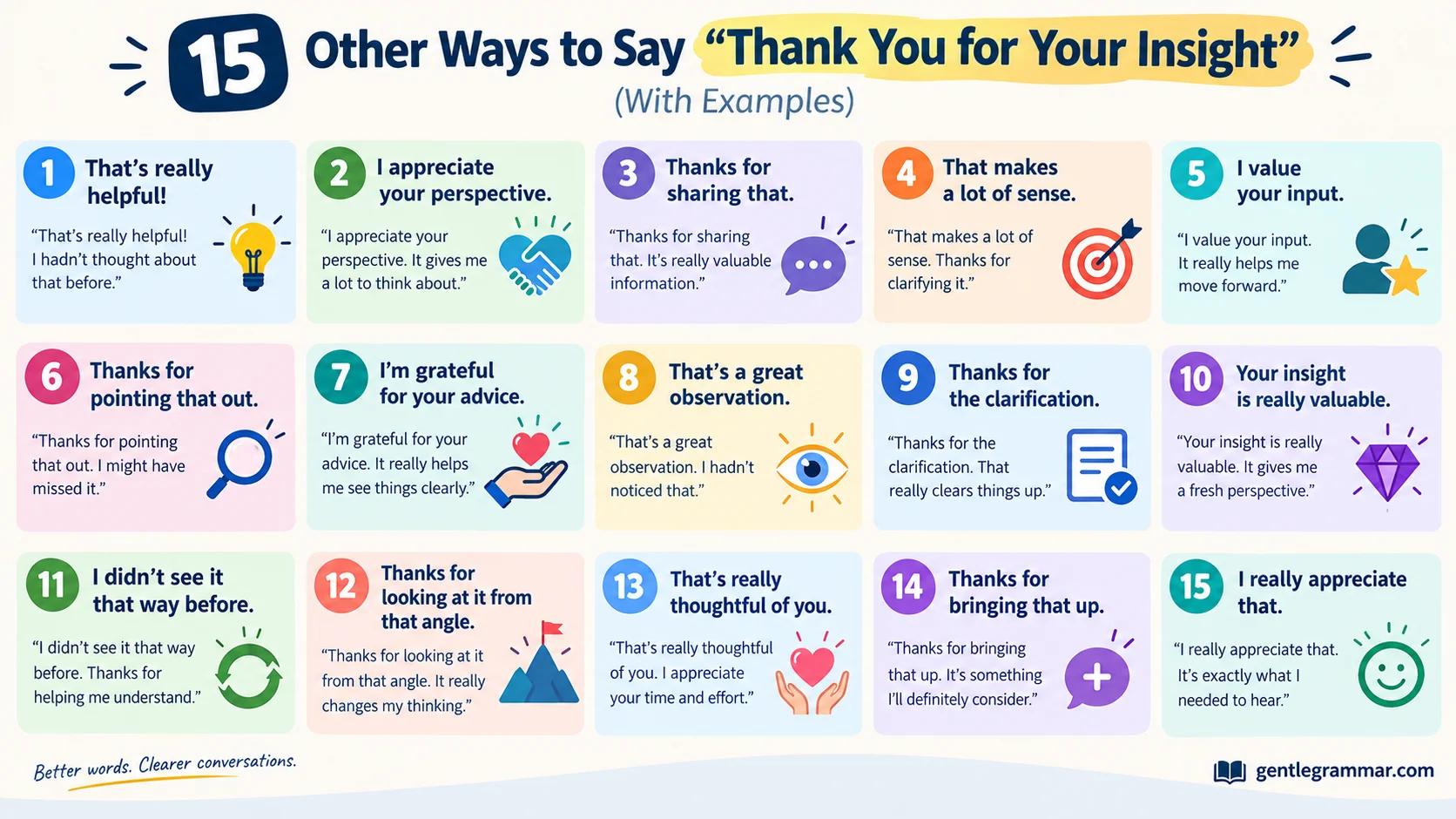
For clear and natural communication, Other Ways to Say “Thank You for Your Insight” can help you choose a warmer response in daily conversations.
Showing appreciation and gratitude for someone’s insight, helpful advice, or guidance is a simple way to recognize their value. In the workplace, during a team project, or in personal conversations, acknowledging someone’s thoughts with genuine appreciation and polite words shows that you value their perspective and valuable insights. From my experience, this can strengthen relationships, trust.
Understanding the role of communication also makes the phrase thank you more meaningful. You can use a helpful response such as thank you for your insight to demonstrate respect, bring warmth to a conversation, and strengthen, build, and encourage better communication. It is an essential part of effective communication, whether you are saying thank you for your suggestion, thank you for your input, or thanking another person for their contribution.
What Does “Thank You for Your Insight” Mean?
“Thank you for your insight” is a polite expression used to show appreciation when someone has shared a useful idea, perspective, understanding, observation, or piece of knowledge. The word insight usually suggests that the person’s contribution helped you understand something more clearly or see an issue from a different angle.
The phrase communicates both gratitude and recognition. For example, if a colleague explains why a project is falling behind, you might say, “Thank you for your insight.” You are not merely thanking them for speaking; you are acknowledging that their explanation or perspective was valuable and helpful. Depending on the context, the phrase can sound professional, respectful, thoughtful, and slightly formal.
Common Situations Where “Thank You for Your Insight” Is Used
People commonly use “Thank you for your insight” when someone offers an explanation, opinion, observation, recommendation, or perspective that adds value to a conversation. It works particularly well when the contribution has helped you understand a complicated issue.
In workplace communication, the phrase can be used after a colleague explains a problem, a manager discusses a strategy, or a client provides useful information. In school or academic settings, it can acknowledge a thoughtful contribution to a discussion. It can also work in personal communication when someone offers a perspective that helps you think about a situation differently.
You may want an alternative when you want to make the appreciation more specific or personal. For instance, “Thanks for the clarification” focuses on clearing up confusion, while “I appreciate your guidance” emphasizes help or direction. The best wording depends on exactly what the other person contributed.
Is It Professional or Polite to Say “Thank You for Your Insight”?
Yes. “Thank you for your insight” is generally a polite and professional expression. It has a respectful tone and is particularly suitable for emails, meetings, consultations, presentations, workplace discussions, and other situations where you want to acknowledge someone’s useful perspective.
It is not necessarily stiff or excessively formal, but it can sound more polished than everyday phrases such as “Thanks for the help.” The word insight also implies that the person’s contribution contained useful understanding rather than simply providing a basic answer.
In casual conversations, however, a simpler expression may sound more natural. Saying “Thanks for sharing that” or “I appreciate your thoughts” can feel more relaxed and personal. There is no single universally correct choice; context and relationship should guide the wording.
Advantages and Disadvantages of Saying “Thank You for Your Insight”
Advantages
The main advantage is that the phrase communicates specific appreciation. Rather than giving a generic “thank you,” it recognizes that someone contributed useful knowledge or perspective. It is also versatile enough for professional emails, conversations, meetings, educational discussions, and thoughtful personal exchanges.
Another benefit is its respectful tone. It gives the recipient credit for helping you understand an issue. This can make communication feel more considerate, especially when someone has spent time explaining a complicated subject or offering a thoughtful opinion.
Disadvantages
The phrase can sometimes feel slightly formal or polished in very casual conversations. If a close friend has casually shared an opinion, “Thanks for your insight” might sound more professional than necessary.
It can also be less precise when you actually mean something more specific. If someone corrected a misunderstanding, “Thanks for the clarification” communicates the purpose more clearly. If they gave you practical direction, “I appreciate your guidance” may be more accurate.
Synonyms for “Thank You for Your Insight”
- I Appreciate Your Insight
- Thanks for Your Perspective
- Thank You for Sharing Your Perspective
- I Appreciate Your Thoughts
- Thanks for the Thoughtful Input
- Your Insight Is Much Appreciated
- I Value Your Perspective
- Thank You for the Helpful Information
- I Appreciate Your Guidance
- Thanks for the Clarification
- Thank You for Your Feedback
- I’m Grateful for Your Input
- Thanks for Shedding Light on This
- Your Thoughts Were Very Helpful
- I Appreciate You Sharing That
1. I Appreciate Your Insight
Meaning
“I appreciate your insight” expresses gratitude for someone’s useful understanding, perspective, or observation. It has essentially the same central meaning as “Thank you for your insight,” but it can sound a little more personal and deliberate.
Definition
I appreciate your insight means I am grateful for the useful understanding or perspective you have shared with me.
Detailed Explanation
This expression directly acknowledges the value of someone’s thinking. Compared with “Thank you for your insight,” the word appreciate can make the gratitude feel slightly more personal. It works particularly well when someone has provided thoughtful analysis rather than a simple piece of information. It is polished enough for professional communication while still sounding natural in ordinary conversation.
Scenario Examples
Scenario: A coworker explains why a customer complaint occurred.
Example: “I appreciate your insight. It gives us a better idea of what we need to address.”
Scenario: A friend offers a different perspective on a difficult decision.
Example: “I appreciate your insight. I hadn’t looked at the situation that way before.”
Best Use
Best for professional emails, meetings, thoughtful conversations, consultations, and personal discussions where you want to emphasize the value of someone’s perspective.
Tone
Tone: Professional, warm, appreciative
The phrase feels respectful without becoming overly formal.
2. Thanks for Your Perspective
Meaning
“Thanks for your perspective” thanks someone specifically for sharing how they see or understand a situation.
Definition
Thanks for your perspective means I appreciate you sharing your particular way of viewing or understanding this issue.
Detailed Explanation
This alternative focuses more on viewpoint than specialized knowledge. It is useful when people have different experiences, opinions, or interpretations of the same subject. Unlike “insight,” perspective does not necessarily suggest that the person’s view contains an answer or expert knowledge. That makes it particularly useful for discussions where multiple viewpoints are important.
Scenario Examples
Scenario: A teammate explains why a proposed change may affect customers differently.
Example: “Thanks for your perspective. I hadn’t considered the customer experience from that angle.”
Scenario: A friend explains how they experienced a disagreement.
Example: “Thanks for your perspective. It helps me understand where you’re coming from.”
Best Use
Best for work discussions, personal conversations, disagreements, brainstorming, and situations involving different viewpoints.
Tone
Tone: Friendly, respectful, conversational
It sounds natural and avoids implying that one person’s viewpoint is necessarily the definitive answer.
3. Thank You for Sharing Your Perspective
Meaning
This expression thanks someone for openly communicating their point of view or personal understanding.
Definition
Thank you for sharing your perspective means I appreciate you taking the time to explain how you see this situation.
Detailed Explanation
This phrase is a little more explicit than “Thanks for your perspective.” The word sharing highlights the person’s willingness to communicate their thoughts. It can be especially appropriate when the subject is personal, sensitive, or open to interpretation. It recognizes the contribution without suggesting that you necessarily agree with everything the person said.
Scenario Examples
Scenario: A colleague discusses how a workplace change affects their responsibilities.
Example: “Thank you for sharing your perspective. It gives us another important point to consider.”
Scenario: Someone participates thoughtfully in an online discussion.
Example: “Thank you for sharing your perspective. Your experience adds useful context to the conversation.”
Best Use
Best for professional discussions, respectful disagreements, community conversations, online discussions, and personal communication.
Tone
Tone: Respectful, thoughtful, inclusive
The phrase sounds considerate because it recognizes the act of opening up and communicating a viewpoint.
4. I Appreciate Your Thoughts
Meaning
“I appreciate your thoughts” is a broad and natural way to thank someone for their ideas, opinions, or reactions.
Definition
I appreciate your thoughts means I am grateful that you took the time to share your ideas or opinions with me.
Detailed Explanation
This is more flexible than “Thank you for your insight.” The word thoughts can refer to opinions, suggestions, reactions, or ideas without implying that the person provided specialized knowledge. It therefore works well when you want your appreciation to sound natural and approachable. It is also useful when the contribution was valuable but you do not want to overstate its importance.
Scenario Examples
Scenario: You ask a friend for an opinion about a personal decision.
Example: “I appreciate your thoughts. I’ll take some time to think about what you said.”
Scenario: A colleague reviews an early project idea.
Example: “I appreciate your thoughts on the proposal. I’ll consider them before the next meeting.”
Best Use
Best for emails, casual conversations, brainstorming, feedback discussions, and personal messages.
Tone
Tone: Warm, natural, conversational
It is less formal than many workplace-oriented alternatives and feels comfortable in everyday communication.
5. Thanks for the Thoughtful Input
Meaning
“Thanks for the thoughtful input” expresses appreciation for a contribution that was carefully considered.
Definition
Thanks for the thoughtful input means I appreciate the careful, useful ideas or comments you contributed.
Detailed Explanation
The word thoughtful adds an important layer of meaning. It suggests that the person did more than simply give an opinion; they considered the issue carefully. Input is commonly used for ideas, suggestions, comments, or recommendations in collaborative settings. As a result, this phrase is particularly natural in professional and team environments.
Scenario Examples
Scenario: Several employees discuss how to improve a workflow.
Example: “Thanks for the thoughtful input. Your suggestions give us several practical options to explore.”
Scenario: A friend gives careful advice about a complicated situation.
Example: “Thanks for the thoughtful input. I really appreciate you taking the time to think it through.”
Best Use
Best for team meetings, workplace emails, collaborative projects, brainstorming, and thoughtful personal advice.
Tone
Tone: Professional, appreciative, sincere
The expression communicates that the person’s contribution was not only useful but also carefully considered.
6. Your Insight Is Much Appreciated
Meaning
This expression emphasizes that the person’s insight is valued and recognized.
Definition
Your insight is much appreciated means the useful understanding or perspective you provided is greatly valued.
Detailed Explanation
This wording places the focus on the value of the contribution rather than directly saying “thank you.” It sounds somewhat more formal than “I appreciate your insight,” making it useful for professional correspondence. The passive structure can create a polished tone, although it may feel less personal in casual conversation. It works best when you want to acknowledge someone’s expertise or useful analysis respectfully.
Scenario Examples
Scenario: A specialist explains a technical issue to your team.
Example: “Your insight is much appreciated as we work through the next stage of the project.”
Scenario: A senior colleague gives useful advice before an important meeting.
Example: “Your insight is much appreciated. It helped us prepare for the discussion.”
Best Use
Best for formal emails, professional communication, consultations, reports, and workplace correspondence.
Tone
Tone: Formal, respectful, professional
The wording sounds polished and is particularly suitable when addressing someone in a professional capacity.
7. I Value Your Perspective
Meaning
“I value your perspective” communicates that you consider someone’s way of thinking important or worthwhile.
Definition
I value your perspective means your viewpoint matters to me, and I consider it important.
Detailed Explanation
This phrase goes beyond simple gratitude by expressing ongoing respect for someone’s viewpoint. It can be especially meaningful in relationships where trust and openness matter. It does not necessarily mean you agree with the person; instead, it indicates that you believe their perspective deserves consideration. That makes it useful during collaborative discussions and respectful disagreements.
Scenario Examples
Scenario: A manager invites an employee to discuss a proposed change.
Example: “I value your perspective, so I’d like to hear how you think this change will affect the team.”
Scenario: A partner explains their feelings about a difficult decision.
Example: “I value your perspective, and I want to understand what matters most to you.”
Best Use
Best for professional relationships, leadership conversations, partnerships, close relationships, and constructive discussions.
Tone
Tone: Respectful, sincere, personal
It feels warmer than a routine thank-you because it communicates that the person’s viewpoint matters to you.
8. Thank You for the Helpful Information
Meaning
This expression thanks someone for providing useful facts, details, or knowledge.
Definition
Thank you for the helpful information means I appreciate the useful information you have given me.
Detailed Explanation
This phrase is more specific than “Thank you for your insight” when the person has primarily supplied information rather than interpretation. It is therefore important not to treat the two expressions as completely interchangeable. If someone simply gives you directions, instructions, dates, or factual details, this wording may be more accurate. It also works well in customer service and administrative communication.
Scenario Examples
Scenario: A customer service representative explains a company’s process.
Example: “Thank you for the helpful information. I now know what documents I need to provide.”
Scenario: A classmate sends you details about an upcoming assignment.
Example: “Thanks for the helpful information. That clears up the requirements for me.”
Best Use
Best for customer communication, school, administrative emails, workplace correspondence, and everyday questions.
Tone
Tone: Polite, clear, professional
It is straightforward and appreciative without adding unnecessary emotional intensity.
9. I Appreciate Your Guidance
Meaning
“I appreciate your guidance” thanks someone for helping you understand what to do or how to proceed.
Definition
I appreciate your guidance means I am grateful for the direction, advice, or support you provided.
Detailed Explanation
This expression differs from “Thank you for your insight” because guidance implies direction. You would normally use it when someone has helped you make a decision, solve a problem, learn a process, or determine your next step. It can suggest a stronger practical benefit than simply receiving someone’s perspective. The phrase is especially useful when speaking to a mentor, manager, teacher, adviser, or experienced colleague.
Scenario Examples
Scenario: A supervisor explains how to handle a complicated assignment.
Example: “I appreciate your guidance. I have a much clearer plan for moving forward.”
Scenario: A teacher helps a student understand how to improve a project.
Example: “Thank you for your guidance. I’ll revise the project based on your suggestions.”
Best Use
Best for mentoring, education, workplace communication, professional advice, and situations involving direction or support.
Tone
Tone: Respectful, professional, grateful
It communicates appreciation while recognizing the other person’s experience or helpful direction.
10. Thanks for the Clarification
Meaning
“Thanks for the clarification” thanks someone for making something easier to understand or correcting confusion.
Definition
Thanks for the clarification means I appreciate you explaining or correcting something that was unclear.
Detailed Explanation
This is a context-specific alternative, not a universal synonym for “Thank you for your insight.” It is appropriate when the person’s contribution has removed uncertainty or misunderstanding. Using it when clarification was not actually provided can sound inaccurate. When the situation does involve confusion, however, it is more precise than a general expression of appreciation.
Scenario Examples
Scenario: A coworker explains a confusing deadline.
Example: “Thanks for the clarification. I’ll make sure the report is submitted by Friday.”
Scenario: A teacher explains a confusing instruction.
Example: “Thanks for the clarification. I understand what we’re expected to include now.”
Best Use
Best for emails, workplace communication, school, customer service, and any conversation involving confusion or misunderstanding.
Tone
Tone: Direct, polite, professional
It is concise and practical, making it especially useful in written communication.
11. Thank You for Your Feedback
Meaning
This expression thanks someone for giving an evaluation, response, criticism, or suggestion about your work or actions.
Definition
Thank you for your feedback means I appreciate the comments, evaluation, or suggestions you provided.
Detailed Explanation
The word feedback is more specific than insight. It usually involves a response to something you have done, created, proposed, or presented. A manager reviewing an employee’s work or a customer commenting on a service may provide feedback. Because feedback can include criticism as well as praise, the phrase is useful when you want to acknowledge the response without suggesting that you agree with every point.
Scenario Examples
Scenario: Your manager reviews a presentation you prepared.
Example: “Thank you for your feedback. I’ll make those changes before presenting it to the client.”
Scenario: A customer comments on your service.
Example: “Thank you for your feedback. We appreciate you taking the time to share your experience.”
Best Use
Best for workplace emails, customer communication, performance discussions, school assignments, surveys, and professional reviews.
Tone
Tone: Professional, respectful, receptive
It signals that you are willing to listen and consider another person’s comments.
12. I’m Grateful for Your Input
Meaning
“I’m grateful for your input” expresses sincere appreciation for someone’s contribution to a discussion, decision, or project.
Definition
I’m grateful for your input means I sincerely appreciate the ideas, comments, or contribution you provided.
Detailed Explanation
This phrase is somewhat more emotionally expressive than “Thank you for your insight.” The word grateful can communicate stronger appreciation, while input keeps the meaning focused on someone’s contribution. It is particularly useful when a person’s ideas have played an important role in a discussion or decision. Although suitable for professional settings, it can also work in personal communication.
Scenario Examples
Scenario: A colleague contributes useful suggestions during a difficult project.
Example: “I’m grateful for your input. It helped us identify an issue we had overlooked.”
Scenario: A friend helps you think through an important choice.
Example: “I’m grateful for your input. Talking it through with you gave me a lot to consider.”
Best Use
Best for meaningful workplace collaboration, personal conversations, important decisions, and situations where you want to express stronger appreciation.
Tone
Tone: Warm, sincere, appreciative
The word grateful makes the expression feel more heartfelt than a routine professional thank-you.
13. Thanks for Shedding Light on This
Meaning
“Thanks for shedding light on this” thanks someone for making a confusing, complicated, or unfamiliar subject easier to understand.
Definition
Thanks for shedding light on this means I appreciate you helping me understand something more clearly.
Detailed Explanation
This is a figurative expression. “Shedding light” suggests bringing clarity to something that was previously unclear or difficult to understand. It is often more conversational and vivid than “Thank you for your insight.” The phrase is especially effective when someone’s explanation has revealed an important detail or helped you see the issue from a clearer angle.
Scenario Examples
Scenario: A colleague explains why a technical problem keeps occurring.
Example: “Thanks for shedding light on this. The cause makes much more sense now.”
Scenario: A friend explains a complicated social situation.
Example: “Thanks for shedding light on this. I understand the situation better now.”
Best Use
Best for conversations, workplace discussions, emails, informal professional communication, and explanations of complicated subjects.
Tone
Tone: Conversational, appreciative, expressive
It has a friendly quality and adds a little more imagery and warmth than a straightforward thank-you.
14. Your Thoughts Were Very Helpful
Meaning
This expression directly tells someone that their ideas or opinions were useful to you.
Definition
Your thoughts were very helpful means the ideas or perspective you shared helped me in a meaningful way.
Detailed Explanation
This alternative focuses on the effect of the person’s contribution rather than simply acknowledging that they offered insight. It is easy to understand and works well for both native speakers and English learners. The phrase can be particularly useful when someone’s comments helped you make a decision or understand a problem. It sounds less formal than some professional expressions, which makes it versatile.
Scenario Examples
Scenario: A friend helps you decide how to handle a difficult conversation.
Example: “Your thoughts were very helpful. I feel more prepared to talk to them now.”
Scenario: A coworker reviews two possible approaches to a project.
Example: “Your thoughts were very helpful as we considered which approach to take.”
Best Use
Best for personal messages, workplace conversations, friendly emails, advice, and everyday communication.
Tone
Tone: Warm, straightforward, appreciative
The wording feels genuine because it clearly explains that the other person’s contribution made a difference.
15. I Appreciate You Sharing That
Meaning
“I appreciate you sharing that” thanks someone for telling you something, particularly when the information, opinion, or experience is personal or meaningful.
Definition
I appreciate you sharing that means I am grateful that you chose to tell me or open up about this.
Detailed Explanation
This expression is broader than “Thank you for your insight.” It does not require the person to have provided expert knowledge or a particularly clever observation. Instead, it emphasizes the act of sharing. It can be especially appropriate when someone reveals a personal experience, concern, feeling, or perspective and you want to acknowledge their openness respectfully.
Scenario Examples
Scenario: A friend talks honestly about a difficult experience.
Example: “I appreciate you sharing that. I can understand why the situation has been difficult for you.”
Scenario: A colleague explains a concern about a team process.
Example: “I appreciate you sharing that. It’s useful to know how the process is affecting your work.”
Best Use
Best for personal conversations, sensitive discussions, supportive communication, workplace conversations, and situations where openness matters.
Tone
Tone: Warm, empathetic, respectful
The expression feels personal because it recognizes not just the information itself but also the person’s willingness to share it.
FAQs:
What is another way to say “Thank You for Your Insight”?
Natural alternatives include “I appreciate your insight,” “Thanks for your perspective,” “I appreciate your thoughts,” and “I value your perspective.” The best choice depends on what the person actually contributed. For example, use “Thanks for the clarification” when they cleared up confusion and “I appreciate your guidance” when they gave you direction.
What does “Thank You for Your Insight” mean?
“Thank You for Your Insight” means that you appreciate someone for sharing a useful perspective, observation, understanding, or interpretation. It often suggests that their contribution helped you understand a subject more clearly or consider it from another angle.
Is “Thank You for Your Insight” professional?
Yes. “Thank you for your insight” is generally professional and polite. It is suitable for workplace emails, meetings, consultations, academic discussions, and other situations where you want to acknowledge someone’s useful perspective respectfully.
What is a more polite way to say “Thank You for Your Insight”?
The original phrase is already polite, but alternatives such as “I appreciate your insight,” “Your insight is much appreciated,” and “I’m grateful for your input” can provide slightly different levels of warmth or formality. Choose the wording according to your relationship with the recipient and the setting.
Which alternative works best in formal communication?
For formal communication, “Your insight is much appreciated” and “I appreciate your guidance” can work well when their meanings fit the situation. If the person supplied factual details, “Thank you for the helpful information” may be more precise. Formality should never come at the expense of accuracy.
Conclusion:
The right alternative to “Thank You for Your Insight” depends on what you are actually thanking someone for. If they offered a viewpoint, “Thanks for your perspective” may be appropriate. If they provided direction, “I appreciate your guidance” is clearer. When they corrected confusion, “Thanks for the clarification” communicates the purpose directly.
The most effective wording is not necessarily the most formal one. Consider the relationship, context, level of appreciation, and specific contribution before choosing your phrase. A thoughtful expression can make even a short message feel more genuine. Whether you are writing a professional email, replying to a friend, or participating in a discussion, choosing precise language helps your gratitude sound natural and sincere.
