
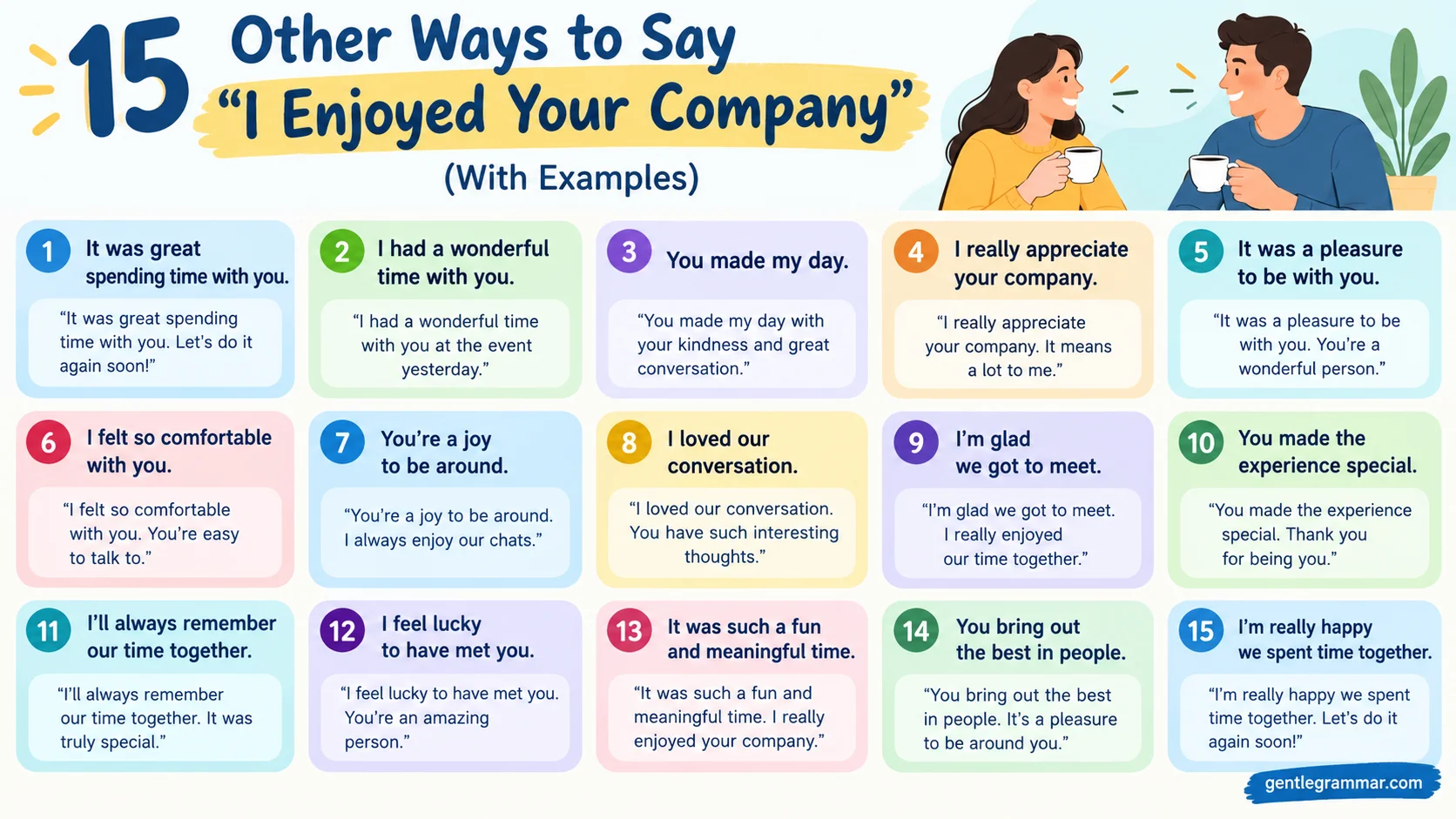
Other Ways to Say “I Enjoyed Your Company” help you express appreciation, warmth, and kindness after spending time with friends, family, or colleagues.
A pleasant conversation, fun weekend, or meaningful dinner can create special moments and happy memories. Instead of saying, “I had fun,” try “I really enjoyed the time I spent with you” or “Spending time with you was the highlight of my week.” These alternative phrases make your message more personal and show genuine appreciation and respect.
From my experience, a heartfelt expression can strengthen a personal connection, deepen friendship, and support relationship building. Saying “Thank you for the wonderful time” communicates gratitude, while “I appreciate your companionship” recognizes the value of shared experiences. Sometimes, shared laughter, private jokes, and cherished moments become meaningful memories worth preserving.
What Does “I Enjoyed Your Company” Mean?
“I Enjoyed Your Company” means that you liked spending time with someone and appreciated having them around. The word company refers to another person’s presence, so the phrase communicates that their presence made your time together pleasant or enjoyable. It is usually a warm expression of appreciation and can be used after a conversation, meal, outing, meeting, visit, or other shared experience.
The phrase is generally positive and friendly, but its exact feeling depends on the relationship and context. Between friends, it can simply mean that you had a good time together. In a romantic situation, it can express attraction or enjoyment without being overly direct. In a professional setting, it can politely communicate that you valued someone’s time and presence, although a more formal expression may sometimes be more suitable.
Common Situations Where “I Enjoyed Your Company” Is Used
People commonly use “I Enjoyed Your Company” after spending meaningful or pleasant time with another person. For example, you might say it to a friend after dinner, to a guest after a visit, or to someone you recently met and would like to see again. It works particularly well when you want to acknowledge that the person’s presence itself contributed to your enjoyment.
The phrase can also appear in text messages, personal communication, and social situations. In romantic relationships, it may sound warm and subtly affectionate. In work-related situations, however, the wording can feel more personal than necessary, so expressions focused on appreciating someone’s time, conversation, or contribution may be clearer.
Using an alternative can also help you avoid repeating the same phrase. More importantly, a carefully chosen expression can communicate whether you mean friendly enjoyment, gratitude, affection, appreciation, or simple pleasure in someone’s presence.
Is It Professional or Polite to Say “I Enjoyed Your Company”?
Yes, “I Enjoyed Your Company” is polite and grammatically natural, but its level of professionalism depends on the situation. In everyday conversation, it sounds friendly, warm, and sincere. It is especially appropriate when speaking to someone you know personally or after an informal social occasion.
In professional communication, the phrase can still be courteous, but “company” may sound somewhat personal. After a business meeting, for example, wording that focuses on the conversation or discussion may feel more appropriate. If you are writing to a client, colleague, or professional contact, consider the relationship and the purpose of the message before choosing your expression.
Advantages and Disadvantages of Saying “I Enjoyed Your Company”
Advantages
One advantage is that “I Enjoyed Your Company” clearly communicates positive feelings about spending time with someone. It is warm without necessarily being overly emotional, which makes it useful in many personal situations. The phrase can also sound thoughtful because it appreciates not just what happened but the person’s presence during the experience.
Another benefit is its flexibility. Depending on the relationship and delivery, it can sound friendly, affectionate, appreciative, or gently romantic. It also works naturally in both spoken English and personal messages.
Disadvantages
The main limitation is that the phrase can sometimes sound slightly formal or old-fashioned in very casual conversation. Friends may naturally choose simpler wording when texting each other. It can also be somewhat ambiguous: a listener may not know whether you mean friendly appreciation, romantic interest, or simply that the conversation was pleasant.
In professional settings, it may also feel more personal than intended. If your purpose is to thank someone for a productive meeting or useful discussion, a more specific expression can communicate your meaning more precisely.
Synonyms for “I Enjoyed Your Company”
- I Had a Great Time With You
- I Really Enjoyed Spending Time With You
- I Loved Spending Time With You
- It Was Great Spending Time With You
- I Enjoyed Spending Time Together
- I Had a Wonderful Time With You
- I’m Glad We Got to Spend Time Together
- I Always Enjoy Our Time Together
- I Really Enjoyed Our Conversation
- I Appreciated Your Company
- It Was a Pleasure Spending Time With You
- I’m So Glad I Got to See You
- I Enjoyed Having You Around
- I Had Such a Nice Time With You
- I’m Happy We Spent Time Together
1. I Had a Great Time With You
Meaning
“I Had a Great Time With You” means that you genuinely enjoyed the time you spent with someone. It focuses on the overall experience rather than specifically describing the person’s company.
Definition
A natural expression used to tell someone that spending time together was very enjoyable and positive.
Detailed Explanation
This is one of the most natural and versatile alternatives to “I Enjoyed Your Company.” It sounds friendly, relaxed, and conversational, making it particularly suitable for everyday interactions. Unlike the original phrase, it emphasizes how much you enjoyed the experience rather than directly evaluating someone’s presence. It can work after a casual outing, dinner, date, visit, or long conversation.
Scenario Examples
Scenario: You went out for coffee with a friend.
Example: “I had a great time with you today. We should do this again soon.”
Scenario: You went on a first date and want to send a warm follow-up message.
Example: “I had a great time with you last night. Thanks for making the evening so enjoyable.”
Best Use
Best for casual conversation, texting, friendly messages, dates, and personal communication.
Tone
Tone: Warm, casual, positive
It feels sincere without sounding overly formal or emotionally intense.
2. I Really Enjoyed Spending Time With You
Meaning
“I Really Enjoyed Spending Time With You” directly expresses that you liked being together and valued the time you shared.
Definition
A warm expression showing that someone’s presence and shared time were especially enjoyable.
Detailed Explanation
This expression is slightly more explicit than “I Had a Great Time With You.” The word “really” adds emphasis and makes the appreciation feel genuine. It is useful when you want to make clear that you enjoyed the person’s presence, not simply the activity you did together. Depending on context, it can sound friendly, affectionate, or subtly romantic.
Scenario Examples
Scenario: You spent an afternoon talking with someone you care about.
Example: “I really enjoyed spending time with you this afternoon. It was exactly what I needed.”
Scenario: You visited an old friend.
Example: “I really enjoyed spending time with you after all these years.”
Best Use
Best for personal messages, friendships, family relationships, dates, and meaningful conversations.
Tone
Tone: Warm, sincere, personal
It sounds more heartfelt than a simple statement that you had fun.
3. I Loved Spending Time With You
Meaning
“I Loved Spending Time With You” expresses strong enjoyment and affection for the time shared with another person.
Definition
A more emotionally expressive way to say that being with someone was especially enjoyable and meaningful.
Detailed Explanation
The word “loved” makes this expression stronger than “enjoyed.” It can communicate genuine affection, enthusiasm, or emotional closeness. In a friendship, it may simply show strong appreciation, while in a romantic relationship it can sound noticeably affectionate. Because of its emotional strength, it is better suited to relationships where that level of warmth feels natural.
Scenario Examples
Scenario: You spent the weekend with a close friend.
Example: “I loved spending time with you this weekend. Let’s plan another trip soon.”
Scenario: You are sending a message to a romantic partner after an evening together.
Example: “I loved spending time with you tonight. Being with you always makes my evening better.”
Best Use
Best for close friendships, romantic relationships, family, and personal messages.
Tone
Tone: Affectionate, warm, enthusiastic
It communicates stronger positive emotion than many of the other expressions on this list.
4. It Was Great Spending Time With You
Meaning
“It Was Great Spending Time With You” tells someone that being together was a very positive experience.
Definition
A friendly expression used to show that you valued and enjoyed shared time with another person.
Detailed Explanation
This expression is natural and easygoing. It does not put as much emotional emphasis on the speaker as “I Loved Spending Time With You,” so it can feel more balanced and relaxed. It is useful when you want to express appreciation without sounding overly sentimental. The phrase can work in both personal and moderately informal professional situations, depending on the relationship.
Scenario Examples
Scenario: A former colleague visits your city.
Example: “It was great spending time with you today. I’m glad we finally had a chance to catch up.”
Scenario: You meet a friend for lunch.
Example: “It was great spending time with you. Thanks for lunch!”
Best Use
Best for casual conversation, friendly emails, social messages, and informal professional relationships.
Tone
Tone: Friendly, relaxed, appreciative
It feels natural without being too intimate.
5. I Enjoyed Spending Time Together
Meaning
“I Enjoyed Spending Time Together” expresses pleasure in the shared experience rather than focusing entirely on the other person.
Definition
A warm statement showing that the time shared by both people was enjoyable.
Detailed Explanation
This wording shifts the emphasis from “your company” to the time you shared together. That makes it especially useful when both people contributed to an enjoyable experience. It can sound warm without being as personal as some alternatives. The phrase is suitable when you want your message to feel appreciative while keeping the focus on the shared moment.
Scenario Examples
Scenario: You and a friend spent an afternoon exploring a new place.
Example: “I enjoyed spending time together today. It was a fun afternoon.”
Scenario: You and a family member had dinner.
Example: “I enjoyed spending time together tonight. We should make this a regular thing.”
Best Use
Best for friends, family, personal messages, and relaxed social situations.
Tone
Tone: Warm, inclusive, comfortable
The wording emphasizes togetherness rather than one person’s effect on the other.
6. I Had a Wonderful Time With You
Meaning
“I Had a Wonderful Time With You” means that the speaker found the shared experience particularly pleasant or memorable.
Definition
An expressive way to communicate that spending time with someone was very enjoyable and meaningful.
Detailed Explanation
“Wonderful” gives this expression a little more warmth and elegance than “great.” It can sound sincere without necessarily being romantic. The phrase is especially useful after a memorable visit, celebration, dinner, or meaningful conversation. Compared with “I Enjoyed Your Company,” it focuses more clearly on the quality of the experience.
Scenario Examples
Scenario: A close friend visits you for the weekend.
Example: “I had a wonderful time with you. Thank you for making the weekend so special.”
Scenario: You attended a family gathering.
Example: “I had a wonderful time with you all yesterday.”
Best Use
Best for personal messages, social occasions, family gatherings, visits, and special events.
Tone
Tone: Warm, gracious, heartfelt
It has a slightly more polished feel than “I Had a Great Time With You.”
7. I’m Glad We Got to Spend Time Together
Meaning
“I’m Glad We Got to Spend Time Together” expresses appreciation that an opportunity to be together happened.
Definition
A warm statement showing gratitude for shared time and happiness that the meeting or visit took place.
Detailed Explanation
This expression adds a feeling of gratitude and opportunity. Instead of simply saying the time was enjoyable, it suggests that spending time together mattered to you. It works particularly well when you do not see someone often or when getting together required planning. The wording is warm but not overly emotional, making it versatile for many personal relationships.
Scenario Examples
Scenario: You meet an old friend during a short visit to their city.
Example: “I’m glad we got to spend time together while I was here.”
Scenario: A relative visits before moving away.
Example: “I’m really glad we got to spend time together before you left.”
Best Use
Best for friends, family, reunions, visits, and meaningful personal messages.
Tone
Tone: Appreciative, warm, sincere
The emphasis is on gratitude for the opportunity to be together.
8. I Always Enjoy Our Time Together
Meaning
“I Always Enjoy Our Time Together” means that spending time with the person is consistently pleasant.
Definition
An affectionate expression indicating that shared time is regularly enjoyable.
Detailed Explanation
Unlike phrases referring to one particular meeting, this expression describes an ongoing relationship or pattern. “Always” suggests that the positive feeling is not limited to one occasion. It can therefore sound more personal and affectionate. Because it refers to repeated experiences, it works best when you already know the person rather than immediately after meeting someone for the first time.
Scenario Examples
Scenario: You are talking to a close friend after another enjoyable afternoon.
Example: “I always enjoy our time together. We never run out of things to talk about.”
Scenario: You are writing a message to a partner.
Example: “I always enjoy our time together, even when we’re doing nothing special.”
Best Use
Best for close friendships, family relationships, romantic relationships, and recurring personal interactions.
Tone
Tone: Affectionate, familiar, sincere
The word “always” gives the expression a stronger sense of emotional continuity.
9. I Really Enjoyed Our Conversation
Meaning
“I Really Enjoyed Our Conversation” specifically expresses appreciation for talking with someone.
Definition
A polite and warm expression used to say that a conversation was interesting, pleasant, or meaningful.
Detailed Explanation
This is a more specific alternative because it focuses on the conversation rather than the entire time together. It is therefore useful when talking was the main part of the interaction. The wording can also be easier to use in professional settings because it avoids the more personal suggestion of “company.” It may communicate appreciation without implying a close relationship.
Scenario Examples
Scenario: You had an insightful discussion with a colleague.
Example: “I really enjoyed our conversation about the project. Your ideas gave me a lot to think about.”
Scenario: You meet someone interesting at an event.
Example: “I really enjoyed our conversation. It was great learning more about your work.”
Best Use
Best for professional communication, networking, meetings, social events, and thoughtful personal conversations.
Tone
Tone: Polite, thoughtful, professional-friendly
It is one of the more adaptable choices when you want warmth without excessive personal intimacy.
10. I Appreciated Your Company
Meaning
“I Appreciated Your Company” communicates that you valued someone’s presence and were grateful to have them with you.
Definition
A somewhat more polished expression of gratitude for someone’s presence.
Detailed Explanation
This phrase is close in meaning to the original but places more emphasis on appreciation than enjoyment. “Appreciated” can sound slightly more formal and deliberate than “enjoyed.” It works well when someone’s presence was comforting, helpful, pleasant, or meaningful. Depending on the setting, it can be warmer or more formal than everyday alternatives.
Scenario Examples
Scenario: A friend stays with you during a difficult evening.
Example: “I really appreciated your company last night. It meant a lot to me.”
Scenario: You spend a quiet afternoon with a family member.
Example: “I appreciated your company today. It was nice to have someone to talk to.”
Best Use
Best for personal messages, supportive situations, thoughtful communication, and moderately formal interactions.
Tone
Tone: Grateful, warm, slightly formal
The expression focuses more on value and gratitude than simple enjoyment.
11. It Was a Pleasure Spending Time With You
Meaning
“It Was a Pleasure Spending Time With You” means that being together was enjoyable and appreciated.
Definition
A courteous expression showing that shared time was pleasant and valued.
Detailed Explanation
This expression has a more polished and courteous quality than many casual alternatives. It can work in personal situations, but it is also suitable when you want to maintain a respectful or professional tone. Unlike “I Loved Spending Time With You,” it avoids strong emotional language. The word “pleasure” makes the expression gracious without necessarily suggesting intimacy.
Scenario Examples
Scenario: You meet a professional contact for coffee.
Example: “It was a pleasure spending time with you. I enjoyed hearing about your experience in the field.”
Scenario: You have dinner with an acquaintance.
Example: “It was a pleasure spending time with you this evening. Thank you for joining me.”
Best Use
Best for professional communication, polite social situations, formal-friendly messages, and respectful personal interactions.
Tone
Tone: Polite, gracious, refined
It sounds more formal than “I Had a Great Time With You.”
12. I’m So Glad I Got to See You
Meaning
“I’m So Glad I Got to See You” expresses happiness about having the opportunity to meet or visit someone.
Definition
A personal expression showing genuine happiness about seeing someone.
Detailed Explanation
This phrase focuses on the opportunity to see the person, rather than directly evaluating how enjoyable the time was. That makes it particularly natural when you have not seen someone for a while. “So glad” adds emotional warmth and enthusiasm. It can be affectionate without necessarily sounding romantic.
Scenario Examples
Scenario: You reconnect with an old friend.
Example: “I’m so glad I got to see you after all this time.”
Scenario: A family member visits unexpectedly.
Example: “I’m so glad I got to see you before you headed home.”
Best Use
Best for reunions, visits, friendships, family messages, and personal texts.
Tone
Tone: Warm, enthusiastic, affectionate
It communicates happiness about the meeting itself rather than simply enjoyment.
13. I Enjoyed Having You Around
Meaning
“I Enjoyed Having You Around” means that you liked having someone present with you.
Definition
A casual expression showing that someone’s presence was pleasant and welcome.
Detailed Explanation
This is a relaxed and conversational expression. “Having you around” suggests comfort and familiarity, so it often sounds especially natural between people who know each other well. It can be used after a visit, shared activity, or period of spending time in the same place. Compared with “I Enjoyed Your Company,” it sounds less formal and more everyday.
Scenario Examples
Scenario: A friend stays at your home for several days.
Example: “I really enjoyed having you around this week. The house feels quiet now!”
Scenario: A family member helps you with a project.
Example: “I enjoyed having you around while I worked on everything.”
Best Use
Best for friends, family, houseguests, close acquaintances, and casual messages.
Tone
Tone: Casual, warm, familiar
It has an easygoing quality that works especially well in spoken English and texting.
14. I Had Such a Nice Time With You
Meaning
“I Had Such a Nice Time With You” means that spending time together felt pleasant, comfortable, and enjoyable.
Definition
A gentle expression used to communicate warm enjoyment of shared time.
Detailed Explanation
This phrase has a softer quality than “I Had a Great Time With You.” The word “nice” makes it understated and natural, while “such a” adds warmth and emphasis. It can work well when you want to sound sincere without making your message feel dramatic. In romantic situations, it can carry subtle affection, but it is also completely natural between friends.
Scenario Examples
Scenario: You have a relaxed coffee date with a friend.
Example: “I had such a nice time with you today. Thanks for meeting me.”
Scenario: You spend an evening getting to know someone.
Example: “I had such a nice time with you tonight. I’m glad we got together.”
Best Use
Best for texting, casual conversation, friendships, dates, and relaxed personal messages.
Tone
Tone: Gentle, warm, friendly
It sounds sincere without being overly intense or formal.
15. I’m Happy We Spent Time Together
Meaning
“I’m Happy We Spent Time Together” expresses satisfaction and appreciation about having shared time with another person.
Definition
A thoughtful expression showing that being together was personally meaningful or positive.
Detailed Explanation
This wording is slightly more reflective than “I Had a Great Time With You.” It can suggest that the time together mattered to you, even if the occasion itself was simple. It is useful when you want to communicate appreciation without making a strong emotional declaration. The expression can fit friendships, family relationships, and other personal connections.
Scenario Examples
Scenario: You spend a quiet afternoon with a friend before they leave town.
Example: “I’m happy we spent time together before you left.”
Scenario: You have a meaningful conversation with someone close to you.
Example: “I’m happy we spent time together tonight. I really needed that conversation.”
Best Use
Best for personal messages, friendships, family, meaningful conversations, and reflective moments.
Tone
Tone: Sincere, appreciative, thoughtful
It emphasizes the value of the shared experience rather than simply saying it was entertaining.
FAQs:
What is another way to say “I Enjoyed Your Company”?
A natural alternative is “I Had a Great Time With You.” Other options include “I Really Enjoyed Spending Time With You,” “It Was Great Spending Time With You,” and “I Had a Wonderful Time With You.” The best choice depends on whether you want to sound casual, affectionate, appreciative, or more polished.
What does “I Enjoyed Your Company” mean?
“I Enjoyed Your Company” means that you liked spending time with someone and appreciated their presence. It is generally a warm and positive expression. Depending on the relationship, it can communicate friendship, affection, gratitude, or simple enjoyment of a pleasant interaction.
Is “I Enjoyed Your Company” professional?
It can be polite, but it is usually more personal and conversational than highly formal professional wording. In a workplace setting, “I Really Enjoyed Our Conversation” or “It Was a Pleasure Spending Time With You” may better match a professional relationship because they can focus on the discussion or shared interaction.
What is a more polite way to say “I Enjoyed Your Company”?
“It Was a Pleasure Spending Time With You” is a polished and courteous choice. “I Appreciated Your Company” can also sound respectful and thoughtful, particularly when you want to emphasize gratitude rather than simply saying that you had fun.
Which alternative works best in formal communication?
For a more formal or professional situation, “It Was a Pleasure Spending Time With You” is a strong option because it sounds courteous and composed. If the interaction centered on a discussion or meeting, “I Really Enjoyed Our Conversation” can be more precise and professional.
Conclusion:
Choosing the right expression can make a simple message feel much more natural and meaningful. “I Enjoyed Your Company” is warm and versatile, but different situations may call for different wording. You might choose “I Had a Great Time With You” for a relaxed message, “I Loved Spending Time With You” for stronger affection, or “It Was a Pleasure Spending Time With You” when a more polished tone is appropriate.
The key is to consider the relationship, context, emotional warmth, and level of formality before choosing your words. Similar expressions can communicate slightly different feelings, so the most useful alternative is the one that accurately reflects what you want to say. Whether you are writing a text, email, or personal message, thoughtful wording can make your appreciation feel more genuine.
