
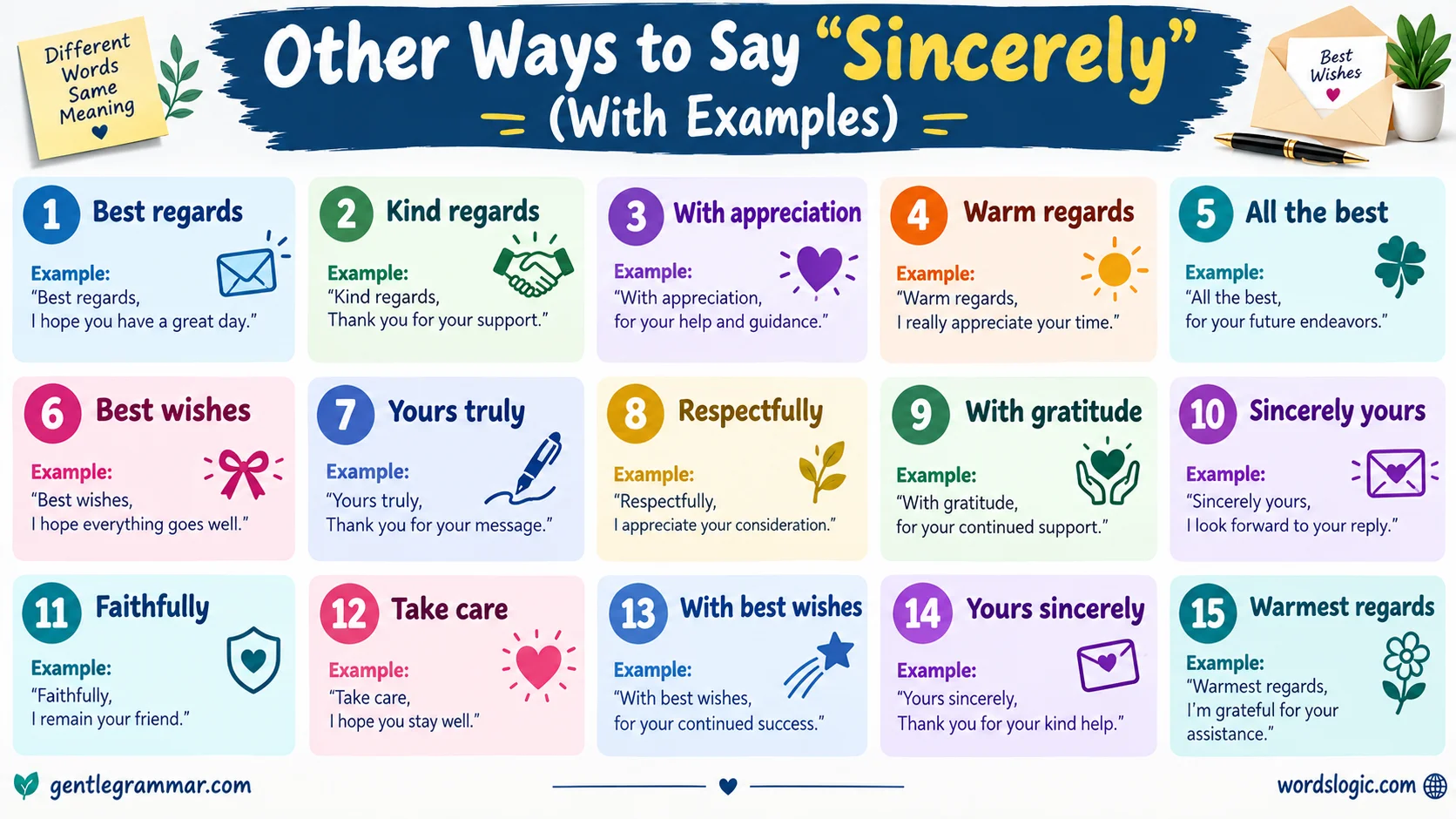
Other Ways to Say “Sincerely” (With Examples) can improve your English writing by helping you choose a warm, genuine, and professional email closing or letter sign-off.
Sincerely is a polite word that creates a clear, respectful finish in formal emails, cover letters, business messages, and letters to teachers, employers, or clients. It helps readers understand your tone and builds trust through honest, straightforward wording.
Depending on the context, alternative phrases can make your message feel warmer, friendlier, or more personal while maintaining professionalism, courtesy, and clarity. Whether you are apologizing sincerely, expressing heartfelt gratitude, or writing a serious message, choosing the right closing phrase can strengthen your communication and leave a positive impression.
What Does “Sincerely” Mean?
Sincerely is a polite closing expression used at the end of a letter or email. It communicates respect, honesty, and genuine intention toward the recipient. In formal correspondence, it appears before the sender’s name, as in “Sincerely, Sarah Williams.” The word can also mean genuinely or honestly when used within a sentence, such as “I sincerely appreciate your help.” Its meaning depends on context: as an email sign-off, it provides a conventional and respectful ending, while within a sentence, it emphasizes that a feeling, statement, or apology is genuine.
Common Situations Where “Sincerely” Is Used
People commonly use this expression when writing business emails, formal letters, job applications, cover letters, and professional requests. It can also appear in correspondence with teachers, university administrators, clients, customers, and people the writer does not know well. In personal communication, “Sincerely” may be appropriate for a serious or heartfelt letter, although it can sound distant in a casual message to a friend.
Writers sometimes choose an alternative to better match the relationship or purpose of their message. For example, “Best regards” may feel natural in a routine business email, while “Warm regards” adds friendliness. A closing such as “Respectfully” can communicate deference in a sensitive or formal situation. The right wording makes the ending feel intentional rather than automatic.
Is It Professional or Polite to Say “Sincerely”?
Yes, “Sincerely” is both professional and polite in most formal correspondence. It is a conventional sign-off that works well when contacting employers, clients, institutions, or professional acquaintances. It communicates respect without being overly emotional or overly familiar. In a formal letter, especially one addressed to a named recipient, it is a dependable choice.
However, it may feel stiff in an informal conversation or a friendly email exchange. In those situations, “Best,” “Thanks,” or “All the best” may sound more natural. Your choice should depend on the recipient, the purpose of the message, and the tone you want to convey. Remember that a sign-off cannot replace a clear, courteous message, but it can help reinforce its intended tone.
Advantages and Disadvantages of Saying “Sincerely”
Advantages
- Professional impression: It provides a conventional and respectful ending to formal correspondence.
- Broad suitability: It works for business letters, applications, official requests, and many professional emails.
- Clear intention: It conveys seriousness and courtesy without requiring emotional language.
- Familiar wording: Most English readers recognize it as a standard letter closing.
Disadvantages
- Can feel formal: It may sound distant when writing to friends, close colleagues, or familiar customers.
- Limited warmth: It does not express gratitude or friendliness as clearly as some alternatives.
- Repetition: Using the same sign-off in every message can make your writing feel routine.
- Context matters: A different closing may communicate appreciation, respect, or personal connection more effectively.
Synonyms for “Sincerely”
- Best regards
- Kind regards
- Warm regards
- Yours faithfully
- Yours truly
- Respectfully
- With appreciation
- With gratitude
- Best wishes
- All the best
- Cordially
- Many thanks
- Thank you
- Respectfully yours
- Yours sincerely
1. Best regards
Meaning
Best regards is a polite, professional closing that expresses goodwill toward the recipient. It is slightly less formal than “Sincerely” while maintaining a respectful tone.
Definition
A standard email sign-off used to end a professional message courteously.
Detailed Explanation
“Best regards” is particularly useful when you want your email to sound professional without feeling overly formal. It suits ongoing business relationships and everyday workplace communication. Unlike “Sincerely,” it places a little more emphasis on goodwill. It is not an expression of deep gratitude, so another closing may be better when thanking someone for a specific favor.
Scenario Examples
Scenario: You are sending a project update to a colleague.
Example: “I have attached the revised timeline for your review. Best regards, Daniel.”
Scenario: You are contacting a prospective business partner.
Example: “Please let me know if you would like to discuss the proposal further. Best regards, Olivia.”
Scenario: You are responding to a professional inquiry.
Example: “The requested information is included in the document. Best regards, James.”
Best Use
Use it in business emails, professional introductions, routine correspondence, and messages to clients or colleagues.
Tone
Tone: Professional, courteous, approachable.
It balances workplace formality with a friendly sense of goodwill.
2. Kind regards
Meaning
Kind regards expresses politeness and goodwill in a slightly warmer way than many formal sign-offs. It is a natural choice when you want to sound respectful and considerate.
Definition
A courteous closing used to communicate friendliness and respect in written correspondence.
Detailed Explanation
“Kind regards” works well in professional situations where maintaining a pleasant relationship matters. It is similar to “Best regards,” although some writers find it a little softer. It is especially useful when contacting someone you know professionally but do not know personally. The phrase is not an explicit thank-you, so use a direct expression of appreciation when that is your main purpose.
Scenario Examples
Scenario: You are emailing a university instructor about an assignment.
Example: “Thank you for clarifying the submission requirements. Kind regards, Ayesha.”
Scenario: You are following up with a customer.
Example: “Please contact us if you need any further assistance. Kind regards, Michael.”
Scenario: You are writing to a new professional contact.
Example: “I look forward to learning more about your team’s work. Kind regards, Priya.”
Best Use
Choose it for professional emails, customer service, academic correspondence, and polite follow-ups.
Tone
Tone: Polite, warm, professional.
It sounds considerate without suggesting an especially close relationship.
3. Warm regards
Meaning
Warm regards conveys goodwill with more personal warmth than a conventional formal sign-off. It is suitable when you want to sound professional while showing friendliness.
Definition
A friendly closing that communicates genuine goodwill toward the recipient.
Detailed Explanation
This expression works especially well when you have an established relationship with the person receiving your message. It adds warmth to a professional email without becoming as casual as “Take care.” Compared with “Sincerely,” it feels more personable and less formal. However, it may seem overly familiar in a strictly official letter or an initial communication with an unfamiliar institution.
Scenario Examples
Scenario: You are emailing a colleague after a successful collaboration.
Example: “It was a pleasure working with you on the launch. Warm regards, Emma.”
Scenario: You are sending an update to a long-standing client.
Example: “We appreciate your continued partnership. Warm regards, Hassan.”
Scenario: You are writing to a former teacher.
Example: “I hope your new semester is going well. Warm regards, Sophie.”
Best Use
Use it for friendly professional emails, established client relationships, personal correspondence, and appreciative follow-ups.
Tone
Tone: Warm, friendly, respectful.
It adds a human touch while remaining appropriate for many professional relationships.
4. Yours faithfully
Meaning
Yours faithfully is a traditional formal sign-off used in certain varieties of English, particularly British English. It is commonly associated with letters that begin with a general greeting rather than the recipient’s name.
Definition
A formal letter closing traditionally used when the recipient is not personally named in the salutation.
Detailed Explanation
In traditional British letter-writing conventions, “Yours faithfully” is often paired with “Dear Sir or Madam” or another impersonal greeting. It is not simply a warmer or friendlier replacement for “Sincerely”; it follows a specific formal convention. In American English, it is less common and may sound old-fashioned. When addressing someone by name in a traditional British formal letter, “Yours sincerely” is generally the conventional pairing.
Scenario Examples
Scenario: You are writing a formal letter to an office without a named contact.
Example: “Dear Sir or Madam, I am writing to request a copy of the relevant policy. Yours faithfully, Ahmed Khan.”
Scenario: You are submitting an official inquiry to an organization.
Example: “Dear Hiring Manager, please find my application enclosed for your consideration. Yours faithfully, Nadia Ali.”
Best Use
Use it in traditional British formal letters, particularly when the recipient is not identified by name. For ordinary emails, a modern professional closing is often more natural.
Tone
Tone: Formal, traditional, respectful.
Its formality comes from established letter-writing conventions rather than emotional warmth.
5. Yours truly
Meaning
Yours truly is a traditional sign-off used to close letters politely. Depending on the region and context, it can sound formal, neutral, or slightly old-fashioned.
Definition
A conventional letter closing that expresses polite goodwill toward the recipient.
Detailed Explanation
“Yours truly” can be used in formal or semi-formal correspondence, especially in American English. It resembles “Sincerely,” but its tone can feel more traditional. It is not the same as saying “I truly mean this” within a sentence; as a sign-off, it functions as a conventional closing. For a modern workplace email, “Best regards” may feel more natural.
Scenario Examples
Scenario: You are writing a formal letter to a local organization.
Example: “Thank you for considering my request for assistance. Yours truly, Robert Miller.”
Scenario: You are sending a traditional business letter.
Example: “I appreciate your time and look forward to your response. Yours truly, Maria Chen.”
Best Use
Choose it for traditional letters and some formal or semi-formal correspondence, especially when its style suits the recipient.
Tone
Tone: Courteous, traditional, restrained.
It is polite but may sound less contemporary than common email closings.
6. Respectfully
Meaning
Respectfully emphasizes respect for the person receiving the message. It is particularly useful when addressing someone in authority or discussing a serious matter.
Definition
A formal closing that communicates deference and consideration.
Detailed Explanation
This sign-off is appropriate when you want to acknowledge a recipient’s position or handle a sensitive issue with care. It can sound more deferential than “Sincerely,” so it is not necessary for every routine email. In some contexts, it may feel overly formal or suggest a hierarchical relationship. Choose it when respect is a central part of the message rather than simply a standard courtesy.
Scenario Examples
Scenario: You are writing a formal request to a school administrator.
Example: “I would appreciate your consideration of this matter. Respectfully, Imran Shah.”
Scenario: You are submitting a formal statement to a public office.
Example: “Thank you for reviewing the information provided. Respectfully, Daniel Brooks.”
Best Use
Use it in official correspondence, formal requests, sensitive discussions, and communications with authorities.
Tone
Tone: Formal, deferential, serious.
It shows consideration for the recipient and suits messages that require particular respect.
7. With appreciation
Meaning
With appreciation expresses gratitude and goodwill at the end of a message. It is a good choice when you want the recipient to recognize that you value their time or effort.
Definition
A closing that conveys thanks for someone’s help, consideration, or contribution.
Detailed Explanation
Unlike “Sincerely,” this expression puts appreciation at the center of the sign-off. It is especially effective when the recipient has reviewed a document, offered guidance, or spent time helping you. It remains professional but feels more personally thankful. If you are simply ending a routine message without a specific reason for gratitude, “Best regards” may be a better fit.
Scenario Examples
Scenario: A colleague has helped you resolve a difficult task.
Example: “Your guidance made the process much easier. With appreciation, Laura.”
Scenario: You are requesting consideration for a proposal.
Example: “Thank you for taking the time to review my submission. With appreciation, Farhan.”
Scenario: A mentor has provided detailed feedback.
Example: “Your suggestions have helped me improve the draft. With appreciation, Maya.”
Best Use
Choose it for thank-you emails, requests involving someone’s time, mentorship, and professional messages that express genuine gratitude.
Tone
Tone: Grateful, thoughtful, professional.
It communicates appreciation more clearly than a neutral sign-off.
8. With gratitude
Meaning
With gratitude expresses sincere thankfulness toward someone. It can feel more heartfelt than a standard business closing.
Definition
A sign-off that emphasizes genuine appreciation for someone’s support, kindness, or assistance.
Detailed Explanation
This phrase is appropriate when someone has done something meaningful for you. It can communicate a deeper sense of thankfulness than “With appreciation,” although the distinction depends on the relationship and context. In everyday transactional emails, it may sound more emotional than necessary. When the message concerns significant support or generosity, however, it can make the ending feel more personal.
Scenario Examples
Scenario: A friend has helped you through a difficult period.
Example: “Thank you for standing by me when I needed support. With gratitude, Sara.”
Scenario: A colleague has taken extra time to help you meet a deadline.
Example: “I truly value the time you spent helping me prepare. With gratitude, Bilal.”
Scenario: A donor has supported a community project.
Example: “Your contribution will help us provide supplies to local families. With gratitude, the project team.”
Best Use
Use it in heartfelt thank-you letters, personal correspondence, appreciation messages, and communications about meaningful support.
Tone
Tone: Sincere, appreciative, heartfelt.
It is more emotionally expressive than a routine formal closing.
9. Best wishes
Meaning
Best wishes expresses goodwill and positive intentions toward the recipient. It is less formal than “Sincerely” and often feels friendly.
Definition
A closing that conveys good wishes to another person.
Detailed Explanation
This expression works well when you want to end a message on a positive and friendly note. It is useful for professional acquaintances, personal letters, and messages about future plans or milestones. Unlike “With gratitude,” it does not necessarily imply that the recipient has helped you. It may be too casual for certain legal, highly formal, or strictly official letters.
Scenario Examples
Scenario: A colleague is leaving the company for a new role.
Example: “I hope your new position brings exciting opportunities. Best wishes, Rachel.”
Scenario: You are writing to someone preparing for an examination.
Example: “I hope everything goes smoothly with your final exams. Best wishes, Omar.”
Scenario: You are ending a friendly professional email.
Example: “I hope the event goes well next week. Best wishes, Helen.”
Best Use
Choose it for friendly emails, personal letters, career updates, congratulations, and messages about future plans.
Tone
Tone: Friendly, positive, considerate.
It focuses on goodwill rather than strict formality.
10. All the best
Meaning
All the best is a friendly expression that communicates good wishes and positive intentions. It often sounds relaxed and natural.
Definition
An informal or semi-formal closing used to wish someone well.
Detailed Explanation
This phrase is especially useful when you know the recipient or want to create an approachable tone. It can suit workplace relationships, personal emails, and conversations that are already friendly. Compared with “Sincerely,” it feels more casual and less traditional. For an official letter or a sensitive formal matter, a more conventional sign-off may be preferable.
Scenario Examples
Scenario: A teammate is starting a new project.
Example: “I hope the presentation goes smoothly tomorrow. All the best, Usman.”
Scenario: You are ending an email to a former classmate.
Example: “It was great hearing about your new job. All the best, Hannah.”
Scenario: You are sending a friendly follow-up to a colleague.
Example: “Let me know how the meeting turns out. All the best, David.”
Best Use
Use it for friendly professional emails, messages to colleagues you know, personal correspondence, and informal follow-ups.
Tone
Tone: Relaxed, encouraging, friendly.
It expresses goodwill without the distance of a traditional formal closing.
11. Cordially
Meaning
Cordially communicates politeness and friendliness in a formal or traditional style. It is associated with courteous written correspondence.
Definition
A formal sign-off that expresses goodwill and respectful friendliness.
Detailed Explanation
“Cordially” can be a suitable alternative when you want to maintain a formal but pleasant tone. It is less common in everyday email than “Best regards” or “Kind regards,” so it may sound traditional in a modern workplace. The word suggests cordiality rather than deep gratitude or emotional sincerity. It is best used when its formal style fits the letter and relationship.
Scenario Examples
Scenario: You are writing to a professional association.
Example: “Thank you for considering my membership application. Cordially, Rebecca James.”
Scenario: You are sending a formal invitation to a business contact.
Example: “We hope you will be able to attend the annual meeting. Cordially, Peter Lewis.”
Best Use
Choose it for traditional business letters, formal invitations, and polite correspondence where a formal style is appropriate.
Tone
Tone: Formal, courteous, traditional.
It communicates polite friendliness but may sound less natural in casual digital communication.
12. Many thanks
Meaning
Many thanks is a direct expression of gratitude that can also work as an email closing. It is useful when you want to emphasize appreciation rather than simply end the message politely.
Definition
A phrase expressing substantial or friendly thanks for someone’s help, time, or consideration.
Detailed Explanation
This expression works well when a message includes a request or when someone has done something helpful. It feels more conversational than “Sincerely” and is common in professional email exchanges. However, it is not a neutral sign-off: it implies that you are thanking the recipient for something. If no thanks are intended, choose a more general closing.
Scenario Examples
Scenario: You ask a colleague to review a report.
Example: “Could you check the figures before Friday? Many thanks, Alex.”
Scenario: A customer sends the information you requested.
Example: “We have received the completed form and will review it shortly. Many thanks, Customer Support.”
Scenario: You request a meeting time from a professional contact.
Example: “Please let me know which afternoon works best for you. Many thanks, Fatima.”
Best Use
Use it in professional emails, polite requests, follow-ups, and messages where appreciation is part of the purpose.
Tone
Tone: Appreciative, conversational, polite.
It makes the closing feel thankful rather than merely formal.
13. Thank you
Meaning
Thank you is a direct expression of gratitude. As an email closing, it is especially effective when you are thanking the recipient for assistance, attention, or a future action.
Definition
A common expression used to acknowledge someone’s help, time, consideration, or effort.
Detailed Explanation
This closing is clear and practical because it identifies gratitude as the main message. It is appropriate for many workplace situations, especially when asking someone to complete a task or review information. Unlike “Sincerely,” it carries a specific meaning rather than serving only as a conventional sign-off. Make sure the message gives the recipient a genuine reason for the thanks; otherwise, it may feel formulaic.
Scenario Examples
Scenario: You are asking a manager to approve a request.
Example: “Please review the attached leave request when you have a moment. Thank you, Nadia.”
Scenario: A customer has provided feedback.
Example: “We appreciate you sharing your experience with our team. Thank you, Customer Care.”
Scenario: You are asking a teacher for clarification.
Example: “Could you explain the second part of the assignment? Thank you, Hamza.”
Best Use
Choose it for requests, customer service, workplace messages, academic emails, and correspondence that genuinely calls for thanks.
Tone
Tone: Polite, direct, appreciative.
It is clear and useful, though it does not have the same neutral function as a general letter sign-off.
14. Respectfully yours
Meaning
Respectfully yours is a formal closing that emphasizes respect and deference. It is more traditional and elaborate than “Respectfully.”
Definition
A formal letter sign-off expressing respect toward the person receiving the correspondence.
Detailed Explanation
This expression is most appropriate when the situation calls for a distinctly formal style. It may appear in traditional letters, official correspondence, or messages where the sender wishes to show deference. In ordinary professional emails, it can sound stiff or overly ceremonial. It also does not automatically communicate agreement or submission; it simply emphasizes a respectful attitude toward the recipient.
Scenario Examples
Scenario: You are submitting a formal request to an institutional office.
Example: “I would be grateful if the committee would consider my application. Respectfully yours, Daniel Reed.”
Scenario: You are writing a traditional letter to a senior official.
Example: “Thank you for reviewing my concerns regarding the proposed changes. Respectfully yours, Amina Yusuf.”
Best Use
Use it for traditional formal letters and selected official communications. In routine emails, “Respectfully” or “Kind regards” will often feel more natural.
Tone
Tone: Highly formal, deferential, traditional.
It gives the correspondence a ceremonial quality that may not suit everyday workplace communication.
15. Yours sincerely
Meaning
Yours sincerely is a traditional formal closing used especially in British English when the writer addresses the recipient by name. It is very close in meaning and function to “Sincerely.”
Definition
A conventional sign-off used to close a formal letter addressed to a named recipient.
Detailed Explanation
This is one of the closest alternatives to the original expression because it serves essentially the same purpose. It is especially common in British-style formal correspondence, where it follows greetings such as “Dear Ms. Ahmed” or “Dear Mr. Brown.” The word “yours” does not imply personal ownership or romantic closeness in this context; it is part of a conventional letter closing. In American English, “Sincerely” alone is often the more familiar choice.
Scenario Examples
Scenario: You are applying for a position in a British organization.
Example: “Dear Ms. Patel, please find my CV attached for your consideration. Yours sincerely, James Carter.”
Scenario: You are writing a formal letter to a named university administrator.
Example: “Dear Dr. Wilson, thank you for explaining the admissions process. Yours sincerely, Mariam Khan.”
Best Use
Choose it for formal British English letters, job applications, academic correspondence, and letters addressed to a named person.
Tone
Tone: Formal, respectful, conventional.
It provides nearly the same level of formality as “Sincerely,” with a traditional British letter-writing style.
FAQs:
What is another way to say “Sincerely”?
Common alternatives include Best regards, Kind regards, Warm regards, Yours sincerely, and Respectfully. The best choice depends on your audience and purpose. Use a neutral professional closing for routine work emails, a warmer expression for familiar contacts, and a traditional formal closing for official letters.
What does “Sincerely” mean at the end of an email?
At the end of an email, “Sincerely” is a conventional sign-off that communicates respect and courtesy. It provides a formal ending before the sender’s name. It does not necessarily express deep emotion; in most professional settings, it functions as a polite and familiar letter closing.
Is “Sincerely” professional?
Yes. “Sincerely” is a professional and polite sign-off suitable for formal emails, job applications, business letters, and official correspondence. It may feel more formal than necessary when writing to a close colleague or friend, so a warmer or more casual alternative may fit better.
What is a more polite way to say “Sincerely”?
“Sincerely” is already polite, but “Kind regards” is a good alternative when you want a courteous, approachable tone. “Respectfully” works well when communicating with someone in authority, while “With appreciation” is useful when gratitude is central to your message.
Which alternative works best in formal communication?
For most formal emails, “Sincerely” or “Yours sincerely” is appropriate, depending on the letter-writing convention you follow. “Respectfully” can suit sensitive or official matters, while “Yours faithfully” is traditionally used in British English when the recipient has not been named. Always consider the greeting and the conventions of your organization.
Conclusion:
Choosing the right sign-off helps your message end on a note that matches its purpose. “Sincerely” remains a reliable option for formal letters, applications, and professional emails, but other expressions can communicate warmth, appreciation, friendliness, or respect more clearly. Best regards and Kind regards work well for everyday professional communication.
Traditional closings such as Yours sincerely and Yours faithfully are useful when following established letter-writing conventions. Before choosing an alternative, consider who will read your message, what you want to communicate, and how formal the situation is. The most effective closing is not necessarily the most elaborate.
