
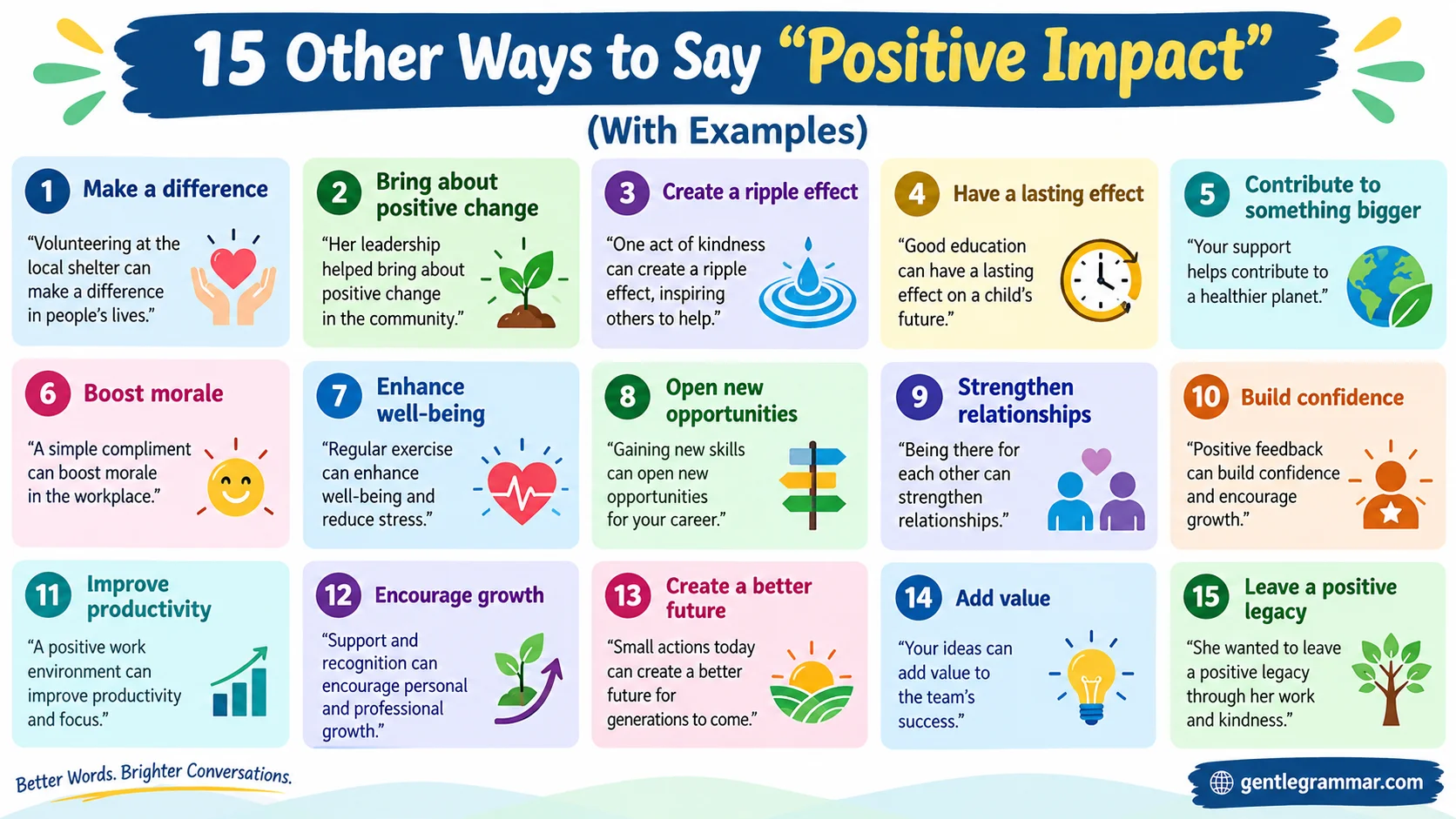
15 Other Ways to Say “Positive Impact” (With Examples) helps readers express these benefits clearly in different workplace situations.
Showing integrity, accountability, and a solution-oriented mindset while completing assigned tasks encourages respect and confidence. Professionals who consistently contribute through clear communication, collaboration, and mutual support help colleagues, managers, and clients work toward shared goals. These habits promote innovation, productivity, leadership, employee performance, and a healthy workplace culture.
They also support professional growth, career advancement, workplace relationships, organizational success, and professional development. From my experience, taking responsibility, solving problems, and maintaining a constructive attitude can strengthen a person’s reputation and professional network while creating meaningful contributions to an organization.
What Does “Positive Impact” Mean?
Positive impact means a beneficial effect or a favorable change caused by a person, action, decision, event, or situation. It describes something that improves conditions, helps others, solves a problem, or contributes to a better outcome. For example, a teacher may have a positive impact on students by encouraging their confidence, while a company may have a positive impact on its community by creating jobs or supporting local projects. The expression can describe both small improvements and significant changes. Its exact meaning depends on the situation and the people affected.
Common Situations Where “Positive Impact” Is Used
People use this expression in many settings when they want to explain how something has helped or improved a situation. In everyday conversation, someone might describe a friend’s encouragement as a positive influence on their confidence. In the workplace, managers may discuss the benefits of a new policy, training program, or team initiative. In school and academic writing, students may explain how education, technology, or environmental policies affect society. Nonprofit organizations and community groups also use the phrase when discussing social progress. In personal messages, it can express appreciation for someone’s support. More specific alternatives help writers describe the exact benefit instead of relying on the same general wording.
Is It Professional or Polite to Say “Positive Impact”?
Yes, positive impact is both professional and polite. It is a neutral, constructive expression that works well in reports, presentations, emails, essays, business proposals, and conversations. It sounds professional because it focuses on beneficial results without being overly emotional or informal. However, the phrase can sometimes feel broad if readers need to understand exactly what changed. For example, improved customer satisfaction is more precise when discussing better service, while meaningful difference may sound warmer when describing personal support. Choosing an alternative depends on whether you want to emphasize measurable results, personal influence, social improvement, or long-term benefits.
Advantages and Disadvantages of Saying “Positive Impact”
Advantages
The phrase is clear, constructive, and widely understood. It works in both formal and casual communication and can describe improvements in education, business, relationships, health, and society. Its broad meaning makes it useful when several different benefits need to be discussed together. It also keeps the tone optimistic without requiring exaggerated praise.
Disadvantages
Because the expression is broad, it may not explain the exact nature of a benefit. Repeating it throughout a report can make the writing feel predictable, and it may sound vague when a reader expects specific outcomes. In emotional or personal situations, it can also feel less warm than a phrase that directly recognizes someone’s help, encouragement, or kindness. Choosing a more precise expression can make the intended message stronger and easier to understand.
Synonyms for “Positive Impact”
- Beneficial Effect
- Positive Influence
- Meaningful Difference
- Favorable Outcome
- Lasting Benefit
- Constructive Contribution
- Positive Change
- Valuable Contribution
- Improved Results
- Tangible Benefits
- Transformative Effect
- Helpful Influence
- Significant Improvement
- Positive Contribution
- Force for Good
1. Beneficial Effect
Meaning
A beneficial effect is a result that helps someone or improves a particular situation. It emphasizes the actual benefit of an action, policy, habit, or event rather than simply describing it as positive.
Definition
A beneficial effect is a helpful or advantageous result produced by something.
Detailed Explanation
This expression is useful when discussing how one thing affects another. Compared with the broader phrase positive impact, it sounds slightly more analytical and factual. It fits discussions about education, health, workplace practices, and environmental changes. Use it when you want to explain a clear advantage without making your writing sound overly emotional.
Scenario Examples
Scenario 1: Education
Example: Regular reading has a beneficial effect on children’s vocabulary and comprehension.
Scenario 2: Workplace
Example: The new scheduling system has had a beneficial effect on employee productivity.
Scenario 3: Personal well-being
Example: Spending time outdoors can have a beneficial effect on my mood.
Best Use
Use beneficial effect in research discussions, reports, educational writing, and explanations of how a particular action produces a helpful result.
Tone
Tone: Professional, objective, informative.
It emphasizes practical benefits rather than personal feelings.
2. Positive Influence
Meaning
A positive influence is a person, experience, or action that encourages beneficial behavior, attitudes, or decisions. It often focuses on how someone or something shapes another person’s development.
Definition
A positive influence is someone or something that encourages helpful changes or desirable behavior.
Detailed Explanation
This expression is especially suitable for describing relationships and personal development. Unlike positive impact, which can refer to almost any beneficial result, positive influence often suggests guidance or an ongoing effect on someone’s choices. A mentor, supportive friend, or inspiring teacher can all be positive influences. Choose this phrase when the emphasis is on encouragement, example, or personal growth.
Scenario Examples
Scenario 1: Friendship
Example: My best friend has been a positive influence on my confidence and motivation.
Scenario 2: School
Example: Our science teacher is a positive influence because she encourages us to ask questions.
Scenario 3: Professional development
Example: Working with an experienced manager has been a positive influence on my career.
Best Use
Use this phrase when discussing mentors, friends, teachers, role models, leadership, and personal development.
Tone
Tone: Warm, encouraging, appreciative.
It often communicates respect for someone who has helped shape another person’s life.
3. Meaningful Difference
Meaning
A meaningful difference is an improvement or change that genuinely matters to someone or makes a situation better in a noticeable way.
Definition
A meaningful difference is a change that has real value or significance.
Detailed Explanation
This expression emphasizes importance rather than simply identifying a favorable result. It works especially well when discussing community service, personal support, charitable work, or improvements in people’s lives. Compared with positive impact, it sounds more personal and emphasizes why the change matters. It does not necessarily mean that the change is large; even a small improvement can be meaningful.
Scenario Examples
Scenario 1: Volunteering
Example: Even a few hours of volunteering each week can make a meaningful difference in our neighborhood.
Scenario 2: Personal support
Example: Your kind message made a meaningful difference during a difficult week.
Scenario 3: Customer service
Example: Listening carefully to customer concerns can make a meaningful difference to their experience.
Best Use
Choose meaningful difference for personal messages, volunteer work, community projects, customer experiences, and situations where human value matters.
Tone
Tone: Compassionate, thoughtful, sincere.
It draws attention to the importance of a change rather than merely its measurable size.
4. Favorable Outcome
Meaning
A favorable outcome is a result that is desirable, advantageous, or better than an unfavorable alternative.
Definition
A favorable outcome is a result that meets a goal or brings an advantage.
Detailed Explanation
This expression focuses on the end result of a decision, process, negotiation, or event. It is more outcome-oriented than positive impact, which can describe broader or continuing effects. A favorable outcome does not necessarily mean that every part of a situation improved; it means that the result was beneficial in the relevant context. Use it when discussing decisions, planning, negotiations, or problem-solving.
Scenario Examples
Scenario 1: Workplace negotiation
Example: Both teams worked together to reach a favorable outcome for the project.
Scenario 2: School
Example: With consistent preparation, the students achieved a favorable outcome on their final assessment.
Scenario 3: Customer support
Example: We reviewed the complaint carefully and hope to reach a favorable outcome for everyone involved.
Best Use
Use favorable outcome in business reports, negotiations, planning discussions, formal correspondence, and evaluations of decisions.
Tone
Tone: Formal, measured, results-focused.
It sounds particularly natural when the goal is to assess whether a situation ended well.
5. Lasting Benefit
Meaning
A lasting benefit is an advantage that continues over time rather than disappearing shortly after it is gained.
Definition
A lasting benefit is a helpful result that remains valuable in the long term.
Detailed Explanation
This expression highlights durability and long-term value. While positive impact can describe an immediate improvement, lasting benefit suggests that the improvement continues to help people or organizations. It is especially useful when discussing education, professional training, sustainable practices, or healthy habits. However, it should be used when there is a reasonable basis for expecting the benefit to continue.
Scenario Examples
Scenario 1: Education
Example: Learning effective study habits can provide a lasting benefit throughout a student’s academic life.
Scenario 2: Employee training
Example: The mentoring program gave new employees a lasting benefit by helping them build practical skills.
Scenario 3: Environmental planning
Example: Protecting local wetlands can provide lasting benefits for wildlife and nearby communities.
Best Use
Choose this phrase for long-term planning, education, sustainability, career development, and investments in people’s skills.
Tone
Tone: Thoughtful, practical, forward-looking.
It emphasizes continued value rather than a temporary improvement.
6. Constructive Contribution
Meaning
A constructive contribution is an action, idea, or effort that helps a group make progress or solve a problem.
Definition
A constructive contribution is a helpful addition that supports progress or improvement.
Detailed Explanation
This phrase is particularly useful in collaborative environments. It emphasizes the value someone adds to a discussion, team, project, or decision-making process. Unlike positive impact, which may describe a broad effect, constructive contribution usually points to a specific person’s input or effort. It can also suggest that the contribution is practical and solution-oriented, not merely agreeable.
Scenario Examples
Scenario 1: Team meeting
Example: Your suggestions made a constructive contribution to our discussion about improving customer service.
Scenario 2: Classroom
Example: Each student made a constructive contribution during the group presentation.
Scenario 3: Community planning
Example: Residents were invited to make a constructive contribution to the neighborhood improvement plan.
Best Use
Use it in team meetings, project reviews, classroom discussions, consultations, and collaborative professional writing.
Tone
Tone: Professional, respectful, cooperative.
It recognizes useful participation and encourages people to focus on solutions.
7. Positive Change
Meaning
A positive change is a development that improves a situation, behavior, system, or set of circumstances.
Definition
Positive change is an improvement from a previous condition.
Detailed Explanation
This expression focuses on what has changed rather than on the person or action responsible. It is often easier to understand than positive impact when describing visible improvements. For example, a workplace might become more flexible, a student might develop better study habits, or a community might gain improved public facilities. The phrase does not automatically mean that every consequence is beneficial, so the context should make the improvement clear.
Scenario Examples
Scenario 1: Personal growth
Example: Setting realistic goals helped me bring positive change to my daily routine.
Scenario 2: Workplace
Example: The revised feedback process has brought positive change to communication between managers and employees.
Scenario 3: Community
Example: The new public garden represents positive change for families living in the area.
Best Use
Choose positive change when describing improvements in habits, policies, systems, relationships, or community conditions.
Tone
Tone: Optimistic, straightforward, encouraging.
It presents improvement as progress from an earlier situation.
8. Valuable Contribution
Meaning
A valuable contribution is something useful or important that a person, group, or organization adds to an effort or outcome.
Definition
A valuable contribution is an addition that provides meaningful worth or practical benefit.
Detailed Explanation
This expression emphasizes the importance of what someone gives, creates, or accomplishes. It is useful for acknowledging expertise, effort, resources, or ideas. Compared with positive impact, it focuses more directly on the contribution itself than on its eventual effects. It can describe a small but useful suggestion just as naturally as a major role in a successful project.
Scenario Examples
Scenario 1: Workplace recognition
Example: Your research made a valuable contribution to the final proposal.
Scenario 2: Academic writing
Example: The study makes a valuable contribution to our understanding of language development.
Scenario 3: Volunteering
Example: Every volunteer made a valuable contribution to the community food drive.
Best Use
Use this expression in professional acknowledgments, research writing, team evaluations, project reports, and volunteer recognition.
Tone
Tone: Appreciative, professional, respectful.
It communicates that someone’s effort or work has genuine value.
9. Improved Results
Meaning
Improved results are outcomes that are better than those achieved previously or better than an established comparison point.
Definition
Improved results are better outcomes measured against an earlier performance level or standard.
Detailed Explanation
This phrase is useful when the improvement can be observed or assessed. It often appears in business, education, sports, and performance reviews. Unlike positive impact, which can describe indirect or emotional effects, improved results emphasizes outcomes that can be compared over time. If you use it in a report, explain which results improved whenever possible rather than assuming the reader knows what changed.
Scenario Examples
Scenario 1: Business
Example: The updated training program helped the sales team achieve improved results during the next quarter.
Scenario 2: Education
Example: Regular feedback and practice led to improved results in students’ writing assignments.
Scenario 3: Personal fitness
Example: Following a consistent routine has helped me achieve improved results in my running sessions.
Best Use
Choose improved results for performance reviews, progress reports, academic assessments, business updates, and goal tracking.
Tone
Tone: Direct, practical, evidence-oriented.
It emphasizes observable progress rather than general approval.
10. Tangible Benefits
Meaning
Tangible benefits are practical advantages that can be clearly identified, experienced, or measured.
Definition
Tangible benefits are specific, recognizable gains that result from an action or decision.
Detailed Explanation
This phrase is useful when readers need to understand what someone actually gains. Examples include lower costs, faster processes, improved access, or time saved. Unlike positive impact, it directs attention toward concrete advantages rather than general improvements in feelings or relationships. Not every worthwhile benefit is tangible, however; increased confidence or a stronger sense of belonging may be important without being easily measured.
Scenario Examples
Scenario 1: Workplace technology
Example: The new scheduling software offers tangible benefits, including fewer booking errors and less administrative work.
Scenario 2: Employee development
Example: The course provides tangible benefits by helping employees develop skills they can use immediately.
Scenario 3: Household budgeting
Example: Preparing meals at home brought tangible benefits by reducing our weekly food expenses.
Best Use
Use tangible benefits in proposals, business cases, product descriptions, project evaluations, and practical discussions about costs or efficiency.
Tone
Tone: Concrete, persuasive, businesslike.
It encourages readers to focus on recognizable advantages rather than vague promises.
11. Transformative Effect
Meaning
A transformative effect is a change that significantly alters how a person, organization, or situation develops or operates.
Definition
A transformative effect is an influence that brings about a major change in condition, direction, or experience.
Detailed Explanation
This expression is stronger than positive impact because it suggests substantial change rather than a modest improvement. It works when an experience, decision, or initiative fundamentally changes someone’s opportunities or the way a system functions. The change may be beneficial, but the surrounding context should establish that it is positive. Avoid using this phrase for minor improvements that do not justify such strong wording.
Scenario Examples
Scenario 1: Education
Example: Access to quality education can have a transformative effect on a student’s future opportunities.
Scenario 2: Business
Example: Automating repetitive tasks had a transformative effect on how our small team manages its workload.
Scenario 3: Personal development
Example: Learning to communicate openly had a transformative effect on my closest relationships.
Best Use
Choose this expression for major organizational changes, personal development, education, technology, and significant social improvements.
Tone
Tone: Powerful, ambitious, emphatic.
It signals substantial change rather than an ordinary benefit.
12. Helpful Influence
Meaning
A helpful influence is a person, experience, or factor that guides someone toward a better decision, habit, or outcome.
Definition
A helpful influence is something that provides useful guidance or encourages beneficial behavior.
Detailed Explanation
This phrase emphasizes assistance and guidance rather than measurable results. It is particularly appropriate when describing people who encourage good habits or help others make thoughtful choices. Compared with positive influence, it places more emphasis on practical support than on inspiration or character development. It is a natural option for informal conversation and personal descriptions, although it can also work in professional discussions about mentoring.
Scenario Examples
Scenario 1: Family
Example: My older sister has been a helpful influence as I learn to manage my responsibilities.
Scenario 2: Workplace mentoring
Example: The senior colleague became a helpful influence during my first few months in the role.
Scenario 3: School
Example: A supportive study group can be a helpful influence on students who struggle with motivation.
Best Use
Use helpful influence when describing supportive relationships, mentoring, guidance, encouragement, and the development of better habits.
Tone
Tone: Friendly, supportive, reassuring.
It highlights guidance that makes a practical difference in someone’s life.
13. Significant Improvement
Meaning
A significant improvement is a noticeable or important advancement in quality, performance, conditions, or results.
Definition
A significant improvement is a meaningful increase in quality or performance compared with an earlier state.
Detailed Explanation
This expression is more specific than positive impact because it identifies improvement as the main result. It often suits situations where progress is noticeable or supported by evidence. In formal reports, significant can sometimes have a statistical meaning, so use it carefully when discussing research findings. In everyday writing, it generally means that the improvement is important enough to matter.
Scenario Examples
Scenario 1: Customer service
Example: The support team’s new response system led to a significant improvement in customer satisfaction.
Scenario 2: Education
Example: After several weeks of practice, she showed significant improvement in her reading fluency.
Scenario 3: Workplace safety
Example: The revised procedures resulted in a significant improvement in workplace safety.
Best Use
Choose this phrase for progress reports, performance assessments, research summaries, quality reviews, and discussions of measurable or noticeable progress.
Tone
Tone: Professional, factual, results-focused.
It emphasizes the importance of an improvement, not merely the fact that something changed.
14. Positive Contribution
Meaning
A positive contribution is an action, effort, or resource that helps a person, group, or project move toward a desirable result.
Definition
A positive contribution is a useful or beneficial addition to a shared effort or outcome.
Detailed Explanation
This expression works well when recognizing someone’s participation or the role of a particular activity. It can describe practical assistance, thoughtful ideas, financial support, or cooperative effort. Compared with positive impact, it places more emphasis on what was added to a situation than on the final effect. It is also flexible enough for professional, academic, and community settings.
Scenario Examples
Scenario 1: Teamwork
Example: Her careful planning made a positive contribution to the team’s successful launch.
Scenario 2: Community service
Example: Local businesses made a positive contribution by donating supplies to the shelter.
Scenario 3: Classroom
Example: His thoughtful questions made a positive contribution to our discussion of the novel.
Best Use
Use positive contribution when recognizing participation, cooperation, assistance, or support in shared activities.
Tone
Tone: Appreciative, balanced, professional.
It recognizes someone’s role without overstating the scale of the outcome.
15. Force for Good
Meaning
A force for good is a person, organization, movement, or idea that actively helps make the world or a community better.
Definition
A force for good is someone or something that consistently promotes beneficial change.
Detailed Explanation
This expression is more inspiring and value-driven than positive impact. It often describes people or organizations that stand for fairness, kindness, social progress, or environmental protection. Rather than pointing to one specific outcome, it suggests an ongoing commitment to beneficial change. Because the wording is strong and somewhat idealistic, it is best reserved for situations where the broader purpose genuinely deserves that emphasis.
Scenario Examples
Scenario 1: Charity
Example: The organization has become a force for good by helping families access essential services.
Scenario 2: Workplace leadership
Example: She uses her position as a manager to be a force for good within the company.
Scenario 3: Environmental protection
Example: Local conservation groups can be a force for good in protecting vulnerable habitats.
Best Use
Choose this phrase for social initiatives, charitable organizations, environmental causes, inspiring leadership, and discussions of moral responsibility.
Tone
Tone: Inspirational, optimistic, values-driven.
It conveys a commitment to doing good rather than simply producing one favorable result.
FAQs:
1. What is another way to say “positive impact”?
Some useful alternatives are beneficial effect, positive influence, meaningful difference, positive change, and lasting benefit. The best choice depends on what you want to emphasize. Use beneficial effect for practical results, positive influence for personal guidance, and meaningful difference when the human value of a change matters most.
2. What does “positive impact” mean?
Positive impact means a beneficial effect or improvement caused by a person, action, decision, or event. For example, a supportive teacher can improve a student’s confidence, while a community project can improve access to essential services.
3. Is “positive impact” professional?
Yes. Positive impact is appropriate for professional emails, reports, presentations, proposals, and workplace discussions. It is clear and constructive, although a more specific expression, such as improved results or tangible benefits, may communicate practical outcomes more precisely.
4. What is a more polite way to say “positive impact”?
Meaningful difference is a warm alternative when discussing personal support or kindness. For professional appreciation, valuable contribution is often suitable. Both expressions recognize someone’s role without sounding overly formal or exaggerated.
5. Which alternative works best in formal communication?
The best option depends on the subject. Beneficial effect works well for explaining cause and effect, favorable outcome suits negotiations and decisions, and significant improvement fits progress reports. Choose wording that accurately describes the result rather than simply replacing the original phrase with a more complicated one.
Conclusion:
Choosing the right expression can make your writing more precise, engaging, and meaningful. Although positive impact works well in professional reports, personal conversations, academic assignments, and everyday communication, a more specific phrase can help readers understand exactly what improved and why it matters. For example, beneficial effect emphasizes a practical advantage, lasting benefit highlights long-term value, and meaningful difference brings attention to the human side of an improvement.
When choosing among these alternatives, consider your audience, purpose, and intended tone. A formal report may benefit from factual wording, while a personal message may call for a warmer expression. You do not need to replace the original phrase every time you use it. Instead, choose the wording that communicates your meaning most clearly and naturally.
