
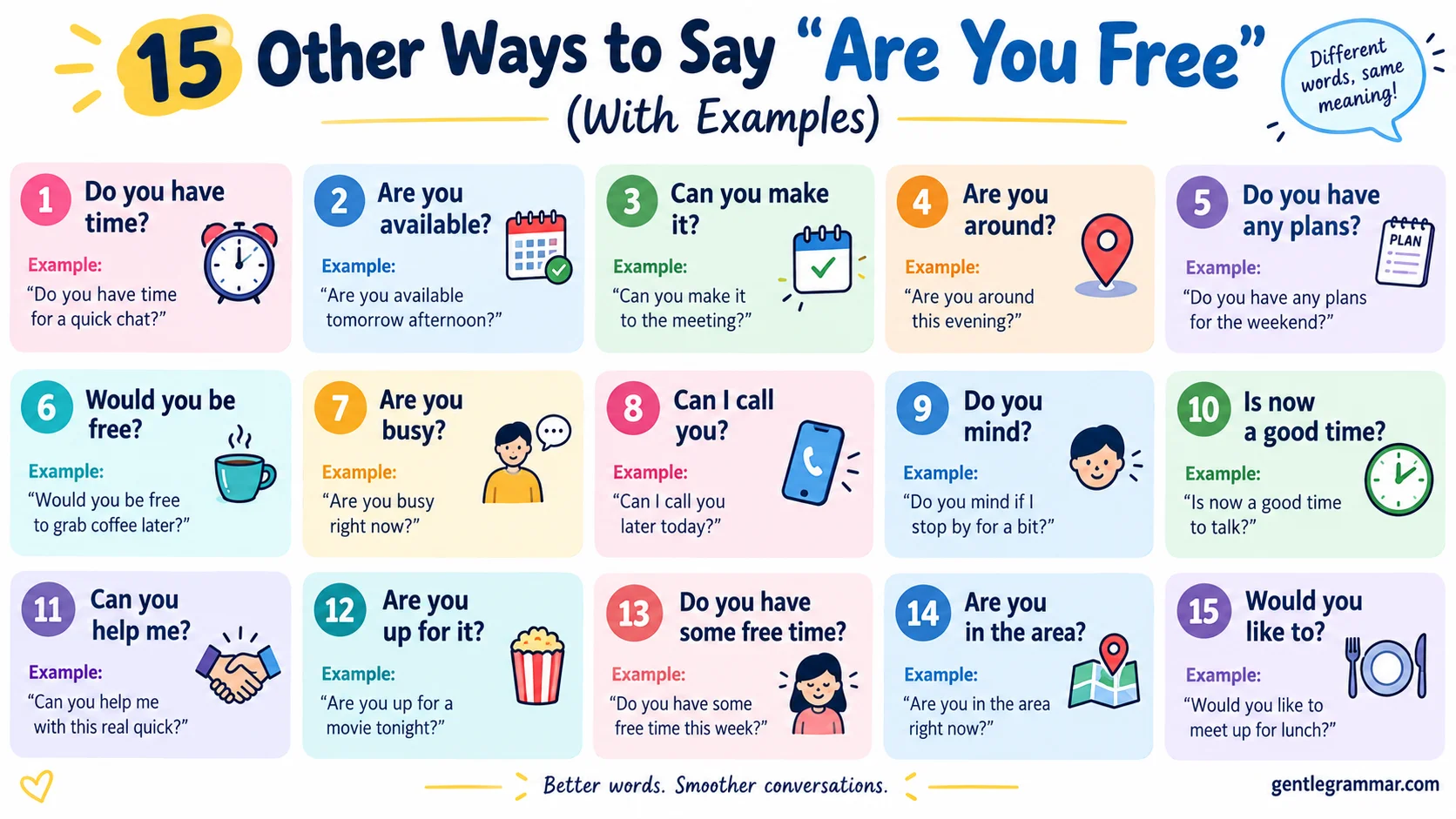
When asking a colleague about their schedule, 15 Other Ways to Say “Are You Free” (With Examples) can help you choose polite, natural phrases for work.
Asking a colleague if they are free or available requires the right wording for effective workplace communication. In my experience, a simple question can feel too casual or vague in a professional environment, especially in an email, workplace chat, or professional email. The key is to communicate politely while considering the person, subject, and time needed. For example, “When are you available?”
English question for scheduling meetings, calls, interviews, appointments, or casual plans. Other options include “Do you have a moment?”, “Are you available to meet?”, “Would you have time for a brief discussion?”, and “Could you share your availability this week?” These polite phrases suit business English, professional communication, and everyday colleague conversations.
What Does “Are You Free” Mean?
“Are you free?” is a question that asks whether someone is available or has time to do something. It can refer to someone’s schedule, their ability to meet, or their willingness to talk at a particular moment. For example, asking a friend, “Are you free this evening?” usually means you want to know whether they have plans. In a workplace, the same question might mean you need a few minutes to discuss a project.
The phrase can also depend on context. Someone asking, “Are you free to talk?” wants to know whether you can give them your attention, while “Are you free tomorrow?” asks about your availability in the future. The wording is generally friendly and straightforward, but a more specific question can communicate greater consideration for another person’s time.
Common Situations Where “Are You Free” Is Used
People use this expression in many everyday situations. You might ask a friend whether they are free for lunch, message a family member about weekend plans, or check whether your partner has time for a conversation. It is also common in professional settings when arranging meetings, requesting assistance, or checking whether a colleague can discuss something.
In emails and workplace messages, however, more specific wording can sometimes be helpful. Asking whether someone has a few minutes or is available at a particular time makes your request clearer. Alternatives are especially useful when you want to sound considerate, avoid interrupting someone, or arrange a meeting without assuming they have time.
Is It Professional or Polite to Say “Are You Free”?
Yes, “Are you free?” is generally polite and acceptable, particularly in everyday conversation and informal workplace communication. Its tone depends on how you ask and your relationship with the other person. With a colleague you know well, “Are you free for a quick chat?” sounds perfectly natural. When contacting a manager, client, or someone you do not know well, a more considerate question such as “Would you be available for a brief meeting?” may sound more professional.
The original phrase is not rude, but it can feel vague if you do not explain what you need. Adding a time, purpose, or polite request helps the other person understand the situation and respond comfortably.
Advantages and Disadvantages of Saying “Are You Free”
Advantages
The phrase is short, clear, and easy to understand. It works well in spoken English, text messages, and many workplace conversations. It allows the other person to answer yes or no without requiring a lengthy explanation. Because it is familiar and conversational, it is especially useful when checking someone’s availability before suggesting plans.
Disadvantages
The question can be too general when the other person does not know why you are asking. It may also sound abrupt in a formal email if you provide no context. Sometimes, asking whether someone is free can imply that you expect them to make time for you. A more specific or considerate expression can communicate your intention more clearly and give the other person greater flexibility.
Synonyms for “Are You Free”
- Are you available?
- Do you have a moment?
- Do you have time?
- Are you around?
- Are you busy?
- Can you talk?
- Is now a good time?
- Would you be available?
- Do you have a minute to spare?
- Are you doing anything?
- Are you free to meet?
- Can we schedule a time?
- Would you have time for this?
- Is your schedule open?
- Can I catch you for a moment?
1. Are You Available?
Meaning
“Are you available?” asks whether someone has time or is able to participate in an activity. It is a close alternative to the original phrase and works in both personal and professional situations.
Definition
A question asking whether someone has time or is able to do something.
Detailed Explanation
This expression sounds slightly more professional and neutral than “Are you free?” It is useful when arranging appointments, meetings, or conversations without assuming the other person has spare time. The word available can refer to a particular time or general readiness to help. Include a date or activity when you want to make the request more specific.
Scenario Examples
Scenario: You want to speak with a colleague.
Example: “Are you available for a quick discussion this afternoon?”
Scenario: You are making plans with a friend.
Example: “Are you available on Saturday? We could grab lunch.”
Best Use
Use it in workplace messages, emails, appointments, and friendly conversations when you want a clear, neutral question.
Tone
Tone: Polite, neutral, professional.
It sounds considerate without being overly formal.
2. Do You Have a Moment?
Meaning
“Do you have a moment?” asks whether someone can spare a little time for a short conversation or request.
Definition
A polite question asking whether someone has a brief amount of time to listen or respond.
Detailed Explanation
Unlike the broader question about availability, this expression usually suggests that you need only a short amount of the person’s time. It works particularly well when you want to ask a question, share information, or raise a small concern. The wording is gentle because it allows the other person to indicate whether they can stop what they are doing. If the conversation may take longer, explain that upfront.
Scenario Examples
Scenario: You need to ask your teacher a question.
Example: “Do you have a moment? I need help understanding the assignment.”
Scenario: You want to speak privately with a coworker.
Example: “Do you have a moment before you leave?”
Best Use
Use this phrase for brief conversations, quick questions, and polite workplace requests.
Tone
Tone: Considerate, friendly, respectful.
It shows awareness that the other person may already be occupied.
3. Do You Have Time?
Meaning
“Do you have time?” asks whether someone can fit an activity or conversation into their schedule.
Definition
A question about whether a person has enough time for a particular task or interaction.
Detailed Explanation
This phrase is useful when the activity might require more than a few minutes. It can refer to a conversation, a favor, a meeting, or time spent together. Unlike “Do you have a moment?”, it does not necessarily suggest a very short interaction. Mentioning the expected duration helps the other person decide whether they can commit.
Scenario Examples
Scenario: You need assistance with a project.
Example: “Do you have time to review my presentation today?”
Scenario: You want to catch up with a relative.
Example: “Do you have time for a phone call this weekend?”
Best Use
Use it when asking about time for a task, conversation, favor, or planned activity.
Tone
Tone: Direct, natural, conversational.
It is straightforward without sounding demanding when you ask respectfully.
4. Are You Around?
Meaning
“Are you around?” asks whether someone is nearby, reachable, or available to connect.
Definition
A casual question about whether someone is present or accessible.
Detailed Explanation
This expression is more informal than asking whether someone is available. It can mean physical presence, such as being at home, or general accessibility, such as being able to chat online. Its exact meaning depends on context, so it may not be the best choice for formal scheduling. When discussing a future date, adding a time or place makes your meaning clearer.
Scenario Examples
Scenario: You want to visit a friend.
Example: “Are you around this evening? I could stop by.”
Scenario: You need to reach a teammate online.
Example: “Are you around? I have a quick question about the document.”
Best Use
Use it for casual texting, checking whether someone is nearby, and informal conversations.
Tone
Tone: Relaxed, familiar, friendly.
It works best when you already have a comfortable relationship with the person.
5. Are You Busy?
Meaning
“Are you busy?” asks whether someone is occupied with work, responsibilities, or another activity.
Definition
A question about whether a person is currently engaged in something.
Detailed Explanation
This phrase approaches availability from the opposite direction: instead of asking whether someone has time, it asks whether something is keeping them occupied. It is common in everyday speech and can introduce a request or conversation. However, being busy does not always mean someone is unavailable, and being free does not necessarily mean they want to participate. A gentle follow-up can make your intention clearer.
Scenario Examples
Scenario: You want to ask a sibling for help.
Example: “Are you busy right now? Could you help me carry these boxes?”
Scenario: You are messaging a friend.
Example: “Are you busy tonight, or would you like to watch a movie?”
Best Use
Use it in casual conversations, family interactions, and friendly messages when checking whether someone is occupied.
Tone
Tone: Casual, direct, familiar.
Depending on delivery, it can sound caring or slightly intrusive, so a polite follow-up helps.
6. Can You Talk?
Meaning
“Can you talk?” asks whether someone can have a conversation at the moment or at a suggested time.
Definition
A question about whether a person can speak with you.
Detailed Explanation
This expression focuses on the ability to communicate rather than general availability. It is especially useful for phone calls, voice messages, and conversations that may require privacy. On its own, it can sound abrupt, particularly when the other person does not know why you want to speak. Adding a short explanation makes the request warmer and more reassuring.
Scenario Examples
Scenario: You want to call a friend.
Example: “Can you talk for a few minutes? I wanted to tell you something.”
Scenario: You need to discuss a work issue.
Example: “Can you talk after the team meeting about the revised deadline?”
Best Use
Use it for phone calls, private discussions, and direct messages when speaking is your main purpose.
Tone
Tone: Direct, conversational, familiar.
A brief explanation can soften the question and prevent unnecessary concern.
7. Is Now a Good Time?
Meaning
“Is now a good time?” asks whether the present moment is convenient for a conversation or request.
Definition
A polite question about whether someone can engage with you right now.
Detailed Explanation
This expression emphasizes consideration for the other person’s circumstances. Rather than simply checking availability, it recognizes that someone may have time but still be concentrating on something important. It is especially helpful before discussing a sensitive subject or interrupting a colleague. If the answer is no, offering to reconnect later keeps the conversation respectful.
Scenario Examples
Scenario: You are about to call a family member.
Example: “Hi, is now a good time to talk?”
Scenario: You approach a colleague at work.
Example: “Is now a good time to go over the client feedback?”
Best Use
Use it before important conversations, phone calls, workplace discussions, and potentially sensitive topics.
Tone
Tone: Thoughtful, polite, respectful.
It gives the other person room to say that another time would be better.
8. Would You Be Available?
Meaning
“Would you be available?” politely asks whether someone could make time for a proposed activity or meeting.
Definition
A courteous question about someone’s possible availability.
Detailed Explanation
The conditional wording makes this expression sound more formal and tactful than the original phrase. It is particularly appropriate when asking someone whose schedule you do not control, such as a client, manager, or professional contact. It often sounds most natural when followed by a specific time or activity. Although it is polite, it can feel unnecessarily formal in a quick conversation with a close friend.
Scenario Examples
Scenario: You are arranging a business meeting.
Example: “Would you be available for a meeting on Thursday morning?”
Scenario: You want to consult a professional.
Example: “Would you be available for a brief consultation next week?”
Best Use
Use it in professional emails, appointment requests, formal invitations, and respectful scheduling messages.
Tone
Tone: Courteous, professional, slightly formal.
It makes the request feel measured rather than demanding.
9. Do You Have a Minute to Spare?
Meaning
“Do you have a minute to spare?” asks whether someone can give you a little of their time.
Definition
A polite, informal question about whether someone has a short period available.
Detailed Explanation
This phrase is similar to asking whether someone has a moment, but it emphasizes that you are requesting their time. It is useful for quick favors, brief explanations, or small work-related questions. Although the expression says “a minute,” the actual conversation may take longer, so avoid using it when you expect a lengthy discussion. Being clear about the request helps manage expectations.
Scenario Examples
Scenario: You need a quick explanation from a classmate.
Example: “Do you have a minute to spare? I’m confused about question four.”
Scenario: You want a coworker’s opinion.
Example: “Do you have a minute to spare to check this heading?”
Best Use
Use it for brief favors, quick questions, and informal professional conversations.
Tone
Tone: Friendly, considerate, informal.
It suggests that you value the other person’s time.
10. Are You Doing Anything?
Meaning
“Are you doing anything?” asks whether someone has plans or activities, often before suggesting something to do together.
Definition
A casual question about someone’s current or future plans.
Detailed Explanation
This expression is often more social than a general availability question. It can be a natural way to invite someone out without making a direct invitation immediately. However, it asks about activities rather than availability alone, so it is not always an exact substitute. Adding a specific time helps clarify whether you are asking about their plans now, later, or on another day.
Scenario Examples
Scenario: You want to invite a friend to dinner.
Example: “Are you doing anything Friday night? Want to try that new restaurant?”
Scenario: You are spending time with a family member.
Example: “Are you doing anything this afternoon, or can we go for a walk?”
Best Use
Use it for social invitations, casual texting, weekend plans, and spending time with friends or family.
Tone
Tone: Casual, sociable, friendly.
It often opens the door to an invitation rather than simply checking a calendar.
11. Are You Free to Meet?
Meaning
“Are you free to meet?” asks whether someone has time to meet in person or attend a planned meeting.
Definition
A question about someone’s availability for a meeting or face-to-face conversation.
Detailed Explanation
This phrase is more specific than the original because it identifies the activity you have in mind. It works for both social plans and professional meetings, although the surrounding wording determines the tone. If the meeting requires travel or preparation, include a proposed time and location. For formal communication, a more courteous version may be preferable when the recipient is senior to you or unfamiliar with you.
Scenario Examples
Scenario: You want to catch up with an old friend.
Example: “Are you free to meet for coffee sometime this week?”
Scenario: You need to discuss a project with a colleague.
Example: “Are you free to meet tomorrow to review the next steps?”
Best Use
Use it for in-person appointments, project discussions, coffee dates, and planned meetings.
Tone
Tone: Clear, practical, conversational.
Its strength is specificity: the recipient knows you are proposing a meeting.
12. Can We Schedule a Time?
Meaning
“Can we schedule a time?” asks whether you and another person can arrange a mutually convenient time for an activity or conversation.
Definition
A request to agree on a suitable time for a future meeting or discussion.
Detailed Explanation
Unlike a simple availability question, this expression focuses on making a plan together. It is useful when neither person knows the other’s schedule or when the conversation does not need to happen immediately. The word schedule gives it a more organized, work-oriented feel, though it can also be used in personal situations. It is less suitable if you only want to know whether someone can talk right now.
Scenario Examples
Scenario: You need to arrange a discussion with a manager.
Example: “Can we schedule a time this week to discuss my progress?”
Scenario: You want to reconnect with a friend who lives far away.
Example: “Can we schedule a time for a video call? Our evenings have been busy.”
Best Use
Use it for planned meetings, appointments, project discussions, and conversations that require coordination.
Tone
Tone: Organized, cooperative, professional.
It invites both people to find a workable time instead of expecting an immediate answer.
13. Would You Have Time for This?
Meaning
“Would you have time for this?” asks whether someone could fit a particular task or request into their schedule.
Definition
A polite question about someone’s capacity to take on a specific activity.
Detailed Explanation
This phrase works best when the other person already understands what “this” refers to. It can sound considerate because it acknowledges that their time and workload matter. However, it may imply a request for work or assistance rather than simply asking whether someone is free to talk. Name the task clearly if there is any chance of confusion, and avoid assuming that a polite question means the person must agree.
Scenario Examples
Scenario: You want a colleague to review a report.
Example: “Would you have time for this before the end of the week?”
Scenario: You are asking a friend for help with an event.
Example: “Would you have time to help me set up the decorations on Saturday?”
Best Use
Use it for work assignments, requests for help, collaborative projects, and favors.
Tone
Tone: Considerate, polite, cooperative.
It gives the other person space to consider their commitments before responding.
14. Is Your Schedule Open?
Meaning
“Is your schedule open?” asks whether someone has a suitable time slot available for a planned activity.
Definition
A question about whether a person’s calendar has room for an appointment or event.
Detailed Explanation
This expression focuses on the person’s schedule rather than their immediate ability to talk. It can be useful when coordinating meetings, arranging appointments, or planning an event in advance. It may sound slightly businesslike, particularly when discussing calendars and deadlines. In casual conversation, a simpler question about a particular day may feel more natural.
Scenario Examples
Scenario: You are planning a project meeting.
Example: “Is your schedule open on Wednesday afternoon for a planning session?”
Scenario: You want to arrange a consultation.
Example: “Is your schedule open next week for a 30-minute appointment?”
Best Use
Use it for calendar coordination, professional appointments, and advance planning.
Tone
Tone: Organized, neutral, businesslike.
It is most effective when you have a specific date or time in mind.
15. Can I Catch You for a Moment?
Meaning
“Can I catch you for a moment?” asks whether you can briefly speak with someone, often when they are available between other activities.
Definition
A polite request to have a short conversation with someone.
Detailed Explanation
This idiomatic expression is especially useful when approaching someone at work or in a shared setting. It suggests a brief conversation rather than a formal appointment, and it can sound more natural than a general availability question when someone is moving between tasks. The phrase catch you does not mean physically catching someone; it means finding an opportunity to speak. For a sensitive or lengthy topic, ask for a suitable time instead.
Scenario Examples
Scenario: You want to speak to your supervisor after a meeting.
Example: “Can I catch you for a moment before you head out?”
Scenario: You need to clarify something with a teammate.
Example: “Can I catch you for a moment? I have one question about the schedule.”
Best Use
Use it for brief workplace conversations, quick clarifications, and informal face-to-face requests.
Tone
Tone: Friendly, respectful, conversational.
It sounds approachable while recognizing that the other person may be on their way somewhere.
FAQs:
1. What is another way to say “Are You Free”?
“Are you available?” is one of the closest alternatives. You can also say “Do you have a moment?” when you need a brief conversation or “Is now a good time?” when you want to be considerate of someone’s current situation.
2. What does “Are You Free” mean?
It means asking whether someone has time or is available to do something. Depending on the context, you might be asking about a phone call, a meeting, a social invitation, or an activity planned for a future date.
3. Is “Are You Free” professional?
Yes, it can be appropriate in professional communication, particularly when speaking with familiar colleagues. For formal emails or client communication, “Would you be available?” or “Is now a good time?” may sound more considerate and polished.
4. What is a more polite way to say “Are You Free”?
“Would you be available?” is a polite option, especially when arranging a meeting. For a quick conversation, “Do you have a moment?” is also considerate because it acknowledges that the other person may be busy.
5. Which alternative works best in formal communication?
“Would you be available?” is a strong choice for formal emails, appointment requests, and professional scheduling. When possible, include a specific date, time, and purpose so the recipient can respond clearly.
Conclusion:
Choosing the right expression can make everyday conversations and professional messages feel more natural. While “Are you free?” is a simple and widely understood question, other phrases can communicate your intention more clearly. For example, “Are you available?” works well for general scheduling, “Do you have a moment?” suits a brief conversation, and “Is now a good time?” shows consideration for someone’s circumstances.
The best alternative depends on your relationship with the person, the situation, and the amount of time you need. A casual message to a friend may require different wording from an email to a client or manager. Before asking, consider whether you want to arrange a meeting, start a conversation, or invite someone to an activity. With these 15 alternatives, you can choose expressions that sound friendly, respectful, and appropriate without making your messages unnecessarily complicated.
