
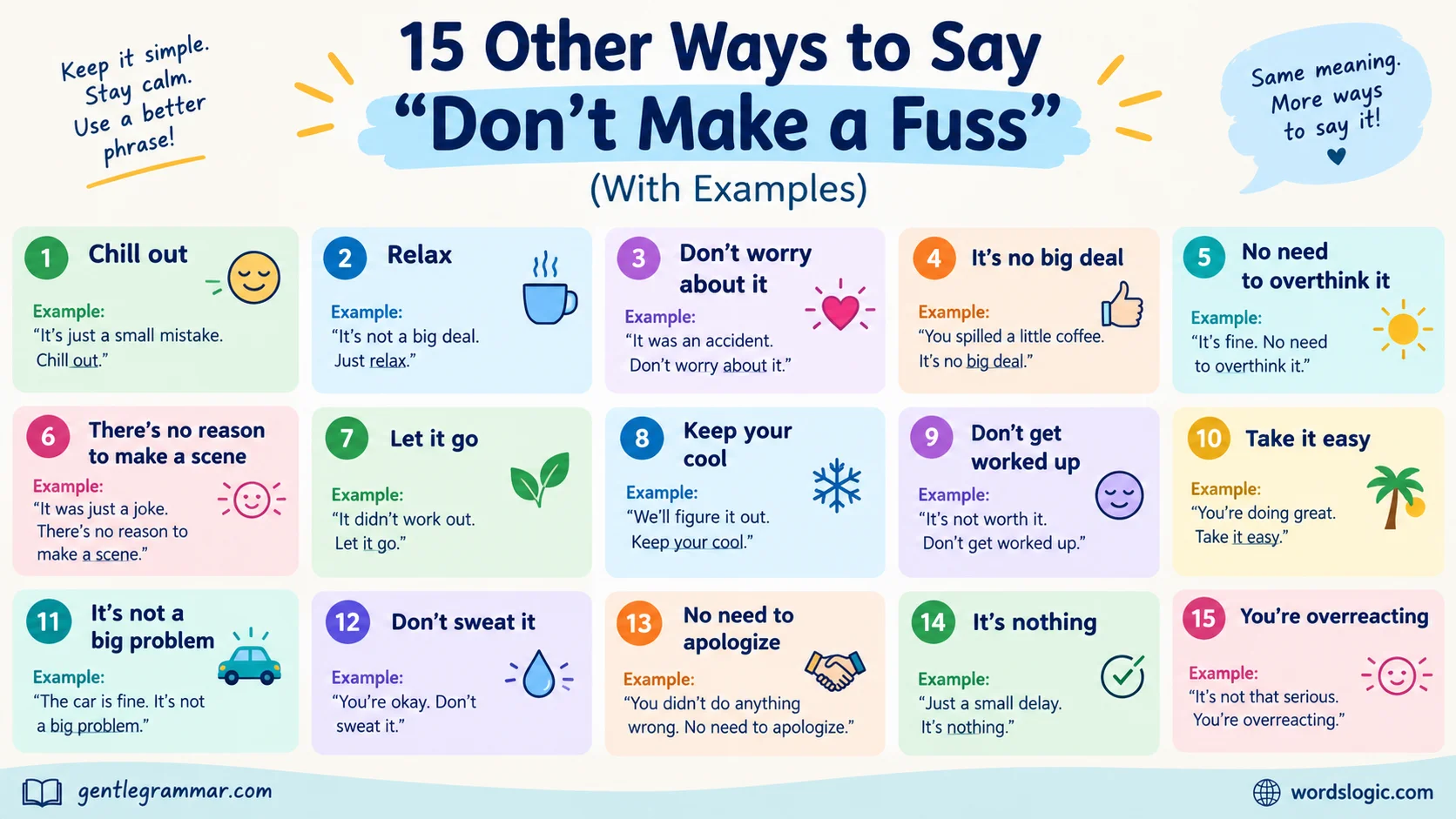
This guide to 15 Other Ways to Say “Don’t Make a Fuss” (With Examples) explores calm responses, clear boundaries, and thoughtful communication.
When life challenges test your patience, staying calm, composed, easygoing, and grounded can prevent a minor issue from becoming an argument or a tense situation. Imagine running late for an important meeting when someone accidentally spills coffee on your documents. Your colleague smiles and says, “Don’t Make A Fuss.” This common English expression encourages calm, perspective, and restraint when something is inconvenient.
Instead of reacting dramatically, losing control, or allowing an emotional response to take over, you can relax, stay chill, and choose a measured response. From my experience, a calm reaction, sensible behavior, and mature response help prevent a small disturbance from becoming a larger problem. Avoiding unnecessary drama, excessive attention, and exaggerated emotions while maintaining balance, emotional control, and a peaceful state of mind makes difficult moments easier to handle.
What Does “Don’t Make a Fuss” Mean?
“Don’t make a fuss” means not to make something seem more serious, complicated, or important than necessary. It is often said when someone is worrying too much, reacting strongly, drawing attention to a minor issue, or making a big deal out of a situation. For example, if a friend apologizes repeatedly for arriving five minutes late, you might say, “Don’t make a fuss; it’s perfectly fine.” In this context, the phrase is reassuring and friendly.
However, the expression can also sound impatient or dismissive, especially when someone has a genuine concern. Telling a colleague or family member not to make a fuss may suggest that their feelings or problems are unimportant. The intended meaning depends on the speaker’s tone, the situation, and the relationship between the people involved. Sometimes, a gentler phrase such as “There’s no need to worry” communicates reassurance more effectively.
Common Situations Where “Don’t Make a Fuss” Is Used
People commonly use this expression in everyday conversations, family discussions, and informal messages. A person might say it when a friend is apologizing unnecessarily, a family member is worrying about a small mistake, or someone is making too much of a minor inconvenience. In these situations, the phrase can help encourage a more relaxed attitude.
It can also appear in workplace conversations when people disagree about minor details or become overly concerned about a small issue. However, professional communication often benefits from more specific and considerate wording. In relationships, the expression may be intended to comfort someone, but it can hurt their feelings if they believe their concerns deserve attention. Choosing an appropriate alternative helps you distinguish between reassuring someone, reducing unnecessary drama, and dismissing a legitimate concern.
Is It Professional or Polite to Say “Don’t Make a Fuss”?
“Don’t make a fuss” is generally informal and direct. It can sound polite and friendly when spoken gently to someone you know well, especially when you want them to stop worrying about a harmless mistake. For example, telling a friend not to make a fuss over a small gift can communicate that their gratitude is appreciated but unnecessary.
In professional settings, the phrase requires more care. Saying it to a coworker who has raised a concern might sound impatient or disrespectful, even if you intend to keep things simple. In an email, expressions such as “There is no need for concern” or “Let’s keep this in perspective” may be more appropriate, depending on the circumstances. The most respectful approach is to acknowledge the other person’s feelings before encouraging them to relax or move forward.
Advantages and Disadvantages of Saying “Don’t Make a Fuss”
Advantages
The expression is short, familiar, and easy to understand. It can reassure someone that a minor mistake is not a problem or encourage people to avoid unnecessary stress. In casual conversations, it can also make a situation feel less serious. When used with warmth, it communicates that the speaker does not want anyone to feel embarrassed or spend too much time worrying about something small.
Disadvantages
The main disadvantage is that the phrase can sound dismissive or controlling. Someone who is genuinely upset may feel that their concerns are being minimized. It may also be too informal for workplace emails or sensitive conversations. Because the expression does not clearly explain whether the speaker means “relax,” “don’t worry,” or “stop drawing attention to this,” an alternative can communicate the intended message more accurately.
Synonyms for “Don’t Make a Fuss”
- Don’t make a big deal out of it
- There’s no need to worry
- Don’t worry about it
- It’s not worth getting upset over
- Let’s keep things in perspective
- There’s no need to overreact
- Let’s not blow this out of proportion
- It’s really not a big deal
- Take it easy
- Let’s not make a scene
- No need to make a big thing of it
- Keep calm
- Let’s not dwell on it
- There’s no reason to get worked up
- Let’s keep it simple
1. Don’t Make a Big Deal Out of It
Meaning
“Don’t make a big deal out of it” means not to treat a situation as more important or serious than it really is. Like “don’t make a fuss,” it encourages someone to take a more relaxed approach.
Definition
An informal expression used to suggest that something does not deserve excessive attention or concern.
Detailed Explanation
This expression is especially common in everyday English. It is slightly more explicit than “don’t make a fuss” because it directly refers to treating something as a major issue. It works well when a mistake is minor and unlikely to have serious consequences. However, it can sound dismissive if the other person believes the matter is important.
Scenario Examples
– Scenario: A friend spills coffee on your desk.
Example: “Don’t make a big deal out of it. I’ll clean it up.”
– Scenario: Your sibling apologizes for forgetting to bring a snack.
Example: “You forgot one thing; don’t make a big deal out of it.”
– Scenario: A teammate worries about a small typo in an informal message.
Example: “Don’t make a big deal out of it. We can correct it easily.”
Best Use
Use this expression in casual conversations with friends, relatives, or familiar colleagues when the problem is genuinely minor.
Tone
Tone: Casual, direct, reassuring
It can sound friendly when delivered warmly, but impatient if spoken sharply.
2. There’s No Need to Worry
Meaning
“There’s no need to worry” reassures someone that a situation is manageable and does not require unnecessary anxiety. It focuses on reducing worry rather than criticizing someone’s reaction.
Definition
A reassuring expression suggesting that someone can feel calmer about a particular situation.
Detailed Explanation
This phrase is gentler than “don’t make a fuss” because it addresses the person’s concern instead of their behavior. It is useful when someone fears that a small mistake will have serious consequences. The expression can also work in professional communication when you have a reasonable basis for reassurance. Avoid using it as a guarantee if the outcome is genuinely uncertain.
Scenario Examples
– Scenario: A colleague worries about submitting a report a few minutes late.
Example: “There’s no need to worry. I’ve informed the manager about the delay.”
– Scenario: Your friend is anxious about meeting your family.
Example: “There’s no need to worry; everyone is looking forward to meeting you.”
– Scenario: A customer asks whether a minor order change is possible.
Example: “There’s no need to worry. I’ll check whether we can update your order.”
Best Use
Choose this phrase for reassuring conversations, supportive messages, customer service, and workplace discussions where reducing anxiety is the main goal.
Tone
Tone: Calm, considerate, reassuring
Its emphasis on comfort makes it less confrontational than expressions that criticize overreaction.
3. Don’t Worry About It
Meaning
“Don’t worry about it” tells someone that a problem, mistake, or inconvenience is not something they need to feel anxious or guilty about.
Definition
An informal expression used to reassure someone that a concern does not require further worry.
Detailed Explanation
This expression is particularly useful when someone apologizes for a minor inconvenience. Unlike “don’t make a fuss,” it can focus on relieving guilt rather than asking someone to reduce their reaction. It is natural in spoken English, texts, and friendly workplace conversations. However, in some contexts, it can also mean that no further action is necessary, so the situation should make your intention clear.
Scenario Examples
– Scenario: A friend apologizes for replying to your message late.
Example: “Don’t worry about it. I know you’ve been busy.”
– Scenario: A coworker accidentally sends you the wrong attachment.
Example: “Don’t worry about it. Just send me the correct file when you can.”
– Scenario: Your partner feels bad about changing dinner plans.
Example: “Don’t worry about it; we can eat somewhere else.”
Best Use
Use it in friendly conversations, text messages, and informal professional exchanges, especially when you want someone to stop feeling guilty.
Tone
Tone: Friendly, relaxed, forgiving
It emphasizes understanding and reassurance rather than telling someone that their reaction is excessive.
4. It’s Not Worth Getting Upset Over
Meaning
“It’s not worth getting upset over” suggests that the emotional stress caused by a situation is greater than the situation deserves.
Definition
An expression encouraging someone not to spend too much emotional energy on a particular problem.
Detailed Explanation
This phrase focuses on the emotional cost of a situation. It can be helpful when someone is frustrated by a small inconvenience that will soon pass. Compared with “don’t make a fuss,” it explains why the speaker thinks the situation should not cause distress. Still, it can sound insensitive if the problem has deeper personal meaning for the other person.
Scenario Examples
– Scenario: A friend is upset because a restaurant has run out of their favorite dessert.
Example: “It’s not worth getting upset over. We can try another place.”
– Scenario: Your brother becomes frustrated after losing a casual board game.
Example: “It’s not worth getting upset over. We were just playing for fun.”
– Scenario: A colleague is annoyed because a meeting room has changed.
Example: “I know it’s inconvenient, but it’s not worth getting upset over.”
Best Use
Use this expression in personal conversations when the problem is relatively small and you want to encourage emotional perspective.
Tone
Tone: Practical, calming, slightly direct
It can encourage perspective, but acknowledging the other person’s frustration first makes it more considerate.
5. Let’s Keep Things in Perspective
Meaning
“Let’s keep things in perspective” means considering a situation in relation to its actual importance rather than focusing too heavily on one problem.
Definition
A measured expression encouraging people to evaluate a situation fairly and proportionately.
Detailed Explanation
This phrase is more thoughtful and diplomatic than “don’t make a fuss.” It invites people to consider the bigger picture instead of suggesting that their reaction is wrong. The word “let’s” also presents the idea as a shared effort rather than a personal criticism. It is useful in professional discussions, although it may sound dismissive if you use it before listening to the concern.
Scenario Examples
– Scenario: A project team becomes discouraged after one unsuccessful presentation.
Example: “Let’s keep things in perspective. The client liked most of the proposal.”
– Scenario: Your friend thinks one awkward conversation has ruined a friendship.
Example: “Let’s keep things in perspective. One difficult conversation doesn’t define your friendship.”
– Scenario: A student feels discouraged by one disappointing quiz result.
Example: “Let’s keep things in perspective. You still have several assessments ahead.”
Best Use
This expression works well in workplace discussions, educational settings, and thoughtful personal conversations where people need a broader view.
Tone
Tone: Diplomatic, measured, constructive
It encourages balanced thinking without directly telling someone to stop reacting.
6. There’s No Need to Overreact
Meaning
“There’s no need to overreact” suggests that someone’s response is stronger than the situation calls for.
Definition
A direct expression used to tell someone that their reaction appears excessive.
Detailed Explanation
This phrase is more confrontational than “don’t make a fuss” because it directly judges the person’s response. It can be appropriate when a minor disagreement is escalating and you want to encourage restraint. However, it may make the other person defensive because “overreact” implies that their feelings or behavior are unreasonable. A calmer explanation of the actual problem may be more effective in sensitive situations.
Scenario Examples
– Scenario: Two friends argue intensely over a harmless misunderstanding.
Example: “There’s no need to overreact. I think we can clear this up.”
– Scenario: A teammate becomes angry about a small formatting change.
Example: “There’s no need to overreact; we can restore the original layout.”
Best Use
Use it sparingly in informal disagreements when a reaction is clearly escalating. Avoid it when someone is sharing a serious concern or feeling hurt.
Tone
Tone: Direct, firm, potentially confrontational
Its strength can help interrupt an argument, but it can also make the other person feel judged.
7. Let’s Not Blow This Out of Proportion
Meaning
“Let’s not blow this out of proportion” means that a problem should not be exaggerated or treated as more serious than it is.
Definition
An informal idiom used to discourage exaggeration and encourage a more balanced assessment.
Detailed Explanation
The expression is vivid and conversational, making it useful when a minor issue is becoming unnecessarily complicated. It suggests that the problem is being made larger in people’s minds or discussions. The phrase can sound more forceful than “let’s keep things in perspective,” particularly during disagreements. Because it challenges how people are interpreting a situation, use it only when you have good reason to believe the concern is being exaggerated.
Scenario Examples
– Scenario: A group chat becomes heated over a misunderstood joke.
Example: “Let’s not blow this out of proportion. I don’t think anyone meant to offend you.”
– Scenario: A family member worries that a minor household mistake will ruin a celebration.
Example: “Let’s not blow this out of proportion. We still have plenty of time to prepare.”
– Scenario: A colleague assumes a small revision means the entire project has failed.
Example: “Let’s not blow this out of proportion. The main plan is still on track.”
Best Use
Choose this phrase for informal disagreements, group discussions, and situations where people are exaggerating a manageable problem.
Tone
Tone: Firm, conversational, corrective
It encourages proportion but may sound dismissive if you have not acknowledged the underlying concern.
8. It’s Really Not a Big Deal
Meaning
“It’s really not a big deal” means that something is not especially important or serious. It often reassures people that they do not need to feel embarrassed or concerned.
Definition
A casual expression used to minimize the importance of an issue or reassure someone that it is manageable.
Detailed Explanation
This phrase is especially useful when you want someone to feel comfortable after making a small mistake. The word “really” adds emphasis, showing that the speaker genuinely considers the matter minor. Unlike “don’t make a fuss,” it describes the situation rather than directly criticizing the person’s behavior. However, the expression can feel invalidating if the other person considers the issue important.
Scenario Examples
– Scenario: A friend accidentally arrives at your house without bringing the dessert they promised.
Example: “It’s really not a big deal. I’m just happy you came.”
– Scenario: A coworker apologizes for asking you to repeat an instruction.
Example: “It’s really not a big deal. I’m happy to explain it again.”
– Scenario: Your partner worries about choosing the wrong movie.
Example: “It’s really not a big deal. We can pick something else.”
Best Use
Use it in casual conversations, friendly texts, and reassuring exchanges where you want to reduce embarrassment or guilt.
Tone
Tone: Warm, relaxed, reassuring
It often sounds kinder than a command, particularly when paired with a practical solution or a little understanding.
9. Take It Easy
Meaning
“Take it easy” encourages someone to relax, slow down, or avoid becoming too stressed about a situation.
Definition
An informal expression used to encourage calmness, rest, or a less intense response.
Detailed Explanation
This phrase focuses on the person’s state of mind rather than the importance of the problem itself. It can be a friendly way to encourage someone who is becoming tense or rushing unnecessarily. Depending on context, it can also mean to rest or avoid strenuous activity, so it is not always a direct synonym for “don’t make a fuss.” Spoken gently, it feels supportive; delivered sharply, it may sound patronizing.
Scenario Examples
– Scenario: Your friend is rushing to finish a simple task before guests arrive.
Example: “Take it easy. We still have half an hour.”
– Scenario: A colleague becomes tense while preparing for a routine meeting.
Example: “Take it easy. You’ve prepared everything you need.”
– Scenario: Your sibling is annoyed by a small disagreement.
Example: “Take it easy. We can talk this through.”
Best Use
Use it in informal conversations and supportive messages when someone needs to relax rather than continue worrying or rushing.
Tone
Tone: Casual, friendly, calming
It works best when the relationship is comfortable enough for informal advice.
10. Let’s Not Make a Scene
Meaning
“Let’s not make a scene” means that people should avoid creating a public disturbance, drawing unwanted attention, or turning a disagreement into a visible confrontation.
Definition
An expression used to discourage disruptive or dramatic behavior in a public or shared setting.
Detailed Explanation
Unlike “don’t make a fuss,” this phrase specifically emphasizes public behavior and unwanted attention. It can be appropriate when an argument is developing in a restaurant, office, or other public place. However, it may sound controlling if used to silence someone who is raising a legitimate concern. It is not a suitable substitute when the goal is simply to comfort someone who feels anxious.
Scenario Examples
– Scenario: Two friends begin arguing loudly at a family gathering.
Example: “Let’s not make a scene here. We can discuss this privately.”
– Scenario: A customer becomes frustrated at a crowded service counter.
Example: “Let’s step aside and talk calmly rather than make a scene.”
Best Use
Use it in public settings or tense social situations where avoiding a disruptive confrontation is the main concern.
Tone
Tone: Firm, discreet, potentially controlling
The expression encourages privacy and restraint, but it should not be used to prevent someone from expressing a valid complaint.
11. No Need to Make a Big Thing of It
Meaning
“No need to make a big thing of it” means that a situation does not require extensive attention, ceremony, or emotional reaction.
Definition
An informal expression suggesting that something should be handled simply rather than treated as a major event.
Detailed Explanation
This expression is particularly natural in British English, although speakers elsewhere may understand it too. It can be used when someone is making too much of a small favor, minor mistake, or ordinary event. Compared with “don’t make a fuss,” it often has a lighter, more understated quality. In a sensitive conversation, however, it can still imply that the other person’s feelings are excessive.
Scenario Examples
– Scenario: A friend thanks you repeatedly for lending them a book.
Example: “No need to make a big thing of it. I’m glad you enjoyed it.”
– Scenario: Your colleague worries about a small change to the lunch schedule.
Example: “There’s no need to make a big thing of it; we can adjust the timing.”
Best Use
Choose this phrase for casual conversations, everyday favors, and minor inconveniences, particularly when you want to keep matters low-key.
Tone
Tone: Understated, casual, reassuring
Its relaxed wording helps keep a situation simple without sounding overly formal.
12. Keep Calm
Meaning
“Keep calm” means to remain composed and avoid allowing stress, anger, or fear to control your response.
Definition
A short expression encouraging someone to maintain emotional control during a difficult or tense situation.
Detailed Explanation
This phrase is more focused on emotional self-control than on deciding whether a problem deserves attention. It can be useful when a situation is becoming chaotic and people need to think clearly. However, it does not necessarily mean that the problem itself is unimportant. In some circumstances, telling someone to keep calm can sound commanding, so a gentler sentence such as “Let’s stay calm and work through this” may be more collaborative.
Scenario Examples
– Scenario: A group is trying to solve a last-minute problem before an event.
Example: “Keep calm. We still have time to find a solution.”
– Scenario: Your friend panics after misplacing their keys.
Example: “Keep calm; let’s retrace our steps first.”
– Scenario: A team faces an unexpected technical problem during a presentation.
Example: “Let’s keep calm and work through the issue together.”
Best Use
Use it during stressful situations, urgent tasks, or moments when people need to remain composed.
Tone
Tone: Firm, practical, encouraging
The phrase emphasizes composure, although its directness may not suit every emotional conversation.
13. Let’s Not Dwell on It
Meaning
“Let’s not dwell on it” means that people should avoid repeatedly thinking or talking about something, particularly when doing so is no longer helpful.
Definition
An expression encouraging someone to move forward instead of continuing to focus on a past event or problem.
Detailed Explanation
This phrase differs from “don’t make a fuss” because it addresses repeated attention to an issue, not necessarily an exaggerated reaction. It is useful after a misunderstanding has been resolved or when a minor mistake cannot be changed. The collaborative word “let’s” can make it feel less accusatory. However, it may be inappropriate if the matter still needs discussion, accountability, or emotional processing.
Scenario Examples
– Scenario: A friend keeps apologizing for an awkward comment from earlier.
Example: “We’ve already talked about it. Let’s not dwell on it.”
– Scenario: A colleague continues discussing a minor error that has been corrected.
Example: “The report has been fixed, so let’s not dwell on it. We can focus on the next step.”
– Scenario: Your sibling feels embarrassed about losing a casual game.
Example: “Let’s not dwell on it. We had a good time, and that’s what matters.”
Best Use
Use it in personal conversations and workplace discussions when a resolved issue is receiving more attention than it needs.
Tone
Tone: Calm, practical, forward-looking
It encourages progress rather than judging the original reaction.
14. There’s No Reason to Get Worked Up
Meaning
“There’s no reason to get worked up” suggests that someone should not become excessively angry, anxious, or emotionally agitated about a situation.
Definition
An informal expression used to discourage strong emotional reactions to a problem.
Detailed Explanation
The phrase “get worked up” refers to becoming emotionally upset or agitated. This expression is more pointed than “there’s no need to worry” because it may imply frustration or anger rather than simple concern. It can be useful when a minor disagreement is becoming heated and a calmer approach would help. Still, it may sound judgmental if the other person’s feelings have a legitimate cause.
Scenario Examples
– Scenario: Your friend becomes irritated because a delivery is running a little late.
Example: “There’s no reason to get worked up. Let’s check the updated delivery time.”
– Scenario: A family member becomes angry over a small misunderstanding.
Example: “There’s no reason to get worked up. I think we’ve misunderstood each other.”
Best Use
Choose this expression for informal disagreements and situations involving unnecessary frustration, rather than sensitive conversations where empathy should come first.
Tone
Tone: Direct, calming, slightly critical
It encourages emotional restraint but can sound dismissive if spoken without acknowledging the person’s concern.
15. Let’s Keep It Simple
Meaning
“Let’s keep it simple” means that people should avoid unnecessary complications and focus on a straightforward solution.
Definition
A collaborative expression encouraging a simple, practical approach instead of adding unnecessary steps or details.
Detailed Explanation
This expression is a useful alternative when the fuss involves overcomplicating a decision, process, or plan. Rather than criticizing someone’s emotions, it suggests focusing on what needs to be done. It is generally more constructive in professional communication than phrases such as “don’t overreact.” However, it is not a direct synonym in every situation because it emphasizes simplicity rather than emotional restraint.
Scenario Examples
– Scenario: Your team spends too much time debating small details for a simple event.
Example: “Let’s keep it simple and choose a plan everyone can manage.”
– Scenario: A friend struggles to decide what to bring to a casual gathering.
Example: “Let’s keep it simple. Just bring your favorite snack.”
– Scenario: A colleague suggests several unnecessary steps for a routine task.
Example: “Let’s keep it simple and follow the process we already agreed on.”
Best Use
Use it in workplace planning, everyday decisions, group projects, and casual conversations where a straightforward approach is preferable.
Tone
Tone: Practical, collaborative, constructive
It shifts attention toward a solution instead of criticizing how someone is reacting.
FAQs:
What is another way to say “don’t make a fuss”?
A good alternative is “don’t make a big deal out of it.” For a gentler tone, try “don’t worry about it” or “there’s no need to worry.” The best choice depends on whether you want to reassure someone, reduce tension, or discourage an exaggerated reaction.
What does “don’t make a fuss” mean?
It means not to make a situation seem more serious or important than necessary. People often use it when someone is worrying about a small mistake, reacting strongly to a minor problem, or drawing unnecessary attention to an issue.
Is “don’t make a fuss” professional?
It can be appropriate in relaxed workplace conversations, especially among colleagues who know each other well. However, it may sound dismissive in formal emails, customer service, or sensitive discussions. A more neutral phrase such as “Let’s keep things in perspective” may be better.
What is a more polite way to say “don’t make a fuss”?
“There’s no need to worry” is a polite option when your goal is to reassure someone. You could also say, “It’s perfectly fine,” or “Let’s work through this calmly,” depending on the situation. Acknowledging the person’s concern before offering reassurance can make your message more considerate.
Which alternative works best in formal communication?
“Let’s keep things in perspective” can work well in professional discussions when you need to encourage balanced thinking. If the goal is to reassure a customer or colleague, “There is no need for concern” may be more suitable. Choose wording that respects the other person’s concern without minimizing it.
Conclusion:
Choosing an alternative to “don’t make a fuss” is about more than changing a few words. It is about understanding what you want to communicate and how the other person might interpret your message. Expressions such as “don’t worry about it” offer reassurance, while “let’s keep things in perspective” encourages balanced thinking. Meanwhile, “let’s not make a scene” is more appropriate when public behavior is the concern.
Remember that similar phrases can carry different levels of warmth, directness, and formality. A sentence that sounds friendly between close friends may feel dismissive in a workplace conversation. Before choosing your wording, consider the situation, your relationship with the listener, and whether the person needs reassurance, practical guidance, or simply an opportunity to be heard. The best expression is the one that communicates your meaning clearly while treating the other person with respect.
