
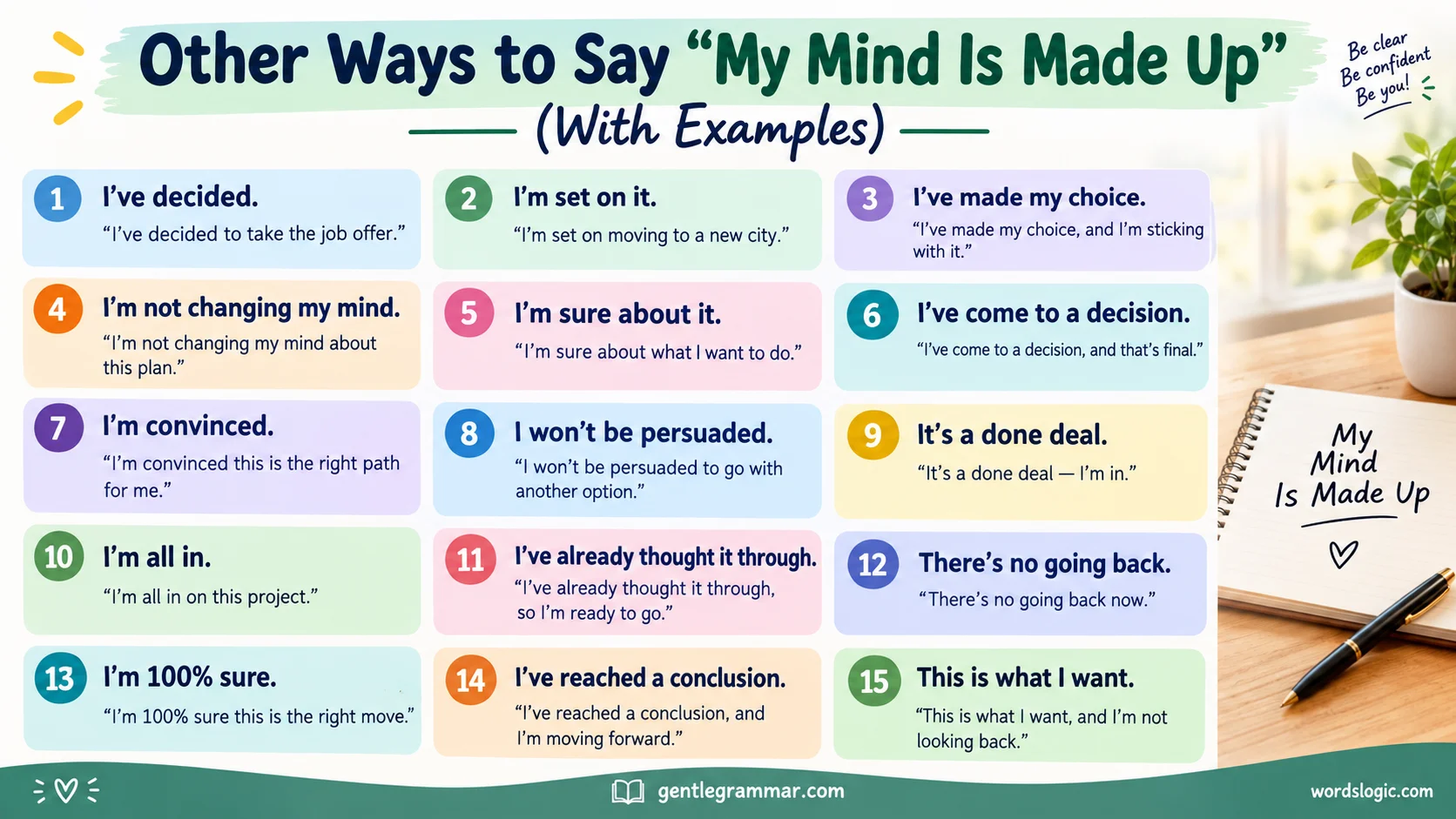
Explore 15 Other Ways to Say “My Mind Is Made Up” (With Examples) to express a firm choice clearly and confidently in everyday conversations.
A moment comes when a person finishes thinking, has a long discussion, and spends time considering each option before reaching a clear choice. The decision-making process often involves deep thinking, reflection, and dealing with uncertainty. However, once confusion, doubt, and hesitation disappear, a settled mindset begins to develop. From my experience, I’ve learned that people sometimes feel the need to explain clearly and communicate their decisions, especially when someone questions their choices.
Saying My Mind Is Made Up expresses a final decision, a firm decision, and a personal sense of certainty. It shows that a person knows what feels right in real life and is no longer indecisive. These expressions also communicate that someone is committed and resolved, has a strong belief, and feels relief, inner peace, and emotional clarity after making a choice.
What Does “My Mind Is Made Up” Mean?
“My Mind Is Made Up” means that you’ve made a decision after thinking about something and don’t intend to change it. It communicates certainty, determination, and confidence in your choice. When someone uses this expression, they’re usually telling others that they’ve considered their options and reached a final decision.
For example, if someone has decided to accept a new job, move to another city, or end a particular arrangement, they might say, “My mind is made up.” The expression can also suggest that further discussion or persuasion probably won’t change their position. Depending on the situation and delivery, it may sound calm and confident or somewhat stubborn and firm.
Common Situations Where “My Mind Is Made Up” Is Used
People commonly use this expression when discussing important personal decisions, such as changing careers, making purchases, choosing a university, or deciding whether to move somewhere new. It’s also common in everyday conversations when someone wants to make their position clear after considering different opinions.
In text messages and personal communication, the phrase can help end a discussion without explaining the decision repeatedly. At work, someone might use it when confirming a choice they’ve already discussed with their team. However, in customer communication, formal writing, or sensitive conversations, a softer alternative may sound more considerate. Expressions such as “I’ve given it careful thought” can communicate confidence without making the other person feel dismissed.
Is It Professional or Polite to Say “My Mind Is Made Up”?
“My Mind Is Made Up” is direct, confident, and slightly informal. It’s perfectly acceptable in everyday conversation and can work in professional situations when you need to communicate a final decision. For example, a manager might use it when explaining why a particular business direction will remain unchanged.
However, the expression can sometimes sound stubborn or dismissive, especially when someone is offering advice or asking to discuss the matter further. In formal emails, workplace discussions, and customer communication, phrases such as “I’ve reached my decision” or “I’ve carefully considered the options” may sound more respectful. The best choice depends on your relationship with the listener and how much discussion the situation requires.
Advantages and Disadvantages of Saying “My Mind Is Made Up”
Advantages
The main advantage of this expression is its clarity. It tells people that you’ve considered a matter and reached a firm conclusion. It also communicates confidence, determination, and personal responsibility for your choices. Instead of leaving others uncertain about your position, you make your intentions clear. It’s particularly useful when someone repeatedly questions a decision you’ve already made.
Disadvantages
The phrase can sometimes sound too forceful, especially during emotional conversations or disagreements. Someone listening may feel that their suggestions or opinions aren’t being considered. It can also sound slightly defensive when used in response to reasonable questions. In professional settings, a more diplomatic expression may communicate the same decision while keeping the conversation respectful.
Synonyms for “My Mind Is Made Up”
- I’ve Made My Decision
- I’ve Reached My Decision
- I’ve Made My Choice
- I Won’t Change My Mind
- My Decision Is Final
- I’ve Made Up My Mind
- I’m Standing by My Decision
- I’ve Settled on My Choice
- I’m Firm in My Decision
- I’ve Given It Careful Thought
- I’m Determined to Follow Through
- I’ve Committed to This
- I’m Set on This
- I’ve Come to a Firm Conclusion
- There’s No Turning Back
1. I’ve Made My Decision
Meaning
“I’ve Made My Decision” communicates that you’ve considered a situation and selected what you believe is the right option. Like the original expression, it shows certainty and personal commitment. However, it focuses more on the act of deciding than on refusing to reconsider.
Definition
A statement indicating that you’ve chosen a particular course of action after considering your options.
Detailed Explanation
This expression is a straightforward alternative that works in both personal and professional conversations. It sounds confident without necessarily suggesting that you’re unwilling to listen to further information. Unlike “My Mind Is Made Up,” it doesn’t automatically carry a stubborn tone. It’s useful when you want to communicate a clear decision without creating unnecessary tension.
Scenario Examples
Scenario 1: Choosing a university
You’ve compared several universities and finally selected one.
Example: “I’ve made my decision. I’m going to study at the university in London.”
Scenario 2: Workplace discussion
Your colleagues are discussing different approaches to a project.
Example: “I’ve made my decision about the new schedule, and we’ll begin next Monday.”
Scenario 3: Personal conversation
A friend asks whether you’re still considering moving.
Example: “I’ve made my decision. I’m ready for a fresh start.”
Best Use
Use this expression in everyday conversations, workplace communication, personal messages, and professional discussions. It’s particularly helpful when you want to sound clear and confident without being overly forceful.
Tone
Tone: Confident, neutral, direct, and professional.
It communicates certainty while leaving room for a respectful conversation.
2. I’ve Reached My Decision
Meaning
“I’ve Reached My Decision” means that you’ve thought about something, considered the available options, and arrived at a conclusion. It emphasizes the thought process behind your choice rather than simply announcing that you’ve made up your mind.
Definition
A formal or thoughtful expression indicating that you’ve arrived at a final decision after consideration.
Detailed Explanation
This phrase sounds slightly more formal than the original expression. It’s especially useful when you want others to understand that your choice wasn’t made carelessly. It communicates a considered position rather than an emotional reaction. Although it suggests that you’ve reached a conclusion, it doesn’t necessarily mean you refuse to consider genuinely important new information.
Scenario Examples
Scenario 1: Job application
You’ve reviewed a job offer and decided whether to accept it.
Example: “I’ve reached my decision, and I’m happy to accept the position.”
Scenario 2: Business meeting
A team has been waiting for your response about a proposed partnership.
Example: “After reviewing the proposal, I’ve reached my decision.”
Scenario 3: Personal matter
A family member asks whether you’ve decided to relocate.
Example: “I’ve reached my decision. Moving closer to my family feels right.”
Best Use
This expression works particularly well in formal conversations, business meetings, professional emails, and important personal discussions. Choose it when you want to highlight careful consideration.
Tone
Tone: Thoughtful, formal, composed, and respectful.
Its measured wording makes it suitable for situations where your decision deserves a serious explanation.
3. I’ve Made My Choice
Meaning
“I’ve Made My Choice” means that you’ve selected one option from several possibilities. It communicates personal preference and commitment without necessarily suggesting that every other option was wrong.
Definition
A statement showing that you’ve selected the option you prefer or intend to pursue.
Detailed Explanation
This expression is especially natural when someone has several alternatives to consider. It focuses on the selection itself rather than the firmness of your position. Compared with “My Mind Is Made Up,” it can sound slightly softer and more personal. You can use it when explaining a choice without turning the conversation into an argument.
Scenario Examples
Scenario 1: Shopping
Your friend keeps suggesting different outfits.
Example: “Thanks for the suggestions, but I’ve made my choice. I’ll wear the blue one.”
Scenario 2: Education
You’re deciding between two academic programs.
Example: “I’ve made my choice, and I’m going to study computer science.”
Scenario 3: Personal relationship
Someone asks whether you’re reconsidering a relationship decision.
Example: “I’ve made my choice, and I think it’s best for both of us.”
Best Use
Use this phrase in casual conversations, shopping decisions, education-related discussions, and personal communication. It works particularly well when choosing between clearly defined options.
Tone
Tone: Natural, confident, personal, and straightforward.
It sounds less forceful than an expression that explicitly declares a decision final.
4. I Won’t Change My Mind
Meaning
“I Won’t Change My Mind” means that you’re determined to maintain your current position. It communicates a strong refusal to reconsider your decision, even if someone tries to persuade you.
Definition
A firm statement indicating that you intend to keep your existing decision or opinion.
Detailed Explanation
This expression is stronger than “My Mind Is Made Up” because it directly addresses the possibility of changing your position. It can be useful when someone repeatedly challenges your decision or refuses to accept your answer. However, it may sound confrontational if the other person is simply trying to help. Use it when setting a clear boundary rather than when inviting further discussion.
Scenario Examples
Scenario 1: Personal boundaries
A friend repeatedly encourages you to attend an event you’ve declined.
Example: “I appreciate the invitation, but I won’t change my mind about staying home tonight.”
Scenario 2: Family discussion
Your relatives disagree with your decision to choose a particular career.
Example: “I’ve thought about my future carefully, and I won’t change my mind about becoming a teacher.”
Scenario 3: Everyday conversation
Someone keeps asking you to reconsider a purchase.
Example: “I’m happy with my choice, and I won’t change my mind.”
Best Use
This phrase works best in direct conversations, personal boundaries, disagreements, and situations involving repeated persuasion. Avoid it when a softer response would preserve a valuable relationship.
Tone
Tone: Firm, assertive, determined, and sometimes confrontational.
Its strength comes from explicitly ruling out a change of position.
5. My Decision Is Final
Meaning
“My Decision Is Final” communicates that you’ve made a choice and consider the matter settled. It leaves little room for further negotiation or discussion.
Definition
A firm declaration that a decision has been completed and will not be reconsidered.
Detailed Explanation
This expression is more authoritative than the original phrase. It often appears when someone needs to establish a clear boundary or communicate a final outcome. Unlike softer alternatives, it can sound official or even strict. It’s particularly useful when you have responsibility for making a decision and need others to respect the outcome.
Scenario Examples
Scenario 1: Management
A manager explains that a company policy won’t be changed.
Example: “We’ve reviewed everyone’s suggestions, but my decision is final.”
Scenario 2: Personal disagreement
Someone continues questioning a decision you’ve already explained.
Example: “I understand your concerns, but my decision is final.”
Scenario 3: Family arrangements
You’ve decided how to organize an important family event.
Example: “The arrangements have been made, and my decision is final.”
Best Use
Choose this expression for firm boundaries, management decisions, official discussions, and situations where further negotiation isn’t appropriate. Use it carefully in sensitive personal conversations.
Tone
Tone: Authoritative, firm, formal, and decisive.
It establishes a clear endpoint rather than simply communicating personal certainty.
6. I’ve Made Up My Mind
Meaning
“I’ve Made Up My Mind” means that you’ve reached a decision after thinking about something. It communicates that you’re no longer undecided and have settled on a particular option.
Definition
An expression indicating that you’ve decided what you want to do or believe.
Detailed Explanation
This phrase is extremely close in meaning to “My Mind Is Made Up.” The main difference is its grammatical structure and emphasis. It describes the process of reaching a decision, whereas the original phrase highlights your current state of certainty. It’s natural in everyday English and can sound friendly, determined, or slightly stubborn depending on how you say it.
Scenario Examples
Scenario 1: Career decision
Your friend asks whether you’re still thinking about changing jobs.
Example: “I’ve made up my mind. I’m going to start looking for a new position.”
Scenario 2: Personal purchase
Your family suggests buying a different car.
Example: “I’ve made up my mind about the car. I want the smaller model.”
Scenario 3: Weekend plans
Someone keeps suggesting other activities.
Example: “I’ve made up my mind. We’re going hiking this weekend.”
Best Use
Use it in everyday speech, friendly conversations, texting, family discussions, and personal decisions. It’s a particularly natural choice when you want to keep your wording simple.
Tone
Tone: Conversational, confident, familiar, and direct.
It sounds natural without being as formal or authoritative as some other alternatives.
7. I’m Standing by My Decision
Meaning
“I’m Standing by My Decision” means that you’re maintaining your original choice despite criticism, disagreement, or pressure to reconsider.
Definition
A statement expressing continued support for a decision you’ve already made.
Detailed Explanation
This expression focuses on defending or maintaining your position rather than simply announcing that you’ve reached a conclusion. It’s particularly useful when other people disagree with your choice. It communicates confidence and personal responsibility, although it may sound defensive if the conversation becomes argumentative. Unlike the original phrase, it emphasizes your willingness to remain consistent when challenged.
Scenario Examples
Scenario 1: Workplace decision
A colleague questions a decision you made about a project.
Example: “I understand your concerns, but I’m standing by my decision to change the deadline.”
Scenario 2: Personal choices
Your friends disagree with your decision to take a year off.
Example: “I know you wouldn’t make the same choice, but I’m standing by my decision.”
Scenario 3: Team leadership
A team member challenges your selection for an important assignment.
Example: “I’ve considered the feedback, and I’m standing by my decision to appoint Sarah.”
Best Use
This phrase works well in professional discussions, leadership situations, disagreements, and conversations where you need to defend an existing choice.
Tone
Tone: Assertive, confident, resolute, and slightly defensive.
It shows that your decision remains unchanged despite outside pressure.
8. I’ve Settled on My Choice
Meaning
“I’ve Settled on My Choice” means that you’ve considered different possibilities and selected the option that feels right. It suggests that you’ve finished comparing alternatives.
Definition
An expression indicating that you’ve chosen one option after considering other possibilities.
Detailed Explanation
This phrase has a more relaxed feeling than the original expression. It emphasizes the process of narrowing down your options rather than refusing to change your mind. It works particularly well when someone has been comparing several possibilities. The expression doesn’t necessarily suggest that you’re unwilling to reconsider if something important changes.
Scenario Examples
Scenario 1: Choosing a holiday destination
You’ve spent days comparing different places to visit.
Example: “I’ve settled on my choice. We’re going to visit Turkey this summer.”
Scenario 2: Buying furniture
Your partner asks whether you’ve selected a sofa.
Example: “I’ve settled on my choice, and the gray one will look perfect in the living room.”
Scenario 3: Selecting a course
You’ve reviewed different online learning programs.
Example: “I’ve settled on my choice. The evening course suits my schedule better.”
Best Use
Use this expression in casual discussions, shopping, travel planning, education, and situations involving several alternatives.
Tone
Tone: Relaxed, thoughtful, confident, and conversational.
It communicates a settled preference without sounding overly forceful.
9. I’m Firm in My Decision
Meaning
“I’m Firm in My Decision” means that you’re confident about your choice and aren’t easily influenced by other people’s opinions. It emphasizes determination and consistency.
Definition
A statement expressing strong confidence in a decision and a willingness to maintain it.
Detailed Explanation
This expression sounds more formal and deliberate than the original phrase. It communicates that your position is based on conviction rather than a temporary feeling. It can be useful when explaining a serious decision to someone who expects a clear answer. However, it doesn’t necessarily mean that you’re unwilling to consider genuinely relevant new information.
Scenario Examples
Scenario 1: Career planning
A mentor questions your decision to start your own business.
Example: “I’m firm in my decision to build my own company.”
Scenario 2: Professional discussion
A department is considering changing an agreed strategy.
Example: “After reviewing the available information, I’m firm in my decision to continue with the current approach.”
Scenario 3: Personal goals
A friend encourages you to give up a challenging goal.
Example: “I know it won’t be easy, but I’m firm in my decision to finish what I started.”
Best Use
This expression suits professional conversations, serious personal decisions, goal-setting discussions, and situations where confidence matters.
Tone
Tone: Determined, serious, confident, and composed.
It expresses conviction without directly criticizing anyone who disagrees.
10. I’ve Given It Careful Thought
Meaning
“I’ve Given It Careful Thought” means that you’ve spent time considering a matter before reaching a conclusion. It emphasizes reflection and responsible judgment rather than simply announcing that your decision is final.
Definition
A statement indicating that you’ve thoughtfully considered something before deciding what to do.
Detailed Explanation
This is a softer and more diplomatic alternative to the original phrase. It reassures others that you’ve taken their concerns or the available information seriously. However, it doesn’t independently communicate that your decision cannot change. If you want to make your final position clear, you can follow it with a direct statement explaining what you’ve decided.
Scenario Examples
Scenario 1: Declining a job offer
A company offers you a position, but you’ve decided to stay at your current workplace.
Example: “I’ve given it careful thought, and I must respectfully decline the offer.”
Scenario 2: Personal relationship
Someone asks whether you’ve reconsidered an important relationship decision.
Example: “I’ve given it careful thought, and I believe this is the healthiest decision for me.”
Scenario 3: Business proposal
A colleague asks whether you’ve reviewed a suggested partnership.
Example: “I’ve given it careful thought, and I don’t think this partnership is the right fit.”
Best Use
Use this expression in formal emails, professional communication, thoughtful refusals, sensitive discussions, and important personal decisions.
Tone
Tone: Polite, thoughtful, diplomatic, and mature.
It shows consideration for others while allowing you to communicate your position respectfully.
11. I’m Determined to Follow Through
Meaning
“I’m Determined to Follow Through” means that you’re committed to completing something you’ve decided or promised to do. It emphasizes action, persistence, and commitment rather than just having a firm opinion.
Definition
An expression showing that you intend to carry out a decision or complete an intended course of action.
Detailed Explanation
This phrase is slightly different from the original because it focuses on what you’ll do next. Someone can have a firm decision without necessarily taking action, but following through means putting that decision into practice. It’s especially useful when discussing goals, responsibilities, and long-term plans. Choose it when you want to communicate determination rather than simply announce a final choice.
Scenario Examples
Scenario 1: Personal development
You’ve decided to complete a challenging fitness program.
Example: “I’ve already started, and I’m determined to follow through until I reach my goal.”
Scenario 2: Workplace responsibility
You promised your manager that you’d complete an important project.
Example: “I’m determined to follow through and deliver the project by Friday.”
Scenario 3: Education
You’ve committed to finishing your degree despite a busy schedule.
Example: “It’s been difficult to balance everything, but I’m determined to follow through.”
Best Use
This expression works best in goal-setting, workplace communication, personal commitments, education, and motivational conversations.
Tone
Tone: Motivational, positive, committed, and determined.
It communicates a willingness to act rather than simply maintain an opinion.
12. I’ve Committed to This
Meaning
“I’ve Committed to This” means that you’ve made a decision to support, pursue, or remain involved in something. It communicates a sense of responsibility and dedication.
Definition
A statement showing that you’ve made a firm commitment to a particular decision, plan, or course of action.
Detailed Explanation
This expression is especially useful when your decision involves an ongoing responsibility. It sounds more focused on dedication than the original phrase. For example, you might use it when discussing a career path, business project, relationship, or personal goal. Unlike “My Mind Is Made Up,” it emphasizes what you’re willing to invest your time and effort in.
Scenario Examples
Scenario 1: Business project
Your team asks whether you’re still interested in continuing a long-term project.
Example: “I’ve committed to this project, and I’m ready to see it through.”
Scenario 2: Personal relationship
Your partner asks whether you’re serious about building a future together.
Example: “I’ve committed to this relationship, and I want us to keep growing together.”
Scenario 3: Education
A friend wonders whether you’ll continue your studies.
Example: “I’ve committed to this degree, so I’m going to finish it.”
Best Use
Use this expression in professional commitments, relationships, long-term plans, teamwork, and personal development. It’s most effective when your decision involves continued effort.
Tone
Tone: Sincere, committed, responsible, and confident.
It highlights dedication rather than simply refusing to reconsider.
13. I’m Set on This
Meaning
“I’m Set on This” means that you’ve developed a strong preference or made a decision about something. It suggests that you’re comfortable with your choice and don’t currently want another option.
Definition
An informal expression showing that you’re strongly decided on a particular choice or course of action.
Detailed Explanation
This phrase is shorter and more conversational than the original expression. It’s particularly natural when discussing plans, purchases, personal preferences, or future goals. It can sound friendly among people who know each other, although it may seem too casual in formal business writing. The phrase communicates strong preference, but its strength depends on the situation.
Scenario Examples
Scenario 1: Choosing a restaurant
Your friends suggest several different places for dinner.
Example: “I’m set on this little Italian restaurant. Let’s try it tonight.”
Scenario 2: Home improvement
Your family suggests changing the color you’ve selected for the living room.
Example: “I’m set on this shade of green. I think it’ll look great.”
Scenario 3: Personal plans
A friend asks whether you’re still planning to travel alone.
Example: “I’m set on this idea, and I really want to experience the trip by myself.”
Best Use
This phrase is ideal for casual conversations, texting, everyday decisions, shopping, and personal preferences. Avoid it in formal correspondence where a more complete expression would sound better.
Tone
Tone: Casual, confident, friendly, and slightly informal.
It makes your preference clear without sounding overly official.
14. I’ve Come to a Firm Conclusion
Meaning
“I’ve Come to a Firm Conclusion” means that you’ve carefully examined a situation and reached a definite judgment. It communicates reasoned certainty and a settled position.
Definition
A statement indicating that you’ve reached a clear and considered conclusion after examining relevant information.
Detailed Explanation
This expression sounds more analytical than the original phrase. It’s particularly appropriate when your decision follows research, discussion, observation, or careful evaluation. It focuses on the reasoning behind your position rather than simply declaring that you’re unwilling to change your mind. However, it is more commonly associated with judgments and assessments than everyday choices.
Scenario Examples
Scenario 1: Business evaluation
You’ve reviewed the results of a company’s performance.
Example: “After examining the figures, I’ve come to a firm conclusion about which strategy we should use.”
Scenario 2: Academic discussion
You’ve researched a topic and formed an opinion.
Example: “After reviewing the evidence, I’ve come to a firm conclusion about the main cause.”
Scenario 3: Personal decision
You’ve spent time reflecting on an important life choice.
Example: “I’ve come to a firm conclusion that relocating is the right step for me.”
Best Use
Choose this phrase for formal discussions, research, professional evaluations, academic writing, and decisions based on careful analysis.
Tone
Tone: Analytical, formal, thoughtful, and decisive.
It suggests that your position comes from consideration rather than impulse.
15. There’s No Turning Back
Meaning
“There’s No Turning Back” means that you’ve reached a point where you’re committed to moving forward and don’t intend to reverse your decision. It can also suggest that a process has advanced too far to return to its previous state.
Definition
An expression indicating that a decision or action has reached a stage where returning to the previous situation is no longer intended or practical.
Detailed Explanation
This phrase is more dramatic than the original expression. It communicates a strong sense of commitment, momentum, or determination. Unlike the other alternatives, it can suggest that you’ve already taken significant steps toward your goal. It isn’t always a direct synonym for having a firm opinion because it often refers to moving forward after an important action has begun.
Scenario Examples
Scenario 1: Starting a business
You’ve invested time and money into launching your company.
Example: “We’ve completed the registration and secured our first clients. There’s no turning back now.”
Scenario 2: Personal transformation
You’ve decided to make a major lifestyle change.
Example: “I’ve started working toward a healthier life, and there’s no turning back.”
Scenario 3: Moving abroad
You’ve accepted an international job and completed the necessary arrangements.
Example: “The tickets are booked, the paperwork is ready, and there’s no turning back.”
Best Use
Use this expression in motivational conversations, major life changes, exciting commitments, creative writing, and situations where moving forward feels significant. Avoid it when you simply want to express a routine preference.
Tone
Tone: Dramatic, determined, motivational, and emphatic.
It creates a stronger emotional impression than a simple statement of certainty.
FAQs:
What Is Another Way to Say “My Mind Is Made Up”?
Some natural alternatives include “I’ve Made My Decision,” “I’ve Made My Choice,” “My Decision Is Final,” and “I’m Standing by My Decision.” The best option depends on how firmly you want to communicate your position. For everyday conversations, “I’ve Made My Choice” sounds natural, while “My Decision Is Final” is more authoritative.
What Does “My Mind Is Made Up” Mean?
“My Mind Is Made Up” means that you’ve reached a decision after considering something and don’t intend to change it. It communicates certainty, determination, and confidence. People often use it when they want others to understand that they’ve already decided what to do.
Is “My Mind Is Made Up” Professional?
Yes, it can be appropriate in professional communication, particularly when you need to communicate a definite position. However, it may sound too direct in sensitive workplace discussions. Alternatives such as “I’ve Reached My Decision” or “I’ve Given It Careful Thought” can sound more diplomatic.
What Is a More Polite Way to Say “My Mind Is Made Up”?
A polite alternative is “I’ve Given It Careful Thought.” It shows that you’ve considered the situation before reaching your conclusion. You could also say, “I appreciate your advice, but I’ve made my decision,” to acknowledge another person’s opinion while maintaining your position.
Which Alternative Works Best in Formal Communication?
“I’ve Reached My Decision” is an excellent choice for formal communication because it sounds thoughtful, clear, and professional. “I’ve Come to a Firm Conclusion” is also suitable when your decision follows careful analysis or evaluation. Choose the expression that best matches the subject and the relationship with your audience.
Conclusion:
Choosing the right words can make a significant difference when communicating a firm decision. Although “My Mind Is Made Up” clearly expresses certainty, alternatives such as “I’ve Made My Decision,” “I’m Standing by My Decision,” and “I’ve Given It Careful Thought” offer different levels of confidence, politeness, and formality. Some expressions work well in casual conversations, while others are better suited to professional discussions or sensitive situations. Remember that having a strong opinion doesn’t mean you need to sound dismissive or unwilling to listen. Consider your audience, the circumstances, and the message you want to communicate. The best expression is the one that makes your decision clear while maintaining the right balance of confidence, respect, and understanding.
