
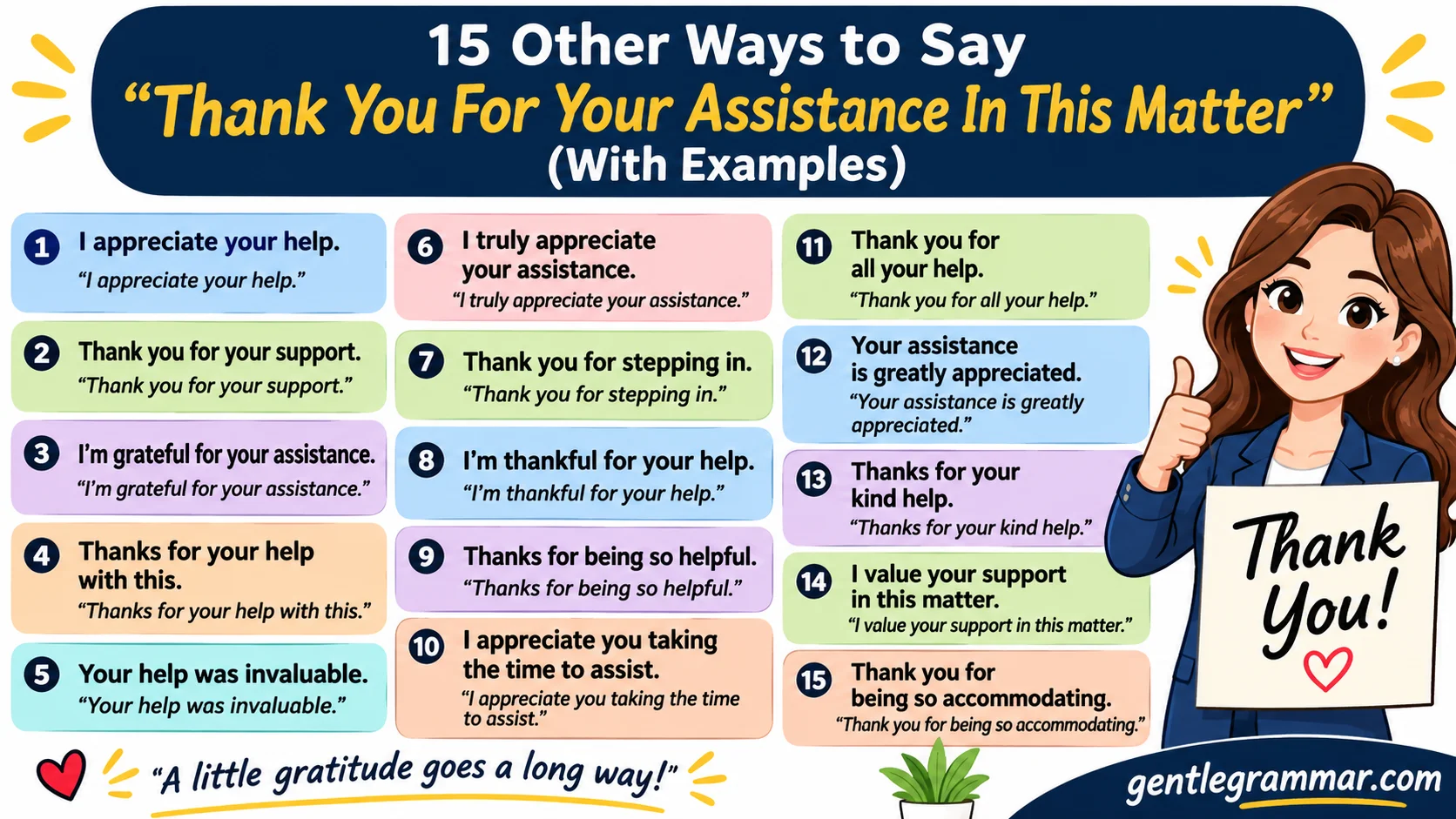
Other Ways to Say “Thank You For Your Assistance In This Matter” (With Examples) helps you choose clear, warm, and natural professional wording.
Thank You for Your Assistance in This Matter is a polite phrase for thanking someone who is helping with a specific issue. In emails, letters, and workplace messages, it sounds respectful, professional, and correct, but using the same tired phrase as a default can feel robotic. A simple thank you can make your message more clear, kind, and natural, especially in business writing, where appreciation and value matter. I’ve found that choosing better ways to express gratitude makes professional communication feel more genuine while showing respect for someone’s help, assistance, support, time, and cooperation.
Different situations call for different alternatives. Thank You for Your Advice fits when someone gives guidance, offers a suggestion, or helps you make a better choice. Other expressions can bring warmth, sincerity, confidence, and personality while keeping your respectful language. This works well in professional communication, a business email, a legal matter, or a follow-up with a colleague who helped at the last minute. The right English expression can create a lasting impression, build strong relationships, and strengthen respect at school, work, and in daily life.
What Does “Thank You For Your Assistance In This Matter” Mean?
“Thank you for your assistance in this matter” is a polite way to express gratitude for someone’s help with a specific issue, request, task, or situation. The word “assistance” refers to help or support, while “this matter” usually points to something already discussed or understood. The phrase is commonly used when you want to acknowledge someone’s effort without sounding overly casual. It can communicate appreciation, respect, and professionalism, especially in workplace or formal correspondence.
The phrase does not necessarily suggest that the person has done something extraordinary. It can simply thank someone for taking time to provide information, solve a problem, answer a question, or handle a request. Its exact feeling depends on context, but it generally sounds formal, courteous, and somewhat businesslike.
Common Situations Where “Thank You For Your Assistance In This Matter” Is Used
This phrase is most common in professional communication, particularly emails, letters, customer service messages, administrative requests, and formal correspondence. For example, someone might use it after asking a colleague to investigate an issue, thanking a customer-service representative for resolving a problem, or acknowledging help with paperwork.
You may also see it in messages involving schools, offices, businesses, government agencies, or professional relationships. In casual conversations, however, it can feel more formal than necessary. Saying “Thanks for your help” or “I really appreciate your help” may sound more natural when speaking with a friend, coworker you know well, or someone in an informal setting.
Is It Professional or Polite to Say “Thank You For Your Assistance In This Matter”?
Yes. “Thank you for your assistance in this matter” is both professional and polite. It has a formal tone that works particularly well when you want to show respect without becoming overly emotional or personal. It is suitable for business emails, official correspondence, customer-service communication, and situations where you do not know the recipient very well.
However, its formality can also make it feel somewhat stiff or traditional in everyday workplace communication. If you have an established relationship with the recipient, a warmer phrase such as “I appreciate your help” may feel more genuine. The best choice depends on your relationship, the seriousness of the situation, and how formal the message needs to be.
Advantages and Disadvantages of Saying “Thank You For Your Assistance In This Matter”
Advantages
The phrase communicates clear appreciation while maintaining a respectful, professional tone. It is especially useful when writing to someone you do not know personally or when discussing an important business or administrative matter. It also works well at the end of an email because it acknowledges the recipient’s effort without requiring a long explanation.
Disadvantages
The main limitation is that the phrase can sound formal, impersonal, or slightly old-fashioned in casual workplace communication. “Assistance” and “this matter” are both somewhat formal, so the expression may create more distance than you intend. If you want to express genuine warmth or personal appreciation, a simpler phrase may communicate your feeling more naturally.
Synonyms for “Thank You For Your Assistance In This Matter”
- Thank you for your help with this.
- I appreciate your assistance.
- Thank you for your support.
- I appreciate your help with this matter.
- Thank you for your time and help.
- I’m grateful for your assistance.
- Thank you for helping me with this.
- I appreciate your support with this.
- Many thanks for your help.
- Thank you for taking care of this.
- I truly appreciate your help.
- Thank you for your attention to this matter.
- I appreciate your time and consideration.
- Thank you for looking into this.
- Your help is greatly appreciated.
1. Thank You for Your Help With This
Meaning
“Thank you for your help with this” is a simple, natural way to express appreciation for someone’s assistance with a specific task or situation.
Definition
It means “I appreciate the help you gave me with this particular issue.”
Detailed Explanation
This expression is less formal than the original phrase and sounds more natural in everyday workplace communication. The word “help” feels warmer and more direct than “assistance.” It works especially well when both people already understand what “this” refers to. Choose it when you want to sound professional without creating unnecessary distance.
Scenario Examples
Scenario: A coworker helps you correct a report.
Example: “Thank you for your help with this. I really appreciate you catching that error.”
Scenario: Someone assists with a customer request.
Example: “Thank you for your help with this. The issue has now been resolved.”
Best Use
Best for work emails, everyday professional messages, and polite conversations where you already have some context.
Tone: Warm, professional, and straightforward. It feels more conversational than the original.
2. I Appreciate Your Assistance
Meaning
“I appreciate your assistance” expresses gratitude for someone’s help while keeping a professional tone.
Definition
It means “I am thankful for the help you have provided.”
Detailed Explanation
This alternative stays fairly close to the original phrase because it keeps the word “assistance.” The difference is that it removes “in this matter,” making the sentence cleaner and less formalistic. It is useful when you want a polished expression without sounding overly elaborate. It can work particularly well in professional correspondence.
Scenario Examples
Scenario: A colleague provides information you needed.
Example: “I appreciate your assistance in gathering these details.”
Scenario: A customer-service representative resolves an account issue.
Example: “I appreciate your assistance in resolving this issue.”
Best Use
Best for professional emails, formal requests, and business correspondence.
Tone: Professional, respectful, and polished. It maintains formality without sounding unnecessarily lengthy.
3. Thank You for Your Support
Meaning
“Thank you for your support” focuses on appreciation for encouragement, cooperation, or practical help.
Definition
It means “I am grateful for the support you have given me or this situation.”
Detailed Explanation
“Support” can be broader than “assistance.” It may refer to practical help, encouragement, cooperation, or continued backing. Because of this wider meaning, it is not always an exact replacement for the original phrase. Use it when the person has contributed more than a single task or has helped you throughout a situation.
Scenario Examples
Scenario: A manager supports you during a difficult project.
Example: “Thank you for your support throughout this project.”
Scenario: A friend encourages you during a challenging period.
Example: “Thank you for your support. It has meant a lot to me.”
Best Use
Best for workplace relationships, personal messages, ongoing projects, and situations involving encouragement.
Tone: Warm, appreciative, and supportive. It can feel more personal than “assistance.”
4. I Appreciate Your Help With This Matter
Meaning
This phrase thanks someone specifically for helping with a particular issue or situation.
Definition
It means “I am grateful for the help you have given me regarding this matter.”
Detailed Explanation
This is a close alternative to the original wording, but it sounds slightly more natural because “help” is more common than “assistance.” Keeping “this matter” preserves a formal quality. It is a good middle ground when you want your message to remain professional while avoiding overly stiff wording.
Scenario Examples
Scenario: A colleague handles a complicated request.
Example: “I appreciate your help with this matter. Please let me know if you need anything else from me.”
Scenario: A school administrator assists with paperwork.
Example: “I appreciate your help with this matter and your prompt response.”
Best Use
Best for formal emails, workplace communication, administrative matters, and professional requests.
Tone: Professional, courteous, and moderately formal.
5. Thank You for Your Time and Help
Meaning
This expression thanks someone for both their effort and the time they spent helping you.
Definition
It means “I am grateful that you took the time to help me.”
Detailed Explanation
This phrase adds a personal element that the original can lack. By mentioning time, you acknowledge that the person had to pause their own work or schedule to assist you. It is especially useful when someone has spent significant time explaining something, meeting with you, or working through a problem.
Scenario Examples
Scenario: A mentor spends an hour reviewing your work.
Example: “Thank you for your time and help. Your feedback was incredibly useful.”
Scenario: A colleague meets with you to solve a problem.
Example: “Thank you for your time and help with this issue.”
Best Use
Best for meetings, mentoring, workplace assistance, interviews, and detailed discussions.
Tone: Appreciative, respectful, and personal.
6. I’m Grateful for Your Assistance
Meaning
“I’m grateful for your assistance” expresses stronger personal appreciation than a simple “thank you.”
Definition
It means “I feel genuinely thankful for the help you provided.”
Detailed Explanation
The word “grateful” gives this phrase more emotional warmth. It still sounds professional because “assistance” is formal vocabulary. Use it when the person’s help was particularly valuable or when you want your appreciation to feel more sincere and deliberate.
Scenario Examples
Scenario: Someone helps you during an urgent workplace situation.
Example: “I’m grateful for your assistance during this unexpected issue.”
Scenario: A professional contact provides important guidance.
Example: “I’m grateful for your assistance and guidance throughout the process.”
Best Use
Best for formal thank-you messages, significant assistance, professional relationships, and situations where you want to show sincere appreciation.
Tone: Sincere, respectful, and warm.
7. Thank You for Helping Me With This
Meaning
This phrase directly thanks someone for personally helping you with a particular problem or task.
Definition
It means “Thank you for the help you gave me with this situation.”
Detailed Explanation
This wording feels more personal because it uses “me” rather than the more distant “this matter.” It is natural in both spoken and written English. Compared with the original, it is less formal and more conversational. It is a strong choice when you know the person reasonably well.
Scenario Examples
Scenario: A friend helps you complete a difficult task.
Example: “Thank you for helping me with this. I couldn’t have finished it without you.”
Scenario: A coworker walks you through new software.
Example: “Thanks for helping me with this. I understand the process now.”
Best Use
Best for coworkers, friends, classmates, personal messages, and informal workplace communication.
Tone: Friendly, warm, and conversational.
8. I Appreciate Your Support With This
Meaning
This expression shows appreciation for someone’s help, cooperation, or encouragement regarding a particular situation.
Definition
It means “I am thankful for the support you have given me with this issue.”
Detailed Explanation
“I appreciate your support with this” is broader than “thank you for your assistance.” It can cover practical help as well as encouragement or cooperation. The phrase works well when you want to recognize someone’s involvement without describing exactly what they did. It is particularly useful when the support has continued over time.
Scenario Examples
Scenario: A manager backs your decision during a project.
Example: “I appreciate your support with this project.”
Scenario: A teammate helps you manage a difficult assignment.
Example: “I appreciate your support with this. It made the workload much easier.”
Best Use
Best for team communication, workplace relationships, ongoing projects, and supportive personal messages.
Tone: Warm, professional, and appreciative.
9. Many Thanks for Your Help
Meaning
“Many thanks for your help” is a concise way to express genuine appreciation for someone’s assistance.
Definition
It means “Thank you very much for helping me.”
Detailed Explanation
This expression is slightly more polished than simply saying “Thanks for your help,” but it remains fairly natural. It is especially common in written communication and can make a short email ending feel friendly without becoming overly personal. However, it may sound a little more traditional than “I really appreciate your help.”
Scenario Examples
Scenario: Someone quickly sends you information.
Example: “Many thanks for your help with the documents.”
Scenario: A colleague responds to a request.
Example: “Many thanks for your help. I’ll take it from here.”
Best Use
Best for emails, professional correspondence, and polite written messages.
Tone: Polite, appreciative, and slightly traditional.
10. Thank You for Taking Care of This
Meaning
This phrase thanks someone for handling a task, problem, or responsibility on your behalf.
Definition
It means “Thank you for dealing with this situation or task.”
Detailed Explanation
This is not a direct synonym in every context because “taking care of this” emphasizes handling or completing something rather than simply providing assistance. It works best when the recipient actually dealt with the issue. The wording sounds natural and efficient, especially when someone has taken responsibility for getting something done.
Scenario Examples
Scenario: A coworker resolves a customer complaint.
Example: “Thank you for taking care of this. I appreciate the quick response.”
Scenario: A colleague handles a scheduling problem.
Example: “Thanks for taking care of this while I was away.”
Best Use
Best for workplace emails, team communication, task management, and practical situations.
Tone: Professional, friendly, and direct.
11. I Truly Appreciate Your Help
Meaning
“I truly appreciate your help” emphasizes genuine and sincere gratitude.
Definition
It means “I am sincerely thankful for the help you gave me.”
Detailed Explanation
The word “truly” adds emotional emphasis without making the phrase overly dramatic. This makes it useful when ordinary “thank you” does not quite express how valuable the assistance was. It sounds more personal than the original phrase and can work in both professional and personal settings.
Scenario Examples
Scenario: A colleague stays late to help finish a project.
Example: “I truly appreciate your help in getting this finished on time.”
Scenario: Someone assists you during a stressful situation.
Example: “I truly appreciate your help. It made a difficult situation much easier.”
Best Use
Best for meaningful assistance, personal messages, workplace appreciation, and sincere thank-you notes.
Tone: Warm, sincere, and personal.
12. Thank You for Your Attention to This Matter
Meaning
This phrase thanks someone for giving careful attention or consideration to a particular issue.
Definition
It means “Thank you for taking the time to consider or deal with this issue.”
Detailed Explanation
This alternative is more specific than simply thanking someone for help. It highlights the person’s attention and consideration, making it suitable when you have asked them to review, investigate, or respond to something. It has a formal tone and may sound more appropriate than “assistance” when the person’s main contribution was reviewing or considering an issue.
Scenario Examples
Scenario: You contact an office about a formal request.
Example: “Thank you for your attention to this matter. I look forward to your response.”
Scenario: A manager reviews a workplace concern.
Example: “Thank you for your attention to this matter and for taking the time to review it.”
Best Use
Best for formal emails, official correspondence, complaints, requests, and administrative communication.
Tone: Formal, respectful, and serious.
13. I Appreciate Your Time and Consideration
Meaning
This expression thanks someone for spending time considering your request, proposal, or situation.
Definition
It means “I am grateful that you took the time to consider what I presented.”
Detailed Explanation
Unlike the original phrase, this wording does not necessarily imply that the person actively helped solve the problem. Instead, it focuses on their time and thoughtful consideration. That makes it especially useful when asking someone to review an application, proposal, request, or important message. It is also a natural closing for professional correspondence.
Scenario Examples
Scenario: You send a proposal to a potential business partner.
Example: “I appreciate your time and consideration. I look forward to hearing from you.”
Scenario: You submit a formal request.
Example: “Thank you for your time and consideration of my request.”
Best Use
Best for formal emails, proposals, applications, requests, and business communication.
Tone: Professional, respectful, and formal.
14. Thank You for Looking Into This
Meaning
“Thank you for looking into this” thanks someone for investigating, checking, or researching a particular issue.
Definition
It means “Thank you for taking the time to investigate this situation.”
Detailed Explanation
This phrase is more specific than the original because it suggests that the person is examining or investigating something. It is an excellent choice when you have reported a problem and asked someone to find out what happened. It would not be appropriate if the person simply gave you general assistance without investigating anything.
Scenario Examples
Scenario: A support team investigates a billing problem.
Example: “Thank you for looking into this. I appreciate the quick update.”
Scenario: A manager checks why a project was delayed.
Example: “Thanks for looking into this and getting back to me.”
Best Use
Best for customer service, workplace issues, technical problems, complaints, and investigations.
Tone: Professional, direct, and appreciative.
15. Your Help Is Greatly Appreciated
Meaning
“Your help is greatly appreciated” communicates strong appreciation for assistance that has been provided.
Definition
It means “The help you have given is very much valued and appreciated.”
Detailed Explanation
This expression places emphasis on the value of the other person’s help rather than on your own feelings. It has a polished, professional quality and is common in workplace or formal communication. Because it uses a passive construction, it can sound slightly more formal and less personal than “I really appreciate your help.” Use it when you want a courteous, businesslike closing.
Scenario Examples
Scenario: A team member helps resolve an urgent issue.
Example: “Your help is greatly appreciated as we work to resolve this issue.”
Scenario: You request assistance from a professional contact.
Example: “Your help is greatly appreciated, and thank you for taking the time to assist us.”
Best Use
Best for professional emails, formal requests, business communication, and situations involving significant assistance.
Tone: Formal, respectful, and appreciative.
FAQs:
What is another way to say “Thank You For Your Assistance In This Matter”?
A natural alternative is “Thank you for your help with this.” For more formal communication, “I appreciate your assistance” or “Thank you for your attention to this matter” can work well.
What does “Thank You For Your Assistance In This Matter” mean?
It means “Thank you for helping me with this particular issue or situation.” The phrase expresses appreciation while maintaining a formal and professional tone.
Is “Thank You For Your Assistance In This Matter” professional?
Yes. It is professional, polite, and formal. It works well in business emails, official correspondence, customer communication, and administrative situations. However, a simpler phrase may sound more natural in casual workplace conversations.
What is a more polite way to say “Thank You For Your Assistance In This Matter”?
The original phrase is already polite. If you want to make your gratitude feel warmer, try “I truly appreciate your help” or “I’m grateful for your assistance.”
Which alternative works best in formal communication?
“I appreciate your assistance” is a strong general choice because it is concise and professional. For formal requests or matters requiring careful review, “Thank you for your attention to this matter” may be more precise.
Conclusion:
Choosing the right thank-you expression can make a small message feel much more natural. “Thank you for your assistance in this matter” is respectful and professional, but its formal wording may not fit every situation. A workplace email might benefit from “I appreciate your assistance,” while a warmer message could use “I truly appreciate your help.” If someone investigated a problem, “Thank you for looking into this” is more precise.
The key is to consider the relationship, context, purpose, and tone before choosing your wording. Similar expressions can communicate appreciation while creating very different impressions. Whether you need a formal business phrase or a friendly everyday response, choose the alternative that sounds natural for the person and situation.
