
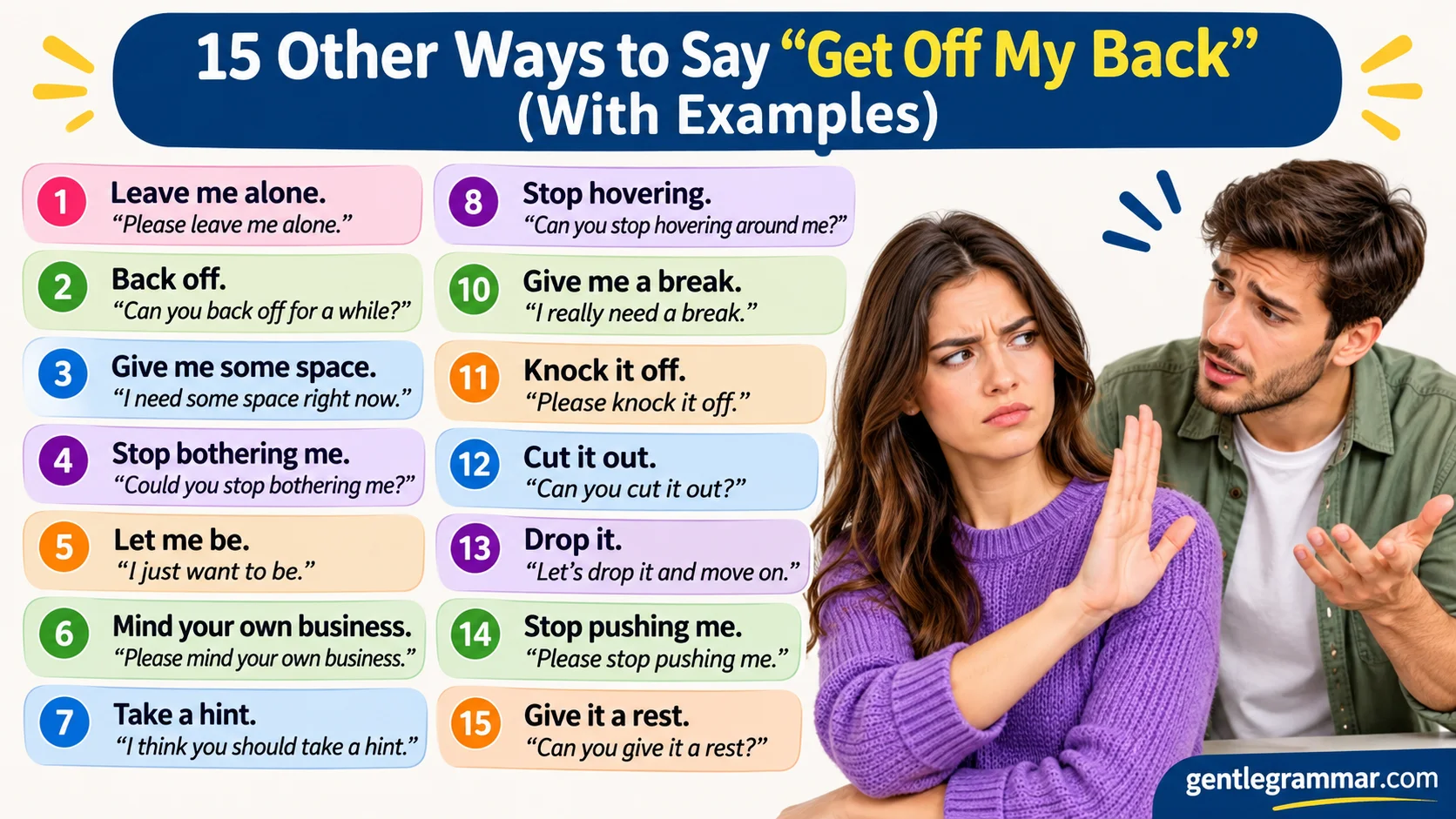
For clear, respectful boundaries, 15 Other Ways to Say “Get Off My Back” (With Examples) can help you sound firm without making tension worse.
When someone, a person, or another person keeps stop bothering, nagging, or criticizing, the phrase, idiom, or expression Get Off My Back can sound irritated and confrontational. People, including men and loved ones, may use it when giving too much advice, offering unwanted advice, or interfering in someone’s life. However, the words you choose can change a tense conversation quickly.
In my experience, when someone kept telling me how to handle an issue, it made me feel stressed. A calmer response can ask for personal space, space, privacy, or boundaries while still showing respect and assertiveness. These natural alternatives can set a boundary with less unnecessary tension. For example, “I need some personal space right now” is a softer, specific, and appropriate way to respond when emotions are high.
What Does “Get Off My Back” Mean?
Get off my back is an informal expression meaning stop criticizing, pressuring, bothering, or repeatedly reminding me about something. Someone might say it when another person keeps asking questions, giving unwanted advice, checking their progress, or complaining about the same issue. For example, “Get off my back about cleaning my room” means “Stop repeatedly bothering me about cleaning my room.”
The phrase usually communicates frustration or annoyance. It does not literally refer to someone being on your back. Depending on the situation, it can mean “leave me alone,” “stop putting pressure on me,” or “stop criticizing me.” Because it can sound sharp, the relationship between the speakers and the situation matter when deciding whether to use it.
Common Situations Where “Get Off My Back” Is Used
People commonly use get off my back in casual conversations when they feel someone is putting too much pressure on them. A teenager might say it to a parent who keeps reminding them about homework. A friend might use it jokingly when another friend keeps teasing them about a mistake. It can also appear in text messages, although the written version may seem harsher because the reader cannot hear the speaker’s tone.
The expression is much less suitable for formal or professional communication. At work, for example, telling a manager to “get off my back” can sound disrespectful even when the employee has a legitimate complaint. In those situations, alternatives such as “Please give me some space,” “I’d appreciate some time to handle this,” or “Could we discuss this later?” can communicate the same basic boundary more constructively.
Is It Professional or Polite to Say “Get Off My Back”?
Get off my back is generally casual, direct, and somewhat confrontational. It can be perfectly natural between close friends or family members, particularly when the relationship allows blunt language. Among friends, it may even be playful: “Okay, okay, get off my back! I’ll call him tomorrow.”
However, it is not normally considered a polite or professional expression. In a workplace, customer conversation, formal email, or sensitive discussion, it can sound irritated or dismissive. A softer alternative can protect the relationship while still establishing a clear boundary. The best choice depends on whether you want to sound firm, calm, polite, or reassuring.
Advantages and Disadvantages of Saying “Get Off My Back”
Advantages
The biggest advantage is clarity. The listener immediately understands that their repeated pressure or criticism has become unwelcome. The phrase is also short, familiar, and emotionally expressive. With close friends or family, its bluntness can communicate genuine frustration without requiring a long explanation.
Disadvantages
The main drawback is its confrontational tone. It can sound angry, impatient, or disrespectful, particularly when directed toward someone you do not know well. It also does not explain exactly what behavior you want to stop. If your real concern is repeated reminders, unwanted advice, or excessive checking, a more specific expression may communicate your needs better.
Synonyms for “Get Off My Back”
- Leave Me Alone
- Give Me Some Space
- Stop Pressuring Me
- Back Off
- Give Me a Break
- Stop Bugging Me
- Quit Riding Me
- Stop Hounding Me
- Let It Go
- Lay Off
- Please Give Me Some Breathing Room
- I Need a Little Space
- Please Stop Pushing Me
- I Can Handle It
- Let Me Deal With It
1. Leave Me Alone
Meaning
Leave me alone tells someone to stop bothering you and give you privacy or distance. Like get off my back, it can be used when someone is being too persistent.
Definition
Leave me alone means stop disturbing me and allow me to be by myself.
Detailed Explanation
This is one of the clearest alternatives, but it can actually sound stronger and colder than the original in some situations. It focuses on wanting distance rather than specifically objecting to criticism or pressure. The phrase works well when you genuinely want someone to stop interacting with you. However, because it can sound harsh, adding “please” can soften it.
Scenario Examples
Scenario: Your sibling keeps interrupting you while you’re trying to study.
Example: “Please leave me alone for an hour so I can finish this.”
Scenario: Someone continues arguing after you’ve asked for a break.
Example: “I don’t want to argue right now. Just leave me alone.”
Best Use
Use it when you need privacy, distance, or uninterrupted time, especially in personal conversations.
Tone
Tone: Direct, firm, sometimes irritated.
It makes your boundary very clear, but it is not the warmest choice.
2. Give Me Some Space
Meaning
Give me some space asks someone to reduce their attention or involvement. It is often gentler than get off my back.
Definition
Give me some space means allow me some time, distance, or freedom without constant attention.
Detailed Explanation
This phrase is useful when you don’t necessarily want the other person to disappear completely. Instead, you want them to stop hovering, questioning, or pushing for a moment. It works particularly well in relationships and emotionally tense conversations. Compared with the original expression, it sounds calmer and more respectful.
Scenario Examples
Scenario: Your partner keeps asking whether you’re ready to talk about an argument.
Example: “I want to work things out, but please give me some space right now.”
Scenario: A coworker keeps checking your progress every few minutes.
Example: “I’ve got it under control. Just give me some space to finish it.”
Best Use
Use it in personal relationships, workplace conversations, and everyday situations when you want a softer boundary.
Tone
Tone: Calm, respectful, and firm.
It communicates a need for distance without directly attacking the other person.
3. Stop Pressuring Me
Meaning
Stop pressuring me focuses specifically on unwanted pressure. It is a good choice when someone keeps demanding a decision or pushing you to act.
Definition
Stop pressuring me means stop trying to force, rush, or strongly influence my decision or actions.
Detailed Explanation
Unlike get off my back, this expression identifies the problem more precisely. It tells the listener that their pressure is the issue rather than simply their presence. The phrase is useful when someone repeatedly asks for an answer, demands progress, or insists that you do something immediately. It is firm but more specific.
Scenario Examples
Scenario: Your friend keeps asking when you’re going to accept a job offer.
Example: “I’m still thinking about it, so please stop pressuring me.”
Scenario: A salesperson keeps pushing you to make a purchase.
Example: “I understand the offer, but stop pressuring me to decide today.”
Best Use
Use it when dealing with repeated demands, rushed decisions, or unwanted persuasion.
Tone
Tone: Direct, serious, and assertive.
It sets a clear boundary without using an insult.
4. Back Off
Meaning
Back off tells someone to reduce their pressure, interference, or aggressive behavior. It is one of the closest alternatives to get off my back.
Definition
Back off means stop pushing, interfering, criticizing, or coming too close.
Detailed Explanation
This expression is short and powerful. It can refer to physical distance, emotional pressure, or unwanted involvement. Because it is blunt, it may sound more aggressive than “give me some space.” Still, among friends or during a heated conversation, it can be a natural way to demand immediate relief from pressure.
Scenario Examples
Scenario: Someone keeps accusing you of making a mistake.
Example: “I already explained what happened. Back off.”
Scenario: A friend is teasing you about your dating life.
Example: “Back off! I’ll tell you when I’m ready.”
Best Use
Use it in casual speech when you need a strong and immediate boundary.
Tone
Tone: Firm, blunt, and sometimes aggressive.
Choose it carefully because it can escalate a tense conversation.
5. Give Me a Break
Meaning
Give me a break can mean “stop bothering me” or “stop criticizing me.” It can also express disbelief, so context matters.
Definition
Give me a break means stop being so demanding, critical, or unreasonable with me.
Detailed Explanation
This phrase is often more conversational than confrontational. It can express frustration when someone is making too much of a small issue or repeatedly criticizing you. However, it has another common meaning: disbelief, similar to “Seriously?” or “Come on.” Because of that second meaning, it is not always a direct substitute for get off my back.
Scenario Examples
Scenario: Your friend keeps complaining about a tiny mistake you made.
Example: “I said I was sorry. Give me a break.”
Scenario: Someone expects you to finish an enormous task immediately.
Example: “Give me a break. I can’t finish all of that in ten minutes.”
Best Use
Use it in casual conversations when someone seems overly demanding or critical.
Tone
Tone: Casual, frustrated, and sometimes humorous.
It can soften irritation with a conversational feel, but it may still sound dismissive.
6. Stop Bugging Me
Meaning
Stop bugging me means stop repeatedly bothering or annoying me.
Definition
Stop bugging me means stop annoying me or repeatedly asking me about something.
Detailed Explanation
This is a very natural casual expression and often comes close to the everyday meaning of get off my back. It is particularly useful when someone keeps asking questions, teasing you, or reminding you about something. The word “bugging” makes it informal, so it does not belong in formal professional communication. Depending on your relationship, it can sound playful or genuinely annoyed.
Scenario Examples
Scenario: Your friend keeps asking whether you’ve finished your homework.
Example: “Stop bugging me about it. I’ll finish it tonight.”
Scenario: Your brother keeps interrupting your video game.
Example: “Stop bugging me while I’m playing.”
Best Use
Use it with friends, siblings, partners, or other people you know well.
Tone
Tone: Casual, irritated, or playful.
The relationship and voice usually determine whether it sounds serious.
7. Quit Riding Me
Meaning
Quit riding me means stop repeatedly criticizing, pressuring, or giving someone a hard time.
Definition
Quit riding me means stop constantly criticizing or pressuring me about something.
Detailed Explanation
This is a strongly informal expression and is especially common in conversational American English. It can be close in meaning to get off my back, particularly when someone keeps reminding you about the same issue. It is less suitable for formal writing because the wording is quite colloquial. In some contexts, “riding someone” can also have other meanings, so surrounding context matters.
Scenario Examples
Scenario: Your parent keeps reminding you to take out the trash.
Example: “I heard you the first three times. Quit riding me about it.”
Scenario: A teammate keeps criticizing your performance.
Example: “I’m trying to improve, so quit riding me.”
Best Use
Use it in very casual spoken English, especially with people you know well.
Tone
Tone: Blunt, informal, and frustrated.
It is stronger than a polite request for space.
8. Stop Hounding Me
Meaning
Stop hounding me means stop repeatedly pursuing, questioning, or pressuring me.
Definition
Stop hounding me means stop repeatedly bothering me about the same matter.
Detailed Explanation
The word hounding suggests persistent behavior that does not easily stop. This makes the expression useful when someone has asked the same question repeatedly or continues demanding an answer. It is similar to get off my back, but it emphasizes persistence more strongly. The phrase is informal but widely understandable.
Scenario Examples
Scenario: A customer keeps asking an employee for an update before there is new information.
Example: “I don’t have an update yet, so please stop hounding me for one.”
Scenario: Your friend repeatedly asks when you’ll make a decision.
Example: “Stop hounding me. I’ll let you know when I’ve decided.”
Best Use
Use it when someone is persistently following up, questioning, or demanding action.
Tone
Tone: Firm, irritated, and direct.
It clearly communicates that repeated pressure has become excessive.
9. Let It Go
Meaning
Let it go tells someone to stop focusing on an issue, mistake, argument, or complaint.
Definition
Let it go means stop talking about or dwelling on something.
Detailed Explanation
This phrase differs from get off my back because it asks the other person to stop pursuing an issue rather than simply stop bothering you. It is especially useful when someone keeps bringing up an old mistake or argument. It can also be used to encourage someone else to move on from a situation. Depending on tone, it may sound supportive or dismissive.
Scenario Examples
Scenario: A friend keeps bringing up an embarrassing mistake from last year.
Example: “I apologized already. Let it go.”
Scenario: Two coworkers are stuck arguing about a minor disagreement.
Example: “We don’t agree, and that’s okay. Let’s let it go.”
Best Use
Use it when someone needs to move past an argument, complaint, or old issue.
Tone
Tone: Calm, practical, and sometimes dismissive.
Its effect depends heavily on how gently you say it.
10. Lay Off
Meaning
Lay off means stop bothering, criticizing, teasing, or putting pressure on someone.
Definition
Lay off means stop treating someone so persistently or aggressively.
Detailed Explanation
This is a concise informal expression that can closely match get off my back. It is often used when someone is teasing, criticizing, or repeatedly interfering. “Lay off” can be directed at a person or at a particular behavior, which makes it flexible. However, it still carries a fairly strong boundary and is not ideal for formal workplace communication.
Scenario Examples
Scenario: Your friends keep teasing you about your new haircut.
Example: “Okay, lay off. I actually like it.”
Scenario: Someone keeps criticizing the way you’re doing a task.
Example: “Lay off for a minute and let me finish this.”
Best Use
Use it in casual conversations, especially when someone is teasing or applying too much pressure.
Tone
Tone: Casual, firm, and slightly confrontational.
It is less severe than an angry command but still quite direct.
11. Please Give Me Some Breathing Room
Meaning
Please give me some breathing room asks someone to stop applying pressure and allow you time or freedom.
Definition
Give me some breathing room means allow me enough space and time to deal with something without constant pressure.
Detailed Explanation
This expression is more figurative and often sounds more thoughtful than get off my back. It suggests that the speaker feels overwhelmed or crowded by demands. Adding “please” makes the request noticeably more polite. It is particularly effective when you want to explain that you need time rather than simply telling someone to stop.
Scenario Examples
Scenario: Your manager asks for repeated updates while you’re handling a complicated task.
Example: “I’m working on it. Please give me some breathing room.”
Scenario: A family member keeps pushing you to make a personal decision.
Example: “I understand why you’re asking, but I need some breathing room.”
Best Use
Use it when you want to set a boundary without sounding unnecessarily hostile.
Tone
Tone: Polite, calm, and assertive.
It communicates pressure while keeping the wording relatively respectful.
12. I Need a Little Space
Meaning
I need a little space communicates a personal need for distance, quiet, or time to think.
Definition
I need a little space means I need some time or distance without other people constantly involving themselves.
Detailed Explanation
This phrase focuses on the speaker’s needs rather than accusing the other person of doing something wrong. That makes it especially useful in sensitive relationships. It can refer to emotional space, physical privacy, or simply uninterrupted time. Compared with get off my back, it sounds considerably softer.
Scenario Examples
Scenario: You’re upset after an argument with your partner.
Example: “I’m still upset, so I need a little space before we talk.”
Scenario: Your roommate keeps trying to chat while you’re studying.
Example: “I need a little space to concentrate for the next hour.”
Best Use
Use it in relationships, friendships, family conversations, and personal situations.
Tone
Tone: Gentle, personal, and respectful.
It creates a boundary without placing direct blame on the listener.
13. Please Stop Pushing Me
Meaning
Please stop pushing me asks someone to stop forcing, rushing, or strongly encouraging you to do something.
Definition
Please stop pushing me means stop pressuring me to make a decision or take an action.
Detailed Explanation
This expression is useful when the problem is not general annoyance but repeated pressure to act. It can apply to decisions, deadlines, personal choices, or requests. The word “please” makes the sentence less aggressive than “get off my back.” It is still clear enough to establish a firm boundary.
Scenario Examples
Scenario: A friend keeps asking you to agree to a weekend trip.
Example: “Please stop pushing me. I need to check my schedule first.”
Scenario: Someone wants you to make a major decision immediately.
Example: “I understand that you need an answer, but please stop pushing me.”
Best Use
Use it when someone is rushing or pressuring you, especially when you want to remain reasonably polite.
Tone
Tone: Assertive, controlled, and respectful.
It communicates frustration without sounding as aggressive as “Back off.”
14. I Can Handle It
Meaning
I can handle it tells someone that you are capable of dealing with a situation and do not need their continued help, reminders, or supervision.
Definition
I can handle it means I am capable of managing this situation myself.
Detailed Explanation
This expression does not directly tell someone to stop bothering you, so it is a softer and more positive alternative to the original phrase. It reassures the other person while establishing independence. It works especially well when someone is repeatedly checking whether you need help. However, it does not fit every situation because it focuses on competence rather than annoyance.
Scenario Examples
Scenario: Your parent keeps reminding you to finish an assignment.
Example: “Thanks, but I can handle it. I know when it’s due.”
Scenario: A coworker repeatedly offers to take over your task.
Example: “I appreciate the help, but I can handle it from here.”
Best Use
Use it in workplaces, family conversations, and everyday situations where someone is over-helping or over-supervising.
Tone
Tone: Confident, calm, and reassuring.
It sets a boundary by emphasizing your ability rather than criticizing the other person.
15. Let Me Deal With It
Meaning
Let me deal with it asks someone to allow you to manage a problem yourself.
Definition
Let me deal with it means allow me to take care of the situation without unnecessary interference.
Detailed Explanation
This phrase works particularly well when another person keeps getting involved in a problem that you want to manage yourself. It can sound firmer than “I can handle it” because it directly asks the person to step back. At the same time, it is more specific and controlled than get off my back. It works naturally in both personal and some workplace situations.
Scenario Examples
Scenario: A friend keeps trying to solve a disagreement you’re having with someone else.
Example: “I appreciate your concern, but let me deal with it.”
Scenario: A coworker keeps interfering with a customer issue you’re already handling.
Example: “I’ve got the situation under control. Let me deal with it.”
Best Use
Use it when you want someone to step back and allow you to manage a situation yourself.
Tone
Tone: Firm, confident, and controlled.
It establishes independence without necessarily sounding angry.
FAQs:
What is another way to say “Get Off My Back”?
Good alternatives include “Give me some space,” “Stop pressuring me,” “Back off,” “Lay off,” and “Please stop pushing me.” The best choice depends on how strong or polite you want to sound. “Back off” is blunt, while “Give me some space” is much softer.
What does “Get Off My Back” mean?
Get off my back means stop bothering, criticizing, pressuring, or repeatedly reminding me about something. It is an informal expression that usually communicates frustration. The exact meaning depends on the situation and the behavior the speaker wants to stop.
Is “Get Off My Back” professional?
Usually, no. It is casual and can sound confrontational, particularly in a workplace. For professional communication, expressions such as “Please give me some time to handle this,” “I have it under control,” or “I’d appreciate some space to work on this” are generally more appropriate.
What is a more polite way to say “Get Off My Back”?
“Give me some space” is one of the most natural polite alternatives. You can also say “I need a little space,” “Please stop pushing me,” or “Please give me some breathing room.” These phrases communicate a boundary without sounding unnecessarily aggressive.
Which alternative works best in formal communication?
“I can handle it” or “I’d appreciate some time to handle this” usually works better than a blunt command. These expressions focus on your ability and needs rather than accusing the other person of being annoying. In formal communication, calm wording is usually more effective than an emotionally charged phrase.
Conclusion:
Choosing an alternative to get off my back depends on what you actually want to communicate. If you need privacy, “Give me some space” is gentle and clear. If someone is applying pressure, “Please stop pushing me” identifies the problem more precisely. For a stronger boundary, “Back off” or “Lay off” may fit casual conversations, while “I can handle it” offers a calmer way to show independence.
The important point is that similar expressions can carry very different levels of politeness, emotional warmth, and directness. Think about your relationship with the listener and the result you want before choosing your wording. Sometimes the best replacement for get off my back isn’t the strongest phrase. It is the one that sets your boundary clearly while keeping the conversation on the right track.
