
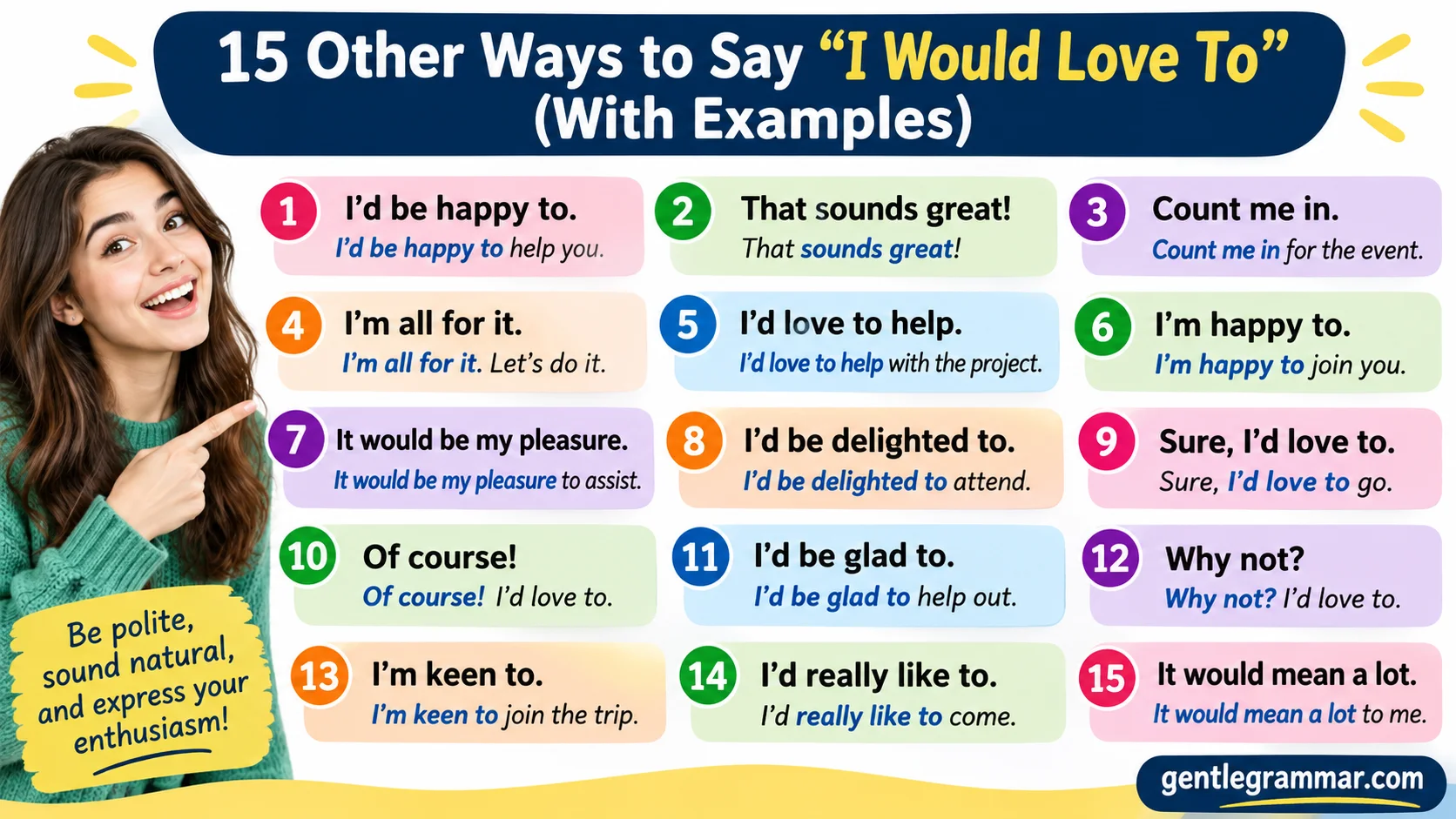
This guide, 15 Other Ways to Say “I Would Love To” (With Examples), shows how to express interest warmly in everyday and professional conversations.
The expression “I Would Love To” sounds warm, positive, and friendly when used in everyday conversation and casual settings. People commonly use it when accepting an invitation, sharing excitement, or offering help. In professional settings, such as the workplace, meetings, interviews, emails, formal discussions, and business negotiations, it communicates willingness, eagerness, and enthusiasm.
From my experience, choosing the right words makes a simple message sound more genuine and welcoming. Whether you are speaking with a colleague, client, manager, or business partner, showing kindness, empathy, gratitude, and respect can create lasting connections. These small communication choices also strengthen professional relationships, interpersonal relationships, polite communication, and social interaction.
What Does “I Would Love To” Mean?
“I Would Love To” is a friendly way to say that you are very willing, interested, or happy to do something. It often communicates enthusiasm without sounding overly forceful. For example, if someone asks, “Would you like to join us for dinner?” you can reply, “I would love to,” meaning that you would be genuinely pleased to join them.
The phrase can also show interest in an opportunity, invitation, activity, or request. It is common in everyday conversation, personal messages, emails, and workplace communication. Depending on context, it can express anything from simple willingness to genuine excitement. The phrase is usually warmer than a plain “yes” and more enthusiastic than “I’m willing to.”
Common Situations Where “I Would Love To” Is Used
People commonly use “I Would Love To” when accepting an invitation, agreeing to participate, expressing interest in an opportunity, or responding positively to someone’s suggestion. For example, you might say it when a friend invites you to dinner, a colleague asks you to join a project, or someone offers to show you around a new city.
It also works well in texts, emails, personal conversations, social interactions, and professional settings. However, the phrase can sometimes feel too warm or conversational for highly formal writing. In those situations, alternatives such as “I would be delighted to” or “I would be pleased to” may better match the setting.
Is It Professional or Polite to Say “I Would Love To”?
Yes. “I Would Love To” is generally polite, friendly, and perfectly acceptable in professional communication when the situation is reasonably conversational. It works especially well when accepting an invitation, volunteering for something, or showing enthusiasm toward a colleague’s suggestion.
Its main quality is warmth rather than formality. A message such as “I would love to discuss this further” sounds positive and approachable. In a highly formal letter, however, “I would be pleased to” or “I would be delighted to” may sound more polished. The best choice depends on your relationship with the reader and the level of formality you need.
Advantages and Disadvantages of Saying “I Would Love To”
Advantages
The biggest advantage of “I Would Love To” is that it communicates clear enthusiasm while remaining natural. It sounds more personable than simply saying “yes,” and it can make your response feel sincere rather than mechanical. The phrase is also flexible enough for both personal and many professional situations.
Another benefit is its positive emotional tone. You can use it to accept an invitation, show interest in an opportunity, or respond warmly to someone’s suggestion without sounding exaggerated. It is especially useful when you want your willingness to feel genuine.
Disadvantages
The phrase is not ideal for every setting. Because “love” carries emotional warmth, it can sound somewhat casual in highly formal correspondence. It may also be less suitable when you want to communicate neutral willingness rather than enthusiasm.
In addition, using the same expression repeatedly can make your writing feel predictable. Choosing a more precise alternative can help you communicate whether you are pleased, excited, grateful, eager, or simply willing to participate.
Synonyms for “I Would Love To”
- I’d Be Delighted To
- I’d Be Happy To
- I’d Be Glad To
- I’d Be Pleased To
- I’d Be Thrilled To
- I’d Be More Than Happy To
- I’d Be Honored To
- I’d Be Excited To
- I’m Looking Forward To It
- Count Me In
- Absolutely, I’d Love To
- I’d Welcome the Opportunity
- I’d Be Very Interested
- That Would Be Wonderful
- I’d Be Eager To
1. I’d Be Delighted To
Meaning
“I’d Be Delighted To” expresses that you would be very pleased and happy to do something. It carries a similar positive meaning to “I Would Love To,” but it usually sounds more polished and formal.
Definition
A warm, enthusiastic way of saying that you would be very pleased to accept or participate.
Detailed Explanation
This expression is especially useful when you want to show enthusiasm while maintaining a professional or refined tone. It works naturally in business emails, invitations, formal conversations, and courteous replies. Compared with “I Would Love To,” it places slightly more emphasis on pleasure and courtesy. It can therefore sound more polished without becoming stiff.
Scenario Examples
Scenario: A client invites you to discuss a new project.
Example: “I’d be delighted to discuss the project with you next week.”
Scenario: You receive an invitation to speak at an event.
Example: “I’d be delighted to take part in the event.”
Scenario: A colleague asks whether you can help.
Example: “I’d be delighted to help with the presentation.”
Best Use
Use it for professional emails, formal invitations, business conversations, and courteous replies.
Tone
Tone: Warm, polished, professional
It communicates genuine enthusiasm while keeping the language respectful and refined.
2. I’d Be Happy To
Meaning
“I’d Be Happy To” means that you are willing and pleased to do something. It is one of the most natural alternatives when you want to sound friendly without being overly enthusiastic.
Definition
A polite expression showing that you are willing and pleased to help, participate, or accept.
Detailed Explanation
This phrase is extremely flexible because it works in both casual and professional situations. It can communicate willingness without the stronger emotional feeling associated with “love.” It is particularly useful when someone asks you for help or assistance. The expression often sounds reassuring because it makes your willingness clear without making a big emotional statement.
Scenario Examples
Scenario: A coworker asks for help with a report.
Example: “I’d be happy to take a look at it this afternoon.”
Scenario: A friend asks whether you want to join them.
Example: “I’d be happy to come along.”
Scenario: A customer asks whether you can provide more information.
Example: “I’d be happy to answer any questions you have.”
Best Use
Use it for work emails, customer communication, friendly conversations, requests, and everyday situations.
Tone
Tone: Friendly, polite, helpful
It sounds positive and cooperative without being overly emotional.
3. I’d Be Glad To
Meaning
“I’d Be Glad To” expresses that you are willing and pleased to do something. It often sounds slightly more courteous than a simple “yes.”
Definition
A polite phrase meaning that you would willingly and happily do something.
Detailed Explanation
This expression is a good choice when you want your response to sound pleasant and cooperative. It is particularly natural when responding to a request or offering assistance. Compared with “I’d Be Happy To,” it can feel a little more traditional or formal. It does not usually carry the strong emotional excitement that “I’d Be Thrilled To” does.
Scenario Examples
Scenario: Someone asks whether you can send them the information.
Example: “I’d be glad to send it over this afternoon.”
Scenario: A neighbor needs help moving a box.
Example: “I’d be glad to give you a hand.”
Scenario: A colleague asks you to explain a process.
Example: “I’d be glad to walk you through it.”
Best Use
Use it in polite requests, workplace communication, helpful replies, and everyday conversation.
Tone
Tone: Courteous, friendly, cooperative
It gives your response a positive and willing quality.
4. I’d Be Pleased To
Meaning
“I’d Be Pleased To” means that you would be happy or satisfied to do something. It is more formal than many everyday alternatives.
Definition
A formal or professional expression showing willingness and pleasure.
Detailed Explanation
This phrase works particularly well when you want to communicate enthusiasm without sounding too casual. It is common in formal correspondence, business communication, and professional settings. Unlike “I’d Be Thrilled To,” it does not suggest intense excitement. Instead, it conveys calm, respectful willingness.
Scenario Examples
Scenario: A business partner asks you to attend a meeting.
Example: “I’d be pleased to attend the meeting on Thursday.”
Scenario: You are responding to a formal invitation.
Example: “I’d be pleased to accept your invitation.”
Scenario: A customer asks for additional assistance.
Example: “I’d be pleased to provide further information.”
Best Use
Use it for formal emails, business letters, professional invitations, and respectful replies.
Tone
Tone: Formal, courteous, professional
It sounds polished and measured rather than highly emotional.
5. I’d Be Thrilled To
Meaning
“I’d Be Thrilled To” communicates strong excitement and enthusiasm about doing something.
Definition
A highly positive expression meaning that you would be extremely happy or excited to participate.
Detailed Explanation
This phrase is stronger than “I Would Love To” because “thrilled” suggests genuine excitement. It is best when the opportunity feels special, exciting, or personally meaningful. Because it expresses strong emotion, it may sound excessive for routine workplace tasks. Use it when you actually want to emphasize enthusiasm.
Scenario Examples
Scenario: You are invited to speak at an event you admire.
Example: “I’d be thrilled to speak at your conference.”
Scenario: A friend invites you on a long-awaited trip.
Example: “I’d be thrilled to join you.”
Scenario: You receive an exciting career opportunity.
Example: “I’d be thrilled to be part of the team.”
Best Use
Use it for exciting opportunities, special invitations, celebrations, and meaningful personal situations.
Tone
Tone: Enthusiastic, excited, warm
It clearly communicates a high level of interest.
6. I’d Be More Than Happy To
Meaning
“I’d Be More Than Happy To” emphasizes that you are very willing and pleased to do something.
Definition
An enthusiastic way of saying that you would be very happy to help or participate.
Detailed Explanation
This expression adds extra warmth to an ordinary offer of help. It can sound especially encouraging when someone is uncertain about asking you for something. The phrase is stronger than simply “I’d Be Happy To,” but it remains natural in everyday and professional communication. It is best used when you genuinely want to show generosity or willingness.
Scenario Examples
Scenario: A colleague hesitates before asking for assistance.
Example: “I’d be more than happy to review your draft.”
Scenario: A friend needs someone to accompany them.
Example: “I’d be more than happy to come with you.”
Scenario: A customer needs additional support.
Example: “I’d be more than happy to arrange that for you.”
Best Use
Use it for helpful replies, customer service, workplace communication, and warm personal messages.
Tone
Tone: Warm, generous, reassuring
It makes your willingness sound especially sincere.
7. I’d Be Honored To
Meaning
“I’d Be Honored To” means that you would feel privileged or deeply appreciative to do something.
Definition
A respectful expression used when an opportunity feels meaningful, important, or prestigious.
Detailed Explanation
This phrase is not simply a stronger version of “I Would Love To.” It adds a sense of respect and significance. You might use it when someone gives you an important responsibility, invitation, or opportunity. It can sound too serious for ordinary situations, so the context matters.
Scenario Examples
Scenario: You are invited to speak at an important ceremony.
Example: “I’d be honored to give the keynote address.”
Scenario: Someone asks you to be part of a meaningful project.
Example: “I’d be honored to contribute to the project.”
Scenario: A respected mentor asks you to assist them.
Example: “I’d be honored to work with you.”
Best Use
Use it for meaningful invitations, prestigious opportunities, ceremonies, and respectful professional situations.
Tone
Tone: Respectful, sincere, formal
It suggests appreciation as well as willingness.
8. I’d Be Excited To
Meaning
“I’d Be Excited To” shows that you feel enthusiastic and eager about doing something.
Definition
A phrase expressing strong interest and anticipation about an upcoming activity or opportunity.
Detailed Explanation
This expression focuses more on excitement about the future than simple willingness. It works well when you want the other person to know that you are genuinely looking forward to an opportunity. It is generally more energetic than “I’d Be Happy To.” In professional settings, it can sound enthusiastic and approachable when used naturally.
Scenario Examples
Scenario: You are joining a new team.
Example: “I’d be excited to work with everyone on this project.”
Scenario: A friend suggests visiting a new place.
Example: “I’d be excited to check it out with you.”
Scenario: You are discussing a potential collaboration.
Example: “I’d be excited to explore that idea together.”
Best Use
Use it for new opportunities, collaborations, trips, projects, and enthusiastic personal conversations.
Tone
Tone: Energetic, optimistic, enthusiastic
It highlights your excitement about what may happen next.
9. I’m Looking Forward To It
Meaning
“I’m Looking Forward To It” means that you are pleased about something that will happen in the future and expect it positively.
Definition
An expression showing positive anticipation about a future event or experience.
Detailed Explanation
This phrase differs from “I Would Love To” because it usually refers to something that has already been planned, offered, or agreed upon. It does not necessarily mean that you are accepting an invitation. Instead, it tells someone that you are anticipating the upcoming experience. It is especially natural at the end of emails and conversations.
Scenario Examples
Scenario: A meeting has already been scheduled.
Example: “Thanks for arranging the meeting. I’m looking forward to it.”
Scenario: You have accepted an invitation from a friend.
Example: “Saturday sounds great. I’m looking forward to it!”
Scenario: A client confirms an upcoming discussion.
Example: “I’m looking forward to speaking with you next week.”
Best Use
Use it for emails, scheduled meetings, trips, events, appointments, and personal plans.
Tone
Tone: Warm, positive, anticipatory
It communicates pleasant expectation rather than immediate acceptance.
10. Count Me In
Meaning
“Count Me In” means include me in the activity, plan, or event. It is a casual and energetic way to show that you want to participate.
Definition
An informal expression meaning “I want to participate” or “I’m joining you.”
Detailed Explanation
This phrase is much more casual than “I’d Be Pleased To.” It works particularly well among friends, colleagues who have a relaxed relationship, or people making informal plans. It has an upbeat quality and often sounds more spontaneous than “I Would Love To.” Avoid it in highly formal correspondence.
Scenario Examples
Scenario: Friends are planning a weekend hike.
Example: “You’re going hiking Saturday? Count me in!”
Scenario: Coworkers are organizing an informal lunch.
Example: “If you’re all going for lunch, count me in.”
Scenario: A group is planning a game night.
Example: “Sounds fun. Count me in.”
Best Use
Use it for casual conversations, group plans, texting, social activities, and informal workplace chats.
Tone
Tone: Casual, upbeat, enthusiastic
It sounds confident, friendly, and spontaneous.
11. Absolutely, I’d Love To
Meaning
“Absolutely, I’d Love To” adds strong agreement and enthusiasm to the original expression.
Definition
An enthusiastic way to say yes while clearly showing that you genuinely want to participate.
Detailed Explanation
This expression is useful when a simple “I Would Love To” does not feel enthusiastic enough. The word “absolutely” makes the response more definite and energetic. It is especially natural in spoken English and informal messages. Because it is strongly conversational, it may be less appropriate for very formal writing.
Scenario Examples
Scenario: A friend invites you to dinner.
Example: “Would you like to come over Friday?” “Absolutely, I’d love to!”
Scenario: Someone offers you a chance to attend a concert.
Example: “Absolutely, I’d love to go.”
Scenario: A colleague suggests grabbing coffee.
Example: “Absolutely, I’d love to catch up.”
Best Use
Use it for friendly conversations, texting, invitations, social plans, and enthusiastic replies.
Tone
Tone: Warm, enthusiastic, conversational
It gives a clear and energetic “yes.”
12. I’d Welcome the Opportunity
Meaning
“I’d Welcome the Opportunity” means that you would greatly appreciate the chance to do something.
Definition
A professional expression showing strong interest in receiving an opportunity.
Detailed Explanation
This phrase is more formal and deliberate than “I Would Love To.” It is particularly useful when discussing jobs, collaborations, interviews, projects, or professional opportunities. Rather than focusing on emotion, it emphasizes your openness and appreciation for the opportunity. It can make your interest sound thoughtful and professional.
Scenario Examples
Scenario: You are applying for a position.
Example: “I’d welcome the opportunity to discuss my experience in an interview.”
Scenario: A company suggests a potential partnership.
Example: “I’d welcome the opportunity to explore a partnership.”
Scenario: You are responding to a professional introduction.
Example: “I’d welcome the opportunity to learn more about your work.”
Best Use
Use it for job applications, professional emails, networking, interviews, proposals, and business communication.
Tone
Tone: Professional, confident, respectful
It communicates serious interest without sounding overly emotional.
13. I’d Be Very Interested
Meaning
“I’d Be Very Interested” communicates that something has strongly caught your attention and you would like to learn more or participate.
Definition
A measured expression showing strong interest or curiosity about an opportunity or proposal.
Detailed Explanation
This phrase is less emotional than “I Would Love To.” It is useful when you want to express interest while keeping your language professional and controlled. It does not always mean that you have already agreed to something. Instead, it can leave room for further discussion or information. That makes it particularly useful in business communication.
Scenario Examples
Scenario: Someone proposes a possible collaboration.
Example: “I’d be very interested in discussing how we could work together.”
Scenario: A recruiter contacts you about a position.
Example: “I’d be very interested in learning more about the role.”
Scenario: Someone mentions an unfamiliar course.
Example: “I’d be very interested in hearing more about it.”
Best Use
Use it for professional conversations, networking, opportunities, proposals, and situations where you want more information.
Tone
Tone: Professional, measured, interested
It shows genuine interest without making an immediate commitment.
14. That Would Be Wonderful
Meaning
“That Would Be Wonderful” expresses that a suggested plan or opportunity sounds very appealing and positive.
Definition
A warm response meaning that something proposed would be very pleasant, welcome, or enjoyable.
Detailed Explanation
Unlike “I Would Love To,” this expression focuses on the proposal or outcome rather than directly stating your willingness to act. It can sound particularly natural when responding to an invitation or suggestion. The phrase is warmer than a simple “that sounds good,” but it does not necessarily make a firm commitment. Context determines whether it functions as enthusiastic agreement or polite appreciation.
Scenario Examples
Scenario: A friend suggests meeting for lunch.
Example: “Lunch next Friday? That would be wonderful.”
Scenario: A family member offers to visit.
Example: “That would be wonderful. We’d love to see you.”
Scenario: A colleague suggests a useful meeting time.
Example: “That would be wonderful. Thursday afternoon works for me.”
Best Use
Use it for friendly invitations, personal messages, social plans, and warm conversational replies.
Tone
Tone: Warm, appreciative, positive
It makes your response feel gracious and genuinely pleased.
15. I’d Be Eager To
Meaning
“I’d Be Eager To” communicates a strong desire and readiness to do something.
Definition
A phrase meaning that you are very interested and ready to participate or take action.
Detailed Explanation
This expression emphasizes motivation and readiness more strongly than “I Would Love To.” It can work well when discussing responsibilities, projects, learning opportunities, or future plans. It is somewhat more formal than “I’d Be Excited To,” especially in professional writing. Because it suggests strong motivation, it should be used when that level of enthusiasm is genuine.
Scenario Examples
Scenario: You are discussing a new work project.
Example: “I’d be eager to contribute to the next phase.”
Scenario: A professor offers an opportunity to research a new topic.
Example: “I’d be eager to learn more about the project.”
Scenario: You are discussing a chance to develop a new skill.
Example: “I’d be eager to take on that challenge.”
Best Use
Use it for professional opportunities, projects, learning, career discussions, and situations involving strong motivation.
Tone
Tone: Motivated, confident, enthusiastic
It suggests that you are not only interested but also ready to get involved.
FAQs:
What is another way to say “I Would Love To”?
Some natural alternatives include “I’d Be Happy To,” “I’d Be Delighted To,” “I’d Be Glad To,” “I’d Be Pleased To,” and “I’d Be Excited To.” The best choice depends on your tone and situation. For casual conversation, “Count Me In” works well, while “I’d Welcome the Opportunity” is better suited to professional communication.
What does “I Would Love To” mean?
“I Would Love To” means that you would be very happy, willing, or enthusiastic to do something. It commonly appears when accepting an invitation, agreeing to participate, or showing interest in an opportunity. It generally sounds warmer than simply saying “yes.”
Is “I Would Love To” professional?
Yes. “I Would Love To” can be professional, particularly in friendly workplace communication. However, it is more conversational than highly formal expressions such as “I’d Be Pleased To” or “I’d Be Delighted To.” Consider the relationship, setting, and level of formality before choosing your wording.
What is a more polite way to say “I Would Love To”?
“I’d Be Delighted To” and “I’d Be Pleased To” are polished, courteous alternatives. If you are responding to a request for help, “I’d Be Happy To” is also naturally polite and approachable. The most suitable option depends on how formal the situation is.
Which alternative works best in formal communication?
For formal communication, “I’d Be Pleased To,” “I’d Be Delighted To,” and “I’d Welcome the Opportunity” are strong choices. “I’d Be Pleased To” sounds calm and professional, while “I’d Welcome the Opportunity” works especially well when discussing jobs, collaborations, or other professional opportunities.
Conclusion:
Choosing the right alternative to “I Would Love To” is less about finding one perfect synonym and more about matching your wording to the situation. “I’d Be Happy To” feels friendly and helpful, while “I’d Be Delighted To” sounds more polished. “Count Me In” brings a casual, energetic feel, whereas “I’d Welcome the Opportunity” communicates professional interest. Other expressions highlight excitement, respect, anticipation, or willingness in slightly different ways.
The important thing is to consider the relationship, context, level of formality, and emotion behind your message. A small change in wording can make your response feel warmer, clearer, or more appropriate. When you understand these differences, you can move beyond repeating “I Would Love To” and choose language that says exactly what you mean.
