
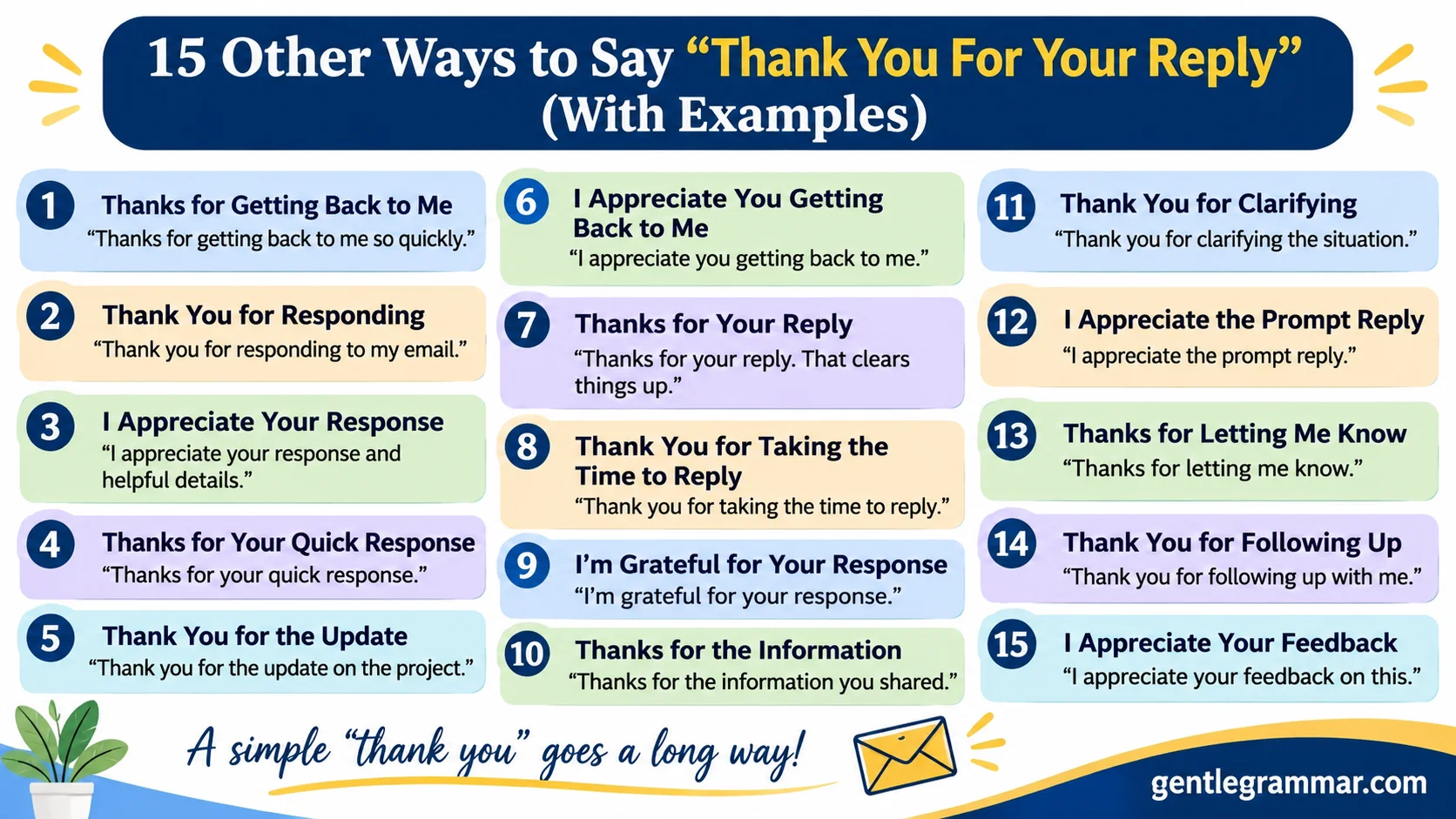
15 Other Ways to Say “Thank You For Your Reply” (With Examples) can help you choose a polite response when a simple thank-you feels too routine.
When I receive an email or reply, I avoid going through autopilot with the same copy-pasted line. A quick reply can show that you thank the person who responds, while a polite, professional, and friendly message helps them feel appreciated and respected. In the business world, email replies are important because a timely response can show that someone is keen and ready for action.
Saying “thank you for your reply” is safe and formal, but natural alternatives can make your communication sound more personal. For instance, “I appreciate your reply,” “your reply is welcome,” and “thank you for getting back to me” are good choices when you want to express appreciation because someone took the time to respond, especially when you weren’t expecting an answer so quickly. These alternatives also make your emails more varied, clear, and engaging instead of leaving you with a stale phrase when replying.
What Does “Thank You For Your Reply” Mean?
“Thank You For Your Reply” is a polite way to express appreciation for someone responding to your message, question, or request. It tells the other person that you noticed their response and appreciate the time they took to answer.
The phrase is commonly used in emails, professional messages, customer service conversations, and personal communication. It does not necessarily express strong emotion. Instead, it provides a simple acknowledgment that the other person has responded. Depending on the situation, you might choose a warmer expression when the reply was especially helpful or a more formal one when communicating in a business setting.
Common Situations Where “Thank You For Your Reply” Is Used
You can use this phrase when someone answers an email, responds to a question, provides requested information, or gets back to you after some time. It works particularly well in professional correspondence because it is courteous without sounding overly familiar.
For example, you might write it to a colleague who answered your question, a customer who provided details, or a company representative who responded to your inquiry. In personal conversations, the phrase can sound slightly formal, so a more relaxed alternative may feel more natural. Choosing another expression can also help you avoid repeating the same wording throughout a long email exchange.
Is It Professional or Polite to Say “Thank You For Your Reply”?
Yes. “Thank You For Your Reply” is both polite and professional. It is especially suitable for emails, workplace communication, customer service, and other situations where you want to acknowledge someone’s response respectfully.
The expression is fairly neutral, though. It does not necessarily show that the response was useful, detailed, or especially appreciated. If someone gave you valuable information, you might prefer “Thank you for the helpful response” or “I appreciate your detailed response.” For a more formal setting, “Thank you for your response” can also sound slightly more polished.
Advantages and Disadvantages of Saying “Thank You For Your Reply”
Advantages
The phrase is clear, courteous, and easy to understand. It immediately acknowledges that someone responded and shows basic appreciation. It also works across many professional situations without sounding excessively formal or emotional. Because the wording is straightforward, it is a safe choice when you want to keep an email concise.
Disadvantages
Its main limitation is that it can sometimes feel routine or repetitive, especially when used frequently in business emails. It also does not tell the reader what you appreciated about their reply. If the person gave detailed guidance, solved a problem, or took considerable time to help you, a more specific expression may communicate your appreciation better.
Synonyms for “Thank You For Your Reply”
- Thank You for Your Response
- I Appreciate Your Response
- Thank You for Getting Back to Me
- Thanks for Getting Back to Me
- I Appreciate Your Reply
- Thank You for the Quick Response
- Thank You for the Prompt Response
- Thank You for Your Helpful Response
- I Appreciate the Information
- Thanks for Taking the Time to Respond
- Thank You for Following Up
- I’m Grateful for Your Response
- Thanks for the Update
- I Appreciate You Getting Back to Me
- Thank You for Taking the Time to Reply
1. Thank You for Your Response
Meaning
“Thank You for Your Response” expresses appreciation for someone answering or responding to your message. It has essentially the same basic purpose as “Thank You For Your Reply.”
Definition
A polite expression used to acknowledge and appreciate someone’s response to a message, question, or request.
Detailed Explanation
This is one of the most natural alternatives for professional communication. “Response” sounds slightly more formal and polished than “reply,” which makes it particularly useful in business emails. It can refer to a short answer or a detailed explanation. Because it is neutral, it works well when you don’t need to express a stronger emotion.
Scenario Examples
Scenario: A client answers your questions about a project.
Example: “Thank you for your response. The additional details are very helpful.”
Scenario: A company replies to your inquiry.
Example: “Thank you for your response regarding my application.”
Best Use
Best for professional emails, formal correspondence, customer communication, and workplace messages.
Tone
Tone: Professional, polite, neutral. It sounds respectful without being overly formal.
2. I Appreciate Your Response
Meaning
“I Appreciate Your Response” shows that you value the person’s effort to respond, rather than simply acknowledging that they answered.
Definition
A courteous expression used to communicate genuine appreciation for someone’s response.
Detailed Explanation
This phrase feels slightly warmer than “Thank You for Your Response.” The verb “appreciate” adds a sense of personal gratitude. It works especially well when the other person provided useful information or took time to address your concerns. It can sound more thoughtful than a standard acknowledgment.
Scenario Examples
Scenario: A colleague gives you detailed feedback.
Example: “I appreciate your response and the suggestions you shared.”
Scenario: Someone answers a difficult question.
Example: “I appreciate your response. It clarified the issue for me.”
Best Use
Useful in professional emails, workplace communication, customer conversations, and respectful personal messages.
Tone
Tone: Warm, professional, appreciative. It communicates more personal gratitude than a basic “thank you.”
3. Thank You for Getting Back to Me
Meaning
“Thank You for Getting Back to Me” thanks someone for responding after you previously contacted them.
Definition
A friendly expression used when someone responds to a previous message, email, or request.
Detailed Explanation
“Getting back to me” is a common conversational expression meaning responding to me later. It is especially natural when there has been some time between your original message and the person’s response. Compared with “Thank You For Your Reply,” this wording feels more relaxed and personal. It is less formal than “Thank You for Your Response.”
Scenario Examples
Scenario: A coworker responds after being busy.
Example: “Thanks for getting back to me. I can meet at 3 p.m.”
Scenario: You receive an answer from a service provider.
Example: “Thank you for getting back to me about the appointment.”
Best Use
Best for work emails, friendly professional communication, and everyday messages.
Tone
Tone: Friendly, polite, conversational. It is respectful without sounding stiff.
4. Thanks for Getting Back to Me
Meaning
“Thanks for Getting Back to Me” is the more casual version of “Thank You for Getting Back to Me.”
Definition
A relaxed way to show appreciation when someone responds to an earlier message or request.
Detailed Explanation
The shorter “Thanks” makes this expression feel more conversational. It is a good choice when you already have a comfortable relationship with the recipient. Although it can work at work, it may not be the best choice for highly formal correspondence. The phrase is particularly natural in emails, chats, and text messages.
Scenario Examples
Scenario: Your friend replies to your question.
Example: “Thanks for getting back to me! Let me know what time works for you.”
Scenario: A familiar coworker answers your message.
Example: “Thanks for getting back to me. I’ll update the document now.”
Best Use
Best for texting, casual emails, friendly workplace communication, and everyday conversations.
Tone
Tone: Casual, friendly, relaxed. It feels more personal than a formal acknowledgment.
5. I Appreciate Your Reply
Meaning
“I Appreciate Your Reply” expresses gratitude for the person’s answer while keeping the focus on the reply itself.
Definition
A polite expression that means you value the response someone has provided.
Detailed Explanation
This expression is close to “I Appreciate Your Response,” but “reply” can feel slightly more conversational. It works well when you want to sound thankful without becoming overly emotional. It is especially useful when the person has answered a specific question. The phrase can also help vary your wording across a series of emails.
Scenario Examples
Scenario: Someone answers your question about an assignment.
Example: “I appreciate your reply. I’ll make the requested changes.”
Scenario: A colleague confirms an important detail.
Example: “I appreciate your reply and the clarification.”
Best Use
Useful in professional emails, school communication, workplace messages, and polite personal correspondence.
Tone
Tone: Polite, warm, professional. It is appreciative while remaining measured.
6. Thank You for the Quick Response
Meaning
“Thank You for the Quick Response” specifically thanks someone for responding quickly.
Definition
A phrase used to appreciate someone who replied sooner than expected or without unnecessary delay.
Detailed Explanation
This alternative adds a specific reason for your gratitude. It is appropriate when speed mattered or when the person answered promptly. Unlike the original phrase, it praises the timeliness of the response. However, you should avoid it when the reply was not actually quick.
Scenario Examples
Scenario: A customer service representative answers within minutes.
Example: “Thank you for the quick response. I was able to resolve the issue right away.”
Scenario: A coworker immediately confirms a meeting.
Example: “Thank you for the quick response. I’ll see you at 10.”
Best Use
Best for work emails, customer service, urgent requests, and time-sensitive communication.
Tone
Tone: Appreciative, professional, direct. It recognizes both the reply and the person’s promptness.
7. Thank You for the Prompt Response
Meaning
“Thank You for the Prompt Response” expresses appreciation for a response that was given quickly and efficiently.
Definition
A formal expression thanking someone for responding without unnecessary delay.
Detailed Explanation
This phrase is similar to “Thank You for the Quick Response,” but “prompt” sounds more formal and businesslike. It is common in professional correspondence where efficiency matters. It works especially well when communicating with clients, organizations, or professional contacts. Because of its formal tone, it may feel excessive in a casual text.
Scenario Examples
Scenario: A company quickly handles your inquiry.
Example: “Thank you for the prompt response to my request.”
Scenario: A client answers before an important deadline.
Example: “Thank you for your prompt response. We can now proceed with the project.”
Best Use
Best for formal emails, business correspondence, client communication, and official messages.
Tone
Tone: Formal, professional, respectful. “Prompt” gives the expression a polished business tone.
8. Thank You for Your Helpful Response
Meaning
“Thank You for Your Helpful Response” thanks someone specifically because their reply provided useful information or assistance.
Definition
A phrase used to express appreciation for a response that helped you understand, decide, or solve something.
Detailed Explanation
This expression adds more meaning than a simple thank-you. Instead of merely acknowledging the response, you tell the recipient that their answer was useful. That makes the message feel more genuine and specific. It is a strong choice when someone has gone beyond giving a short answer.
Scenario Examples
Scenario: A colleague explains how to complete a task.
Example: “Thank you for your helpful response. I understand the process now.”
Scenario: Customer support solves your problem.
Example: “Thank you for your helpful response and clear instructions.”
Best Use
Ideal for customer service, workplace communication, support emails, and professional correspondence.
Tone
Tone: Warm, appreciative, professional. The word “helpful” makes your gratitude more specific.
9. I Appreciate the Information
Meaning
“I Appreciate the Information” thanks someone for sharing useful facts, details, or instructions.
Definition
A polite expression showing gratitude for information someone has provided.
Detailed Explanation
This expression shifts the focus from the act of replying to the information contained in the reply. That makes it particularly useful when someone answers your question with facts or instructions. It is not a direct synonym in every situation because it may not fit a reply that contains little or no information. Use it when the content itself is what you value.
Scenario Examples
Scenario: A manager gives you project details.
Example: “I appreciate the information. I’ll review the schedule this afternoon.”
Scenario: A company explains its pricing.
Example: “I appreciate the information about the available plans.”
Best Use
Best for business emails, customer communication, research, workplace conversations, and informational exchanges.
Tone
Tone: Professional, appreciative, measured. It sounds focused on the usefulness of the information.
10. Thanks for Taking the Time to Respond
Meaning
“Thanks for Taking the Time to Respond” recognizes that someone spent time and effort answering you.
Definition
A warm expression used to appreciate someone’s effort in providing a response.
Detailed Explanation
This phrase goes beyond thanking someone for simply replying. It acknowledges the time and attention they gave you. That makes it especially suitable when the response was detailed, thoughtful, or required effort. It is warmer than a routine “Thank You for Your Reply.”
Scenario Examples
Scenario: A professor gives detailed feedback.
Example: “Thanks for taking the time to respond to my questions.”
Scenario: A colleague helps you work through a complicated issue.
Example: “I really appreciate you taking the time to respond so thoroughly.”
Best Use
Best for thoughtful professional messages, academic communication, detailed replies, and personal correspondence.
Tone
Tone: Warm, respectful, sincere. It emphasizes the person’s effort.
11. Thank You for Following Up
Meaning
“Thank You for Following Up” thanks someone for checking back, providing an update, or continuing a conversation.
Definition
A phrase used to appreciate someone who returns to an issue or contacts you again with additional information.
Detailed Explanation
This expression is not interchangeable with “Thank You For Your Reply” in every situation. It works when the person has taken an additional step after an earlier conversation or request. For example, they may have checked on a problem and then contacted you with the result. It is useful when the follow-up itself is what you appreciate.
Scenario Examples
Scenario: A customer service representative checks on your complaint.
Example: “Thank you for following up on my request.”
Scenario: A recruiter contacts you again with an update.
Example: “Thank you for following up and keeping me informed.”
Best Use
Best for customer service, workplace communication, hiring conversations, project updates, and ongoing professional discussions.
Tone
Tone: Professional, appreciative, attentive. It shows that you noticed the person’s continued effort.
12. I’m Grateful for Your Response
Meaning
“I’m Grateful for Your Response” expresses stronger and more heartfelt appreciation for someone’s answer.
Definition
A warm expression used to communicate genuine gratitude for a person’s response.
Detailed Explanation
“Grateful” carries more emotional weight than “thankful” or “appreciate” in many contexts. It works best when the person’s response genuinely mattered to you or provided meaningful help. It can sound too emotional for a routine business acknowledgment. Use it selectively when you want your gratitude to feel sincere and substantial.
Scenario Examples
Scenario: Someone provides important personal advice.
Example: “I’m grateful for your response and your honest advice.”
Scenario: A colleague helps during a difficult situation.
Example: “I’m truly grateful for your response. It gave me a clear way forward.”
Best Use
Best for personal messages, meaningful professional communication, and situations involving significant help or support.
Tone
Tone: Warm, sincere, heartfelt. It communicates deeper appreciation than a routine thank-you.
13. Thanks for the Update
Meaning
“Thanks for the Update” thanks someone for sharing new information about a situation, task, or event.
Definition
A concise expression used to appreciate new information or progress someone has communicated.
Detailed Explanation
This phrase is useful when the person’s reply tells you what has changed or what is happening next. It is not a general substitute for every reply because it specifically focuses on an update. For example, it works well when someone tells you that a project is delayed or an order has shipped. Its short wording makes it especially natural in workplace messages.
Scenario Examples
Scenario: A coworker tells you a project has moved forward.
Example: “Thanks for the update. I’ll adjust my schedule accordingly.”
Scenario: A company tells you when your order will arrive.
Example: “Thanks for the update on my delivery.”
Best Use
Best for work chats, project communication, customer service, emails, and brief professional messages.
Tone
Tone: Friendly, concise, professional. It is practical rather than emotional.
14. I Appreciate You Getting Back to Me
Meaning
“I Appreciate You Getting Back to Me” expresses gratitude for someone responding after you contacted them earlier.
Definition
A friendly expression that appreciates someone’s effort to reply or return to a conversation.
Detailed Explanation
This phrase combines the warmth of “I appreciate” with the conversational expression “getting back to me.” It sounds more personal than “I Appreciate Your Response.” It works particularly well when you had been waiting for an answer or when the person made an effort to reconnect. It is generally less formal than traditional business wording.
Scenario Examples
Scenario: A colleague responds after being unavailable.
Example: “I appreciate you getting back to me. That clears things up.”
Scenario: Someone answers your earlier message after checking the details.
Example: “I appreciate you getting back to me with that information.”
Best Use
Best for friendly professional emails, workplace communication, personal messages, and ongoing conversations.
Tone
Tone: Warm, conversational, appreciative. It feels personal without being overly informal.
15. Thank You for Taking the Time to Reply
Meaning
“Thank You for Taking the Time to Reply” thanks someone for making an effort to answer you.
Definition
A polite expression that recognizes the time and attention someone gave when responding.
Detailed Explanation
This phrase is similar to “Thanks for Taking the Time to Respond,” but “reply” gives it a slightly more conversational feel. It is useful when the person’s answer required thought, explanation, or effort. The wording makes your appreciation more specific than a simple thank-you. It can also make a professional message feel more considerate.
Scenario Examples
Scenario: A mentor answers several questions you sent.
Example: “Thank you for taking the time to reply to all my questions.”
Scenario: A customer gives detailed feedback.
Example: “Thank you for taking the time to reply and share your experience.”
Best Use
Best for professional emails, personal correspondence, academic messages, and thoughtful replies.
Tone
Tone: Respectful, warm, sincere. It highlights the effort behind the response.
FAQs:
What is another way to say “Thank You For Your Reply”?
A strong general alternative is “Thank You for Your Response.” For a warmer tone, try “I Appreciate Your Response.” If the person responded after some time, “Thank You for Getting Back to Me” sounds more conversational.
What does “Thank You For Your Reply” mean?
It means you appreciate someone responding to your message, question, or request. It is a simple and polite way to acknowledge that the person took the time to answer.
Is “Thank You For Your Reply” professional?
Yes. It is professional, polite, and neutral, making it suitable for workplace emails, customer communication, and formal correspondence. “Thank You for Your Response” can sound slightly more polished in formal writing.
What is a more polite way to say “Thank You For Your Reply”?
If you want to emphasize the person’s effort, try “Thank You for Taking the Time to Reply.” If the response was especially useful, “Thank You for Your Helpful Response” communicates more specific appreciation.
Which alternative works best in formal communication?
“Thank You for Your Response” is one of the safest choices for formal communication. For a particularly formal or business-focused message, “Thank You for the Prompt Response” works well when the person actually responded quickly.
Conclusion:
Choosing the right way to express gratitude can make a small message feel much more thoughtful. “Thank You For Your Reply” is already polite and professional, but different situations call for different shades of meaning. You might want to highlight speed, helpfulness, effort, new information, or simply the fact that someone responded.
The best alternative depends on your relationship with the recipient, the purpose of the message, and the tone you want to create. “Thank You for Your Response” is a reliable professional choice, while “Thanks for Getting Back to Me” feels more conversational. When someone put real effort into answering, “Thank You for Taking the Time to Reply” can express that appreciation more clearly.
