
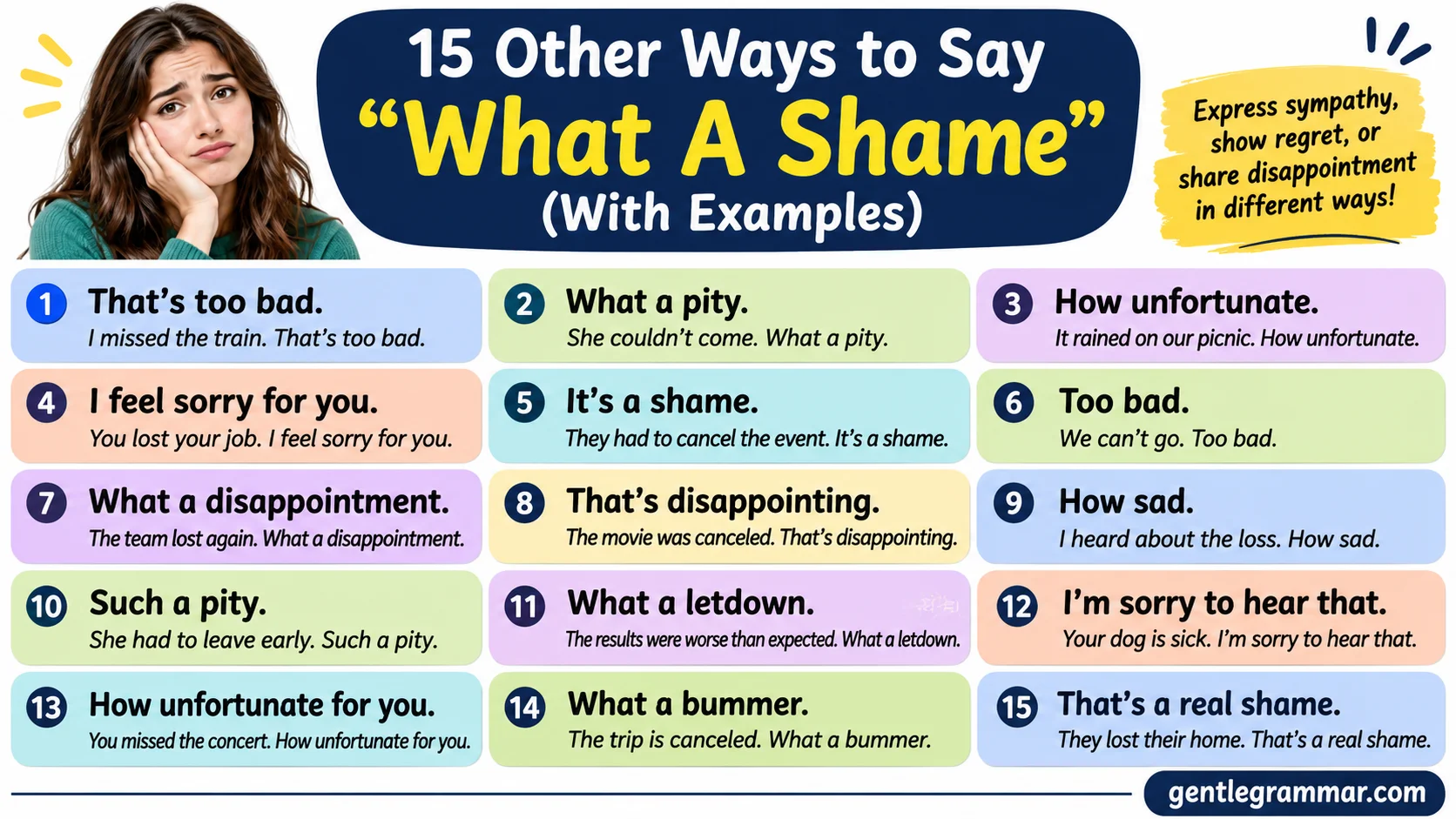
This guide to 15 Other Ways to Say “What A Shame” (With Examples) helps you respond to bad news with warmth, empathy, and care with confidence.
In everyday conversation, life often brings bad news, and knowing the right words can make a difference. “What a shame” is a common expression used to show disappointment, sympathy, regret, or concern when an unfortunate situation occurs. It means something is too bad or sad, similar to saying, “that’s what a pity.” This mild phrase sounds natural, polite, and supportive when expressing feelings without exaggeration.
For example, when someone shares news about an event, such as a flight canceled, or when a plan fails and an opportunity is lost, a thoughtful response can offer warmth and understanding. These alternative expressions and English phrases help you choose appropriate wording depending on the context, whether you’re speaking with a friend, a colleague, or someone in a professional setting. They also work well in daily conversation, formal communication, and informal communication.
What Does “What A Shame” Mean?
“What a shame” is an expression used to show disappointment, regret, or sympathy about something unfortunate. It usually means that the speaker thinks a situation is unfortunate and wishes it had happened differently. For example, if a friend tells you that their vacation was canceled because of bad weather, you might say, “What a shame!” to show that you feel sorry about the situation.
The phrase can be used for both small disappointments and more serious situations, although the surrounding context determines how it sounds. In everyday conversation, it is often sympathetic and conversational. Depending on your tone of voice, however, it can sometimes sound sarcastic or dismissive. Because of this, a warmer alternative may be better when someone is genuinely upset.
Common Situations Where “What A Shame” Is Used
People commonly use “What a shame” in everyday conversations when reacting to disappointing news. It can work in a conversation with a friend, a text message, a family discussion, or a casual social interaction. For example, if someone says they missed an important event because they were sick, “What a shame” naturally communicates regret.
The expression can also appear in personal messages and informal workplace conversations. However, it is less suitable for highly formal communication, especially when discussing serious problems with customers, clients, or colleagues. In those situations, a more precise expression such as “That’s unfortunate” or “I’m sorry to hear that” may sound more considerate and professional.
Is It Professional or Polite to Say “What A Shame”?
“What a shame” is generally polite, but it is more conversational than formal. It can sound warm and sympathetic when you say it sincerely, especially when someone shares mildly disappointing news. For example, telling a coworker, “What a shame you couldn’t attend the event,” can sound perfectly natural in a friendly conversation.
The phrase is less appropriate when you need a carefully worded professional response to a serious matter. In an email to a customer or a formal business message, “That’s unfortunate”, “I’m sorry to hear that”, or “That is regrettable” may communicate the same basic idea with greater sensitivity. Tone also matters because “What a shame” can sound sarcastic if the speaker emphasizes it in the wrong way.
Advantages and Disadvantages of Saying “What A Shame”
Advantages
“What a shame” is short, natural, and emotionally clear. It lets you acknowledge disappointment without giving a long explanation. The expression is especially useful when someone has just shared mildly bad news and you want to respond sympathetically. It also works well in spoken English because it feels spontaneous rather than overly prepared.
Another advantage is its flexibility. You can use it for something relatively minor, such as missing a concert, or something more meaningful, such as losing an opportunity. Its exact emotional strength comes from the situation and your tone.
Disadvantages
The main limitation is that “What a shame” can be too casual or vague for some situations. If someone has experienced a serious personal difficulty, the phrase may not express enough empathy on its own. A more direct response such as “I’m sorry to hear that” may feel more caring.
There is also a small risk of sounding dismissive or sarcastic, particularly when the phrase is used without context. In formal writing, it may also feel less precise than expressions such as “That is unfortunate” or “That is regrettable.”
Synonyms for “What A Shame”
- What a pity
- That’s unfortunate
- That’s too bad
- Such a shame
- I’m sorry to hear that
- How unfortunate
- That’s disappointing
- It’s unfortunate
- That’s regrettable
- What a disappointment
- That’s a real shame
- What a letdown
- Sadly, that happened
- That’s really unfortunate
- It’s a pity
1. What a pity
Meaning
“What a pity” expresses disappointment or regret about an unfortunate situation. It is very close in meaning to “What a shame” and often suggests that something desirable did not happen.
Definition
“What a pity” means that something is unfortunate or disappointing and that you wish the situation were different.
Detailed Explanation
This expression is a natural alternative when you want to sound sympathetic without being overly emotional. It is especially common when discussing missed opportunities, canceled plans, or unfortunate circumstances. Compared with “What a shame,” it can sometimes sound slightly more polished or old-fashioned, depending on the speaker and region. It works naturally in both spoken English and personal writing.
Scenario Examples
Scenario: A friend cannot attend a concert because they have to work.
Example: “What a pity you have to miss the concert. You were really looking forward to it.”
Scenario: A student tells a teacher that the school trip was canceled.
Example: “What a pity. I know everyone was excited about the trip.”
Scenario: Someone missed seeing a famous performer by a few minutes.
Example: “What a pity you arrived just after the show ended.”
Best Use
Use “What a pity” in casual conversations, personal messages, and situations involving missed opportunities or disappointing plans.
Tone
Tone: Sympathetic, conversational, and mildly formal. It sounds caring without being too dramatic.
2. That’s unfortunate
Meaning
“That’s unfortunate” acknowledges that something has gone wrong or that a situation is disappointing. It is one of the most useful alternatives when you need a more professional or neutral response.
Definition
“That’s unfortunate” means that something undesirable or unlucky has happened.
Detailed Explanation
This phrase is more neutral than “What a shame” and fits a wider range of professional situations. It can express concern without sounding overly emotional or familiar. You might use it when responding to a customer, colleague, client, or acquaintance. It is particularly useful when you want to acknowledge bad news while keeping your response measured.
Scenario Examples
Scenario: A customer explains that their delivery arrived damaged.
Example: “That’s unfortunate. Let me check what options are available for you.”
Scenario: A colleague says they cannot attend an important meeting.
Example: “That’s unfortunate. We’ll make sure you receive the meeting notes afterward.”
Scenario: Someone tells you that their flight was canceled.
Example: “That’s unfortunate. I hope you’re able to get another flight soon.”
Best Use
Use this expression in professional communication, customer service, workplace conversations, and polite everyday exchanges.
Tone
Tone: Neutral, polite, professional, and restrained. It acknowledges the problem without becoming overly personal.
3. That’s too bad
Meaning
“That’s too bad” expresses disappointment or sympathy when something undesirable happens. It is especially common in casual American English.
Definition
“That’s too bad” means that you think a situation is unfortunate or disappointing.
Detailed Explanation
This is one of the most natural conversational alternatives to “What a shame.” It is relaxed and easy to use with friends, family members, coworkers, and acquaintances. The phrase can sound genuinely sympathetic, although its simplicity means it may feel insufficient for very serious situations. In some contexts, your tone matters greatly because a flat delivery can make it sound less caring.
Scenario Examples
Scenario: Your friend cannot join you for dinner.
Example: “That’s too bad. We were hoping you could come.”
Scenario: A coworker misses a free event.
Example: “That’s too bad. The presentation was actually really interesting.”
Scenario: Someone loses their chance to buy tickets.
Example: “That’s too bad. They sold out so quickly.”
Best Use
Use it in casual conversation, texting, friendly messages, and everyday workplace interactions.
Tone
Tone: Casual, friendly, and sympathetic. It sounds natural but is not especially formal.
4. Such a shame
Meaning
“Such a shame” expresses strong disappointment or regret about something unfortunate. It is very close to “What a shame,” but its wording can place slightly more emphasis on the unfortunate nature of the situation.
Definition
“Such a shame” means that something is especially unfortunate, disappointing, or regrettable.
Detailed Explanation
This expression is useful when you want to emphasize that you genuinely regret what happened. It can sound warmer than a very neutral statement such as “That’s unfortunate.” Depending on context, it may refer to a missed opportunity, a ruined plan, or something that had great potential. Like “What a shame,” it can also become sarcastic if delivered with an inappropriate tone.
Scenario Examples
Scenario: A local event is canceled because of heavy rain.
Example: “Such a shame. The organizers had planned everything so carefully.”
Scenario: A friend cannot visit because their train was canceled.
Example: “Such a shame. I was really looking forward to seeing you.”
Scenario: A talented athlete has to leave a competition because of an injury.
Example: “Such a shame. She was having an excellent season.”
Best Use
Use it in personal conversations, friendly messages, and situations where you want to show genuine regret.
Tone
Tone: Warm, sympathetic, and conversational. It carries slightly more emotional weight than a neutral acknowledgment.
5. I’m sorry to hear that
Meaning
“I’m sorry to hear that” directly expresses sympathy after someone shares bad, upsetting, or disappointing news.
Definition
“I’m sorry to hear that” means that you feel sympathy because someone has told you about an unpleasant situation.
Detailed Explanation
This expression is often better than “What a shame” when the situation involves personal difficulty or emotional pain. It focuses less on judging the event and more on acknowledging the person’s feelings. You can use it with friends, coworkers, customers, or acquaintances. It is especially helpful when you want your response to sound compassionate rather than simply disappointed.
Scenario Examples
Scenario: A colleague tells you that their family member is ill.
Example: “I’m sorry to hear that. I hope things improve soon.”
Scenario: A customer explains that an important item was lost.
Example: “I’m sorry to hear that. Let’s see how we can help.”
Scenario: A friend tells you they did not get the job they wanted.
Example: “I’m sorry to hear that. I know how much you wanted that position.”
Best Use
Use this expression for personal messages, workplace conversations, customer communication, and emotionally sensitive situations.
Tone
Tone: Compassionate, respectful, and supportive. It is usually more personal than “That’s unfortunate.”
6. How unfortunate
Meaning
“How unfortunate” expresses regret about something unlucky, disappointing, or undesirable.
Definition
“How unfortunate” means that a situation is very unfortunate or regrettable.
Detailed Explanation
This expression sounds more polished and formal than “That’s too bad.” It can be useful when you want to acknowledge an unfortunate event without sounding overly emotional. In everyday speech, it may sometimes sound slightly formal or old-fashioned, so it should match the speaker’s natural style. It can also sound sarcastic in certain contexts if delivered with exaggerated emphasis.
Scenario Examples
Scenario: A formal event is disrupted by an unexpected technical problem.
Example: “How unfortunate. We’ll need a few minutes to resolve the issue.”
Scenario: A guest arrives after a venue has closed.
Example: “How unfortunate. The reception desk closed only a few minutes ago.”
Scenario: Someone misses an important appointment because of a transportation delay.
Example: “How unfortunate. I hope they can arrange another appointment.”
Best Use
Use it in polite conversation, formal settings, professional communication, and carefully worded responses.
Tone
Tone: Formal, restrained, and sympathetic. It sounds more polished than most casual alternatives.
7. That’s disappointing
Meaning
“That’s disappointing” directly says that an outcome did not meet expectations. It is useful when the problem is not merely unfortunate but specifically fails to satisfy or match what someone hoped for.
Definition
“That’s disappointing” means that something has caused disappointment because the result was worse than expected.
Detailed Explanation
This phrase focuses on the difference between expectations and reality. For example, you might use it when a product does not work properly, an event is canceled, or someone does not receive an expected result. Unlike “What a shame,” it does not simply describe the situation as unfortunate. It makes the feeling of disappointment more explicit.
Scenario Examples
Scenario: A restaurant delivers the wrong meal.
Example: “That’s disappointing. I was really looking forward to the dish I ordered.”
Scenario: A team loses a game after leading most of the match.
Example: “That’s disappointing. They were so close to winning.”
Scenario: A product does not perform as advertised.
Example: “That’s disappointing, especially considering how much I paid for it.”
Best Use
Use it when expectations were not met, especially in personal conversations, workplace discussions, reviews, and customer communication.
Tone
Tone: Direct, honest, and mildly emotional. It clearly communicates dissatisfaction without necessarily sounding aggressive.
8. It’s unfortunate
Meaning
“It’s unfortunate” describes a situation as regrettable, unlucky, or undesirable.
Definition
“It’s unfortunate” means that something has happened in an undesirable way and is regrettable.
Detailed Explanation
This phrase is similar to “That’s unfortunate,” but the sentence structure makes it useful when you are describing the situation rather than reacting directly to another person’s statement. It has a calm and professional quality. Because it does not strongly emphasize personal emotion, it can be useful when discussing difficult circumstances objectively. It is particularly effective in business and formal writing.
Scenario Examples
Scenario: A company needs to postpone a scheduled event.
Example: “It’s unfortunate that the event has to be postponed, but we’ll provide a new date shortly.”
Scenario: A meeting cannot take place because of a scheduling conflict.
Example: “It’s unfortunate that we won’t be able to meet this week.”
Scenario: A student cannot participate in a competition.
Example: “It’s unfortunate that she has to withdraw at the last minute.”
Best Use
Use it in emails, workplace communication, formal writing, and neutral explanations.
Tone
Tone: Professional, neutral, and measured. It expresses regret without becoming overly emotional.
9. That’s regrettable
Meaning
“That’s regrettable” says that a situation is unfortunate and worthy of regret. It is considerably more formal than “What a shame.”
Definition
“That’s regrettable” means that something has happened that should not have happened or is unfortunate to have occurred.
Detailed Explanation
This expression is best when you need formal, careful wording. It can appear in professional statements, official communication, or serious discussions. However, it can feel distant in an intimate conversation because it does not strongly express personal sympathy. Use it when you want to acknowledge a negative situation with professionalism and restraint.
Scenario Examples
Scenario: A company must cancel an important appointment.
Example: “That’s regrettable, but we’ll contact you to arrange another time.”
Scenario: An organization acknowledges a service problem.
Example: “The delay is regrettable, and we appreciate your patience.”
Scenario: A formal discussion addresses an avoidable mistake.
Example: “That outcome is regrettable, particularly given the effort involved.”
Best Use
Use it for formal emails, official communication, professional statements, and serious discussions.
Tone
Tone: Formal, serious, and restrained. It sounds more official than emotional.
10. What a disappointment
Meaning
“What a disappointment” expresses strong disappointment about an outcome, event, or experience.
Definition
“What a disappointment” means that something turned out much worse than expected or hoped.
Detailed Explanation
This phrase is stronger than “What a shame” because it focuses specifically on disappointment. It works particularly well when someone had high expectations for something. For example, a highly anticipated event that gets canceled or a product that performs poorly could both prompt this response. It can sound sympathetic, but it may also express your own dissatisfaction rather than simply comfort another person.
Scenario Examples
Scenario: A highly anticipated concert is canceled.
Example: “What a disappointment. We had been waiting months for it.”
Scenario: A hotel does not resemble its advertised description.
Example: “What a disappointment. The photos looked much better than the actual room.”
Scenario: A student works hard but receives a lower grade than expected.
Example: “What a disappointment. I know you put a lot of effort into that assignment.”
Best Use
Use it when expectations were high and the final result was disappointing, especially in conversations about events, experiences, or outcomes.
Tone
Tone: Emotional, direct, and disappointed. It expresses a stronger reaction than a simple acknowledgment of bad luck.
11. That’s a real shame
Meaning
“That’s a real shame” emphasizes genuine regret about an unfortunate situation. It is a slightly stronger version of “That’s a shame.”
Definition
“That’s a real shame” means that something is particularly unfortunate or disappointing.
Detailed Explanation
Adding “real” gives the expression more emotional emphasis. It is useful when you want to show that you genuinely feel disappointed about what happened. The phrase remains conversational, so it works best with people you would normally speak to in a relaxed way. It is not usually the first choice for formal business writing.
Scenario Examples
Scenario: A friend misses a once-a-year festival.
Example: “That’s a real shame. You would have loved it.”
Scenario: A family has to cancel a long-planned trip.
Example: “That’s a real shame after all the planning you did.”
Scenario: A small business closes after years of serving the community.
Example: “That’s a real shame. They were such a valued part of the neighborhood.”
Best Use
Use it in friendly conversation, personal messages, and situations involving genuine regret.
Tone
Tone: Warm, casual, and emotionally sincere. The word “real” adds emphasis without making the expression dramatic.
12. What a letdown
Meaning
“What a letdown” describes something that is disappointing because it failed to live up to expectations.
Definition
“What a letdown” means that an experience, result, or situation was disappointing after you expected something better.
Detailed Explanation
This phrase is more informal and expressive than “What a shame.” It is often used when something had been anticipated positively but turned out badly. It can describe a movie, event, product, service, trip, or experience. Because it focuses on unmet expectations, it is not always appropriate when someone is simply unlucky.
Scenario Examples
Scenario: You watch a movie that everyone recommended, but you dislike it.
Example: “What a letdown. I expected much more from that movie.”
Scenario: A highly advertised event turns out to be poorly organized.
Example: “What a letdown. The event was nothing like the advertisement.”
Scenario: A friend finally visits a restaurant they had heard about for years.
Example: “What a letdown. The food wasn’t nearly as good as everyone said.”
Best Use
Use it for casual conversations, reviews, personal opinions, and disappointing experiences.
Tone
Tone: Informal, expressive, and disappointed. It sounds more opinionated than “That’s unfortunate.”
13. Sadly, that happened
Meaning
“Sadly, that happened” acknowledges an unfortunate event while adding a sense of sadness or resignation.
Definition
“Sadly, that happened” means that an unpleasant or disappointing event occurred and is difficult or unfortunate to accept.
Detailed Explanation
This wording is more reflective than “What a shame.” It is useful when you are talking about something that has already happened and cannot easily be changed. The expression emphasizes sadness and acceptance rather than surprise. It can work in personal conversations, storytelling, and reflective writing, although it is less common as a direct response to everyday minor disappointments.
Scenario Examples
Scenario: Someone describes how a community project failed despite months of work.
Example: “Sadly, that happened despite everyone’s best efforts.”
Scenario: A friend talks about an opportunity they missed years ago.
Example: “Sadly, that happened, but you still have other opportunities ahead.”
Scenario: Someone reflects on a difficult event from the past.
Example: “Sadly, that happened, and there wasn’t much anyone could do at the time.”
Best Use
Use it in reflective conversations, personal writing, storytelling, and situations involving genuine sadness.
Tone
Tone: Reflective, serious, and somewhat emotional. It carries more sadness than the usual casual alternatives.
14. That’s really unfortunate
Meaning
“That’s really unfortunate” expresses stronger concern or regret than the simpler “That’s unfortunate.”
Definition
“That’s really unfortunate” means that something is particularly undesirable, unlucky, or disappointing.
Detailed Explanation
The word “really” adds emphasis without making the response overly dramatic. This makes the expression useful when ordinary “That’s unfortunate” feels too restrained. It can work in professional conversations as well as everyday interactions. Compared with “What a shame,” it sounds more neutral and less idiomatic, which can make it easier to use in sensitive or professional situations.
Scenario Examples
Scenario: A customer explains that an important order was delivered to the wrong address.
Example: “That’s really unfortunate. Let me look into the delivery details.”
Scenario: A friend tells you that their phone was stolen while traveling.
Example: “That’s really unfortunate. I hope you can get everything sorted out.”
Scenario: A team loses access to an important venue shortly before an event.
Example: “That’s really unfortunate, especially with the event so close.”
Best Use
Use it for professional conversations, customer communication, personal messages, and situations requiring a stronger expression of regret.
Tone
Tone: Polite, sympathetic, and moderately formal. It is more emphatic than “That’s unfortunate” while remaining professional.
15. It’s a pity
Meaning
“It’s a pity” expresses regret or disappointment about something that is unfortunate or could have turned out better.
Definition
“It’s a pity” means that something is unfortunate and causes a feeling of regret.
Detailed Explanation
This expression is closely related to “What a pity”, but the sentence structure makes it useful when you want to comment on a situation directly. It can sound natural in British English and other varieties of English, while some American speakers may prefer “That’s a shame” or “That’s too bad.” The phrase is generally polite and mild. It works especially well when discussing missed opportunities or circumstances that cannot easily be changed.
Scenario Examples
Scenario: A friend has to leave a city before an important festival.
Example: “It’s a pity you’ll miss the festival. I think you would have enjoyed it.”
Scenario: A historical building cannot be preserved.
Example: “It’s a pity that such an old building couldn’t be saved.”
Scenario: Someone cannot join a planned dinner.
Example: “It’s a pity you can’t make it tonight.”
Best Use
Use it in everyday conversation, personal messages, reflective comments, and situations involving missed opportunities.
Tone
Tone: Polite, gentle, and mildly regretful. It communicates disappointment without sounding overly strong.
FAQs:
What is another way to say “What A Shame”?
Good alternatives include “What a pity,” “That’s unfortunate,” “That’s too bad,” “Such a shame,” and “I’m sorry to hear that.” The best choice depends on the situation. “That’s unfortunate” works well professionally, while “That’s too bad” is more casual.
What does “What A Shame” mean?
“What a shame” means that something is unfortunate, disappointing, or regrettable. It usually communicates that you wish the situation had turned out differently. The phrase can be used for missed opportunities, canceled plans, bad luck, and other disappointing events.
Is “What A Shame” professional?
“What a shame” is polite but generally conversational rather than highly formal. It can work in friendly workplace conversations, but a more professional response such as “That’s unfortunate” or “That is regrettable” may be better in formal emails or official communication.
What is a more polite way to say “What A Shame”?
“I’m sorry to hear that” is often the most considerate choice when someone is experiencing personal difficulty. For a neutral professional response, “That’s unfortunate” is a strong option because it acknowledges the situation without sounding overly casual.
Which alternative works best in formal communication?
“That’s regrettable” is one of the most formal options on this list, while “That’s unfortunate” is usually more natural in everyday professional communication. Choose based on how serious and official the situation is. For sensitive personal news, “I’m sorry to hear that” is generally warmer.
Conclusion:
Choosing an alternative to “What a shame” depends on more than simply finding a phrase with a similar meaning. You also need to consider tone, context, emotional strength, and formality. “That’s too bad” sounds relaxed and conversational, while “That’s unfortunate” fits professional situations more comfortably. “I’m sorry to hear that” adds personal sympathy, and “That’s regrettable” creates a more formal tone.
The best expression is the one that matches the situation and the relationship you have with the other person. If someone is mildly disappointed, a casual phrase may be enough. If they are dealing with something painful, a more compassionate response can feel much more appropriate. “What a shame” is useful and natural, but having several alternatives gives you greater control over how your message sounds.
