
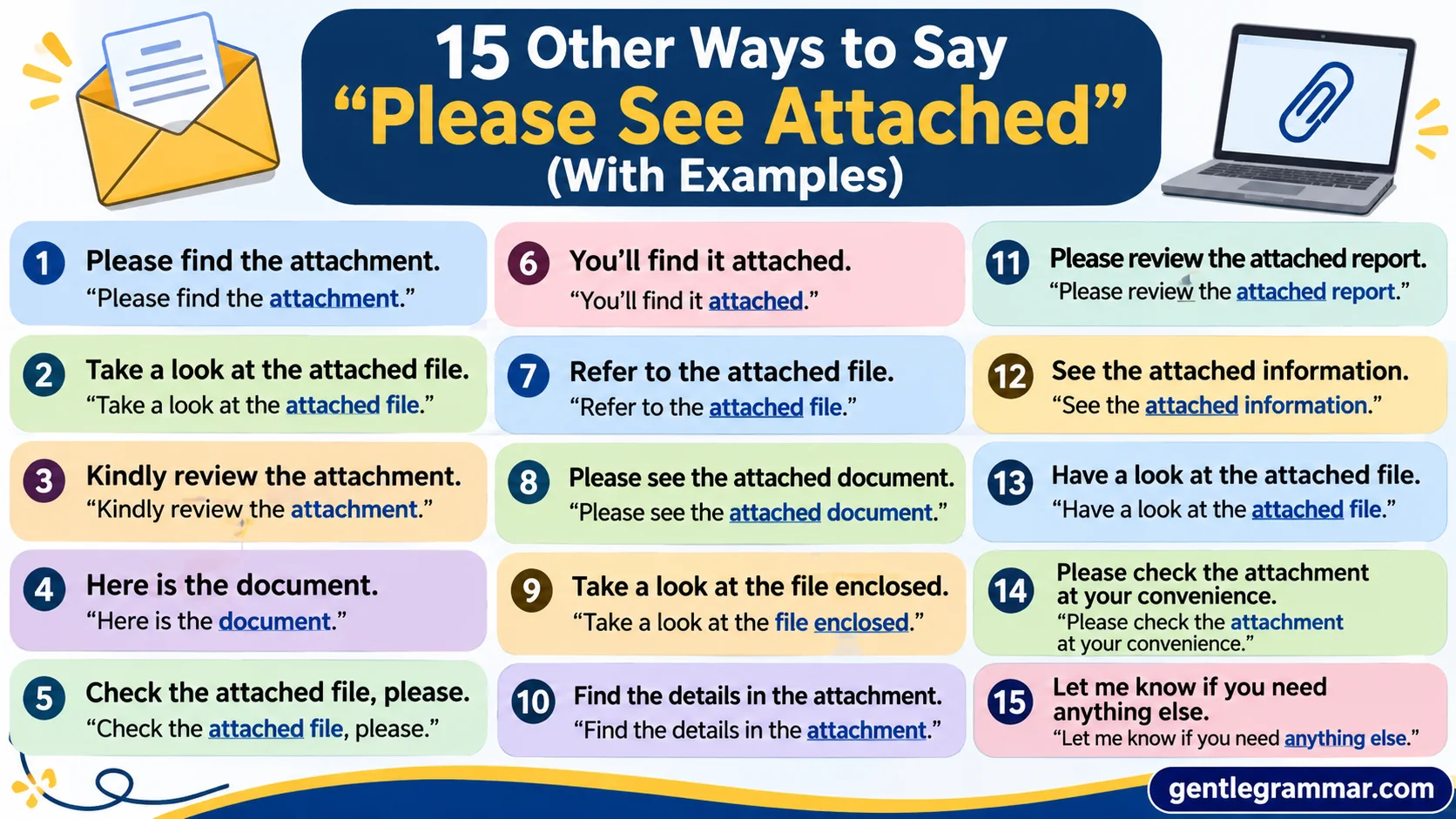
Use these 15 Other Ways to Say “Please See Attached” (With Examples) to make your email wording clearer, more natural, polished, and professional.
In emails, your message should be clear and professional, especially when you are sending attachments or supporting documents. Please see attached is a default phrase in email communication, but it can sometimes sound copied from a dusty office handbook. When you use it without thinking about the context, your wording may feel less natural. The first step is to understand what the phrase means and then choose different expressions that match your tone.
For example, you may need to attach a resume, report, proposal, invoice, screenshot, or random PDF. In professional writing and business communication, small changes can improve clarity, professionalism, and the overall email message. Instead of relying on one commonplace expression, you can use thoughtful expressions that sound warm, polished, confident, or formal.
What Does “Please See Attached” Mean?
“Please see attached” is an email phrase used to tell someone that a file, document, image, or other attachment has been included with the message. In simple terms, you are asking the recipient to open or review the attached material. For example, you might write, “Please see attached the revised contract,” when sending a new version of a document.
The phrase is widely understood in workplace and professional email communication. It is usually polite and direct, although it can sound slightly formal or routine. Depending on your purpose, you may want wording that tells the reader exactly what they should do with the attachment, such as reviewing it, checking it, or using it for reference.
Common Situations Where “Please See Attached” Is Used
People commonly use “Please see attached” when sending documents by email. This might include contracts, reports, invoices, applications, forms, photographs, spreadsheets, presentations, or revised files. It is especially common when the attachment is an important part of the message.
The phrase also appears in business communication, customer service, school emails, and administrative messages. An alternative can be useful when you want to sound less repetitive or when you need to explain why the attachment matters. For example, “I’ve attached the updated proposal for your review” gives the recipient more information than simply saying “Please see attached.”
Is It Professional or Polite to Say “Please See Attached”?
Yes. “Please see attached” is generally professional and polite, particularly in workplace emails and formal correspondence. It is direct without being rude, and most readers immediately understand what it means.
However, it can sometimes feel formulaic or slightly stiff, especially when used repeatedly. More natural alternatives often make the email easier to read because they explain the attachment in a conversational way. For example, “I’ve attached the report for your review” sounds professional while also making the purpose of the file clear.
Advantages and Disadvantages of Saying “Please See Attached”
Advantages
The biggest advantage is clarity and brevity. The recipient immediately knows that an attachment is included and should be opened or reviewed. The phrase also works well in professional settings because it is neutral, polite, and widely recognized.
It can be particularly useful when the attachment is already obvious from the surrounding message. If you simply need to point someone toward a document without adding much explanation, the phrase gets the job done efficiently.
Disadvantages
The main limitation is that “Please see attached” can sound repetitive or impersonal when it appears frequently in emails. It also does not explain what the recipient should do with the file. “Please review the attached proposal,” for example, gives a clearer instruction.
Another issue is that the phrase may sound slightly formal or old-fashioned in casual workplace communication. A sentence such as “I’ve attached the photos you requested” often feels more natural while remaining professional.
Synonyms for “Please See Attached”
- I’ve attached the document for your review.
- Please find the attached document.
- I’ve included the file for your reference.
- The document is attached for your review.
- I’m attaching the requested file.
- You’ll find the document attached.
- I’ve attached the information you requested.
- Please review the attached file.
- I’ve included the attachment for your consideration.
- The requested document is attached.
- I’m sharing the attached file for your review.
- Please refer to the attached document.
- I’ve attached the relevant details for your reference.
- Attached is the requested document.
- I’ve included the document below for your review.
1. I’ve attached the document for your review.
Meaning
This phrase tells the recipient that you have included a document and would like them to review it. It is more specific than “Please see attached.”
Definition
A professional way to say that a document is included with the email and should be examined.
Detailed Explanation
This is one of the most natural alternatives for workplace email. It clearly identifies both the attachment and the requested action. The wording feels professional without being overly formal. It works especially well when you expect the recipient to read, check, or comment on the document.
Scenario Examples
Scenario: You send a revised proposal to a client.
Example: “I’ve attached the revised proposal for your review.”
Scenario: You send a report to your manager.
Example: “I’ve attached the monthly report for your review.”
Scenario: You send a draft to a colleague.
Example: “I’ve attached the updated draft for your review.”
Best Use
Best for professional emails, reports, proposals, contracts, and drafts.
Tone
Tone: Professional, clear, respectful. It sounds purposeful because it tells the reader exactly what to do.
2. Please find the attached document.
Meaning
This politely directs the recipient to the document included with your email.
Definition
A formal email expression used to point someone toward an attached document.
Detailed Explanation
This wording is closely related to “Please see attached,” but it has a slightly more formal feel. It is common in business correspondence and administrative communication. Although grammatically acceptable, some modern writers prefer more conversational wording such as “I’ve attached the document.”
Scenario Examples
Scenario: You submit paperwork to an organization.
Example: “Please find the attached application form.”
Scenario: You send official records to a business contact.
Example: “Please find the attached documents for your reference.”
Best Use
Useful in formal business emails, administrative communication, and official correspondence.
Tone
Tone: Formal, polite, professional. It has a traditional business-email style.
3. I’ve included the file for your reference.
Meaning
This tells the recipient that you have included a file that may be useful for checking information or keeping as a reference.
Definition
A polite way to explain that an attached file is provided for information or future use.
Detailed Explanation
Unlike “Please see attached,” this expression emphasizes the purpose of the file rather than simply pointing to it. It works well when the recipient does not necessarily need to take immediate action. The phrase “for your reference” makes the message feel informative rather than demanding.
Scenario Examples
Scenario: You send background information to a colleague.
Example: “I’ve included the previous report for your reference.”
Scenario: A customer needs supporting information.
Example: “I’ve included the product specifications for your reference.”
Best Use
Best when the attachment is informational or supplementary.
Tone
Tone: Professional, helpful, neutral. It feels less directive than “Please review.”
4. The document is attached for your review.
Meaning
This states directly that the document has been attached and is ready for the recipient to review.
Definition
A professional sentence indicating that an attached document should be examined.
Detailed Explanation
This option is especially useful when you want to sound direct and organized. It focuses on the document and the action required from the reader. Compared with “I’ve attached,” it sounds slightly more formal and impersonal.
Scenario Examples
Scenario: You send a contract for approval.
Example: “The contract is attached for your review.”
Scenario: You submit a revised policy.
Example: “The updated policy is attached for your review.”
Best Use
Works well for formal workplace communication and document review.
Tone
Tone: Professional, direct, formal. It is efficient without sounding unfriendly.
5. I’m attaching the requested file.
Meaning
This tells the recipient that you are providing the file they previously asked for.
Definition
A concise way to say that the requested attachment is included with the email.
Detailed Explanation
This phrase works particularly well when there has already been a conversation about the file. It reminds the recipient that you are responding to their specific request. It also sounds more natural and personal than a generic attachment notice.
Scenario Examples
Scenario: A manager asks for a spreadsheet.
Example: “I’m attaching the requested spreadsheet.”
Scenario: A customer asks for a copy of an invoice.
Example: “I’m attaching the requested invoice for your records.”
Best Use
Ideal for follow-up emails and responses to requests.
Tone
Tone: Helpful, professional, straightforward. It feels responsive rather than formulaic.
6. You’ll find the document attached.
Meaning
This tells the reader where to find the document without giving a direct instruction to review it.
Definition
A natural expression used to point someone toward an attached document.
Detailed Explanation
This wording has a slightly more conversational feel than “Please find the attached document.” It works well when you simply want to tell someone that the file is there. It does not necessarily imply that they must take immediate action.
Scenario Examples
Scenario: You send a copy of a receipt.
Example: “You’ll find the receipt attached to this email.”
Scenario: You send supporting documents to a colleague.
Example: “You’ll find the supporting documents attached.”
Best Use
Good for routine workplace emails and friendly professional communication.
Tone
Tone: Professional, friendly, natural. It feels less formal than traditional attachment language.
7. I’ve attached the information you requested.
Meaning
This tells the recipient that you have provided the specific information they previously asked for.
Definition
A professional way to explain that requested information has been included as an attachment.
Detailed Explanation
This is more informative than simply saying “Please see attached.” It reminds the reader that the attachment directly answers a previous request. That connection can make the email easier to follow, especially when several messages have been exchanged.
Scenario Examples
Scenario: A client asks for pricing information.
Example: “I’ve attached the pricing information you requested.”
Scenario: A coworker asks for sales figures.
Example: “I’ve attached the sales figures you requested.”
Best Use
Best for customer service, workplace follow-ups, and request-based emails.
Tone
Tone: Helpful, professional, responsive. It clearly connects the attachment to the recipient’s needs.
8. Please review the attached file.
Meaning
This asks the recipient to actively examine the file attached to the email.
Definition
A direct but polite request for someone to read or check an attached file.
Detailed Explanation
This expression is stronger than “Please see attached” because it clearly communicates an action. Use it when the recipient needs to check the contents rather than merely know that a file exists. It is especially useful when you need feedback, approval, corrections, or confirmation.
Scenario Examples
Scenario: Your manager needs to approve a budget.
Example: “Please review the attached budget and let me know if you approve it.”
Scenario: A client needs to check a proposal.
Example: “Please review the attached proposal at your convenience.”
Best Use
Use it when reviewing the attachment is important.
Tone
Tone: Professional, direct, respectful. The request is clear without being unnecessarily forceful.
9. I’ve included the attachment for your consideration.
Meaning
This indicates that you have provided a file that you would like the recipient to think about or evaluate.
Definition
A formal expression used when an attachment is being presented for consideration.
Detailed Explanation
This phrase is more deliberate than “Please see attached.” It suggests that the recipient may need to consider an option, proposal, recommendation, or decision. It can sound too formal for a casual message, so it is best reserved for situations where careful thought is expected.
Scenario Examples
Scenario: You submit a business proposal.
Example: “I’ve included the proposal for your consideration.”
Scenario: You suggest an alternative plan.
Example: “I’ve included the revised plan for your consideration.”
Best Use
Useful for proposals, recommendations, business decisions, and formal requests.
Tone
Tone: Formal, thoughtful, professional. It signals that the attachment deserves consideration rather than a quick glance.
10. The requested document is attached.
Meaning
This tells the recipient that the document they asked for is included with the message.
Definition
A concise statement confirming that a requested document has been attached.
Detailed Explanation
This wording is particularly useful when the recipient already knows which document you are discussing. It is short and efficient, making it suitable for quick professional responses. Because it uses a passive construction, it sounds slightly more formal than “I’ve attached the requested document.”
Scenario Examples
Scenario: Someone requests a copy of a contract.
Example: “The requested document is attached.”
Scenario: A customer asks for an invoice.
Example: “The requested invoice is attached for your records.”
Best Use
Best for brief professional replies and administrative emails.
Tone
Tone: Formal, concise, neutral. It focuses on the document rather than the sender.
11. I’m sharing the attached file for your review.
Meaning
This tells the recipient that you are providing a file and would like them to review its contents.
Definition
A modern professional expression for sharing an attachment with someone for examination.
Detailed Explanation
The word “sharing” gives this phrase a slightly warmer and more collaborative feel. It works particularly well when colleagues are working together on a document or project. Compared with “Please see attached,” it sounds less like a formal instruction and more like an invitation to look at the material.
Scenario Examples
Scenario: You share a project draft with a teammate.
Example: “I’m sharing the attached project draft for your review.”
Scenario: You send updated materials to a team.
Example: “I’m sharing the attached materials for your review before tomorrow’s meeting.”
Best Use
Good for teamwork, collaboration, project updates, and professional email.
Tone
Tone: Collaborative, professional, friendly. The wording encourages cooperation.
12. Please refer to the attached document.
Meaning
This asks the recipient to use the attached document as a source of information or guidance.
Definition
A formal expression directing someone to consult an attached document.
Detailed Explanation
“Please refer to” suggests that the attachment contains information relevant to the subject of the email. It is not necessarily asking the person to review every detail. This makes it useful when the document serves as a reference, policy, guide, or supporting record.
Scenario Examples
Scenario: You send a policy document.
Example: “Please refer to the attached policy for the updated procedures.”
Scenario: You provide technical instructions.
Example: “Please refer to the attached guide for installation details.”
Best Use
Best for instructions, policies, guidelines, reports, and reference material.
Tone
Tone: Formal, professional, instructional. It sounds appropriate when the attachment contains authoritative information.
13. I’ve attached the relevant details for your reference.
Meaning
This tells the recipient that you have provided the important information they may need to consult later.
Definition
A professional way to introduce an attachment containing useful or relevant information.
Detailed Explanation
This phrase is useful when the attachment contains specific details rather than one simple document. It also avoids making the attachment sound like something the recipient must immediately act on. “For your reference” keeps the request low-pressure while still explaining why the file is included.
Scenario Examples
Scenario: You send meeting details to a colleague.
Example: “I’ve attached the relevant details for your reference.”
Scenario: You provide information about an event.
Example: “I’ve attached the schedule and relevant details for your reference.”
Best Use
Useful for informational emails, schedules, background material, and supporting documents.
Tone
Tone: Helpful, professional, neutral. It provides information without demanding immediate action.
14. Attached is the requested document.
Meaning
This directly states that the requested document has been included with the email.
Definition
A concise and formal way to introduce an attached document.
Detailed Explanation
This construction places the attachment at the center of the sentence. It is common in formal business writing and works particularly well when the email itself is short. While perfectly understandable, it has a somewhat traditional formal-business tone, so “I’ve attached the requested document” may feel more conversational.
Scenario Examples
Scenario: You respond to a formal document request.
Example: “Attached is the requested document for your records.”
Scenario: You submit paperwork to an office.
Example: “Attached is the completed form you requested.”
Best Use
Best for formal correspondence, document submissions, and concise business emails.
Tone
Tone: Formal, concise, professional. It sounds polished but somewhat traditional.
15. I’ve included the document below for your review.
Meaning
This tells the recipient that the document appears below the sentence or message, rather than necessarily being a separate attachment.
Definition
A clear way to direct someone to a document included below the main message.
Detailed Explanation
This phrase is useful when the document or information has been inserted directly into the email. It differs from “Please see attached” because “below” indicates where the material can be found. If the file is actually an email attachment, avoid this wording because it could confuse the recipient.
Scenario Examples
Scenario: You paste a short report into an email.
Example: “I’ve included the document below for your review.”
Scenario: You provide a written summary beneath your message.
Example: “I’ve included the requested details below for your review.”
Best Use
Use it when the material appears within the email below, not when it is a separate attachment.
Tone
Tone: Clear, professional, practical. It makes the location of the information explicit.
FAQs:
What is another way to say “Please See Attached”?
A natural alternative is “I’ve attached the document for your review.” Other options include “I’ve included the file for your reference,” “Please review the attached file,” and “You’ll find the document attached.” The best choice depends on whether you want the recipient to review, reference, or simply locate the file.
What does “Please See Attached” mean?
“Please see attached” means that a file or document has been included with an email and the recipient should look at it. The phrase is commonly used in professional communication when sending reports, forms, invoices, applications, or other documents.
Is “Please See Attached” professional?
Yes. “Please see attached” is professional and polite, although it can sound somewhat routine or formal. In many modern workplace emails, “I’ve attached the document for your review” sounds more natural because it identifies the attachment and its purpose.
What is a more polite way to say “Please See Attached”?
“I’ve included the file for your reference” is a polite and gentle option. If you need the recipient to take action, “Please review the attached file” is clearer while remaining respectful.
Which alternative works best in formal communication?
“Please find the attached document” or “Attached is the requested document” can work well in formal correspondence. For modern professional writing, however, “I’ve attached the document for your review” often provides a more natural balance of professionalism and clarity.
Conclusion:
Choosing an alternative to “Please see attached” is less about finding a perfect synonym and more about explaining what the attachment is doing in your message. If you want a clear request, “Please review the attached file” works well. If you are simply providing information, “I’ve included the file for your reference” may be better. For a collaborative workplace tone, “I’m sharing the attached file for your review” feels natural and friendly.
Small wording changes can make professional emails feel more purposeful. Think about the relationship, formality, and action you want from the reader before choosing your phrase. The strongest wording tells people not only that a file exists, but also why it matters.
