
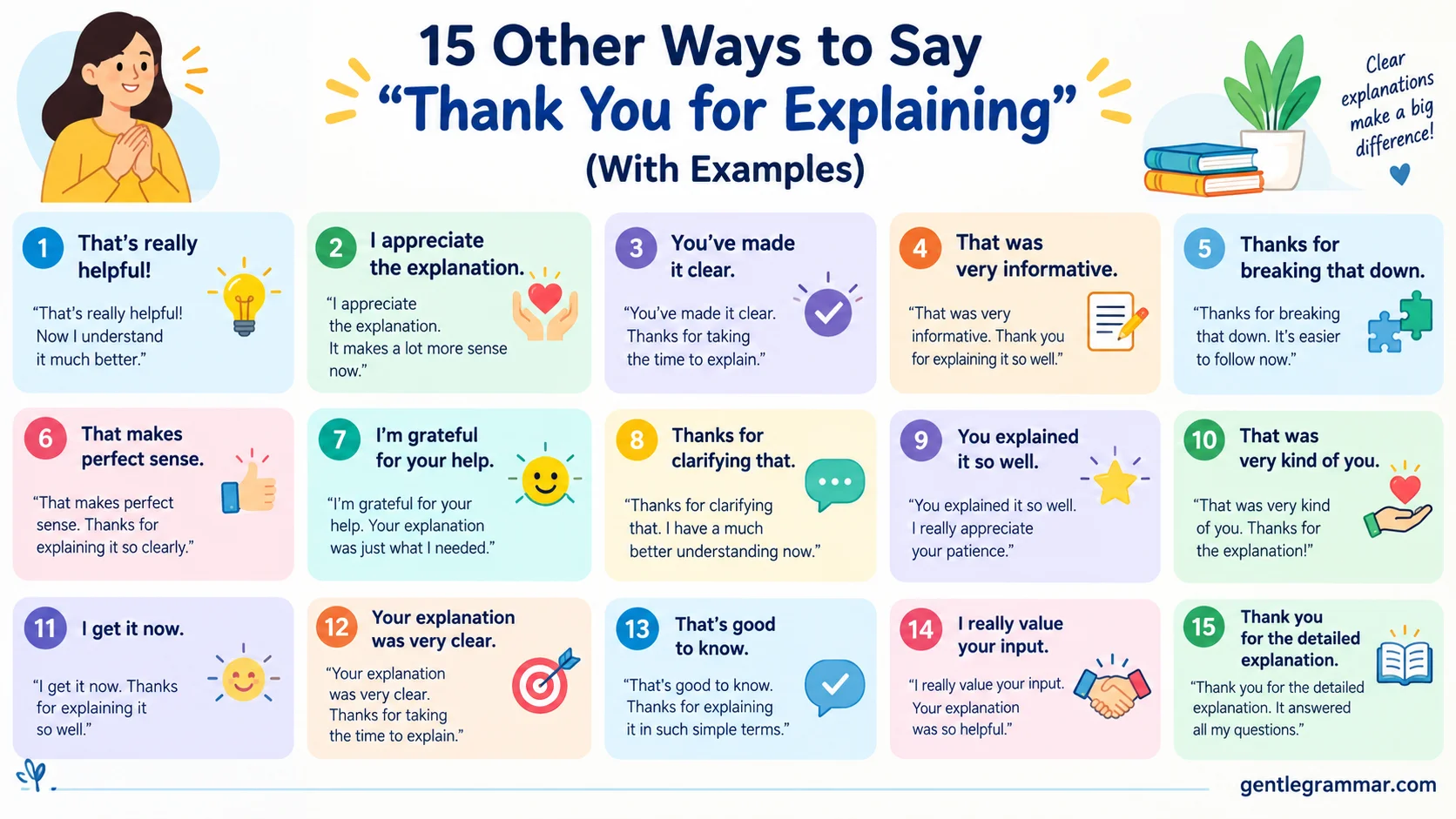
In a work email, email, or Slack message, using Other Ways to Say “Thank You for Explaining” can make your replies sound more natural and less repetitive.
I often notice that repeating the same phrase or line creates an autopilot response, even when the writer genuinely feels appreciation. When a manager, professor, coworker, colleague, boss, or client clarifies a process, walks you through a report, or answers a confused question, choosing the right thank you can show genuine understanding. In business correspondence and writing email.
The best option depends on the situation, type of conversation, and tone, whether it is formal, informal, or workplace-professional. Showing appreciation for someone’s time, effort, and help can make a big difference, especially during less-than-ideal situations, while expressing gratitude can encourage good behavior and help people feel valued when communicating. I have found that knowing when to say thank you or simply say thank you makes everyday conversations clearer.
What Does “Thank You for Explaining” Mean?
“Thank you for explaining” is a polite expression used to show appreciation when someone has taken the time to make an idea, situation, process, or problem easier to understand. It communicates that you recognize the other person’s effort and found their explanation useful. The phrase can be used after someone answers a question, provides additional information, or helps clear up something that was confusing.
The expression is generally friendly, respectful, and neutral. It does not necessarily mean that you completely agree with what was explained; it simply acknowledges that the person provided information or clarification. Depending on the situation, it can sound casual in conversation or appropriately professional in workplace and educational communication.
Common Situations Where “Thank You for Explaining” Is Used
People commonly use “Thank you for explaining” after asking a question and receiving a helpful response. For example, a student might say it to a teacher, a customer might use it when speaking with a representative, or a colleague might say it after receiving an explanation about a work process.
The phrase also works well in text messages, emails, meetings, personal conversations, and classroom discussions. Because it is relatively neutral, it can fit many relationships without sounding overly formal or overly familiar. However, someone may choose different wording when they want to emphasize a particular quality, such as the person’s patience, the clarity of the explanation, or the useful context they provided.
Is It Professional or Polite to Say “Thank You for Explaining”?
Yes. “Thank you for explaining” is both polite and professionally acceptable in most situations. It shows appreciation without being excessively formal, making it suitable for coworkers, managers, teachers, customers, clients, and other professional contacts. It can also be used naturally with friends and family.
The tone is usually respectful, straightforward, and friendly. In a formal email, however, you might prefer wording that specifically recognizes the person’s clarification or detailed response. In casual conversation, a shorter and warmer expression may feel more natural. The best choice depends on your relationship with the person and the kind of explanation they gave.
Advantages and Disadvantages of Saying “Thank You for Explaining”
Advantages
The main advantage is clarity. The phrase directly tells someone that you appreciate the explanation they provided. It is also versatile, because it works in casual conversations, professional settings, educational situations, and written communication. Another benefit is its neutral tone: it expresses gratitude without sounding exaggerated or overly emotional.
Disadvantages
Although useful, the phrase can sometimes feel generic if you use it repeatedly. It also does not explain exactly what you appreciated about the response. If someone gave you a detailed clarification, patiently walked you through a complicated process, or provided important background information, a more specific expression may communicate your appreciation more effectively.
Synonyms for “Thank You for Explaining”
- Thanks for Clarifying
- Thank You for the Clarification
- I Appreciate the Explanation
- Thanks for Walking Me Through It
- I Appreciate You Explaining That
- Thanks for Shedding Light on This
- Thanks for Making That Clear
- I Understand Now
- That Clears Things Up
- Thanks for the Insight
- I Appreciate the Context
- Thanks for Breaking That Down
- Your Explanation Helped
- Thanks for Taking the Time to Explain
- I Appreciate the Detailed Explanation
1. Thanks for Clarifying
Meaning
“Thanks for clarifying” expresses appreciation when someone has made something confusing, uncertain, or ambiguous easier to understand. It is especially useful when the person has corrected a misunderstanding or provided additional information.
Definition
Thanks for clarifying means “I appreciate you making the situation or information clearer.”
Detailed Explanation
This expression is closely related to “Thank you for explaining,” but it usually focuses more specifically on removing confusion or uncertainty. It works particularly well when someone has answered a question or corrected an assumption. The wording is slightly more conversational than the full “Thank you for clarifying,” making it natural in emails, chats, and spoken conversations.
Scenario Examples
Scenario: A coworker explains a deadline that you misunderstood.
Example: “Thanks for clarifying. I’ll make sure the report is submitted by Thursday.”
Scenario: A friend explains what they meant in a confusing text.
Example: “Thanks for clarifying. I understand what you meant now.”
Best Use
Best for work emails, conversations, messages, and situations involving confusion or misunderstanding.
Tone
Tone: Polite, friendly, direct
It sounds appreciative without being overly formal.
2. Thank You for the Clarification
Meaning
“Thank you for the clarification” shows appreciation for information that has removed uncertainty or corrected a misunderstanding.
Definition
It means “I appreciate the additional information that made this clearer.”
Detailed Explanation
This expression has a somewhat more formal and professional feel than “Thanks for clarifying.” It is particularly useful when replying to a detailed email, workplace question, or formal discussion. Rather than emphasizing the act of explaining, it focuses on the clarification itself and the value it provided.
Scenario Examples
Scenario: A client explains an important requirement.
Example: “Thank you for the clarification. We’ll update the document accordingly.”
Scenario: A teacher explains an assignment requirement.
Example: “Thank you for the clarification. I’ll follow those instructions.”
Best Use
Best for professional emails, customer communication, academic settings, and formal conversations.
Tone
Tone: Professional, respectful, formal
The noun “clarification” gives the expression a polished written quality.
3. I Appreciate the Explanation
Meaning
“I appreciate the explanation” communicates gratitude for the information or reasoning someone has provided.
Definition
It means “I am grateful that you took the time to explain this to me.”
Detailed Explanation
This wording sounds slightly more thoughtful and deliberate than “Thank you for explaining.” It recognizes not only the information but also the usefulness of the person’s response. It can work particularly well when someone has given a careful explanation rather than a quick answer.
Scenario Examples
Scenario: A manager explains why a project decision was made.
Example: “I appreciate the explanation. It helps me understand the reasoning behind the decision.”
Scenario: Someone explains a complicated personal situation.
Example: “I appreciate the explanation. That gives me a better understanding of what happened.”
Best Use
Best for professional discussions, thoughtful conversations, and situations where the explanation required some effort.
Tone
Tone: Warm, respectful, thoughtful
It conveys genuine appreciation without becoming overly emotional.
4. Thanks for Walking Me Through It
Meaning
“Thanks for walking me through it” is used when someone explains a process or situation step by step.
Definition
It means “Thank you for guiding me through the information or process.”
Detailed Explanation
This expression is more specific than the original phrase because it suggests that the person provided step-by-step guidance. It is especially natural when learning how to use something, complete a task, solve a problem, or understand a process. The phrase is conversational and may sound too informal for some highly formal correspondence.
Scenario Examples
Scenario: A coworker shows you how to use new software.
Example: “Thanks for walking me through it. I think I can handle it on my own now.”
Scenario: A friend explains how to complete an online form.
Example: “Thanks for walking me through it. I was completely stuck before.”
Best Use
Best for workplace conversations, tutorials, technical help, everyday conversations, and friendly messages.
Tone
Tone: Friendly, casual, appreciative
The phrase sounds natural and approachable, especially in spoken English.
5. I Appreciate You Explaining That
Meaning
“I appreciate you explaining that” directly thanks someone for taking the time to explain a particular point.
Definition
It means “I am grateful that you took the time to explain that specific thing.”
Detailed Explanation
This expression places attention on the person’s effort, making it feel more personal than a simple acknowledgment. It can be useful when someone patiently explains something you did not understand. The wording is friendly enough for personal communication but can also work in professional conversations.
Scenario Examples
Scenario: A colleague patiently answers several questions.
Example: “I appreciate you explaining that. I had been unsure about the process.”
Scenario: A friend explains a difficult decision.
Example: “I appreciate you explaining that. It makes more sense from your perspective now.”
Best Use
Best for personal conversations, workplace discussions, supportive exchanges, and situations involving patience.
Tone
Tone: Warm, personal, respectful
The phrase feels more individualized because it acknowledges the other person’s effort.
6. Thanks for Shedding Light on This
Meaning
“Thanks for shedding light on this” expresses appreciation when someone has helped make a confusing or unclear subject easier to understand.
Definition
It means “Thank you for helping me understand something that was previously unclear.”
Detailed Explanation
This expression is somewhat more expressive and idiomatic than the original phrase. It is particularly appropriate when the subject was complicated, uncertain, or difficult to understand. It does not simply acknowledge an explanation; it suggests that the information has brought greater understanding to the situation.
Scenario Examples
Scenario: A colleague explains why a project experienced delays.
Example: “Thanks for shedding light on this. I can see where the issue started.”
Scenario: Someone explains a complicated situation involving several people.
Example: “Thanks for shedding light on this. I had only heard part of the story.”
Best Use
Best for professional discussions, thoughtful conversations, written communication, and complex topics.
Tone
Tone: Thoughtful, appreciative, slightly expressive
It sounds more polished and figurative than a basic thank-you.
7. Thanks for Making That Clear
Meaning
“Thanks for making that clear” shows appreciation when someone has successfully removed confusion about a particular point.
Definition
It means “Thank you for helping me understand that clearly.”
Detailed Explanation
This expression emphasizes the result of the explanation rather than the explanation itself. It works well when you were uncertain about a particular detail and now understand it. The wording is direct and natural, making it suitable for everyday speech as well as informal workplace communication.
Scenario Examples
Scenario: A coworker explains which version of a document should be used.
Example: “Thanks for making that clear. I’ll use the latest version.”
Scenario: Someone clears up a misunderstanding between friends.
Example: “Thanks for making that clear. I didn’t realize that was what you meant.”
Best Use
Best for everyday conversations, workplace chats, texts, and situations involving misunderstandings.
Tone
Tone: Casual, direct, friendly
It is easygoing and does not sound overly formal.
8. I Understand Now
Meaning
“I understand now” tells someone that their explanation has successfully helped you understand something.
Definition
It means “The information you gave me has helped me understand the situation.”
Detailed Explanation
Unlike the original phrase, this expression does not directly say thank you. Instead, it communicates the outcome of the person’s explanation: you now understand. It can be especially useful when you want to reassure someone that their explanation worked. Because it focuses on understanding rather than gratitude, it is not a perfect replacement in every situation.
Scenario Examples
Scenario: A teacher explains a difficult grammar rule.
Example: “I understand now. The examples made the difference.”
Scenario: A friend explains why they changed their plans.
Example: “Okay, I understand now. Thanks for being honest with me.”
Best Use
Best for conversation, classroom discussions, personal communication, and moments when you want to confirm understanding.
Tone
Tone: Clear, conversational, reassuring
It focuses on successful understanding rather than formal gratitude.
9. That Clears Things Up
Meaning
“That clears things up” means that someone’s explanation has removed confusion or uncertainty.
Definition
It means “That information has helped me understand the situation.”
Detailed Explanation
This is a natural conversational expression that emphasizes the effect of the explanation. It can sound more relaxed than “Thank you for explaining.” Although it does not explicitly contain a thank-you, it communicates that the information was useful. Adding a brief expression of appreciation can make the response warmer when gratitude is important.
Scenario Examples
Scenario: A coworker explains an unexpected change to a schedule.
Example: “That clears things up. I’ll adjust my plans accordingly.”
Scenario: A friend explains a confusing message.
Example: “Ah, that clears things up. I had misunderstood what you meant.”
Best Use
Best for casual conversation, workplace chats, texts, and everyday situations involving confusion.
Tone
Tone: Casual, natural, relieved
It sounds especially natural when you have just received information that resolves uncertainty.
10. Thanks for the Insight
Meaning
“Thanks for the insight” expresses appreciation for a useful idea, perspective, or piece of understanding that someone has shared.
Definition
It means “Thank you for giving me a useful perspective or understanding.”
Detailed Explanation
This expression is not an exact substitute for every use of “Thank you for explaining.” It works best when the explanation provides a useful perspective, observation, or deeper understanding. It can sound more sophisticated than a basic thank-you and is particularly common in professional or thoughtful discussions.
Scenario Examples
Scenario: A colleague explains why customers are responding differently to a product.
Example: “Thanks for the insight. That gives us something important to consider.”
Scenario: Someone shares their perspective on a difficult decision.
Example: “Thanks for the insight. I hadn’t considered that angle before.”
Best Use
Best for professional conversations, meetings, discussions, feedback, and thoughtful exchanges.
Tone
Tone: Professional, thoughtful, appreciative
The word “insight” suggests that the information offered meaningful perspective.
11. I Appreciate the Context
Meaning
“I appreciate the context” thanks someone for providing background information that makes a situation easier to understand.
Definition
It means “I am grateful for the background information that helps me understand this properly.”
Detailed Explanation
This expression is useful when someone has explained not only what happened, but also the circumstances surrounding it. It differs from a general explanation because the emphasis is on background, history, or surrounding information. It is especially useful in professional, academic, and analytical conversations.
Scenario Examples
Scenario: A manager explains the history behind a company decision.
Example: “I appreciate the context. It helps me understand why the policy was introduced.”
Scenario: A teacher provides background about a historical event.
Example: “I appreciate the context. It makes the topic much easier to follow.”
Best Use
Best for workplace communication, academic discussions, reports, meetings, and detailed conversations.
Tone
Tone: Professional, thoughtful, respectful
It sounds measured and is particularly suitable when background information matters.
12. Thanks for Breaking That Down
Meaning
“Thanks for breaking that down” thanks someone for explaining something complicated in smaller, easier-to-understand parts.
Definition
It means “Thank you for making a complicated subject easier to understand.”
Detailed Explanation
This expression is especially useful when the original subject felt technical, complicated, or overwhelming. It highlights the person’s ability to simplify information rather than merely provide an explanation. The wording is fairly informal, so it is more natural in conversation, chat, or relaxed workplace communication than in highly formal writing.
Scenario Examples
Scenario: A coworker explains a complicated financial report.
Example: “Thanks for breaking that down. The numbers make much more sense now.”
Scenario: A friend explains how a complicated application works.
Example: “Thanks for breaking that down. I finally know what I need to do.”
Best Use
Best for casual conversation, workplace chats, tutorials, technical explanations, and friendly messages.
Tone
Tone: Casual, friendly, appreciative
The phrase sounds relaxed and suggests that the explanation made something complicated manageable.
13. Your Explanation Helped
Meaning
“Your explanation helped” tells someone that the information they provided made a positive difference in your understanding.
Definition
It means “What you explained was useful to me.”
Detailed Explanation
This expression focuses on the usefulness and effect of the explanation. It can feel sincere because it tells the person that their effort actually made a difference. It does not sound as formal as “I appreciate the explanation,” so it works particularly well in personal and conversational settings.
Scenario Examples
Scenario: A friend helps you understand a difficult situation.
Example: “Your explanation helped. I was looking at the situation from the wrong angle.”
Scenario: A classmate explains a difficult concept before an exam.
Example: “Your explanation helped a lot. I finally understand how it works.”
Best Use
Best for personal communication, classroom conversations, tutoring, friendly messages, and everyday discussions.
Tone
Tone: Sincere, warm, conversational
It directly communicates that the person’s explanation had a useful effect.
14. Thanks for Taking the Time to Explain
Meaning
“Thanks for taking the time to explain” expresses gratitude for both the explanation and the effort someone made to provide it.
Definition
It means “I appreciate that you spent time explaining this to me.”
Detailed Explanation
This wording adds an important layer of appreciation for the person’s time and effort. It is useful when someone gave you a detailed response, answered several questions, or patiently helped you understand something. Because it explicitly recognizes the time involved, it can sound warmer and more considerate than the shorter original phrase.
Scenario Examples
Scenario: A manager patiently answers several questions about a new process.
Example: “Thanks for taking the time to explain. I feel much more prepared now.”
Scenario: Someone carefully explains a complicated issue during a long conversation.
Example: “Thanks for taking the time to explain. I really appreciate the effort.”
Best Use
Best for professional emails, detailed conversations, customer communication, teaching situations, and personal messages.
Tone
Tone: Warm, respectful, considerate
It highlights the value of the person’s time and effort, making the appreciation feel more personal.
15. I Appreciate the Detailed Explanation
Meaning
“I appreciate the detailed explanation” thanks someone for providing thorough and comprehensive information.
Definition
It means “I am grateful that you provided such a thorough explanation.”
Detailed Explanation
This expression is appropriate when someone has gone beyond a brief answer and provided substantial detail. It sounds more formal and polished than the everyday “Thank you for explaining.” It is especially useful when responding to a detailed professional email, technical explanation, academic response, or carefully prepared answer.
Scenario Examples
Scenario: A customer-service representative gives a detailed explanation of a billing issue.
Example: “I appreciate the detailed explanation. I now understand how the charge was calculated.”
Scenario: A colleague provides extensive background for a project decision.
Example: “I appreciate the detailed explanation. It gives me a much clearer picture of the situation.”
Best Use
Best for professional emails, formal communication, academic settings, technical discussions, and detailed responses.
Tone
Tone: Professional, respectful, appreciative
The word “detailed” signals that the explanation was thorough and worth acknowledging.
FAQs:
What is another way to say “Thank You for Explaining”?
There are several natural alternatives, including “Thanks for clarifying,” “I appreciate the explanation,” and “Thanks for walking me through it.” The best expression depends on what you want to emphasize, such as clarity, effort, detail, or step-by-step guidance.
What does “Thank You for Explaining” mean?
“Thank you for explaining” is a polite way to show appreciation after someone has made information, an idea, process, or situation easier to understand. It recognizes the person’s effort without necessarily expressing agreement with what they said.
Is “Thank You for Explaining” professional?
Yes. “Thank you for explaining” is professional and polite in most workplace situations. It has a neutral tone and can be used with coworkers, managers, clients, teachers, and customers.
What is a more polite way to say “Thank You for Explaining”?
For a warmer or more considerate response, “Thanks for taking the time to explain” is a useful choice because it recognizes both the explanation and the person’s effort. “I appreciate the detailed explanation” can also work well when the response was thorough.
Which alternative works best in formal communication?
For formal communication, “Thank you for the clarification,” “I appreciate the explanation,” or “I appreciate the detailed explanation” can fit well depending on the context. Choose wording that accurately reflects what the person provided rather than simply choosing the most formal-sounding phrase.
Conclusion:
Choosing the right expression after someone gives you information can make your communication feel more specific, thoughtful, and natural. While “Thank you for explaining” is polite and versatile, different situations may call for wording that emphasizes clarification, effort, context, detail, or usefulness. For example, “Thanks for clarifying” suits a misunderstanding.
The important thing is to consider the relationship, situation, tone, and purpose of your message. Similar expressions can carry slightly different meanings, so a little attention to context can make your words feel more genuine. When you understand these distinctions, you can use “Thank you for explaining” or another suitable expression with greater confidence and precision.
