
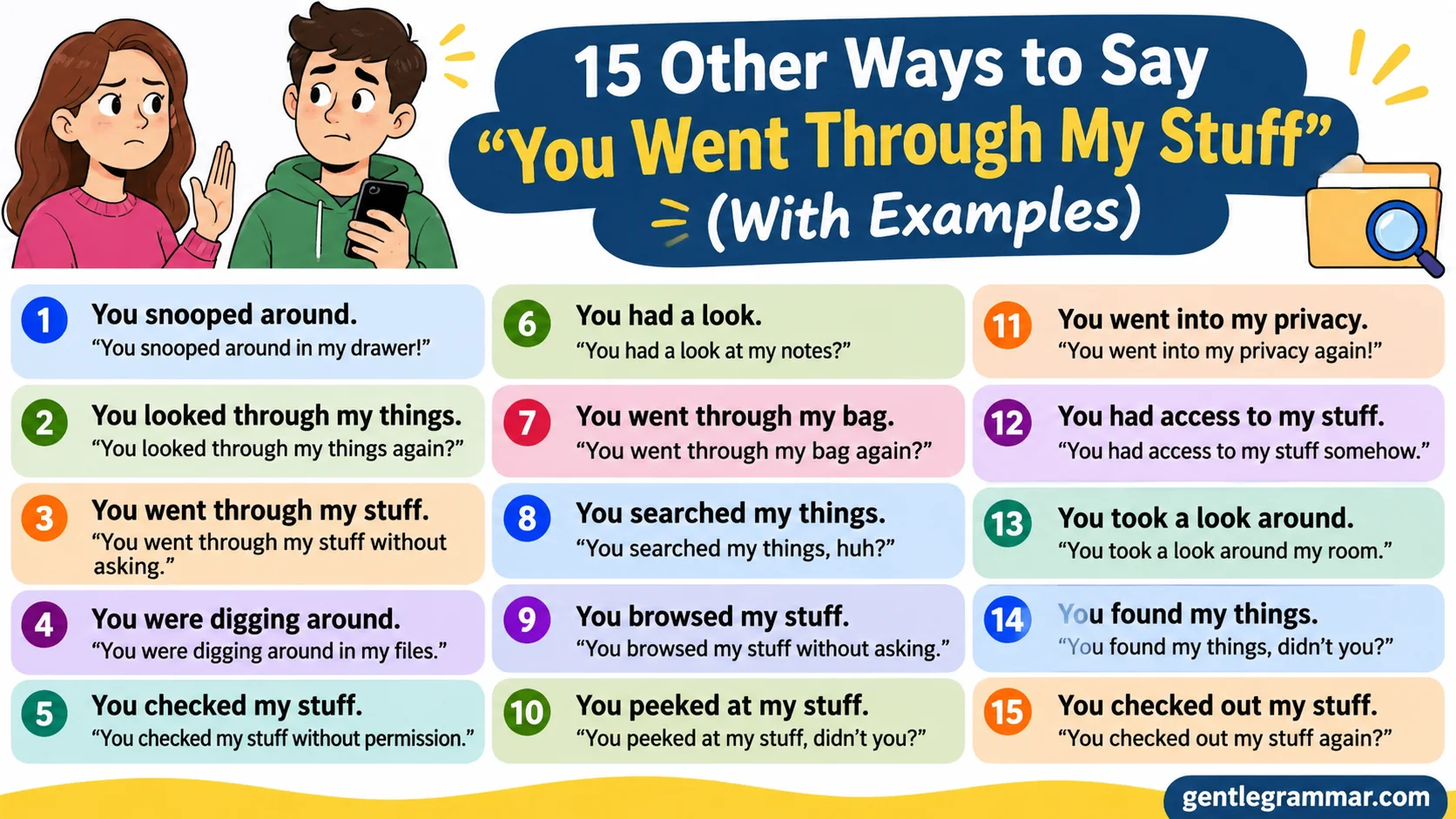
This guide to 15 Other Ways to Say “You Went Through My Stuff” (With Examples) helps you explain a privacy concern clearly and calmly to others.
When someone enters your personal space or searches your personal belongings without permission, it can create discomfort and damage trust. Imagine returning home and noticing a drawer slightly open. You might realize that someone has searched your phone, bag, bedroom, private messages, or personal files. Your first reaction could be anger, disappointment, or frustration because these things are yours.
In everyday English, saying “You Went Through My Stuff” is a direct way to describe this invasion of privacy. It communicates that someone crossed your personal boundaries, ignored your privacy concerns, and examined your possessions without asking. Sometimes, snooping, rifling, or searching for hidden things can also create suspicion and unwanted curiosity. The experience carries emotional weight because personal property deserves protection and respect.
What Does “You Went Through My Stuff” Mean?
“You Went Through My Stuff” means that someone searched, examined, or looked through your personal belongings without your permission. The phrase usually suggests that the speaker feels their privacy has been invaded or their personal boundaries have been ignored. The word “stuff” can refer to belongings such as bags, drawers, clothes, documents, phones, personal notes, or other private items.
In everyday English, this expression often communicates frustration, disappointment, suspicion, or anger. For example, if you discover that a roommate searched your bedroom drawers, you might say, “You went through my stuff while I was away.” The statement directly identifies what happened and makes it clear that you are unhappy about the situation. Depending on your tone and relationship with the other person, it can sound mildly annoyed or strongly confrontational.
Common Situations Where “You Went Through My Stuff” Is Used
People commonly use this expression when someone accesses their personal belongings without asking first. It can come up during everyday conversations between family members, friends, roommates, and romantic partners. For example, someone might discover that a sibling opened their private diary or that a partner searched their phone without permission.
The phrase also fits disagreements involving personal space and trust. In a shared home, a roommate might move someone’s belongings or search through a private drawer. At school, a student might confront someone who opened their backpack. In a workplace, the issue could involve personal documents or items kept in a desk. In these situations, choosing a more specific expression can help explain exactly what happened without making the conversation unnecessarily hostile.
Is It Professional or Polite to Say “You Went Through My Stuff”?
“You Went Through My Stuff” is generally casual, direct, and somewhat confrontational. It is understandable in everyday English, especially when speaking with someone you know. However, the word “stuff” is informal, and the phrase can sound accusatory when delivered angrily. It may be appropriate when confronting a friend, family member, or roommate about an invasion of privacy.
In professional communication, a more measured expression is usually better. For example, “You accessed my personal belongings without permission” sounds clearer and more professional. Similarly, “I noticed that my desk had been searched” communicates the concern without immediately escalating the disagreement. The best choice depends on the seriousness of the situation, your relationship with the person, and whether you want to express anger or establish a clear boundary.
Advantages and Disadvantages of Saying “You Went Through My Stuff”
Advantages
- Direct communication: It clearly tells someone that you noticed them examining your personal belongings.
- Easy to understand: The wording uses everyday vocabulary that most English speakers recognize.
- Expresses frustration: It communicates dissatisfaction when someone ignores your privacy.
- Encourages accountability: It brings attention to an action that may have damaged trust.
Disadvantages
- Can sound accusatory: The wording may make the other person defensive, especially during an argument.
- Lacks specificity: The word “stuff” does not explain whether someone searched your phone, bag, bedroom, or documents.
- Informal wording: It may not be suitable for workplace complaints or formal discussions.
- Limited emotional nuance: It does not always communicate whether you feel hurt, betrayed, uncomfortable, or simply annoyed.
Synonyms for “You Went Through My Stuff”
- You Looked Through My Personal Belongings
- You Searched Through My Things
- You Invaded My Privacy
- You Crossed My Personal Boundaries
- You Went Through My Personal Items
- You Rummaged Through My Belongings
- You Snooped Through My Things
- You Had No Permission to Touch My Things
- You Checked My Private Belongings
- You Looked Through My Private Things
- You Went Through My Drawers
- You Searched My Personal Space
- You Didn’t Respect My Privacy
- You Took It Upon Yourself to Search My Things
- You Overstepped by Going Through My Belongings
1. You Looked Through My Personal Belongings
Meaning
“You Looked Through My Personal Belongings” means someone examined your possessions without your permission. It is a slightly more specific and polished way to express that someone went through your things. The phrase emphasizes personal ownership and privacy.
Definition
To examine someone’s private possessions, often without their knowledge or consent.
Detailed Explanation
This expression is a straightforward alternative that sounds more neutral than the original phrase. It replaces the informal word “stuff” with personal belongings, making the statement more precise. It does not automatically suggest that the person was searching for something suspicious. Instead, it focuses on the action itself and allows you to explain why it bothered you.
Scenario Examples
Scenario: Your friend opens your backpack while borrowing a pen.
Example: “I noticed you looked through my personal belongings. Please ask me before doing that.”
Scenario: A family member searches your bedroom while you’re away.
Example: “You looked through my personal belongings when I wasn’t home, and I’m not comfortable with that.”
Best Use
Use this expression in everyday conversations, personal disagreements, and respectful discussions about privacy. It also works when you want to describe the situation without sounding overly aggressive.
Tone
Tone: Neutral, direct, respectful.
It identifies the behavior clearly while leaving room for a calm conversation.
2. You Searched Through My Things
Meaning
This expression means someone actively searched your possessions, possibly looking for a particular item or piece of information. It suggests more deliberate action than simply looking at something.
Definition
To examine someone’s belongings in an attempt to find something.
Detailed Explanation
“You Searched Through My Things” is useful when someone did more than casually glance at your belongings. It communicates that they examined different items or places, possibly without permission. Compared with the original phrase, it puts more emphasis on the searching action. It can sound serious because it suggests that the person deliberately looked for something.
Scenario Examples
Scenario: Your roommate searches your desk for a missing charger.
Example: “You searched through my things instead of asking me where the charger was.”
Scenario: Your sibling looks through several boxes in your room.
Example: “Why did you search through my things while I was outside?”
Best Use
This expression works best when someone has actively examined your belongings. Use it in casual conversations, roommate disagreements, and family discussions.
Tone
Tone: Direct, serious, slightly accusatory.
It communicates that the other person’s actions were intentional rather than accidental.
3. You Invaded My Privacy
Meaning
“You Invaded My Privacy” means someone crossed a personal boundary by accessing information, belongings, or spaces that should have remained private.
Definition
To interfere with someone’s right to keep personal matters private.
Detailed Explanation
This is a stronger and more emotionally meaningful expression than the original phrase. Rather than simply describing someone looking through your possessions, it explains why the action was wrong. It can refer to searching your phone, reading private messages, opening personal documents, or entering a private space without permission. Choose it when the situation feels like a serious violation of trust.
Scenario Examples
Scenario: Your partner reads your private messages without asking.
Example: “Reading my conversations without permission is an invasion of my privacy.”
Scenario: Someone opens your personal diary.
Example: “You invaded my privacy by reading something I never intended to share.”
Best Use
Use this expression in serious personal conversations, relationship disagreements, and discussions about confidentiality. It is also appropriate when explaining a privacy concern formally.
Tone
Tone: Firm, emotional, serious.
It communicates that the behavior affected your sense of privacy and trust.
4. You Crossed My Personal Boundaries
Meaning
This phrase means someone ignored limits you had established about how they should treat you or your personal belongings.
Definition
To act beyond the limits someone has set for their personal comfort and privacy.
Detailed Explanation
Unlike the original phrase, this expression focuses on the boundary that was violated, not just the physical act of searching through possessions. It is especially useful when you have already explained that certain things are private. The wording is firm without necessarily sounding hostile. It also makes clear that the issue involves respect, not simply ownership.
Scenario Examples
Scenario: A friend repeatedly opens your bedroom cupboard.
Example: “You crossed my personal boundaries by going through my cupboard without asking.”
Scenario: Your partner checks your phone despite knowing you dislike it.
Example: “I feel that you crossed my personal boundaries when you checked my phone.”
Best Use
Use this phrase in relationships, family conversations, friendships, and discussions about personal limits. It works particularly well when you want to explain that a behavior should not happen again.
Tone
Tone: Firm, mature, respectful.
It communicates dissatisfaction while encouraging a conversation about mutual respect.
5. You Went Through My Personal Items
Meaning
This expression means someone examined specific belongings that belong to you, such as your bag, documents, clothes, or personal accessories.
Definition
To look through or examine items that belong to another person.
Detailed Explanation
This alternative stays very close to the original meaning while replacing “stuff” with the more precise term personal items. It sounds slightly more polished and works well when you want to identify the action without adding too much emotion. It does not necessarily imply that the person intended to steal something or cause harm. Your surrounding words can communicate whether you are disappointed, angry, or simply uncomfortable.
Scenario Examples
Scenario: Your colleague opens a personal folder on your desk.
Example: “I noticed you went through my personal items while I was at lunch.”
Scenario: Your cousin searches your travel bag.
Example: “Please don’t go through my personal items without asking me first.”
Best Use
Choose this expression for everyday communication, shared living situations, and workplace discussions involving personal belongings.
Tone
Tone: Neutral, clear, slightly formal.
It sounds more precise than the original phrase without making the accusation unnecessarily strong.
6. You Rummaged Through My Belongings
Meaning
“Rummaged Through My Belongings” means someone searched through your possessions in a messy, hurried, or thorough way.
Definition
To search through someone’s belongings by moving or disturbing different items.
Detailed Explanation
The word rummaged gives this expression a stronger visual meaning than simply looking through something. It suggests that the person moved items around while searching. This makes it particularly suitable when your drawers, bags, or cupboards were left disorganized. Compared with the original phrase, it describes the manner of searching rather than just the fact that it happened.
Scenario Examples
Scenario: Your sibling searches through your wardrobe for a jacket.
Example: “You rummaged through my belongings and left everything out of place.”
Scenario: Someone searches your luggage while looking for a missing key.
Example: “I can’t believe you rummaged through my suitcase without asking.”
Best Use
Use it in casual conversations, family disagreements, and storytelling when you want to emphasize that someone disturbed your belongings while searching.
Tone
Tone: Disapproving, descriptive, direct.
The word “rummaged” naturally suggests careless or intrusive behavior.
7. You Snooped Through My Things
Meaning
This phrase means someone secretly or unnecessarily examined your belongings because they were curious about your private matters.
Definition
To secretly investigate or look through another person’s private belongings or information.
Detailed Explanation
“Snooped” adds an important emotional element that the original phrase does not always contain. It suggests that someone was being nosy or secretly curious about something private. This expression is especially appropriate when someone deliberately searched your phone, messages, diary, or personal documents. It sounds more judgmental than a neutral description of looking through belongings.
Scenario Examples
Scenario: Your friend reads your private notebook while you’re away.
Example: “I found out you snooped through my notebook. That wasn’t okay.”
Scenario: Your partner secretly checks your browsing history.
Example: “Why were you snooping through my phone instead of talking to me?”
Best Use
Use this phrase in informal conversations, relationship disagreements, and situations involving secret investigation. Avoid it in formal complaints unless a conversational tone is appropriate.
Tone
Tone: Accusatory, informal, emotionally charged.
It suggests curiosity or secrecy and often expresses frustration.
8. You Had No Permission to Touch My Things
Meaning
This expression means someone handled or accessed your belongings without receiving your approval.
Definition
To act without someone’s consent to handle their personal possessions.
Detailed Explanation
This alternative emphasizes permission and consent rather than the act of searching. It is useful when someone touched, moved, opened, or handled your possessions even if they did not thoroughly examine them. It is more direct about the rule the person ignored. However, touching something is not necessarily the same as searching through it, so use this expression when the lack of permission is your main concern.
Scenario Examples
Scenario: Your roommate borrows your headphones without asking.
Example: “You had no permission to touch my things. Please ask me next time.”
Scenario: Someone moves your personal documents from your desk.
Example: “You had no permission to touch my things, especially those important papers.”
Best Use
Use it in shared homes, workplaces, family discussions, and situations where consent matters.
Tone
Tone: Firm, authoritative, direct.
It clearly establishes that the other person should have asked first.
9. You Checked My Private Belongings
Meaning
This phrase means someone examined possessions that you consider private, possibly without your knowledge or permission.
Definition
To inspect or look at another person’s belongings that are intended to remain personal.
Detailed Explanation
The verb checked can sound less aggressive than “searched” or “snooped.” It describes the action without automatically suggesting bad intentions. This makes the expression useful when you are unsure why someone examined your belongings but still want to address the situation. It is particularly suitable when the person may have thought they were helping but did not respect your privacy.
Scenario Examples
Scenario: A family member checks your personal documents.
Example: “I didn’t expect you to check my private belongings without telling me.”
Scenario: Your roommate opens a personal storage box.
Example: “Please don’t check my private belongings when I’m not around.”
Best Use
Use this expression in calm personal conversations and situations where you want to avoid making an immediate accusation about someone’s intentions.
Tone
Tone: Calm, cautious, mildly disapproving.
It allows you to raise a concern without making the conversation unnecessarily emotional.
10. You Looked Through My Private Things
Meaning
This expression means someone examined possessions or materials that you consider personal and not meant for others to see.
Definition
To examine another person’s private possessions without being invited to do so.
Detailed Explanation
This wording is close to the original phrase but gives more attention to the private nature of the belongings. It works well when someone has looked through a personal notebook, private letters, photographs, or other sensitive items. The expression is less forceful than saying someone invaded your privacy, but it still communicates discomfort. It is a natural choice when you want the other person to understand that the items were not meant to be shared.
Scenario Examples
Scenario: A friend reads your personal letters.
Example: “You looked through my private things, and I really wish you had asked first.”
Scenario: Your sibling opens a box of personal photographs.
Example: “I don’t appreciate you looking through my private things without permission.”
Best Use
Use it in personal messages, conversations with family, and discussions about private documents or possessions.
Tone
Tone: Personal, disappointed, direct.
It communicates that the person ignored something you wanted to keep private.
11. You Went Through My Drawers
Meaning
This phrase means someone opened and examined the contents of your drawers without your permission.
Definition
To search or inspect the items stored inside another person’s drawers.
Detailed Explanation
This is a specific rather than general alternative. Unlike the original expression, it identifies exactly where the person searched. It is particularly useful when someone opened your bedroom drawers, office desk drawers, or storage compartments. Because it focuses on a physical location, it should not be used as a replacement when the person searched your phone or private messages instead.
Scenario Examples
Scenario: Your sibling searches your bedroom drawers for cash.
Example: “Why did you go through my drawers while I was at school?”
Scenario: A roommate looks inside your desk drawers for a missing cable.
Example: “I noticed you went through my drawers. Please ask before opening them.”
Best Use
Use this expression in everyday conversations and household disagreements when you know exactly where someone searched.
Tone
Tone: Direct, casual, mildly confrontational.
It describes the action clearly without using overly emotional language.
12. You Searched My Personal Space
Meaning
This expression means someone examined an area that belongs to you or is reserved for your personal use.
Definition
To inspect an individual’s private area or belongings without their consent.
Detailed Explanation
This wording focuses on the personal area that was searched, rather than individual objects. It can refer to a bedroom, workspace, locker, or private storage area. Compared with the original phrase, it sounds somewhat more formal and emphasizes the person’s right to have a private space. It is particularly useful when several belongings were disturbed in one area.
Scenario Examples
Scenario: A roommate searches your side of a shared room.
Example: “You searched my personal space while I was out, and that made me uncomfortable.”
Scenario: Someone looks through your office area without permission.
Example: “I would appreciate it if you didn’t search my personal space again.”
Best Use
Use this expression in shared accommodation, workplace discussions, and conversations about physical privacy.
Tone
Tone: Formal, firm, respectful.
It sounds more measured than an emotional accusation and focuses on personal space.
13. You Didn’t Respect My Privacy
Meaning
This phrase means someone acted in a way that ignored your right to keep personal information or belongings private.
Definition
To fail to show consideration for another person’s privacy or personal boundaries.
Detailed Explanation
This expression focuses on the lack of respect rather than describing exactly what someone did. It can apply to situations involving private messages, personal belongings, confidential conversations, and private documents. Compared with the original phrase, it communicates the emotional impact more clearly. It is also useful when you want to explain why someone’s behavior damaged your trust.
Scenario Examples
Scenario: Your partner reads your private conversations.
Example: “You didn’t respect my privacy when you opened my messages without asking.”
Scenario: A friend shares details from your personal notebook.
Example: “I trusted you with that information, but you didn’t respect my privacy.”
Best Use
Use it in personal relationships, serious conversations, and discussions about trust and confidentiality. It also works in professional communication when privacy expectations have been ignored.
Tone
Tone: Disappointed, serious, emotionally honest.
It communicates hurt and dissatisfaction without necessarily sounding aggressive.
14. You Took It Upon Yourself to Search My Things
Meaning
This phrase means someone decided independently to search your belongings without asking for your permission or approval.
Definition
To make an unauthorized decision to examine another person’s possessions.
Detailed Explanation
This expression places emphasis on the person’s decision to act without consulting you. It sounds more elaborate and formal than the original phrase. It is particularly useful when someone assumes they have the right to inspect your belongings simply because they are nearby or have access to your space. The wording can sound strongly critical, so it is best used when you want to highlight that the person should have asked first.
Scenario Examples
Scenario: A relative searches your bedroom while cleaning.
Example: “You took it upon yourself to search my things without even asking me.”
Scenario: A colleague examines your personal files without discussing it.
Example: “You took it upon yourself to search my things, and I don’t think that was appropriate.”
Best Use
Use this phrase in serious personal discussions, workplace disagreements, and situations involving unauthorized decisions.
Tone
Tone: Formal, critical, assertive.
Its longer structure makes the statement sound deliberate and emphasizes personal responsibility.
15. You Overstepped by Going Through My Belongings
Meaning
This expression means someone went beyond acceptable personal boundaries by examining your possessions without permission.
Definition
To exceed acceptable limits by interfering with another person’s private belongings.
Detailed Explanation
“Overstepped” communicates that someone crossed a line they should have respected. It is more focused on personal boundaries and acceptable behavior than the original phrase. The expression sounds mature and firm without being as emotionally charged as saying someone betrayed you. It is especially useful when you want to explain that the behavior was inappropriate and should not happen again.
Scenario Examples
Scenario: A friend searches your bag because they are looking for something.
Example: “You overstepped by going through my belongings without asking.”
Scenario: Your partner opens a private folder on your laptop.
Example: “I feel you overstepped when you went through my personal files.”
Best Use
Use this expression in relationship conversations, friendships, workplace discussions, and situations where you need to establish clear boundaries.
Tone
Tone: Assertive, mature, respectful.
It addresses inappropriate behavior while keeping the focus on boundaries and mutual respect.
FAQs:
1. What is another way to say “You Went Through My Stuff”?
You can say “You Looked Through My Personal Belongings,” “You Invaded My Privacy,” or “You Searched Through My Things.” The best alternative depends on whether you want to sound neutral, direct, or emotionally firm.
2. What does “You Went Through My Stuff” mean?
It means someone searched, examined, or looked through your personal belongings without your permission. The phrase often communicates frustration because the person feels their privacy was not respected.
3. Is “You Went Through My Stuff” professional?
It is understandable but generally informal and direct. In a professional setting, “You accessed my personal belongings without permission” sounds more appropriate and precise.
4. What is a more polite way to say “You Went Through My Stuff”?
A more polite alternative is “I noticed you looked through my personal belongings. Could you please ask me before doing that again?” This wording addresses the problem without unnecessarily escalating the conversation.
5. Which alternative works best in formal communication?
“You Accessed My Personal Belongings Without Permission” is a suitable formal expression. It clearly describes the behavior and emphasizes the lack of authorization. It is especially useful in workplace discussions or written complaints.
Conclusion:
Choosing the right words matters when someone crosses your personal boundaries. While “You Went Through My Stuff” communicates frustration clearly, other expressions can help you explain the situation with greater precision and emotional awareness. For example, “You Invaded My Privacy” expresses a serious concern, while “You Looked Through My Personal Belongings” sounds more neutral. Similarly, “You Crossed My Personal Boundaries” emphasizes respect and personal limits.
Consider your relationship with the other person, the seriousness of the situation, and the message you want to communicate before choosing an expression. Remember, you can be firm without being disrespectful. Your privacy matters, and expressing your concerns clearly is an important step toward maintaining healthy boundaries.
