
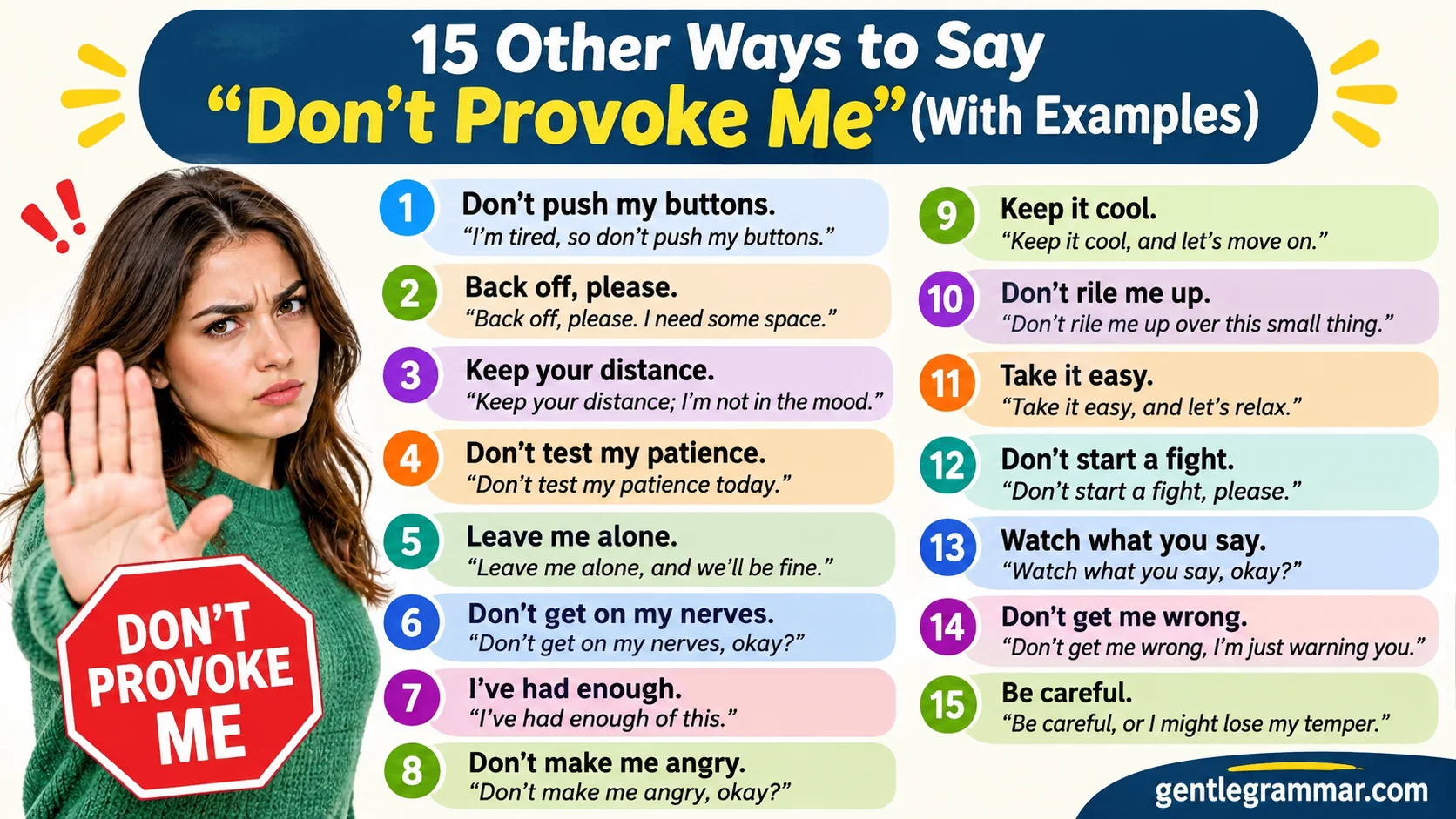
You spend several minutes staying calm, but the other person keeps pushing limits, testing patience, and messing with your buttons. Finally, you say, “Don’t Provoke Me.”
This guide to 15 Other Ways to Say “Don’t Provoke Me” (With Examples) helps you set clear boundaries without turning tension into needless conflict. The simple phrase sends a straightforward message: stop deliberately irritating behavior before it escalates into unwanted responses or conflict.
In real life, I’ve found that a measured tone and drawing a clear line can protect personal space, reduce pressure, and prevent emotions from reacting destructively. Depending on the situation, expressions like “Don’t mess with me” and “Don’t push me” can deliver a stronger warning when someone repeatedly challenges your patience.
What Does “Don’t Provoke Me” Mean?
“Don’t provoke me” means stop doing or saying things that deliberately irritate, anger, challenge, or upset me. The word provoke refers to an action that causes someone to react emotionally, particularly with anger or frustration. When someone uses this expression, they are usually warning another person that their behavior is testing their patience. It can communicate irritation, frustration, or a desire to prevent an argument. Depending on the speaker’s tone and the relationship, it may sound like a serious warning, an emotional response, or a firm request to respect personal boundaries. For example, someone might say it when another person repeatedly makes insulting comments or continues an argument after being asked to stop.
Common Situations Where “Don’t Provoke Me” Is Used
People commonly use “Don’t provoke me” when someone repeatedly pushes their buttons, makes irritating remarks, or deliberately tries to start an argument. It can appear in everyday conversations, especially between friends, siblings, partners, or people who know each other well. In text messages and social media conversations, the expression can communicate frustration when someone refuses to stop making provocative comments.
It may also appear in workplace or school disagreements when someone feels disrespected or deliberately challenged. However, the wording can sound confrontational in professional communication. In customer service or formal writing, a calmer expression is usually more effective. Choosing an alternative helps communicate the same boundary while keeping the conversation respectful and appropriate.
Is It Professional or Polite to Say “Don’t Provoke Me”?
“Don’t provoke me” is generally direct, emotional, and somewhat confrontational. It is understandable in casual conversations, particularly when someone repeatedly behaves in an irritating or disrespectful way. Among close friends or family members, it may sound like a warning rather than a serious threat, depending on the delivery. However, it is not usually the best choice for professional emails, customer communication, or formal discussions because it can make the speaker sound angry or defensive.
In a workplace setting, expressions such as “Please don’t push this issue further” or “I’d appreciate it if we kept this conversation respectful” communicate boundaries more professionally. The best wording depends on your relationship with the other person and how strongly you need to respond.
Advantages and Disadvantages of Saying “Don’t Provoke Me”
Advantages
The expression communicates frustration and boundaries clearly. It lets the other person know that their behavior is becoming upsetting and that you expect it to stop. It is short, direct, and easy to understand. In situations involving repeated irritation or disrespect, it can make your feelings clear without requiring a lengthy explanation.
Disadvantages
The phrase can sound aggressive, threatening, or emotionally charged, especially when spoken in an angry voice. It may also make an argument more intense instead of encouraging a solution. In professional or unfamiliar relationships, the wording might be misunderstood as an attempt to intimidate someone. A softer alternative can communicate the same concern while encouraging more respectful communication.
Synonyms for “Don’t Provoke Me”
- Don’t push my buttons.
- Don’t test my patience.
- Don’t push me.
- Don’t push your luck.
- Don’t try me.
- Stop antagonizing me.
- Don’t rile me up.
- Don’t get on my nerves.
- Don’t bait me.
- Don’t get me worked up.
- Don’t make me lose my temper.
- Stop pushing my limits.
- Don’t get me started.
- Back off.
- Leave me alone.
1. Don’t Push My Buttons
Meaning
“Don’t push my buttons” means stop doing things that deliberately irritate or upset me. It suggests that someone knows which words or behaviors trigger your frustration and keeps using them.
Definition
A warning asking someone to stop deliberately irritating you or triggering an emotional reaction.
Detailed Explanation
This expression is closely related to “Don’t provoke me” because both communicate irritation caused by another person’s behavior. However, it focuses more on personal emotional triggers than on provoking a general reaction. It is especially natural when someone repeatedly makes annoying jokes, brings up sensitive subjects, or behaves in a way they know you dislike. The phrase is informal and often works well between people who know each other.
Scenario Examples
Scenario 1: A conversation with a sibling
Your brother keeps making jokes about something that embarrasses you.
Example: “You know I don’t like those jokes, so don’t push my buttons.”
Scenario 2: A disagreement with a friend
A friend keeps making sarcastic comments during an argument.
Example: “I’m trying to have a normal conversation. Please don’t push my buttons.”
Best Use
Use this expression in casual conversations, text messages, and personal relationships. It works particularly well when someone repeatedly touches a sensitive subject or intentionally irritates you.
Tone
Tone: Casual, assertive, emotional.
The wording communicates frustration while sounding more conversational than a direct warning.
2. Don’t Test My Patience
Meaning
“Don’t test my patience” means stop doing things that are making it increasingly difficult for me to remain calm. It warns someone that you are reaching the limit of your tolerance.
Definition
A firm request for someone to stop behaving in an irritating or unreasonable way before your patience runs out.
Detailed Explanation
Unlike “Don’t provoke me,” this expression focuses on patience rather than anger itself. It suggests that you have tolerated someone’s behavior for a while but are becoming increasingly frustrated. The phrase can sound serious without necessarily suggesting that you want a confrontation. It is useful when someone repeatedly ignores requests, delays an important task, or continues an unnecessary argument.
Scenario Examples
Scenario 1: Dealing with repeated interruptions
A colleague keeps interrupting you while you are explaining something important.
Example: “I’ve asked you to let me finish. Please don’t test my patience.”
Scenario 2: Talking to a friend
Your friend keeps arriving late despite several reminders.
Example: “I’ve waited long enough. Don’t test my patience again.”
Best Use
This expression works in everyday conversations, disagreements, and situations involving repeated frustration. It can also be used in workplace conversations, although a softer version may be preferable in formal settings.
Tone
Tone: Firm, serious, warning.
It communicates that your tolerance is running low without directly stating that you are angry.
3. Don’t Push Me
Meaning
“Don’t push me” means stop pressuring, challenging, or irritating me beyond what I am willing to accept. It can express frustration when someone refuses to respect your limits.
Definition
A direct warning asking someone not to pressure or challenge you further.
Detailed Explanation
This is one of the shorter and more direct alternatives to “Don’t provoke me.” However, it has a broader meaning because it can refer to emotional pressure, repeated demands, or deliberate confrontation. The expression may sound stronger when used during an argument. It is especially appropriate when someone continues challenging your decisions or refuses to respect a clearly stated boundary.
Scenario Examples
Scenario 1: A disagreement with a friend
Someone keeps insisting that you change a decision you have already made.
Example: “I’ve explained my decision already. Don’t push me.”
Scenario 2: Family conversation
A relative keeps asking personal questions after you have declined to answer.
Example: “I don’t want to discuss that right now. Please don’t push me.”
Best Use
Use it in casual conversations, personal disagreements, and situations where someone is ignoring your boundaries. In professional settings, consider a more specific and polite request.
Tone
Tone: Direct, firm, assertive.
It establishes a clear boundary but can sound confrontational if delivered angrily.
4. Don’t Push Your Luck
Meaning
“Don’t push your luck” means don’t continue taking advantage of someone’s patience, generosity, or willingness to tolerate your behavior.
Definition
A warning telling someone not to continue behaving in a way that could lead to an unfavorable response.
Detailed Explanation
This expression is slightly different from “Don’t provoke me” because it focuses on someone’s willingness to tolerate a situation rather than their immediate emotional reaction. It suggests that the other person has already received enough chances or benefits. Continuing the same behavior could change the situation for the worse. It is particularly useful when someone repeatedly takes advantage of your kindness or ignores previous warnings.
Scenario Examples
Scenario 1: Friends joking around
Your friend continues teasing you after you have asked them to stop.
Example: “All right, you’ve had your fun. Don’t push your luck.”
Scenario 2: Lending something
Someone repeatedly borrows your belongings without returning them on time.
Example: “I’ve helped you several times, so don’t push your luck by asking for another favor.”
Best Use
This phrase is best for informal conversations, friendly warnings, and situations involving repeated behavior or excessive demands. It is not a direct substitute when you simply want someone to stop irritating you.
Tone
Tone: Warning, confident, slightly stern.
It sounds firm and sometimes playful, depending on the relationship.
5. Don’t Try Me
Meaning
“Don’t try me” means don’t challenge me, test my limits, or deliberately see how far you can go with me.
Definition
An informal warning telling someone not to challenge or provoke you.
Detailed Explanation
This expression is more forceful than many ordinary alternatives. It suggests that the speaker will not tolerate disrespectful behavior or deliberate attempts to challenge them. Unlike “Don’t test my patience,” it often communicates confidence and a refusal to be intimidated. The phrase can sound intimidating in a heated disagreement, so it should be used carefully when a peaceful conversation is important.
Scenario Examples
Scenario 1: Someone making disrespectful comments
A person keeps making insulting remarks during a discussion.
Example: “I’ve been respectful toward you, so don’t try me.”
Scenario 2: A disagreement between friends
Your friend keeps challenging a boundary you have already established.
Example: “I’m serious about this. Don’t try me today.”
Best Use
Use it in informal conversations, dramatic dialogue, and situations where you want to establish a strong personal boundary. Avoid it in formal emails or customer communication.
Tone
Tone: Strong, confident, confrontational.
It communicates that you are unwilling to tolerate further disrespect.
6. Stop Antagonizing Me
Meaning
“Stop antagonizing me” means stop deliberately behaving in a way that makes me angry, irritated, or hostile.
Definition
A direct request for someone to stop intentionally irritating or upsetting you.
Detailed Explanation
The word antagonize describes behavior that creates hostility or encourages conflict. This makes the expression particularly close in meaning to “Don’t provoke me.” However, it sounds somewhat more formal and specific because it identifies the other person’s behavior as deliberately hostile. It is useful when someone repeatedly insults you, argues unnecessarily, or intentionally creates tension. The wording is stronger than a simple request to stop annoying someone.
Scenario Examples
Scenario 1: An ongoing argument
Someone keeps making personal remarks instead of discussing the actual issue.
Example: “Can we discuss the problem without personal attacks? Stop antagonizing me.”
Scenario 2: An uncomfortable family conversation
A family member keeps bringing up an old disagreement to upset you.
Example: “We’ve already discussed this. Please stop antagonizing me.”
Best Use
Use this phrase in serious conversations, personal disagreements, and situations where someone is deliberately creating hostility. It can also work in written communication when a firm boundary is necessary.
Tone
Tone: Serious, direct, somewhat formal.
It sounds more deliberate and controlled than some emotional alternatives.
7. Don’t Rile Me Up
Meaning
“Don’t rile me up” means don’t do things that make me angry, irritated, or emotionally worked up.
Definition
An informal request asking someone not to excite or intensify your anger.
Detailed Explanation
This expression focuses on the emotional reaction caused by another person’s words or actions. It is similar to “Don’t provoke me,” but it places more emphasis on becoming upset or worked up. It can be used when someone keeps making annoying comments or bringing up subjects that create unnecessary frustration. Compared with a serious warning, it can sound more relaxed or conversational.
Scenario Examples
Scenario 1: Talking with a friend
Your friend keeps discussing a subject that always frustrates you.
Example: “You know how I feel about that topic. Don’t rile me up again.”
Scenario 2: Watching a sports match
Someone keeps making comments about your favorite team after a disappointing result.
Example: “I’m already frustrated about the match. Don’t rile me up!”
Best Use
This phrase works best in casual conversations, friendly arguments, and familiar relationships. It is particularly natural in spoken English.
Tone
Tone: Informal, emotional, slightly playful.
It communicates irritation without necessarily sounding as serious as a direct threat or warning.
8. Don’t Get on My Nerves
Meaning
“Don’t get on my nerves” means stop behaving in a way that repeatedly irritates or annoys me.
Definition
An informal expression used to tell someone that their behavior is becoming annoying.
Detailed Explanation
This phrase is more about everyday annoyance than deliberate provocation. Someone might use it when another person keeps interrupting, making unnecessary noises, or repeating irritating comments. Unlike “Don’t provoke me,” it does not always suggest that the other person is intentionally trying to make you angry. It is a natural expression for communicating frustration in familiar relationships, although it can sound rude if delivered sharply.
Scenario Examples
Scenario 1: A conversation with a sibling
Your younger brother keeps repeating the same question.
Example: “You’ve asked me five times already. Don’t get on my nerves.”
Scenario 2: Working with a friend
Your friend keeps playing loud music while you are trying to concentrate.
Example: “Could you turn that down? You’re starting to get on my nerves.”
Best Use
Use this expression in casual conversations, friendly disagreements, and everyday situations involving annoyance. It is less suitable for formal communication.
Tone
Tone: Casual, irritated, blunt.
It sounds natural in informal English but can seem dismissive when spoken harshly.
9. Don’t Bait Me
Meaning
“Don’t bait me” means don’t deliberately tempt, challenge, or provoke me into reacting.
Definition
A warning asking someone not to use comments or actions to draw you into an argument or emotional reaction.
Detailed Explanation
This expression is especially useful when someone is deliberately trying to get a reaction from you. The word bait suggests setting a trap to encourage a particular response. Unlike “Don’t provoke me,” it highlights the other person’s possible intention to make you react. It is commonly understood in arguments and online discussions, where someone may use insulting comments to encourage an emotional response.
Scenario Examples
Scenario 1: An online argument
Someone repeatedly posts insulting replies to make you angry.
Example: “I’m not interested in arguing with you, so don’t bait me.”
Scenario 2: A personal disagreement
A friend keeps making exaggerated statements to start an argument.
Example: “I know what you’re doing. Don’t bait me into another argument.”
Best Use
This expression works well in online discussions, social media, personal disagreements, and conversations involving deliberate emotional manipulation.
Tone
Tone: Guarded, firm, controlled.
It communicates that you recognize someone’s attempt to provoke a reaction and do not want to participate.
10. Don’t Get Me Worked Up
Meaning
“Don’t get me worked up” means don’t make me unnecessarily upset, frustrated, or emotionally agitated.
Definition
An informal request asking someone not to increase your emotional stress or frustration.
Detailed Explanation
This expression focuses on emotional agitation rather than direct confrontation. It is similar to “Don’t provoke me,” but it can also refer to situations where someone unintentionally increases your stress. The phrase is useful when you want to avoid becoming upset over a disagreement or unnecessary discussion. It often sounds softer and more conversational than a serious warning.
Scenario Examples
Scenario 1: Discussing a stressful subject
Your friend keeps bringing up a problem you are already worried about.
Example: “I’ve got enough to think about today. Don’t get me worked up.”
Scenario 2: Preparing for an important event
A family member keeps pointing out everything that could go wrong before your interview.
Example: “Please stop listing all the possible problems. You’re getting me worked up.”
Best Use
Use this expression in personal conversations, family discussions, and situations involving stress or frustration. It is especially useful when you want to maintain a calm atmosphere.
Tone
Tone: Conversational, emotional, moderately gentle.
It communicates discomfort without necessarily accusing someone of deliberately provoking you.
11. Don’t Make Me Lose My Temper
Meaning
“Don’t make me lose my temper” means stop doing things that could cause me to become seriously angry.
Definition
A strong warning asking someone to stop irritating or upsetting you before you become angry.
Detailed Explanation
This expression is more intense than “Don’t provoke me” because it directly mentions losing control of your temper. It suggests that the speaker is already frustrated and may become angrier if the behavior continues. Unlike softer alternatives, it clearly communicates a serious emotional limit. Because it can sound intimidating, it is important to consider the relationship and situation before using it.
Scenario Examples
Scenario 1: Repeated disrespect
Someone continues interrupting you and making insulting remarks.
Example: “I’ve asked you to speak respectfully. Don’t make me lose my temper.”
Scenario 2: A heated family disagreement
A relative refuses to stop arguing about a sensitive matter.
Example: “Let’s end this conversation before we both get angry. Don’t make me lose my temper.”
Best Use
This phrase is most appropriate for serious personal disagreements and situations involving repeated disrespect. Avoid it in professional emails and customer-facing conversations.
Tone
Tone: Strong, emotional, stern.
It signals that your anger is increasing and that you want the behavior to stop.
12. Stop Pushing My Limits
Meaning
“Stop pushing my limits” means stop testing how much pressure, frustration, or unacceptable behavior I am willing to tolerate.
Definition
A firm request for someone to respect your personal boundaries and stop going beyond what you consider acceptable.
Detailed Explanation
This alternative focuses on personal boundaries and tolerance rather than anger alone. It is useful when someone repeatedly makes unreasonable demands, ignores your requests, or continues behaving in a way that makes you uncomfortable. Compared with “Don’t provoke me,” it can sound more mature and boundary-focused. It also works when the issue involves pressure or disrespect rather than an attempt to make you angry.
Scenario Examples
Scenario 1: A demanding friend
Your friend keeps asking you to cancel your plans to help them.
Example: “I’ve already changed my schedule twice. Stop pushing my limits.”
Scenario 2: A workplace disagreement
A colleague keeps assigning you tasks outside your agreed responsibilities.
Example: “I’m happy to help when possible, but please stop pushing my limits.”
Best Use
Use this expression in personal relationships, workplace discussions, and conversations about boundaries. It can be particularly effective when you want to sound firm but composed.
Tone
Tone: Assertive, serious, boundary-focused.
It communicates self-respect and makes your expectations clear.
13. Don’t Get Me Started
Meaning
“Don’t get me started” means don’t bring up a subject that could make me complain, become frustrated, or express strong feelings.
Definition
An informal expression used when a particular topic is likely to trigger a lengthy or emotional reaction.
Detailed Explanation
This phrase is not an exact synonym for “Don’t provoke me.” It is more commonly used when someone mentions a subject that the speaker already feels strongly about. It can suggest annoyance, disappointment, or strong disagreement. Unlike a direct warning, it often sounds humorous or dramatic among friends. It is particularly useful when you want to indicate that discussing a particular topic could lead to a long complaint.
Scenario Examples
Scenario 1: Talking about poor customer service
A friend asks about your recent experience with a company.
Example: “Don’t get me started on their customer service. I’ve had enough problems with them.”
Scenario 2: Discussing a frustrating situation
Someone mentions a subject that has repeatedly caused you trouble.
Example: “Don’t get me started about the traffic this morning!”
Best Use
This phrase works best in casual conversations, friendly discussions, social media posts, and humorous situations. It is less appropriate as a serious request to stop someone’s behavior.
Tone
Tone: Casual, expressive, sometimes humorous.
It communicates strong feelings while often adding a conversational or playful touch.
14. Back Off
Meaning
“Back off” means stop pressuring, bothering, threatening, or interfering with me.
Definition
A direct command asking someone to give you space or stop interfering.
Detailed Explanation
This is a stronger boundary-setting expression than many alternatives. While “Don’t provoke me” asks someone to stop causing irritation, “Back off” tells them to create distance or stop their involvement. It can be appropriate when someone is invading your personal space, pressuring you, or refusing to respect your boundaries. However, it is not always interchangeable with the original phrase because it emphasizes distance and interference rather than emotional provocation.
Scenario Examples
Scenario 1: Someone interfering in a personal matter
A person keeps demanding details about something private.
Example: “This is a personal matter. Please back off.”
Scenario 2: An uncomfortable confrontation
Someone moves too close and continues arguing aggressively.
Example: “I don’t want any trouble. Back off and give me some space.”
Best Use
Use this expression when you need to establish a clear personal boundary, particularly in uncomfortable confrontations or situations involving unwanted pressure. In professional communication, use a more polite request.
Tone
Tone: Forceful, direct, defensive.
It communicates a strong desire for distance and should be used carefully.
15. Leave Me Alone
Meaning
“Leave me alone” means stop bothering me, give me space, and let me deal with my situation without interference.
Definition
A direct request for someone to stop contacting, disturbing, or interfering with you.
Detailed Explanation
This expression is different from “Don’t provoke me” because it focuses on wanting privacy or distance rather than warning someone about their irritating behavior. It is useful when you feel overwhelmed, frustrated, or emotionally exhausted and no longer want to continue a conversation. The wording is simple and widely understood, although it can sound rude or dismissive depending on the delivery. A softer version can communicate the same need without creating additional tension.
Scenario Examples
Scenario 1: Needing personal space
You have had a difficult day and do not feel ready to talk.
Example: “I’m exhausted right now. Please leave me alone for a little while.”
Scenario 2: Ending an unwanted conversation
Someone continues messaging you after you have asked for some space.
Example: “I’ve already said I don’t want to talk about this. Please leave me alone.”
Best Use
Use this expression in personal conversations, text messages, and situations where you need privacy or emotional space. For professional communication, phrases such as “I’d appreciate some time to myself” sound more respectful.
Tone
Tone: Direct, emotional, firm.
It communicates a clear desire for distance and can sound either reasonable or harsh depending on the situation.
FAQs:
What is another way to say “Don’t Provoke Me”?
Some natural alternatives include “Don’t push my buttons,” “Don’t test my patience,” “Don’t try me,” “Stop antagonizing me,” and “Don’t rile me up.” The best choice depends on whether you want to sound casual, serious, assertive, or emotional.
What does “Don’t Provoke Me” mean?
“Don’t provoke me” means stop deliberately doing or saying things that make me angry, irritated, or upset. It is generally used when someone feels that another person’s behavior is testing their patience or encouraging an argument.
Is “Don’t Provoke Me” professional?
It is generally not the best expression for formal workplace communication because it can sound confrontational. A more professional option would be “Please respect my boundaries” or “I’d appreciate it if we kept this discussion respectful.”
What is a more polite way to say “Don’t Provoke Me”?
A polite alternative is “Please don’t push this issue further.” You could also say, “I’d appreciate it if you stopped making those comments.” These expressions communicate discomfort without sounding unnecessarily aggressive.
Which alternative works best in formal communication?
“Please respect my boundaries” is a suitable choice when you want to communicate a personal limit professionally. In a workplace disagreement, “I’d appreciate it if we kept the conversation constructive” can also help maintain a respectful atmosphere.
Conclusion:
Choosing the right words can make a difficult conversation easier to manage. Although “Don’t provoke me” clearly communicates frustration, alternatives such as “Don’t test my patience,” “Stop antagonizing me,” and “Stop pushing my limits” offer different levels of firmness and emotional expression. Some phrases are better for friendly conversations, while others work when you need to establish a serious boundary.
Remember that similar expressions do not always have identical meanings. Consider your relationship with the other person, the situation, and the message you want to communicate before choosing your wording. The best expression is one that makes your feelings clear while respecting both your boundaries and the other person’s dignity.
