
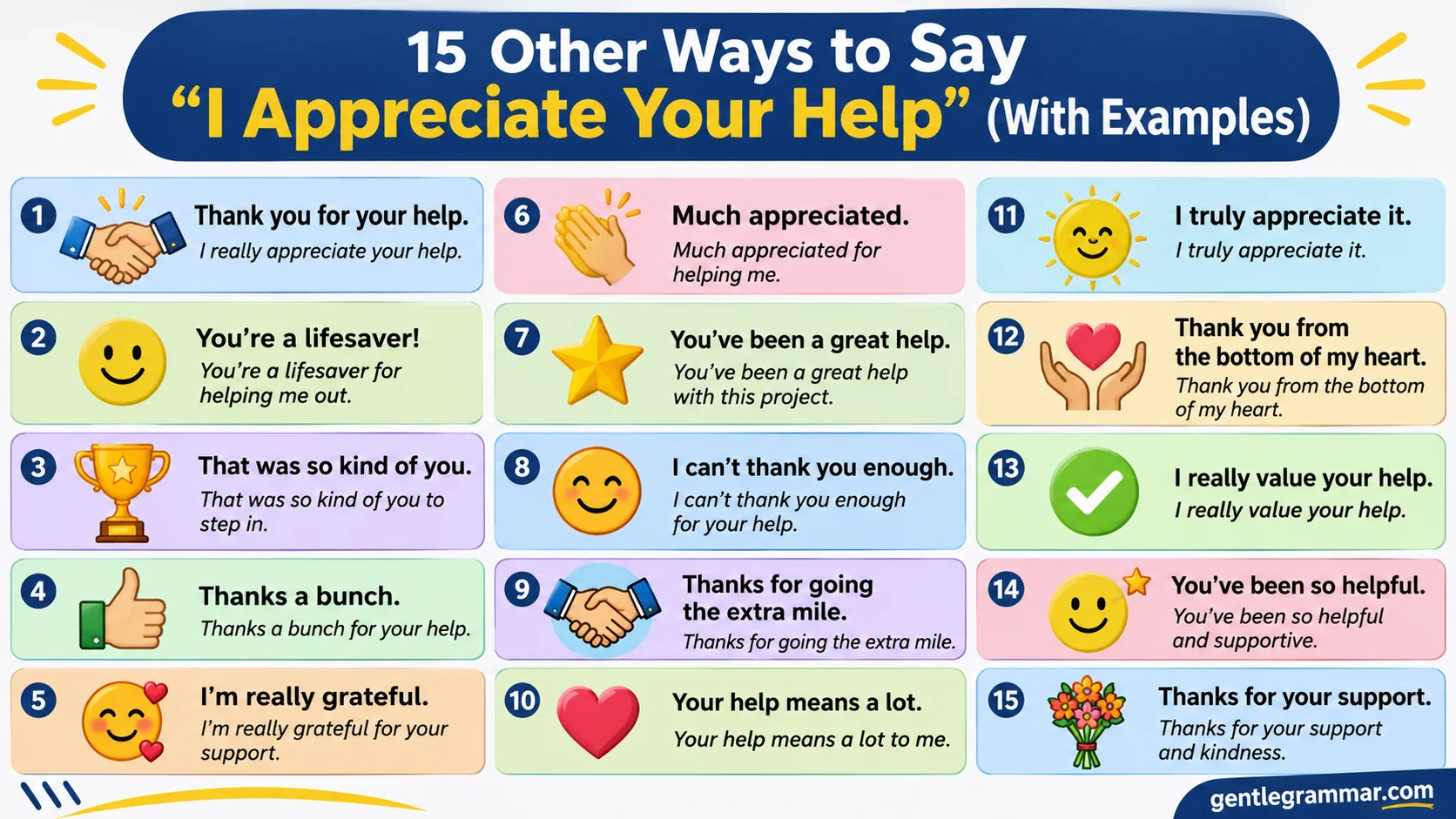
This guide to 15 Other Ways to Say “I Appreciate Your Help” (With Examples) shows how thoughtful words make gratitude sound more personal and sincere.
Expressing gratitude is more than good manners; it shows appreciation and helps strengthen professional connections. When you say I Appreciate Your Help, you acknowledge someone’s effort, time, and care invested in your success. Even a small message can improve communication, encourage positive behavior, and create a memorable impression. However, if you’ve typed one phrase for the third time this week, it may sound like a copy-paste reflex instead of real gratitude.
That’s not a flaw because English offers dozens of ways to express thanks with different shades of warmth, formality, and emotion. Whether you’re thanking coworkers, clients, mentors, or friends, choosing words that carry meaning makes your message more genuine. This guide explains what the phrase actually means, when it works best, and how 25 other ways to say it can keep your gratitude from sounding like a template. The good news is that you can express the same thing in a more natural and personal way.
What Does “I Appreciate Your Help” Mean?
“I appreciate your help” means that you recognize and feel grateful for someone’s assistance. It communicates that you value the time, effort, advice, or support the person has given you. The expression is more thoughtful than a simple acknowledgment because it shows that their contribution matters to you.
In everyday English, this phrase can express anything from polite gratitude for a small favor to sincere thanks for significant support. For example, you might say it to a coworker who helped you finish a project, a friend who listened when you needed advice, or a customer service representative who resolved an issue. The exact feeling depends on the situation and your relationship with the person. Overall, it is a polite, natural, and versatile expression of gratitude.
Common Situations Where “I Appreciate Your Help” Is Used
People use this expression in many situations when they want to acknowledge another person’s effort.
- Everyday conversation: Thanking a friend, neighbor, or family member for helping with a task.
- Workplace communication: Recognizing a colleague’s contribution, a manager’s guidance, or a teammate’s cooperation.
- Emails and messages: Expressing gratitude after receiving information, advice, feedback, or assistance.
- School and education: Thanking a teacher, classmate, tutor, or school administrator for their support.
- Personal relationships: Showing someone that their time, encouragement, or practical help matters.
- Customer communication: Acknowledging assistance from a support agent or thanking a customer for their cooperation.
Sometimes, a different expression communicates your feelings more precisely. You might want to sound warmer, emphasize someone’s effort, acknowledge a specific favor, or use more formal language in a business email. Choosing the right wording helps your message feel genuine rather than routine.
Is It Professional or Polite to Say “I Appreciate Your Help”?
Yes. “I appreciate your help” is both polite and professional in most situations. It works well in workplace emails, conversations with supervisors, business correspondence, and messages to clients. The phrase communicates respect without sounding overly formal, making it suitable for everyday professional communication.
It can also sound warm and personal when used with friends or family. In a formal email, you might prefer “I sincerely appreciate your assistance,” especially when acknowledging substantial support. In a casual text, “Thanks so much for helping me out!” may feel more relaxed and natural. The best expression depends on the relationship, the effort involved, and the tone you want to convey.
Advantages and Disadvantages of Saying “I Appreciate Your Help”
Advantages
The phrase is clear, courteous, and widely understood. It acknowledges someone’s contribution without requiring a long explanation, and it fits both personal and professional settings. It also sounds sincere when you use it to recognize a person’s time, advice, or effort. Because it is relatively neutral, you can use it with people you know well and people you interact with professionally.
Disadvantages
The expression can feel routine or impersonal if you use it repeatedly without mentioning what the person actually did. It also does not always communicate the depth of your gratitude. When someone has gone out of their way to support you, a more personal statement may feel more meaningful. Similarly, if you want to emphasize exceptional effort, long-term support, or a specific favor, a more detailed expression can communicate that appreciation more effectively.
Synonyms for “I Appreciate Your Help”
- Thank You for Your Help
- Thanks So Much for Your Support
- I’m Grateful for Your Assistance
- I Truly Appreciate Your Support
- Thank You for Going Out of Your Way
- Your Help Means a Lot to Me
- I’m Thankful for Your Guidance
- I Couldn’t Have Done It Without You
- I Appreciate You Taking the Time
- Many Thanks for Your Assistance
- I’m So Glad You Could Help
- Thank You for Being So Helpful
- I Value Your Support
- I’m Indebted to You
- I Can’t Thank You Enough
1. Thank You for Your Help
Meaning
“Thank you for your help” expresses direct, polite gratitude to someone who has assisted you. It communicates the same basic message as “I appreciate your help” but sounds slightly simpler and more straightforward.
Definition
A courteous expression used to acknowledge and thank someone for providing assistance.
Detailed Explanation
This phrase is one of the most natural ways to express appreciation in everyday English. It works when someone completes a small favor or provides meaningful assistance. Unlike more emotional expressions, it keeps the focus on the person’s helpful action. You can make it warmer by adding a person’s name or mentioning what they did.
Scenario Examples
Scenario: A coworker helps you organize a presentation.
Example: “Thank you for your help with the presentation. I really appreciate your time.”
Scenario: A friend helps you move some furniture.
Example: “Thank you for your help today. I couldn’t have moved everything so quickly alone.”
Scenario: A customer service agent resolves a billing problem.
Example: “Thank you for your help in resolving this issue.”
Best Use
Use this expression in everyday conversations, workplace emails, customer service messages, and personal notes. It is especially useful when you want to sound polite without making your gratitude overly emotional.
Tone
Tone: Polite, friendly, neutral
Its straightforward wording makes it appropriate for both familiar and professional relationships.
2. Thanks So Much for Your Support
Meaning
“Thanks so much for your support” expresses warm gratitude for someone’s help, encouragement, or continued assistance. It often acknowledges more than one specific task.
Definition
A friendly expression of sincere thanks for practical or emotional support.
Detailed Explanation
The word “support” can include encouragement, advice, practical assistance, or simply being there when someone needs help. Adding “so much” makes the expression warmer and more enthusiastic. This phrase is particularly useful when someone has helped you through a demanding period rather than completing a single favor. However, it can sound more personal than a simple thank-you, especially in emotional situations.
Scenario Examples
Scenario: A friend encourages you during a difficult week.
Example: “Thanks so much for your support. Having someone to talk to really helped.”
Scenario: Your team helps you prepare for an important launch.
Example: “Thanks so much for your support throughout this project. It made a real difference.”
Scenario: You thank followers after receiving encouragement for a new project.
Example: “Thanks so much for your support as I get this new venture started!”
Best Use
Choose this expression for personal messages, team communication, social media posts, and situations involving ongoing encouragement or cooperation.
Tone
Tone: Warm, appreciative, enthusiastic
The phrase conveys more emotional warmth than a basic thank-you while remaining natural and accessible.
3. I’m Grateful for Your Assistance
Meaning
“I’m grateful for your assistance” communicates sincere appreciation for someone’s help using a slightly more formal style than everyday expressions.
Definition
A respectful statement expressing gratitude for assistance received.
Detailed Explanation
This wording is particularly useful when you want your message to sound composed and professional. “Assistance” is more formal than “help,” so the expression fits business correspondence and official requests. It can acknowledge anything from useful information to substantial practical support. Although it is perfectly natural English, it may sound unnecessarily formal in a quick conversation with a close friend.
Scenario Examples
Scenario: A colleague helps you understand a complicated report.
Example: “I’m grateful for your assistance in reviewing the figures before the meeting.”
Scenario: A university administrator explains an application procedure.
Example: “I’m grateful for your assistance with the enrollment process.”
Scenario: A professional contact shares useful industry information.
Example: “I’m grateful for your assistance and the time you took to answer my questions.”
Best Use
Use it in professional emails, academic communication, formal correspondence, and messages to people you do not know well.
Tone
Tone: Professional, respectful, formal
The word “assistance” gives the expression a polished quality without making it cold or impolite.
4. I Truly Appreciate Your Support
Meaning
“I truly appreciate your support” expresses genuine and heartfelt gratitude. The word “truly” emphasizes that your appreciation is sincere.
Definition
A statement that strongly conveys how much someone’s support matters to you.
Detailed Explanation
This expression is useful when an ordinary thank-you does not fully communicate your feelings. It can recognize emotional encouragement, practical help, or a person’s continued commitment to you. The added emphasis makes it more personal than a neutral statement of gratitude. In professional settings, it remains appropriate when someone’s contribution has been particularly valuable.
Scenario Examples
Scenario: Your manager supports your professional development.
Example: “I truly appreciate your support as I take on these new responsibilities.”
Scenario: A friend stands by you during a personal setback.
Example: “I truly appreciate your support during this difficult time. It means more than you know.”
Scenario: Your colleagues help you meet an important deadline.
Example: “I truly appreciate your support and teamwork in getting everything finished on time.”
Best Use
Use this phrase in meaningful personal messages, workplace acknowledgments, and situations where you want to emphasize sincere gratitude.
Tone
Tone: Sincere, warm, emphatic
“Truly” adds emotional weight while keeping the expression respectful and natural.
5. Thank You for Going Out of Your Way
Meaning
“Thank you for going out of your way” recognizes someone who has made extra effort or a special accommodation to help you.
Definition
An expression of gratitude for assistance that required more effort than usual.
Detailed Explanation
This phrase does more than acknowledge the help itself. It shows that you noticed the inconvenience, time, or additional effort the person accepted on your behalf. It is especially appropriate when someone rearranges their schedule, travels farther, or takes an extra step to solve a problem. Use it when the person genuinely made an extra effort rather than simply performing an ordinary responsibility.
Scenario Examples
Scenario: A colleague stays late to help you finish a report.
Example: “Thank you for going out of your way to help me meet the deadline.”
Scenario: A friend drives across town to bring you something you need.
Example: “Thank you for going out of your way to bring this over. That was really thoughtful.”
Scenario: A supplier arranges an unusual delivery to meet your schedule.
Example: “Thank you for going out of your way to arrange the earlier delivery.”
Best Use
Choose this expression when acknowledging extra effort, special favors, unexpected assistance, or thoughtful gestures.
Tone
Tone: Appreciative, thoughtful, personal
It makes your gratitude more specific by recognizing the effort behind the help.
6. Your Help Means a Lot to Me
Meaning
“Your help means a lot to me” tells someone that their assistance has personal significance beyond the immediate task.
Definition
A heartfelt expression explaining that someone’s help is especially important to you.
Detailed Explanation
This phrase focuses on the impact of the help rather than merely acknowledging that it happened. It is particularly effective when someone’s actions have reduced your stress, helped you overcome a challenge, or made you feel supported. It sounds more emotional than a standard professional thank-you, although it can also work at work when the situation calls for genuine warmth. The phrase feels most natural when the person’s contribution has made a meaningful difference.
Scenario Examples
Scenario: A friend helps you prepare for an important exam.
Example: “Your help means a lot to me. I feel much more confident about tomorrow.”
Scenario: A family member supports you during a busy period.
Example: “Your help means a lot to me, especially with everything going on right now.”
Scenario: A teammate steps in when you are overwhelmed.
Example: “Your help means a lot to me. I was struggling to manage everything on my own.”
Best Use
Use this expression in personal messages, close working relationships, supportive conversations, and moments when you want to communicate emotional significance.
Tone
Tone: Heartfelt, warm, personal
It emphasizes the value of the person’s contribution and the effect it has had on you.
7. I’m Thankful for Your Guidance
Meaning
“I’m thankful for your guidance” expresses gratitude for someone’s advice, direction, or help in making decisions.
Definition
A statement thanking someone for offering advice or helping you understand what to do.
Detailed Explanation
This expression is more specific than a general thank-you because it focuses on guidance rather than practical assistance alone. It is useful when someone explains a process, shares experience, or helps you make a difficult decision. The wording can convey respect for a person’s knowledge without excessive praise. It is less suitable when someone has only completed a physical task, such as carrying boxes or delivering a package.
Scenario Examples
Scenario: A mentor helps you plan your career.
Example: “I’m thankful for your guidance as I work toward my next career goal.”
Scenario: A teacher explains how to improve an assignment.
Example: “I’m thankful for your guidance. Your feedback helped me understand where I went wrong.”
Scenario: A manager advises you on handling a workplace challenge.
Example: “I’m thankful for your guidance on how to approach this conversation professionally.”
Best Use
Use it for mentoring, education, professional development, decision-making, and situations involving advice or direction.
Tone
Tone: Respectful, thoughtful, appreciative
The emphasis on guidance makes the expression especially suitable when acknowledging someone’s experience or advice.
8. I Couldn’t Have Done It Without You
Meaning
“I couldn’t have done it without you” communicates strong appreciation for someone’s important contribution to an achievement or completed task.
Definition
A statement acknowledging that another person’s help was essential to your success.
Detailed Explanation
This expression is stronger than a general thank-you because it highlights how important the person’s contribution was. It often works well after completing a challenging project, reaching a goal, or overcoming an obstacle together. It can sound affectionate among friends and enthusiastic among teammates. However, it may exaggerate the person’s role if you could realistically have completed the task without their assistance.
Scenario Examples
Scenario: Your teammate helps you finish a demanding project.
Example: “We finally got it submitted! I couldn’t have done it without you.”
Scenario: A friend helps you prepare for a community event.
Example: “I couldn’t have done it without you. You handled all the details I was worried about.”
Scenario: Your family helps you organize a major move.
Example: “I couldn’t have done it without you all. Thank you for making the move so much easier.”
Best Use
Choose this phrase for shared achievements, major projects, difficult tasks, and situations where another person’s contribution was essential.
Tone
Tone: Grateful, enthusiastic, heartfelt
It emphasizes the person’s importance to the outcome rather than simply acknowledging assistance.
9. I Appreciate You Taking the Time
Meaning
“I appreciate you taking the time” thanks someone for devoting time and attention to you or your request.
Definition
An expression of gratitude for the time someone spent helping, listening, reviewing, or responding.
Detailed Explanation
This phrase is particularly useful when a person’s time is valuable or when they have made space in a busy schedule to assist you. It recognizes a specific part of their contribution that a general thank-you might overlook. You can complete the expression by explaining what the person took time to do. In polished professional writing, “I appreciate you taking the time to review my proposal” is natural and respectful.
Scenario Examples
Scenario: A recruiter meets with you to discuss a role.
Example: “I appreciate you taking the time to speak with me about the position.”
Scenario: A friend listens while you talk through a problem.
Example: “I appreciate you taking the time to listen. I needed to talk it through.”
Scenario: A colleague reviews your presentation before a meeting.
Example: “I appreciate you taking the time to review my slides and share your feedback.”
Best Use
Use it in professional emails, interviews, consultations, requests for feedback, and personal conversations where someone’s time deserves acknowledgment.
Tone
Tone: Considerate, polite, professional
It demonstrates that you recognize not only the help itself but also the time the person invested.
10. Many Thanks for Your Assistance
Meaning
“Many thanks for your assistance” is a polite expression of gratitude often used in written communication.
Definition
A courteous way to thank someone for providing help or assistance.
Detailed Explanation
This phrase sounds slightly more formal than “thanks for your help.” It is especially common in professional correspondence where you want to remain friendly but maintain a respectful distance. It works well when someone provides information, resolves a request, or helps move a process forward. In casual conversation, however, it can sound a little stiff compared with simpler wording.
Scenario Examples
Scenario: A coworker sends the documents you requested.
Example: “Many thanks for your assistance in gathering these documents.”
Scenario: An office administrator helps arrange an appointment.
Example: “Many thanks for your assistance with scheduling the meeting.”
Scenario: A business contact provides details for a report.
Example: “Many thanks for your assistance. The information was very useful.”
Best Use
Choose this expression for business emails, formal requests, administrative communication, and professional correspondence.
Tone
Tone: Courteous, polished, moderately formal
The wording communicates gratitude clearly while maintaining a professional style.
11. I’m So Glad You Could Help
Meaning
“I’m so glad you could help” expresses pleasure and relief that someone was available and able to assist you.
Definition
A friendly statement showing that you are happy someone was able to provide the help you needed.
Detailed Explanation
Unlike a direct statement of gratitude, this phrase emphasizes how pleased you are that the person could help. It is particularly natural when someone’s availability made a task easier or solved an immediate problem. The expression feels conversational rather than formal. You can follow it with a specific thank-you if you want to make your appreciation even clearer.
Scenario Examples
Scenario: A friend helps you troubleshoot a computer problem.
Example: “I’m so glad you could help. I had no idea why the computer kept freezing.”
Scenario: A coworker agrees to cover a shift.
Example: “I’m so glad you could help with Friday’s shift. I really needed the extra time.”
Scenario: A neighbor helps you find a lost package.
Example: “I’m so glad you could help me track it down!”
Best Use
Use it in casual conversations, friendly messages, everyday favors, and situations where you feel relieved that someone was available.
Tone
Tone: Friendly, relaxed, relieved
It combines appreciation with a positive reaction to the person’s willingness or ability to help.
12. Thank You for Being So Helpful
Meaning
“Thank you for being so helpful” thanks someone for their helpful attitude, willingness, or repeated acts of assistance.
Definition
A statement expressing gratitude for someone’s helpful behavior or approach.
Detailed Explanation
This expression recognizes the person’s general helpfulness rather than just one particular action. It works especially well when someone has been patient, cooperative, or consistently willing to answer questions. It can make a message feel more personal because it acknowledges a positive quality in the other person. In contrast, a phrase focused on a specific task may be more appropriate when you want to recognize one clearly defined contribution.
Scenario Examples
Scenario: A new employee receives patient guidance from a colleague.
Example: “Thank you for being so helpful while I’m learning the new system.”
Scenario: A store employee answers several questions.
Example: “Thank you for being so helpful. I appreciate you explaining all the options.”
Scenario: A friend assists with several small errands.
Example: “Thank you for being so helpful this week. You’ve made everything much easier.”
Best Use
Choose this expression for customer service, workplace relationships, everyday favors, and situations involving patience or ongoing cooperation.
Tone
Tone: Friendly, appreciative, encouraging
It acknowledges the person’s helpful nature, which can make your thanks feel more personal.
13. I Value Your Support
Meaning
“I value your support” communicates that you consider someone’s help, encouragement, or cooperation important.
Definition
A respectful expression showing that someone’s support is meaningful and appreciated.
Detailed Explanation
This phrase emphasizes the importance you place on a person’s contribution or continued involvement. It can work particularly well in professional relationships, partnerships, and situations where cooperation matters over time. Compared with “thank you for your help,” it sounds more measured and emphasizes the value of the relationship or contribution. It may feel a little distant in a highly emotional personal conversation, where more heartfelt wording could be better.
Scenario Examples
Scenario: A project leader thanks colleagues for their cooperation.
Example: “I value your support as we work through the final stages of this project.”
Scenario: A small business owner thanks a long-term client.
Example: “I value your support and the trust you’ve placed in our business.”
Scenario: A colleague provides ongoing encouragement.
Example: “I value your support and the honest feedback you’ve shared with me.”
Best Use
Use it in professional communication, partnerships, ongoing collaborations, and messages acknowledging sustained support.
Tone
Tone: Respectful, professional, sincere
The expression communicates appreciation while emphasizing the importance of the other person’s contribution.
14. I’m Indebted to You
Meaning
“I’m indebted to you” expresses deep gratitude for a significant favor or act of kindness. It suggests that the person has done something for which you feel especially thankful.
Definition
A strong expression of gratitude that conveys a sense of owing someone thanks for their help.
Detailed Explanation
This phrase carries more emotional weight than an ordinary thank-you. It is often used when someone has gone to considerable trouble or provided important assistance during a difficult situation. In everyday conversation, it can also be used playfully to express strong appreciation for a favor. However, it may sound overly dramatic when the help was minor, and it should not automatically be interpreted as a literal financial or legal debt.
Scenario Examples
Scenario: A friend helps you arrange urgent transportation.
Example: “I’m indebted to you for helping me get there on such short notice.”
Scenario: A colleague covers a major responsibility while you are unavailable.
Example: “I’m indebted to you for stepping in and handling the client meeting.”
Scenario: Someone offers significant help during a difficult personal situation.
Example: “I’m truly indebted to you for everything you’ve done for my family.”
Best Use
Choose this expression for substantial favors, significant acts of kindness, heartfelt conversations, or playful exchanges with people you know well. In formal business writing, a straightforward expression of gratitude is often more appropriate.
Tone
Tone: Deeply grateful, emphatic, sometimes dramatic
It conveys a stronger sense of obligation and appreciation than a routine thank-you.
15. I Can’t Thank You Enough
Meaning
“I can’t thank you enough” expresses very strong gratitude when you feel that ordinary words do not fully capture your appreciation.
Definition
An emphatic expression used when someone has helped you so much that a simple thank-you feels insufficient.
Detailed Explanation
This phrase is especially useful after a meaningful favor, a difficult period, or a generous act of kindness. It emphasizes the depth of your gratitude rather than the details of the assistance. People commonly use it in spoken English, personal messages, and warm professional communication. Although it is not usually meant literally, it can sound exaggerated if the situation involves only a very small favor.
Scenario Examples
Scenario: A friend helps you prepare for an important life event.
Example: “I can’t thank you enough for helping me get everything ready. I would’ve been overwhelmed without you.”
Scenario: A colleague rescues an important project by resolving a difficult issue.
Example: “I can’t thank you enough for fixing that problem before the client presentation.”
Scenario: A family member provides support during a challenging time.
Example: “I can’t thank you enough for being there for me when I needed you most.”
Best Use
Use it for significant favors, emotional support, generous assistance, and situations where you want to emphasize how deeply grateful you feel.
Tone
Tone: Heartfelt, emphatic, emotional
The phrase conveys strong appreciation and makes the importance of someone’s help unmistakable.
FAQs:
What is another way to say “I Appreciate Your Help”?
You can say “Thank you for your help,” “I’m grateful for your assistance,” or “Your help means a lot to me.” Choose the expression that matches your relationship with the person and the amount of help they provided. For a professional email, “I’m grateful for your assistance” works well. For a personal message, “Your help means a lot to me” feels warmer.
What does “I Appreciate Your Help” mean?
“I appreciate your help” means you recognize and feel grateful for someone’s assistance. It acknowledges their time, effort, advice, or support. The expression is polite and suitable for many everyday and professional situations.
Is “I Appreciate Your Help” professional?
Yes, it is a professional and polite expression suitable for workplace conversations, emails, and business correspondence. It communicates gratitude without sounding overly formal. If you want a more formal version, you can say, “I sincerely appreciate your assistance.”
What is a more polite way to say “I Appreciate Your Help”?
A polite alternative is “Thank you for your assistance.” It sounds respectful and works well in professional emails and formal communication. You can also say, “I appreciate you taking the time to help me,” when you want to acknowledge someone’s time and effort.
Which alternative works best in formal communication?
“I’m grateful for your assistance” is an excellent choice for formal communication. It sounds respectful, clear, and professional. “Many thanks for your assistance” is another suitable option for business emails, administrative requests, and other formal written messages.
Conclusion:
Choosing the right words helps you express gratitude in a way that feels genuine and appropriate. While “I appreciate your help” works in almost any everyday or professional situation, other expressions can communicate more specific feelings. You might emphasize someone’s extra effort, acknowledge their guidance, recognize ongoing support, or express heartfelt thanks for a meaningful favor.
The best alternative depends on your relationship, the situation, and the tone you want to convey. For workplace emails, a professional expression such as “I’m grateful for your assistance” may be ideal. For a friend who has supported you through a difficult time, “Your help means a lot to me” can feel more personal. Remember that sincere gratitude is not about using complicated words. It’s about recognizing what someone has done and making them feel appreciated.
