
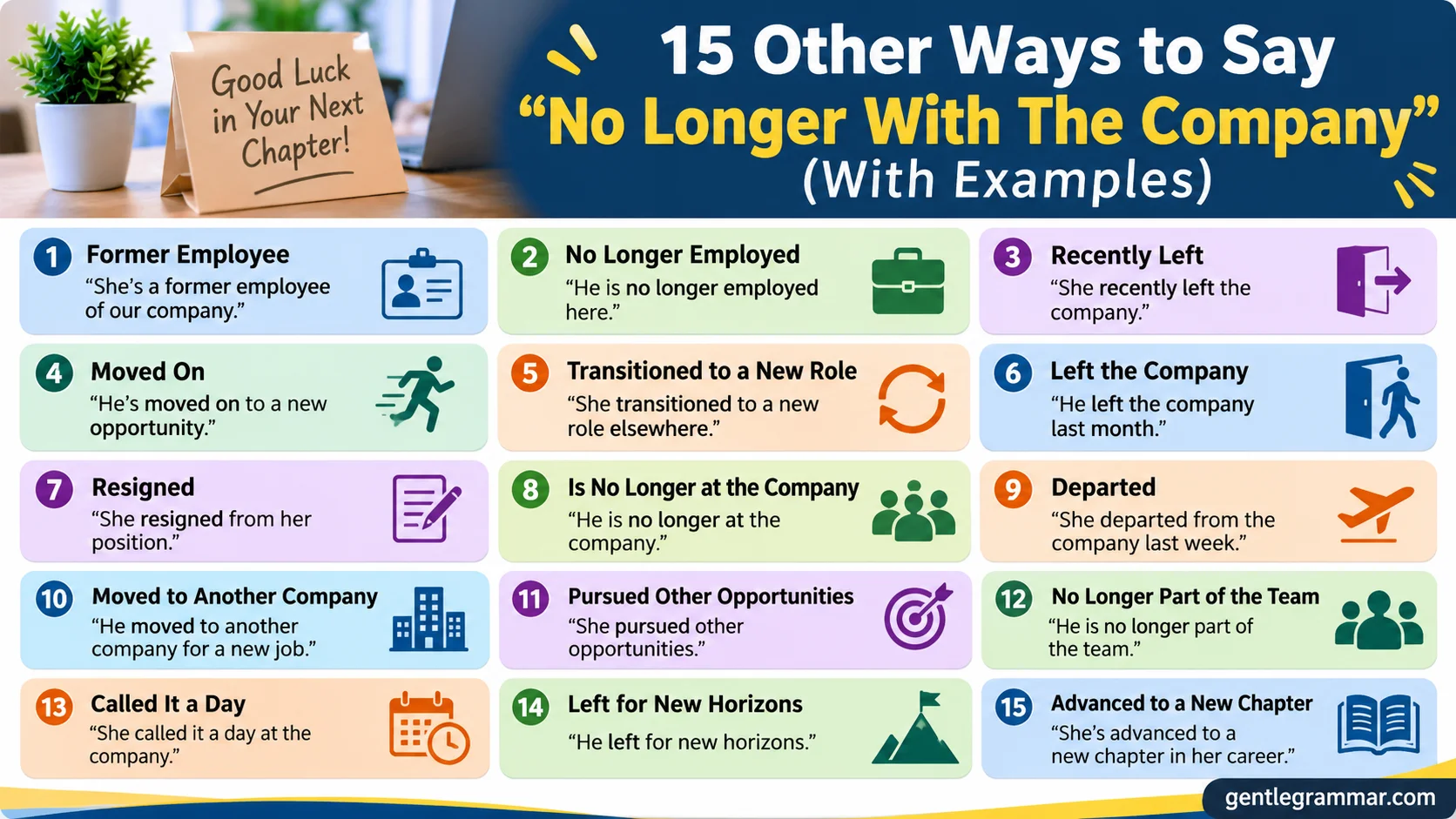
For clear workplace updates, use 15 Other Ways to Say “No Longer With The Company” (With Examples) to choose respectful wording for every situation.
When Someone Left the Company, respect, clarity, and professionalism matter because an employee may have resigned, retired, been laid off, terminated, or simply moved on. The workplace news should use the right wording in emails, HR updates, and everyday interactions. Thoughtful phrasing can shape perception, protect work relationships, and make difficult messages easier for colleagues, clients, and stakeholders to understand and accept.
When announcing that a colleague left, no longer with the company can become tired, stiff, or repetitive, especially when the same person is mentioned more than once in a document. I’ve edited HR emails and LinkedIn posts where this pattern appears: people often default to one safe phrase and become stuck when they need a second or third way to express the same message. The good news is that English gives you room for precision, warmth, or distance, depending on the situation.
What Does “No Longer With The Company” Mean?
“No longer with the company” means that a person does not currently work for an organization anymore. It is a polite, indirect way to explain that someone has left their job, whether because they resigned, retired, changed careers, was laid off, or their employment ended for another reason. The phrase usually focuses on the present situation rather than explaining why the person left.
The wording is intentionally neutral and discreet. For example, saying “Maria is no longer with the company” tells a customer that Maria is not an employee anymore without sharing private employment details. This makes the expression useful when you want to communicate a departure professionally while keeping the explanation brief.
Common Situations Where “No Longer With The Company” Is Used
The phrase commonly appears in workplace communication, especially when someone asks about a former employee. A manager might tell a colleague, “James is no longer with the company,” or a customer-service representative might explain that the person they previously dealt with has left.
It can also appear in emails, business conversations, customer communication, and professional correspondence. People often choose it when they want to avoid discussing the employee’s reasons for leaving. Depending on the relationship and context, however, a more specific alternative can make the message warmer or clearer. For example, “She has moved on to a new opportunity” sounds more positive, while “She has resigned” is more direct.
Is It Professional or Polite to Say “No Longer With The Company”?
Yes. “No longer with the company” is generally professional, polite, and neutral. It works particularly well when you need to tell someone that an employee has departed without providing personal or sensitive details. It is less blunt than simply saying, “She was fired,” and less informal than “She’s gone.”
However, the phrase can sometimes sound slightly evasive or corporate if the audience expects a clearer explanation. If the person voluntarily resigned, for example, “She has moved on to a new opportunity” may sound warmer. In formal records where precision matters, “Her employment ended on…” or “He resigned from his position” may be more appropriate.
Advantages and Disadvantages of Saying “No Longer With The Company”
Advantages
The biggest advantage is neutrality. The phrase communicates that someone has left without explaining the circumstances. It is also professional and discreet, making it useful when speaking with customers, colleagues, or external contacts. Because it does not imply resignation, dismissal, retirement, or any other specific reason, it avoids making assumptions about the person’s departure.
Disadvantages
The main limitation is that the phrase can feel vague. Someone hearing it may still wonder whether the employee resigned, retired, was dismissed, or simply moved to another role. It can also sound somewhat corporate in casual conversations. When the reason for leaving is relevant and appropriate to share, a more specific expression may provide better clarity.
Synonyms for “No Longer With The Company”
- Has Left the Company
- Has Moved On
- Has Moved On to a New Opportunity
- Has Departed the Company
- Is No Longer Employed by the Company
- Has Resigned
- Has Stepped Down
- Has Left the Organization
- Has Ended Their Employment
- Has Pursued Other Opportunities
- Has Taken a New Position
- Has Retired
- Has Moved to a New Role
- Is No Longer Part of the Team
- Has Gone on to New Endeavors
1. Has Left the Company
Meaning
“Has left the company” means that the person no longer works for the organization. It is one of the closest and most straightforward alternatives to “no longer with the company.”
Definition
Has left the company: No longer works for the organization.
Detailed Explanation
This expression is clear, neutral, and natural in everyday workplace English. Unlike “has resigned,” it does not suggest that the employee personally chose to leave. It can therefore cover many situations without explaining the circumstances. It is especially useful when you want to be direct without sounding harsh.
Scenario Examples
Scenario: A customer asks for a former account manager.
Example: “Sarah has left the company, but I can connect you with her replacement.”
Scenario: A colleague asks where a former coworker is.
Example: “Daniel has left the company and started working elsewhere.”
Best Use
Best for workplace conversations, emails, customer communication, and general professional messages.
Tone
Tone: Neutral, professional, direct. It states the situation without adding unnecessary emotion or detail.
2. Has Moved On
Meaning
“Has moved on” suggests that someone has left their previous workplace and continued with another stage of their life or career.
Definition
Has moved on: Has left a previous situation and continued toward something new.
Detailed Explanation
This phrase is softer and more indirect than “has left the company.” It often carries a positive or accepting feeling, especially when talking about someone’s career. However, it does not specifically say that the person has started another job, so the context may need to provide that information.
Scenario Examples
Scenario: A former employee’s client asks about them.
Example: “Tom has moved on, so I’ll be handling your account from now on.”
Scenario: A colleague asks why someone is no longer around.
Example: “Lisa has moved on, but everyone here wishes her well.”
Best Use
Best for friendly workplace conversations, customer communication, and informal professional messages.
Tone
Tone: Warm, positive, indirect. It makes the departure sound like a natural transition rather than an abrupt ending.
3. Has Moved On to a New Opportunity
Meaning
This expression indicates that someone has left the company and is pursuing another career or professional opportunity.
Definition
Has moved on to a new opportunity: Has left the current workplace to pursue something new.
Detailed Explanation
This is more positive and encouraging than simply saying someone has left. It works particularly well when the person voluntarily accepted another opportunity. Because it suggests career growth or a fresh beginning, it is often a good choice when you want to speak respectfully about a former employee.
Scenario Examples
Scenario: A customer asks why their previous contact is unavailable.
Example: “Emily has moved on to a new opportunity, and I’ll be your new point of contact.”
Scenario: A coworker announces a colleague’s departure.
Example: “Mark has moved on to a new opportunity after five great years with the team.”
Best Use
Best for farewell messages, customer emails, announcements, and positive workplace communication.
Tone
Tone: Warm, professional, optimistic. It emphasizes the person’s next step rather than their departure.
4. Has Departed the Company
Meaning
“Has departed the company” means that the person has left the organization.
Definition
Has departed the company: Has formally or officially left the organization.
Detailed Explanation
This wording is more formal than “has left the company.” It may sound natural in official announcements, business correspondence, or formal writing, although it can feel stiff in casual conversation. It focuses entirely on the fact of departure without suggesting why it happened.
Scenario Examples
Scenario: A company sends a formal internal announcement.
Example: “Mr. Patel has departed the company after serving as director for eight years.”
Scenario: A business responds to a formal inquiry.
Example: “The employee who previously handled this matter has departed the company.”
Best Use
Best for formal business communication, official notices, and professional writing.
Tone
Tone: Formal, neutral, official. The wording has a more corporate feel than everyday alternatives.
5. Is No Longer Employed by the Company
Meaning
This expression states directly that the person does not have an employment relationship with the company anymore.
Definition
Is no longer employed by the company: Does not currently work for the organization.
Detailed Explanation
This is one of the most precise alternatives on the list. It is particularly useful when clarity matters more than warmth. Unlike “has moved on,” it does not imply a positive reason for leaving. It can therefore sound more factual and administrative.
Scenario Examples
Scenario: A formal business inquiry asks about an employee.
Example: “Mr. Ahmed is no longer employed by the company.”
Scenario: A former employee’s access needs to be explained.
Example: “She is no longer employed by the company, so her previous account access has been removed.”
Best Use
Best for formal communication, administrative matters, HR-related wording, and official correspondence.
Tone
Tone: Formal, factual, direct. It prioritizes accuracy over emotional warmth.
6. Has Resigned
Meaning
“Has resigned” means that the person formally chose to leave their position.
Definition
Has resigned: Has voluntarily given up their job or position.
Detailed Explanation
This alternative is more specific than “no longer with the company.” It indicates that the employee resigned rather than simply leaving for an unspecified reason. Because it describes a particular type of departure, you should only use it when you know that resignation occurred.
Scenario Examples
Scenario: A manager informs a team about a voluntary departure.
Example: “James has resigned from his position as sales manager.”
Scenario: A customer asks about their former contact.
Example: “Anna has resigned, and I’ll be assisting you with your account from now on.”
Best Use
Best for professional announcements, workplace conversations, HR communication, and formal emails when the person actually resigned.
Tone
Tone: Professional, factual, direct. It gives more information than the original phrase without sounding emotional.
7. Has Stepped Down
Meaning
“Has stepped down” usually means that someone has voluntarily left a position of responsibility or leadership.
Definition
Has stepped down: Has voluntarily given up a role, office, or position of responsibility.
Detailed Explanation
This is not a universal replacement for “no longer with the company.” It works best when the person held a leadership or official position. Someone can step down from being a CEO, manager, director, or chairperson while remaining connected to an organization, so context matters.
Scenario Examples
Scenario: A company announces a leadership change.
Example: “Our managing director has stepped down from the role.”
Scenario: A school organization announces a change in leadership.
Example: “Ms. Lewis has stepped down as department head.”
Best Use
Best for leadership announcements, formal workplace communication, and organizational updates.
Tone
Tone: Formal, respectful, measured. It focuses on leaving a role rather than simply leaving a workplace.
8. Has Left the Organization
Meaning
“Has left the organization” means that the person no longer works for the organization.
Definition
Has left the organization: Has departed from the organization where they previously worked.
Detailed Explanation
This is a close alternative to “has left the company,” but organization can sound broader and more formal. It works well for companies, nonprofits, schools, institutions, and other structured groups. The phrase remains neutral because it does not explain why the person left.
Scenario Examples
Scenario: A nonprofit responds to a donor.
Example: “David has left the organization, so I’ll be taking over his responsibilities.”
Scenario: A university department explains a staffing change.
Example: “Professor Clark has left the organization and is no longer handling student inquiries.”
Best Use
Best for formal communication, institutional settings, professional emails, and business writing.
Tone
Tone: Professional, neutral, respectful. It sounds slightly broader and more formal than “left the company.”
9. Has Ended Their Employment
Meaning
This phrase means that the person’s employment relationship with the company has ended.
Definition
Has ended their employment: Is no longer working under an employment relationship with the organization.
Detailed Explanation
This is a highly formal expression and is more common in administrative or HR-related contexts than everyday conversation. It does not necessarily explain who initiated the separation. Depending on the context, it can sound more serious than “has left the company.”
Scenario Examples
Scenario: An official record needs neutral wording.
Example: “The employee has ended their employment with the company.”
Scenario: HR communicates a staffing change.
Example: “Ms. Brown has ended her employment and will no longer be handling client requests.”
Best Use
Best for formal workplace documentation, HR communication, and administrative writing.
Tone
Tone: Formal, neutral, administrative. It sounds precise but less conversational.
10. Has Pursued Other Opportunities
Meaning
“Has pursued other opportunities” suggests that someone has left their current workplace to explore or accept other possibilities.
Definition
Has pursued other opportunities: Has left a current role to seek or take advantage of other professional possibilities.
Detailed Explanation
This expression is often used when you want to present a departure in a positive and respectful way. It does not necessarily confirm that the person already has another job. Instead, it emphasizes their decision to explore something different. That makes it useful for farewell announcements and professional introductions.
Scenario Examples
Scenario: A company announces a former employee’s departure.
Example: “Jessica has pursued other opportunities after several successful years with our team.”
Scenario: A client asks about a former consultant.
Example: “Michael has pursued other opportunities, so I’ll be assisting you going forward.”
Best Use
Best for farewell announcements, professional emails, company communications, and positive workplace messages.
Tone
Tone: Positive, professional, respectful. It focuses on future possibilities rather than the ending itself.
11. Has Taken a New Position
Meaning
This expression means that someone has accepted another job or position, usually elsewhere.
Definition
Has taken a new position: Has accepted a different job or role.
Detailed Explanation
This is more specific than “no longer with the company” because it suggests the person has already secured another position. It is useful when you know that the employee has moved to another job. Avoid using it if you do not know whether they have accepted a new role.
Scenario Examples
Scenario: A colleague announces someone’s departure.
Example: “Robert has taken a new position with a technology firm.”
Scenario: A client asks about a former account manager.
Example: “Nina has taken a new position elsewhere, so I’ll be your new contact.”
Best Use
Best for professional announcements, farewell messages, LinkedIn-style updates, and workplace conversations.
Tone
Tone: Positive, informative, professional. It communicates a clear next step.
12. Has Retired
Meaning
“Has retired” means that someone has stopped working, generally after reaching a stage of life or career when they choose to leave employment permanently.
Definition
Has retired: Has stopped working permanently or indefinitely after completing their working career.
Detailed Explanation
This is a specific reason for leaving, so it should only be used when retirement is confirmed. It can be warmer than saying someone is simply no longer with the company. In workplace messages, it often carries a respectful tone because retirement can mark the end of a long career.
Scenario Examples
Scenario: A customer asks for a long-serving employee.
Example: “Mr. Wilson has retired after more than 20 years with the company.”
Scenario: A team announces a colleague’s departure.
Example: “Susan has retired, and we’re celebrating her many years of service.”
Best Use
Best for retirement announcements, farewell messages, company newsletters, and personal workplace communication.
Tone
Tone: Warm, respectful, celebratory. It recognizes the person’s career rather than simply stating that they left.
13. Has Moved to a New Role
Meaning
“Has moved to a new role” means that someone has transitioned into a different position.
Definition
Has moved to a new role: Has changed from one professional position to another.
Detailed Explanation
This phrase needs careful context because the new role may be inside or outside the company. If someone moved to another department within the same organization, they are not actually “no longer with the company.” It is therefore best used when the destination is clear or when the phrase is followed by additional information.
Scenario Examples
Scenario: An employee changes departments.
Example: “Karen has moved to a new role in our product development team.”
Scenario: A professional changes companies.
Example: “Alex has moved to a new role with another organization.”
Best Use
Best for career updates, internal announcements, professional conversations, and networking communication.
Tone
Tone: Neutral, positive, forward-looking. It emphasizes transition rather than departure.
14. Is No Longer Part of the Team
Meaning
This phrase means that someone is no longer a member of the team.
Definition
Is no longer part of the team: Does not currently belong to or work within the team.
Detailed Explanation
This wording feels more personal and conversational than “is no longer employed by the company.” It can work well when speaking to coworkers or customers who had a relationship with the employee. However, being outside a particular team does not always mean someone has left the company, so use it carefully.
Scenario Examples
Scenario: A customer asks for a former team member.
Example: “John is no longer part of the team, but I’d be happy to help you.”
Scenario: A manager explains a staffing change.
Example: “Maria is no longer part of the team, and we wish her the best in her next chapter.”
Best Use
Best for team communication, customer messages, friendly workplace conversations, and informal professional settings.
Tone
Tone: Friendly, warm, personal. It feels less corporate than many other alternatives.
15. Has Gone on to New Endeavors
Meaning
“Has gone on to new endeavors” means that someone has left their previous situation and is pursuing new activities, projects, or opportunities.
Definition
Has gone on to new endeavors: Has moved forward into new work, projects, or experiences.
Detailed Explanation
This is a warm and somewhat polished expression that emphasizes the future. It does not specify whether the person has taken another job, started a business, retired, or pursued something else. Because “endeavors” is slightly formal and expressive, this phrase works better in farewell messages than in routine administrative communication.
Scenario Examples
Scenario: A company writes a farewell message.
Example: “We wish Daniel all the best as he goes on to new endeavors.”
Scenario: A colleague writes a personal farewell note.
Example: “It was wonderful working with you. Best wishes as you go on to new endeavors.”
Best Use
Best for farewell messages, appreciation notes, announcements, and warm professional writing.
Tone
Tone: Warm, respectful, optimistic. It looks toward the person’s future rather than focusing on their departure.
FAQs:
What is another way to say “No Longer With The Company”?
A natural alternative is “has left the company.” Other choices include “has moved on,” “has departed the company,” and “is no longer employed by the company.” The best option depends on whether you want a neutral, formal, warm, or more specific tone.
What does “No Longer With The Company” mean?
It means that a person does not work for the company anymore. The phrase is deliberately neutral and usually does not explain whether the person resigned, retired, was dismissed, or moved to another job.
Is “No Longer With The Company” professional?
Yes. It is generally professional, polite, and neutral. It is especially useful when speaking with customers or colleagues because it communicates the departure without revealing unnecessary details.
What is a more polite way to say “No Longer With The Company”?
For a warmer message, you could say “has moved on to a new opportunity” or “has pursued other opportunities.” These expressions can make the departure sound positive while avoiding unnecessary details.
Which alternative works best in formal communication?
“Is no longer employed by the company” is one of the clearest formal choices. For official leadership announcements, “has stepped down” may be better when someone has left a particular leadership role. Choose the wording based on what actually happened rather than simply choosing the most formal phrase.
Conclusion:
Choosing the right expression for an employee’s departure can make workplace communication clearer, more respectful, and more appropriate to the situation. “No longer with the company” is a useful neutral phrase because it protects privacy while communicating the basic fact. However, alternatives such as “has resigned,” “has retired,” or “has moved on to a new opportunity” provide different levels of detail and warmth.
The key is to match your wording to the facts and the relationship with your audience. Use precise language when the reason matters, and choose softer wording when a simple professional transition is all that needs to be communicated. A thoughtful alternative can turn a routine workplace statement into communication that feels much more natural and considerate.
