
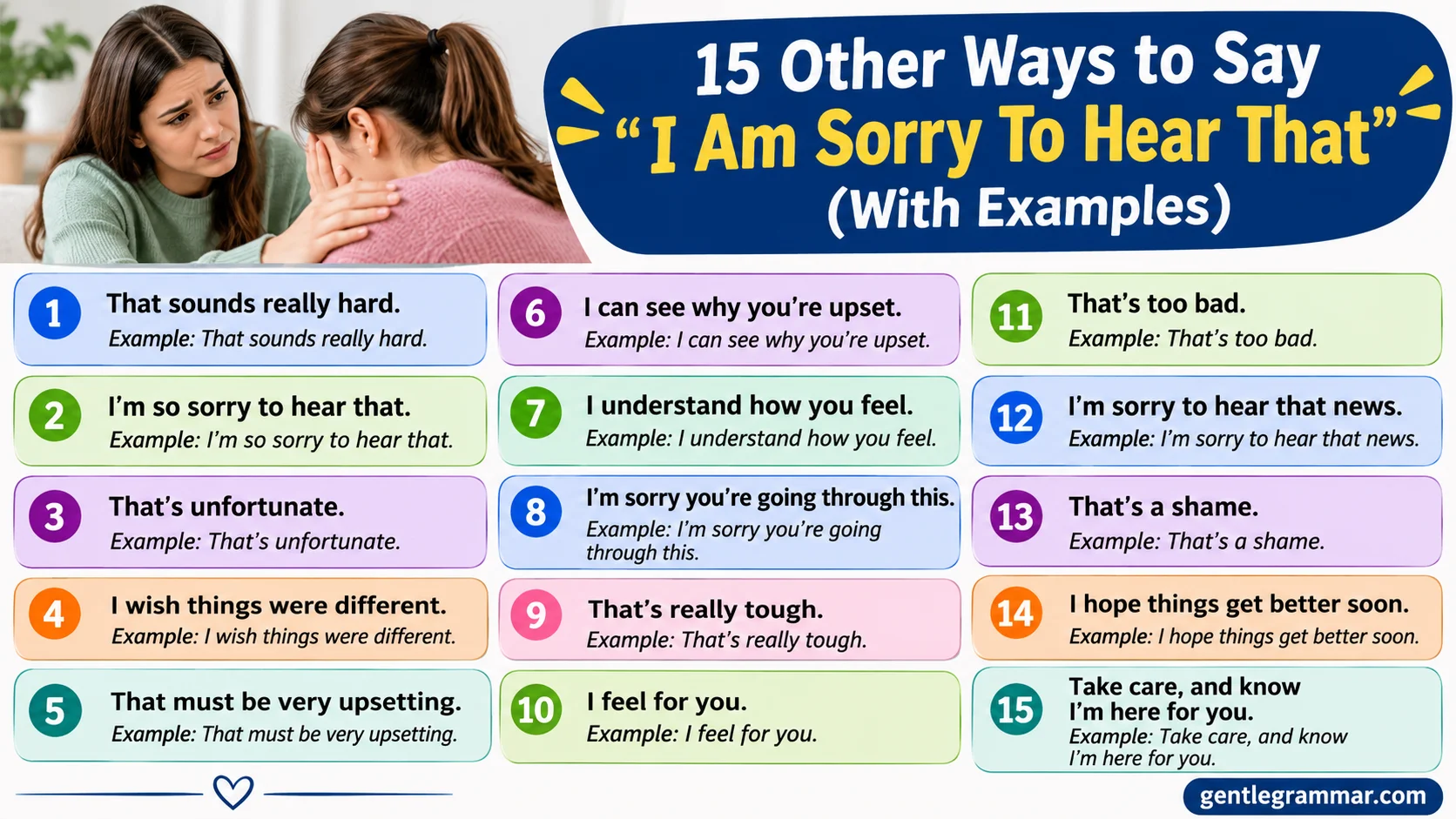
This guide to 15 Other Ways to Say “I Am Sorry To Hear That” (With Examples) helps you choose kind, natural words for difficult moments in life.
When someone shares bad news, difficult news, disappointing news, or a troubling experience, responding with genuine sympathy, kindness, and understanding can make a difference. I am sorry to hear that is a common English expression for expressing empathy and helping another person feel acknowledged.
Whether a friend, colleague, or someone close loses a loved one, the right response can offer comfort during grief, sadness, loss, personal hardship, or emotional hardship. From my personal experience, I have learned that thoughtful words and genuine care often mean more than complicated English phrases. A simple phrase or heartfelt expression can help people feel seen, feel heard, feel supported, and not alone during an unexpected turn in life.
What Does “I Am Sorry To Hear That” Mean?
“I am sorry to hear that” is an expression used to show sympathy, concern, or sadness after learning about someone else’s unpleasant experience. It communicates that you recognize their difficulty and care about how they are feeling. Despite containing the word “sorry,” it does not necessarily mean that you caused the problem or are accepting responsibility for it.
People commonly use this phrase when someone shares bad news, experiences disappointment, faces a personal problem, or goes through a difficult period. For example, if a friend tells you that they lost their job, responding with this expression acknowledges their situation and shows that you care.
The phrase is generally polite, gentle, and emotionally supportive. However, its meaning can change slightly depending on the situation. In a casual conversation, it may simply express concern, while in a conversation about death or serious illness, it can communicate deeper sympathy.
Common Situations Where “I Am Sorry To Hear That” Is Used
People use this expression in different situations when they want to acknowledge someone’s difficulties without making the conversation uncomfortable.
- Everyday conversations: When a friend or acquaintance shares disappointing news, such as a canceled plan or an unexpected problem.
- Text messages: When responding to someone who explains that they are having a difficult day or dealing with personal challenges.
- Personal relationships: When a partner, family member, or close friend shares something upsetting and needs emotional support.
- Workplace communication: When a colleague mentions an illness, family emergency, professional setback, or other personal difficulty.
- Customer communication: When responding politely to a customer’s complaint, inconvenience, or frustrating experience.
- School and education: When a student or classmate discusses a disappointing result, academic difficulty, or personal setback.
- Social media: When commenting on someone’s difficult experience or responding to an emotional announcement.
Sometimes, people prefer an alternative because the original expression feels too familiar or does not communicate enough emotional warmth. A more specific response can show that you have listened carefully and genuinely understand the situation.
Is It Professional or Polite to Say “I Am Sorry To Hear That”?
Yes, “I am sorry to hear that” is both polite and professionally appropriate in most situations. It communicates concern without becoming overly personal or emotional. You can use it when speaking with colleagues, managers, customers, clients, and professional acquaintances.
In workplace emails, the phrase works particularly well when someone shares difficult personal news or explains an unexpected problem. For example, saying, “I’m sorry to hear about the delay. I hope everything is resolved soon,” sounds respectful and considerate.
In casual conversations, the shorter version, “Sorry to hear that,” sounds natural and friendly. For more emotional situations, however, a warmer expression such as “My heart goes out to you” may communicate deeper sympathy.
The important thing is to match your wording to the situation. A professional message should remain respectful, while a personal conversation may benefit from more warmth and emotional support.
Advantages and Disadvantages of Saying “I Am Sorry To Hear That”
Advantages
One major advantage of this expression is its simplicity and versatility. It communicates sympathy without requiring a lengthy explanation. Most English speakers understand its meaning immediately, making it useful in everyday conversations and professional settings.
It is also a relatively safe expression when you are unsure how to respond to someone’s difficult news. It acknowledges their feelings without making assumptions about what they need or how they should react. Additionally, it works in both spoken and written communication.
Disadvantages
Although the expression is polite, it can sometimes sound repetitive or impersonal, especially when used in response to every difficult situation. Someone experiencing a serious loss may appreciate a more thoughtful message that acknowledges the importance of their experience.
It can also feel somewhat distant when communicating with close friends or family members. In those situations, a personal expression of support may sound more genuine. Furthermore, the phrase does not always explain whether you are available to help, listen, or offer practical assistance.
Choosing a more specific alternative can make your response feel warmer and more appropriate.
Synonyms for “I Am Sorry To Hear That”
- That’s Really Unfortunate.
- I’m Sorry You’re Going Through This.
- My Heart Goes Out to You.
- That’s Terrible News.
- I Can Only Imagine How Difficult That Must Be.
- I’m Thinking of You.
- Please Accept My Condolences.
- That’s Such a Shame.
- I Wish Things Were Different.
- I’m Here for You.
- That Must Be Really Hard.
- I’m Saddened to Hear That.
- Sending You My Best Wishes.
- I Hope Things Get Better Soon.
- Is There Anything I Can Do to Help?
1. That’s Really Unfortunate.
Meaning
“That’s really unfortunate” expresses sympathy when something disappointing, unexpected, or unpleasant happens to someone. It acknowledges the situation without necessarily suggesting deep personal involvement.
Definition
A polite expression used to recognize that someone has experienced an unfortunate or disappointing event.
Detailed Explanation
This expression is a slightly more neutral alternative to the original phrase. It focuses on the unfortunate circumstances rather than directly expressing personal sadness. It works particularly well when responding to everyday problems, missed opportunities, or unexpected setbacks. Although it communicates concern, it may sound less emotionally warm than a personal expression of sympathy.
Scenario Examples
Scenario: A colleague tells you that an important meeting has been canceled.
Example: “That’s really unfortunate. Hopefully, you can arrange another meeting soon.”
Scenario: Your friend explains that they missed an opportunity because of a scheduling problem.
Example: “That’s really unfortunate. I know you were looking forward to it.”
Best Use
Use this expression in everyday conversations, workplace communication, and polite professional messages. It is particularly suitable for disappointing situations that do not require deep emotional support.
Tone
Tone: Polite, neutral, considerate.
It acknowledges someone’s disappointment without making the conversation overly emotional.
2. I’m Sorry You’re Going Through This.
Meaning
“I’m sorry you’re going through this” expresses personal sympathy toward someone experiencing a difficult period. It recognizes that the person may be dealing with emotional, physical, or practical challenges.
Definition
A compassionate expression used to acknowledge someone’s ongoing hardship and communicate concern.
Detailed Explanation
Unlike the original phrase, this expression focuses directly on the person’s experience rather than simply reacting to the news. It feels more personal because it recognizes that the situation may involve ongoing difficulties. It is particularly appropriate when someone is struggling with illness, family problems, grief, or emotional stress. The wording also shows that you care about how the person is coping.
Scenario Examples
Scenario: Your friend explains that they have been dealing with several family problems.
Example: “I’m sorry you’re going through this. I hope things become easier for you.”
Scenario: A coworker tells you about a challenging personal situation.
Example: “I’m sorry you’re going through this. Please take the time you need.”
Best Use
This expression works best in personal conversations, supportive text messages, and sensitive workplace communication. Use it when someone is experiencing an ongoing challenge rather than a minor inconvenience.
Tone
Tone: Warm, compassionate, supportive.
Its personal wording makes it feel more emotionally involved than a general expression of sympathy.
3. My Heart Goes Out to You.
Meaning
“My heart goes out to you” communicates deep sympathy and emotional concern. It suggests that you genuinely care about someone who is experiencing sadness, grief, or hardship.
Definition
A heartfelt expression used to show compassion toward someone facing a painful or difficult experience.
Detailed Explanation
This expression is more emotionally powerful than the original phrase. It communicates genuine concern and acknowledges that someone may be experiencing significant pain. People often use it when responding to bereavement, serious illness, family tragedy, or other deeply upsetting events. Because it carries strong emotional warmth, it may feel excessive when responding to a small inconvenience.
Scenario Examples
Scenario: Someone announces the loss of a family member.
Example: “My heart goes out to you and your family during this difficult time.”
Scenario: A friend shares a heartbreaking personal experience.
Example: “My heart goes out to you. I wish you strength and comfort.”
Best Use
Use this expression in condolence messages, personal conversations, sympathy cards, and heartfelt social media comments. It is especially appropriate when someone experiences a serious emotional loss.
Tone
Tone: Deeply sympathetic, heartfelt, compassionate.
The expression conveys emotional warmth and a strong sense of concern.
4. That’s Terrible News.
Meaning
“That’s terrible news” communicates that something someone has shared is extremely upsetting, disappointing, or distressing.
Definition
A direct expression used to acknowledge particularly bad or upsetting news.
Detailed Explanation
This alternative places greater emphasis on how serious or upsetting the news is. It can sound more direct and emotionally immediate than the original expression. People naturally use it when someone shares a major setback, serious accident, or unexpected tragedy. However, it focuses more on the news itself than on the person’s feelings, so adding a supportive sentence can make it more comforting.
Scenario Examples
Scenario: Your friend tells you that their house was damaged by a storm.
Example: “That’s terrible news. I hope everyone is safe.”
Scenario: A colleague shares that an important project has failed unexpectedly.
Example: “That’s terrible news. Let’s see what we can do to address the situation.”
Best Use
This expression is suitable for serious everyday conversations, workplace discussions, and immediate reactions to upsetting news. Use it when the situation genuinely deserves a strong response.
Tone
Tone: Direct, concerned, emotionally expressive.
The word “terrible” communicates a stronger reaction than the more neutral word “sorry.”
5. I Can Only Imagine How Difficult That Must Be.
Meaning
“I can only imagine how difficult that must be” communicates empathy toward someone facing a challenging experience. It recognizes that their situation may be difficult even if you have not experienced anything similar yourself.
Definition
A considerate expression used to acknowledge another person’s emotional or practical struggles.
Detailed Explanation
This phrase emphasizes understanding rather than simply reacting to bad news. It is particularly useful when you want to acknowledge someone’s feelings without pretending to know exactly what they are experiencing. Compared with the original phrase, it sounds more thoughtful and emotionally attentive. However, it is longer and may feel unnecessarily formal in a quick casual exchange.
Scenario Examples
Scenario: A friend tells you about caring for an unwell family member.
Example: “I can only imagine how difficult that must be. I hope you’re getting some support, too.”
Scenario: A colleague explains how stressful a recent personal situation has become.
Example: “I can only imagine how difficult that must be. Please don’t hesitate to reach out if you need anything.”
Best Use
Use this expression in heartfelt conversations, supportive emails, personal messages, and sensitive professional communication. It works especially well when you want to acknowledge a challenge without making assumptions.
Tone
Tone: Empathetic, thoughtful, respectful.
It demonstrates emotional awareness and avoids claiming that you completely understand another person’s experience.
6. I’m Thinking of You.
Meaning
“I’m thinking of you” lets someone know that they are in your thoughts during a difficult or emotional period. It communicates care without requiring them to respond or explain their situation further.
Definition
A warm expression used to show someone that you remember and care about them during a challenging time.
Detailed Explanation
This expression is more personal and relationship-focused than the original phrase. Rather than simply acknowledging bad news, it communicates continued concern. It works particularly well when someone is dealing with grief, illness, family difficulties, or a stressful period. It can also be used days or weeks after receiving the original news, making it useful for checking in later.
Scenario Examples
Scenario: Your friend is recovering from surgery.
Example: “I’m thinking of you and hoping your recovery goes smoothly.”
Scenario: Someone you know is going through a difficult family situation.
Example: “Just wanted to let you know I’m thinking of you. Sending you lots of strength.”
Best Use
This phrase works best in personal text messages, greeting cards, supportive emails, and follow-up conversations. It is especially useful when you want to show ongoing care.
Tone
Tone: Gentle, warm, caring.
Its simplicity makes it comforting without putting pressure on the other person to continue the conversation.
7. Please Accept My Condolences.
Meaning
“Please accept my condolences” is a formal expression of sympathy, particularly when someone has experienced the death of a loved one.
Definition
A respectful statement expressing sympathy to someone who is grieving a personal loss.
Detailed Explanation
This expression is more formal and specific than the original phrase. It is primarily associated with bereavement rather than everyday disappointment or general bad news. You can use it when writing a condolence card, sending a professional sympathy email, or addressing someone whose family member has passed away. Unlike a casual expression of concern, it carries a respectful and solemn tone.
Scenario Examples
Scenario: You are writing a sympathy email to a business colleague.
Example: “Please accept my condolences for the loss of your father. My thoughts are with you and your family.”
Scenario: A neighbor informs you about the death of a family member.
Example: “Please accept my condolences. I wish you and your family comfort during this difficult time.”
Best Use
Use this expression in formal condolence letters, professional emails, sympathy cards, and respectful personal communication following a death.
Tone
Tone: Formal, respectful, compassionate.
Its traditional wording makes it appropriate for serious situations involving bereavement.
8. That’s Such a Shame.
Meaning
“That’s such a shame” expresses disappointment or regret about something unfortunate that has happened.
Definition
A conversational expression used to acknowledge an unfortunate outcome or disappointing situation.
Detailed Explanation
This expression is more casual than the original phrase and is generally used for less serious situations. It communicates that you recognize something has gone wrong or that someone has missed out on something important. It can sound friendly and natural when responding to canceled plans, lost opportunities, or disappointing results. However, it is usually too lighthearted for serious illness, death, or major personal tragedy.
Scenario Examples
Scenario: Your friend tells you that their weekend trip was canceled.
Example: “That’s such a shame. You were really looking forward to that trip.”
Scenario: A classmate explains that they missed an important event.
Example: “That’s such a shame. I know you wanted to be there.”
Best Use
This expression works best in casual conversations, friendly text messages, and everyday discussions about disappointing events.
Tone
Tone: Casual, sympathetic, conversational.
It expresses mild disappointment without suggesting deep emotional involvement.
9. I Wish Things Were Different.
Meaning
“I wish things were different” expresses regret or sadness about a situation that cannot easily be changed.
Definition
A thoughtful expression used to communicate that you feel unhappy about someone’s circumstances and wish they could improve.
Detailed Explanation
This phrase focuses on the unfortunate circumstances rather than directly expressing sympathy. It suggests that you recognize the situation is difficult and would prefer a better outcome. Compared with the original expression, it can sound more reflective and emotionally personal. It is especially useful when someone is dealing with a situation that is beyond your control, although it should be paired with reassurance when the person needs practical support.
Scenario Examples
Scenario: Your friend cannot attend an important family celebration because of unavoidable circumstances.
Example: “I wish things were different. We were really hoping to see you.”
Scenario: Someone shares that their personal circumstances have prevented them from pursuing an opportunity.
Example: “I wish things were different for you. You deserved a better opportunity.”
Best Use
Use this expression in personal conversations, emotional messages, and situations involving disappointment or circumstances you cannot change.
Tone
Tone: Reflective, sympathetic, gentle.
It communicates regret and concern without making unrealistic promises.
10. I’m Here for You.
Meaning
“I’m here for you” tells someone that you are available to listen, offer emotional support, or help them through a difficult situation.
Definition
A supportive expression that communicates your willingness to stand by someone during a challenging period.
Detailed Explanation
This expression goes beyond acknowledging someone’s bad news. It offers a sense of companionship and reassurance, which can be especially meaningful when someone feels overwhelmed or alone. Compared with the original phrase, it communicates a willingness to provide support rather than simply expressing sympathy. However, it should be used sincerely because it suggests that you are genuinely available to help.
Scenario Examples
Scenario: Your close friend tells you that they are struggling with a personal problem.
Example: “I’m here for you whenever you need someone to talk to.”
Scenario: Your partner is dealing with a stressful period at work.
Example: “I know things have been difficult lately, but I’m here for you.”
Best Use
This phrase works best in close relationships, personal conversations, supportive text messages, and situations involving emotional difficulties.
Tone
Tone: Reassuring, caring, supportive.
It provides comfort by reminding someone that they do not have to face everything alone.
11. That Must Be Really Hard.
Meaning
“That must be really hard” acknowledges that someone’s circumstances are challenging and may be emotionally or practically exhausting.
Definition
An empathetic expression used to recognize the difficulty of another person’s experience.
Detailed Explanation
This expression is more focused on the person’s feelings than on the news itself. It shows that you recognize the situation may be taking an emotional toll. It is less formal than the original phrase and sounds particularly natural in conversations between friends, family members, and trusted colleagues. It also leaves room for the other person to share more if they want to talk.
Scenario Examples
Scenario: Your friend tells you that balancing work and family responsibilities has become overwhelming.
Example: “That must be really hard. I hope you’re finding some time for yourself.”
Scenario: A coworker explains that they have been dealing with a difficult recovery.
Example: “That must be really hard. I hope you’re feeling a little better each day.”
Best Use
Use this expression in personal conversations, supportive messages, and informal workplace discussions. It is particularly useful when someone needs acknowledgment rather than advice.
Tone
Tone: Understanding, gentle, empathetic.
Its natural conversational style makes it easy to use without sounding overly formal.
12. I’m Saddened to Hear That.
Meaning
“I’m saddened to hear that” communicates genuine sadness after learning about someone’s upsetting experience.
Definition
A polite expression used to convey personal sadness or concern in response to disappointing or distressing news.
Detailed Explanation
This expression is slightly more formal and emotionally explicit than the original phrase. It directly communicates that the news has affected you emotionally. It is suitable for serious personal situations and thoughtful professional correspondence. Although it sounds sincere, it may feel somewhat formal in a relaxed conversation with a close friend, where simpler language might feel more natural.
Scenario Examples
Scenario: A former colleague shares news about a serious family difficulty.
Example: “I’m saddened to hear that. I hope you and your family are doing okay.”
Scenario: Someone announces an upsetting development in their community.
Example: “I’m saddened to hear that such a difficult situation has affected so many people.”
Best Use
This expression is appropriate for professional emails, thoughtful personal messages, formal correspondence, and serious conversations.
Tone
Tone: Respectful, sincere, formal.
It communicates a clear emotional response while maintaining a considerate level of formality.
13. Sending You My Best Wishes.
Meaning
“Sending you my best wishes” expresses goodwill and hope that someone experiences comfort, improvement, or a positive outcome.
Definition
A polite expression used to communicate encouragement and goodwill during a challenging situation.
Detailed Explanation
This expression focuses more on positive wishes than on directly acknowledging sadness. It can make a message feel encouraging and supportive, especially when someone is facing a temporary difficulty or waiting for an important outcome. Compared with the original phrase, it sounds more optimistic and less focused on the negative news. However, it may feel too general when someone is experiencing deep grief or a serious personal loss.
Scenario Examples
Scenario: A colleague is preparing for a medical procedure.
Example: “Sending you my best wishes for a smooth procedure and a comfortable recovery.”
Scenario: Your friend is dealing with a stressful situation before an important event.
Example: “Sending you my best wishes. I hope everything works out well.”
Best Use
Use this expression in polite emails, greeting cards, professional messages, and supportive personal communication when you want to offer encouragement.
Tone
Tone: Positive, courteous, encouraging.
It shifts the focus toward hope and goodwill rather than sadness.
14. I Hope Things Get Better Soon.
Meaning
“I hope things get better soon” expresses a wish that someone’s difficult circumstances will improve in the near future.
Definition
An encouraging expression used to communicate hope for a positive change in someone’s situation.
Detailed Explanation
This phrase emphasizes future improvement rather than simply reacting to unpleasant news. It is particularly suitable when someone is facing a temporary setback, stressful period, or manageable personal difficulty. Compared with the original expression, it feels more optimistic and encouraging. However, avoid suggesting that serious grief or long-term hardship will quickly disappear, as this could unintentionally minimize someone’s feelings.
Scenario Examples
Scenario: A friend tells you that they have been having a difficult week.
Example: “I hope things get better soon. Take care of yourself.”
Scenario: Your colleague is dealing with an unexpected professional setback.
Example: “I hope things get better soon. Wishing you a smoother week ahead.”
Best Use
This expression works well in casual conversations, friendly messages, workplace communication, and supportive emails when someone is experiencing a temporary difficulty.
Tone
Tone: Hopeful, encouraging, kind.
It offers reassurance by focusing on the possibility of better circumstances.
15. Is There Anything I Can Do to Help?
Meaning
“Is there anything I can do to help?” offers practical assistance to someone experiencing a difficult situation. It shows that your concern is supported by a willingness to take action.
Definition
A considerate question used to offer help, support, or assistance to someone who needs it.
Detailed Explanation
Unlike the original expression, this alternative moves beyond sympathy and focuses on what you can do to make the situation easier. It is particularly useful when someone faces a practical challenge, personal emergency, or stressful responsibility. Asking this question can make your response feel more meaningful because it offers support rather than simply acknowledging the problem. However, only ask it when you are genuinely willing and able to help.
Scenario Examples
Scenario: Your friend tells you that they are moving house during a stressful week.
Example: “That sounds like a lot to manage. Is there anything I can do to help?”
Scenario: A colleague explains that they are struggling to complete an urgent task because of an unexpected problem.
Example: “I’m sorry things have become difficult. Is there anything I can do to help with the workload?”
Best Use
Use this expression in personal relationships, workplace conversations, customer support, and situations where practical assistance would be useful.
Tone
Tone: Helpful, caring, considerate.
It communicates genuine concern through an offer of meaningful support.
FAQs:
What is another way to say “I Am Sorry To Hear That”?
Some natural alternatives include “I’m sorry you’re going through this,” “My heart goes out to you,” “I’m thinking of you,” and “That must be really hard.” The best choice depends on the situation and how much emotional support you want to communicate.
What does “I Am Sorry To Hear That” mean?
It means you feel sympathy or concern after learning about someone’s difficult or upsetting experience. It acknowledges their situation and shows that you care without suggesting that you caused the problem.
Is “I Am Sorry To Hear That” professional?
Yes. It is a polite and professional expression suitable for workplace conversations, customer communication, and business emails. It is particularly appropriate when a colleague or client shares disappointing or personal news.
What is a more polite way to say “I Am Sorry To Hear That”?
“I’m saddened to hear that” and “Please accept my condolences” are polite alternatives. The first works in several serious situations, while the second is specifically appropriate when someone has experienced a death in the family or another personal bereavement.
Which alternative works best in formal communication?
“I’m saddened to hear that” is a suitable choice for formal communication involving difficult news. When responding to a death, “Please accept my condolences” is more appropriate. Choose the expression that matches the seriousness of the situation.
Conclusion:
Choosing the right words when someone shares difficult news can make a meaningful difference. Although “I am sorry to hear that” is polite and widely understood, other expressions can communicate deeper sympathy, personal warmth, encouragement, or practical support. For example, “My heart goes out to you” works well for serious emotional situations, while “I’m here for you” offers reassurance to someone who needs support.
In professional conversations, a more neutral or formal expression may be appropriate. Remember that similar phrases do not always carry the same emotional meaning. Consider the person’s circumstances, your relationship, and the kind of support they need before responding. A thoughtful, sincere message will always mean more than simply choosing impressive words.
