
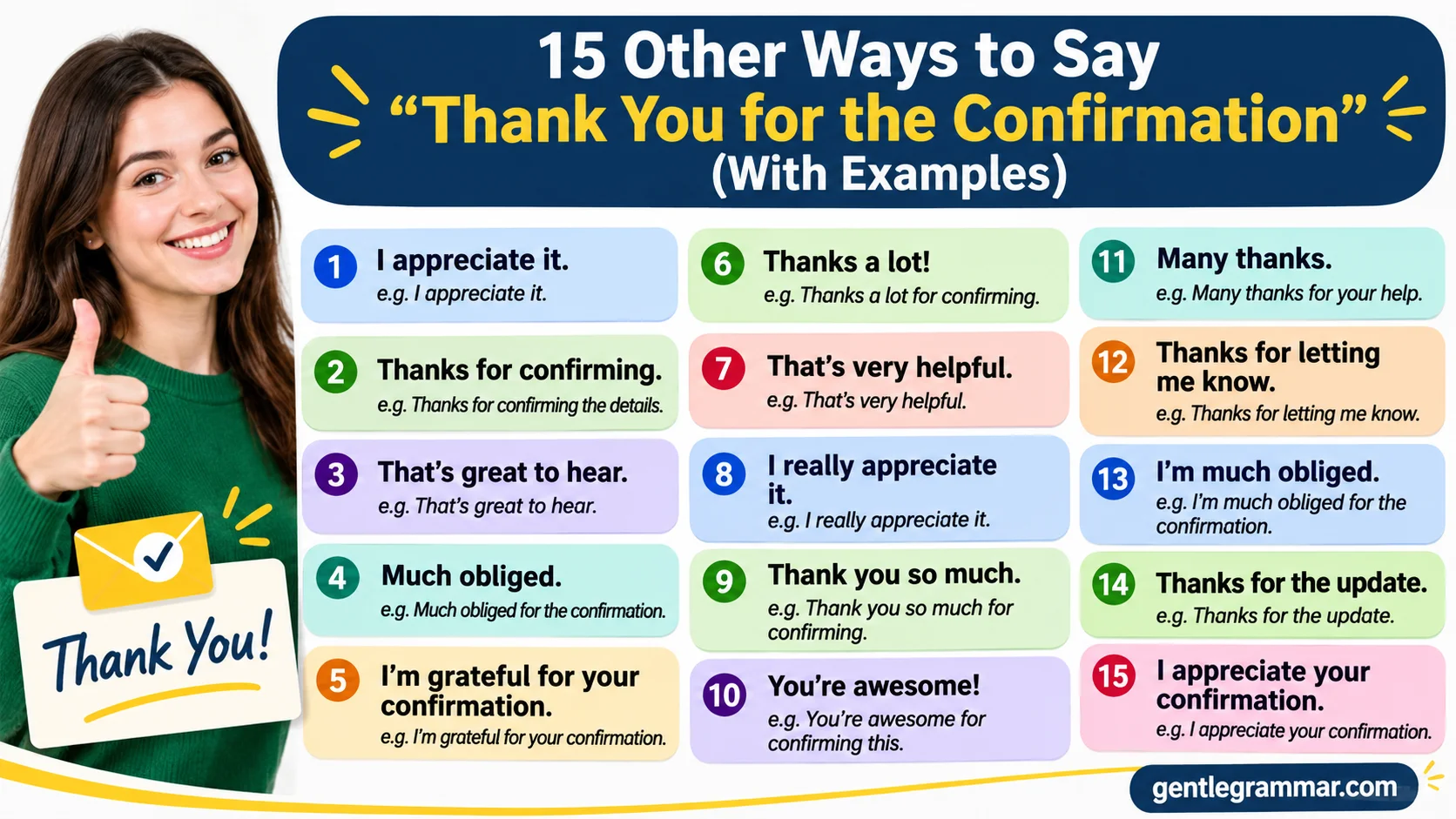
Explore 15 Other Ways to Say “Thank You for the Confirmation” (With Examples) to make your emails sound warmer, clearer, and more natural today.
When writing a business email or communicating in professional settings, a simple Thank You for the Confirmation expresses appreciation and lets the sender know that the information received is clear and understood. Whether you’re discussing an appointment, meeting schedule, meeting arrangements, scheduling, or a project update, choosing thoughtful alternatives can make your email communication, workplace communication, and personal communication feel more genuine.
For example, Thank you for confirming, Thanks for Confirming, thanks for your confirmation, I appreciate your confirmation, and confirmed with thanks are useful variations for different situations. Sometimes, you may feel unsure or awkward while typing a reply in your inbox because finding the right words can be surprisingly tricky.
What Does “Thank You for the Confirmation” Mean?
“Thank you for the confirmation” is a polite expression used to show appreciation when someone verifies information or confirms an arrangement. It acknowledges that another person has provided the information you needed, agreed to something, or verified that a particular detail is correct. For example, if a colleague confirms a meeting time or a customer verifies an order, this expression lets them know you have received and appreciated their response.
The phrase communicates gratitude, acknowledgment, and courtesy. It is commonly used in professional emails, business correspondence, appointment arrangements, and everyday messages. Depending on the situation, it can also reassure the other person that their confirmation has been received and understood. Although the expression is polite and straightforward, you can choose a warmer or more specific alternative when you want your response to feel less formal or more personal.
Common Situations Where “Thank You for the Confirmation” Is Used
People use this expression whenever someone provides confirmation or verifies previously discussed information. It is particularly common in professional communication, where clear acknowledgment helps keep conversations organized.
- Workplace emails: When a colleague confirms a meeting, deadline, or project requirement.
- Business communication: When a client verifies an order, appointment, or service arrangement.
- Customer communication: When a customer confirms their booking or provides requested details.
- School and education: When a student or teacher confirms attendance, submission dates, or schedules.
- Personal messages: When a friend or family member confirms plans for an upcoming event.
- Appointment arrangements: When someone verifies a date, time, or location.
- Formal correspondence: When an organization acknowledges confirmation of an agreement or important information.
An alternative can be useful when you want to avoid repeating the same expression in every email. It can also help you communicate a particular feeling, such as appreciation for a quick response, gratitude for someone’s assistance, or acknowledgment that specific details are correct.
Is It Professional or Polite to Say “Thank You for the Confirmation”?
Yes. “Thank you for the confirmation” is both professional and polite in most workplace and business situations. It communicates appreciation without sounding overly emotional or informal. You can comfortably use it when responding to managers, clients, colleagues, suppliers, customers, and business partners.
The expression is slightly formal, making it particularly suitable for emails and written correspondence. However, it may sound somewhat repetitive if you use it in every response. In casual conversations, a simpler expression can feel more natural. For professional situations, you might choose wording that specifically acknowledges the information received or appreciates the person’s effort. The best choice depends on your relationship with the recipient and the purpose of your message.
Advantages and Disadvantages of Saying “Thank You for the Confirmation”
Advantages
One major advantage is that the expression is clear, polite, and easy to understand. The recipient immediately knows that you have received their confirmation and appreciate their response. It also helps maintain a respectful tone in professional relationships. Because it works in emails, business messages, and everyday communication, it is a convenient expression for many situations. Another benefit is that it acknowledges the other person’s effort without requiring a lengthy response.
Disadvantages
The main limitation is that the phrase can become repetitive and somewhat formulaic when used frequently. It does not always communicate the specific reason you feel grateful. For example, someone might have confirmed an appointment quickly, verified important information, or helped resolve confusion. A more specific expression can acknowledge that effort more effectively. Additionally, its slightly formal wording may feel unnecessary in a relaxed conversation with friends or family.
Synonyms for “Thank You for the Confirmation”
- Thanks for Confirming
- I Appreciate the Confirmation
- Thank You for Letting Me Know
- I Appreciate You Confirming
- Thank You for Verifying That
- Thanks for the Update
- I’ve Received Your Confirmation
- That’s Confirmed, Thank You
- Thank You for Getting Back to Me
- I’m Grateful for the Confirmation
- Thanks for Confirming the Details
- I Appreciate the Quick Response
- Thanks for the Clarification
- Noted With Thanks
- Thank You for Your Response
1. Thanks for Confirming
Meaning
“Thanks for confirming” expresses appreciation when someone verifies information, agrees to an arrangement, or confirms a previous discussion. It is a shorter and more conversational version of the original phrase.
Definition
A friendly expression used to thank someone for verifying or agreeing to something.
Detailed Explanation
This expression is especially useful when you want to acknowledge a straightforward confirmation without making your response sound overly formal. It communicates the same basic gratitude as the original phrase but feels more relaxed and natural. You can use it when someone confirms a meeting, appointment, reservation, or deadline. It is particularly effective in everyday workplace emails and quick messages.
Scenario Examples
Scenario 1: A colleague confirms a meeting time.
Example: “Thanks for confirming. I’ll see you at 10 a.m. tomorrow.”
Scenario 2: A friend agrees to attend an event.
Example: “Thanks for confirming! Looking forward to seeing you there.”
Scenario 3: A client verifies an appointment.
Example: “Thanks for confirming your appointment. We look forward to welcoming you.”
Best Use
Use this expression in workplace emails, text messages, customer communication, and everyday conversations. It works especially well when you want to sound appreciative without being overly formal.
Tone
Tone: Friendly, polite, conversational.
Its relaxed wording makes it suitable for both professional and personal communication, particularly when the confirmation is straightforward.
2. I Appreciate the Confirmation
Meaning
“I appreciate the confirmation” communicates that you are thankful someone took the time to verify information or provide a definite answer. It places slightly more emphasis on your gratitude.
Definition
A polite expression that acknowledges and values someone’s confirmation.
Detailed Explanation
This alternative sounds a little more formal and thoughtful than a simple thank-you. It is useful when receiving confirmation is important for your plans or responsibilities. Unlike a quick acknowledgment, it makes your appreciation more noticeable. It also works well when someone has helped remove uncertainty or provided information you were waiting for.
Scenario Examples
Scenario 1: A manager confirms an important deadline.
Example: “I appreciate the confirmation. I’ll make sure everything is ready by Friday.”
Scenario 2: A business partner verifies an agreement.
Example: “I appreciate the confirmation regarding the revised terms.”
Scenario 3: A customer confirms a service booking.
Example: “I appreciate the confirmation of your booking. Your appointment is now scheduled.”
Best Use
Choose this expression for professional emails, business correspondence, formal requests, and important arrangements. It is especially appropriate when you want to communicate sincere appreciation.
Tone
Tone: Professional, respectful, appreciative.
The phrase sounds considerate because it directly expresses the value you place on the other person’s response.
3. Thank You for Letting Me Know
Meaning
“Thank you for letting me know” expresses gratitude when someone shares information or provides an update. It can replace the original phrase when the confirmation also informs you about something.
Definition
A polite expression used to thank someone for communicating information.
Detailed Explanation
This expression is slightly broader than the original phrase because it does not necessarily require someone to verify a previous statement. It simply acknowledges that they have shared useful information. It works particularly well when someone confirms a change, provides an update, or informs you about a decision. Its natural wording makes it suitable for both professional and personal conversations.
Scenario Examples
Scenario 1: A colleague confirms that a report has been submitted.
Example: “Thank you for letting me know. I’ll review it this afternoon.”
Scenario 2: A friend confirms a change in weekend plans.
Example: “Thank you for letting me know! That works better for me.”
Scenario 3: A customer confirms a delivery arrangement.
Example: “Thank you for letting me know about your preferred delivery time.”
Best Use
Use this phrase in emails, text messages, workplace conversations, customer service, and personal communication. It is particularly useful when the information matters more than the act of confirmation itself.
Tone
Tone: Warm, polite, approachable.
It feels considerate without being excessively formal, making it an easy expression for everyday communication.
4. I Appreciate You Confirming
Meaning
“I appreciate you confirming” expresses gratitude directly toward the person who verified the information. It emphasizes their action and effort, rather than simply acknowledging the confirmation.
Definition
A courteous expression used to show appreciation for someone’s act of confirming something.
Detailed Explanation
This wording feels slightly more personal than “I appreciate the confirmation.” Instead of focusing on the information received, it recognizes the person who provided it. It is especially useful when someone has taken the time to respond or help finalize an arrangement. The phrase works naturally in professional emails, although the specific information being confirmed should be clear from the surrounding conversation.
Scenario Examples
Scenario 1: A colleague verifies a project deadline.
Example: “I appreciate you confirming the deadline. I’ll update the project schedule.”
Scenario 2: A client confirms the final design.
Example: “I appreciate you confirming the design. We’ll proceed with the next stage.”
Scenario 3: A team member verifies attendance.
Example: “I appreciate you confirming your availability for the meeting.”
Best Use
This expression works best in professional emails, team communication, business messages, and situations where someone’s effort deserves acknowledgment.
Tone
Tone: Respectful, appreciative, professional.
Its focus on the recipient’s action gives the message a personal and considerate quality.
5. Thank You for Verifying That
Meaning
“Thank you for verifying that” expresses gratitude when someone has checked information and established that it is accurate or correct.
Definition
A polite expression used to appreciate someone’s effort in checking and confirming information.
Detailed Explanation
This alternative is more specific than the original phrase because verification usually involves checking something for accuracy. It is not always interchangeable with a simple confirmation. For example, someone might confirm that they received an email without actually verifying its contents. This expression is especially useful when accuracy matters and another person has checked a fact, document, payment, or record.
Scenario Examples
Scenario 1: An accountant checks a payment record.
Example: “Thank you for verifying that the payment was received.”
Scenario 2: A colleague checks a document.
Example: “Thank you for verifying that the figures are correct.”
Scenario 3: A customer service representative checks an order number.
Example: “Thank you for verifying that information. I’ll proceed with your request.”
Best Use
Use this phrase in administrative communication, financial correspondence, customer support, workplace emails, and situations involving accuracy or verification.
Tone
Tone: Professional, precise, respectful.
The word “verifying” gives the expression a more factual and detail-oriented quality.
6. Thanks for the Update
Meaning
“Thanks for the update” communicates appreciation when someone provides new information about a situation, decision, or arrangement. It can replace the original phrase when confirmation is part of a broader update.
Definition
An informal but polite expression used to acknowledge and appreciate new information.
Detailed Explanation
This phrase is more general than the original expression. A confirmation establishes that something is definite, while an update may include new developments or changes. For example, if a colleague confirms that a project is on schedule, thanking them for the update sounds natural. However, if you need to acknowledge a specific verification, a more precise expression may be better. It is particularly convenient for ongoing conversations.
Scenario Examples
Scenario 1: A manager shares the latest project status.
Example: “Thanks for the update. I’ll adjust my priorities accordingly.”
Scenario 2: A friend confirms a change in travel arrangements.
Example: “Thanks for the update! I’ll meet you at the new location.”
Scenario 3: A supplier confirms an order’s expected arrival.
Example: “Thanks for the update regarding the delivery schedule.”
Best Use
This alternative is ideal for workplace communication, project discussions, customer messages, informal emails, and ongoing conversations.
Tone
Tone: Casual, friendly, professional.
It strikes a comfortable balance between friendliness and courtesy, especially when communicating with familiar colleagues.
7. I’ve Received Your Confirmation
Meaning
“I’ve received your confirmation” communicates that you have successfully received someone’s confirmation. It focuses more on acknowledgment and receipt than on expressing personal gratitude.
Definition
A formal statement confirming that another person’s confirmation has reached you.
Detailed Explanation
Unlike the original phrase, this expression does not directly thank the recipient. Instead, it reassures them that their message has been received. It is useful when keeping records or acknowledging important business communication. You can also add a separate expression of appreciation if you want to make the response warmer. Its wording is more formal and administrative than everyday conversational English.
Scenario Examples
Scenario 1: A company receives an appointment confirmation.
Example: “I’ve received your confirmation and have updated our appointment records.”
Scenario 2: An employee acknowledges a manager’s approval.
Example: “I’ve received your confirmation regarding the revised schedule.”
Scenario 3: A business receives a customer’s booking confirmation.
Example: “I’ve received your confirmation. Your booking details are now on file.”
Best Use
Use this expression in formal emails, administrative correspondence, booking communication, business records, and situations where confirming receipt is important.
Tone
Tone: Formal, neutral, professional.
It is more focused on accurate communication than emotional appreciation, making it suitable for official correspondence.
8. That’s Confirmed, Thank You
Meaning
“That’s confirmed, thank you” acknowledges that an arrangement or detail has been established. It combines confirmation and appreciation in one short response.
Definition
A concise expression used to acknowledge that something is confirmed while thanking the other person.
Detailed Explanation
This expression sounds direct and confident. It is particularly useful when both people have discussed an arrangement and the remaining details are now settled. Unlike the original phrase, it also reinforces that you understand the arrangement as final. However, it can sound slightly abrupt if used without enough context. Adding a friendly sentence can make it feel more welcoming.
Scenario Examples
Scenario 1: A colleague confirms a meeting location.
Example: “That’s confirmed, thank you. I’ll see everyone at the main office.”
Scenario 2: A customer finalizes a reservation.
Example: “That’s confirmed, thank you. We’ll see you on Saturday.”
Scenario 3: A team member agrees to a presentation schedule.
Example: “That’s confirmed, thank you. I’ll add it to the calendar.”
Best Use
This expression works well in short emails, business conversations, appointment arrangements, scheduling messages, and situations where an agreement has been finalized.
Tone
Tone: Direct, polite, confident.
It communicates that the matter is settled while maintaining a courteous tone.
9. Thank You for Getting Back to Me
Meaning
“Thank you for getting back to me” expresses appreciation when someone responds to your earlier message, question, or request. It is suitable when their response includes confirmation.
Definition
A polite expression used to thank someone for replying to a previous communication.
Detailed Explanation
This phrase focuses on the person’s response rather than the confirmation itself. It is especially useful when you have been waiting for an answer or following up on an earlier conversation. The wording sounds natural in both professional and personal communication. However, it is broader than the original phrase because the response does not necessarily have to confirm anything. It also conveys a little extra appreciation when someone has taken time to reply.
Scenario Examples
Scenario 1: A recruiter responds to an interview scheduling email.
Example: “Thank you for getting back to me. Tuesday afternoon works perfectly.”
Scenario 2: A friend replies to a message about weekend plans.
Example: “Thanks for getting back to me! I’m glad we’re still on for Sunday.”
Scenario 3: A customer responds with the requested information.
Example: “Thank you for getting back to me with the details. We’ll proceed accordingly.”
Best Use
Choose this expression for follow-up emails, business correspondence, job applications, customer communication, and personal messages.
Tone
Tone: Friendly, courteous, conversational.
It acknowledges the recipient’s effort to respond and feels especially natural when there has been a delay between messages.
10. I’m Grateful for the Confirmation
Meaning
“I’m grateful for the confirmation” communicates sincere appreciation for someone providing definite information or resolving uncertainty.
Definition
A thoughtful expression that shows genuine thankfulness for receiving confirmation.
Detailed Explanation
This alternative is more emotionally expressive than the original phrase. The word “grateful” emphasizes that the confirmation has particular value to you. It is useful when someone’s response has helped you make an important decision or move forward with a plan. Although it can be used professionally, it may feel more personal or heartfelt than a routine acknowledgment. Use it when you genuinely want to emphasize your appreciation.
Scenario Examples
Scenario 1: A colleague confirms approval for an important project.
Example: “I’m grateful for the confirmation. We can now move forward with the proposal.”
Scenario 2: A family member confirms travel arrangements.
Example: “I’m grateful for the confirmation. It helps me organize everything in advance.”
Scenario 3: A business partner confirms an important agreement.
Example: “I’m grateful for the confirmation of our agreed terms.”
Best Use
This expression is appropriate for important professional emails, personal correspondence, meaningful arrangements, and situations where confirmation provides reassurance.
Tone
Tone: Warm, sincere, appreciative.
It conveys more emotional warmth than a routine thank-you, so it is best reserved for situations where that extra appreciation feels genuine.
11. Thanks for Confirming the Details
Meaning
“Thanks for confirming the details” expresses appreciation when someone verifies specific information about an arrangement, plan, or transaction.
Definition
A polite expression used to thank someone for checking and confirming particular details.
Detailed Explanation
This alternative is more specific than the original phrase because it identifies what has been confirmed. It works especially well when several details need to be correct, such as dates, times, prices, addresses, or project requirements. It also helps avoid confusion because the recipient knows exactly what you are acknowledging. Unlike a general thank-you, this wording is particularly useful when accuracy and clear records matter.
Scenario Examples
Scenario 1: A colleague verifies a meeting agenda and schedule.
Example: “Thanks for confirming the details. I’ll share the updated agenda with the team.”
Scenario 2: A customer verifies a delivery address.
Example: “Thanks for confirming the details. Your order will be sent to the address provided.”
Scenario 3: An event organizer confirms the venue and start time.
Example: “Thanks for confirming the details. I’ll make sure everyone has the correct information.”
Best Use
Use this expression in business emails, order management, event planning, customer service, and workplace communication where specific information needs verification.
Tone
Tone: Professional, clear, appreciative.
Its precise wording makes it particularly useful for organized communication and practical arrangements.
12. I Appreciate the Quick Response
Meaning
“I appreciate the quick response” expresses gratitude for someone replying promptly. It is a useful alternative when the person has provided confirmation without making you wait.
Definition
A polite expression used to appreciate someone for responding quickly.
Detailed Explanation
This phrase emphasizes speed and responsiveness, rather than confirmation itself. It works particularly well when someone has replied sooner than expected or helped you avoid a delay. Although it can acknowledge a confirmation, it is not an exact synonym because the response does not have to contain verified information. If you want to recognize someone’s efficiency, however, this expression sounds natural and thoughtful.
Scenario Examples
Scenario 1: A manager quickly approves a meeting request.
Example: “I appreciate the quick response. I’ll send the invitation shortly.”
Scenario 2: A customer service representative promptly answers your question.
Example: “I appreciate the quick response and the information you provided.”
Scenario 3: A colleague quickly confirms their availability.
Example: “I appreciate the quick response. I’ll finalize the schedule now.”
Best Use
This phrase is especially useful in professional emails, customer support, business correspondence, and time-sensitive conversations where prompt communication deserves recognition.
Tone
Tone: Respectful, professional, appreciative.
It communicates gratitude for efficiency and responsiveness, making it more specific than a general acknowledgment.
13. Thanks for the Clarification
Meaning
“Thanks for the clarification” expresses appreciation when someone explains something more clearly or removes confusion. It can be appropriate when their explanation also confirms previously discussed information.
Definition
A polite expression used to thank someone for making information easier to understand.
Detailed Explanation
Clarification and confirmation are related but different. Confirmation establishes that something is correct or agreed upon, while clarification explains something that may have been unclear. This expression is particularly useful when a person has answered a question or explained a confusing detail. It helps you acknowledge the value of their explanation rather than simply thanking them for a response. Use it only when the other person has genuinely made something clearer.
Scenario Examples
Scenario 1: A manager explains an unclear project requirement.
Example: “Thanks for the clarification. I’ll follow the updated instructions.”
Scenario 2: A teacher explains an assignment deadline.
Example: “Thanks for the clarification. I’ll submit the work before the revised deadline.”
Scenario 3: A customer explains a change to their order.
Example: “Thanks for the clarification. I’ll make sure the order reflects your preferences.”
Best Use
This expression works best in workplace discussions, educational communication, customer service, email conversations, and situations involving misunderstandings.
Tone
Tone: Polite, appreciative, collaborative.
It encourages clear communication and shows that you value the other person’s effort to explain something.
14. Noted With Thanks
Meaning
“Noted with thanks” communicates that you have received and acknowledged information while expressing appreciation. It is often used when someone provides a confirmation, instruction, or important update.
Definition
A concise expression used to acknowledge information and thank the person who provided it.
Detailed Explanation
This expression is more formal and business-oriented than most alternatives. It focuses on acknowledging information rather than expressing strong personal gratitude. You may see it in administrative emails and professional correspondence, particularly when a brief response is preferred. However, it can sound stiff in everyday conversations or friendly messages. If you want a warmer response, a more conversational expression may be better.
Scenario Examples
Scenario 1: An employee receives confirmation of a revised schedule.
Example: “Noted with thanks. I’ll update my calendar accordingly.”
Scenario 2: A business receives confirmation of a purchase order.
Example: “Noted with thanks. We will proceed with the processing.”
Scenario 3: A team member acknowledges an official instruction.
Example: “Noted with thanks. I’ll ensure the requested changes are completed.”
Best Use
Use this phrase in formal business emails, administrative communication, official correspondence, and brief workplace acknowledgments. Avoid relying on it in relaxed personal conversations.
Tone
Tone: Formal, concise, businesslike.
Its short structure is efficient, although it can feel less warm than a more personal expression of gratitude.
15. Thank You for Your Response
Meaning
“Thank you for your response” expresses appreciation when someone replies to your message, request, or inquiry. It can replace the original phrase when their response contains confirmation.
Definition
A courteous expression used to thank someone for answering or replying to a communication.
Detailed Explanation
This expression is broader than the original phrase because a response does not always contain confirmation. It can include an explanation, decision, update, or answer to a question. Its formal wording makes it particularly useful in professional correspondence and customer communication. It also works when you want to acknowledge a reply without repeating the specific details. If the person has verified something important, a more specific expression may communicate your appreciation more clearly.
Scenario Examples
Scenario 1: A company responds to a business inquiry.
Example: “Thank you for your response. We appreciate the information about your services.”
Scenario 2: A colleague replies to a scheduling request.
Example: “Thank you for your response. I’ll arrange the meeting accordingly.”
Scenario 3: A customer answers a support request.
Example: “Thank you for your response. We have received the information needed to assist you.”
Best Use
This phrase is suitable for formal emails, business correspondence, customer service, professional inquiries, and written communication where a courteous acknowledgment is appropriate.
Tone
Tone: Formal, polite, neutral.
It is a reliable choice when you want to maintain professionalism without adding unnecessary emotional language.
FAQs:
1. What is another way to say “Thank You for the Confirmation”?
Some natural alternatives include “Thanks for confirming,” “I appreciate the confirmation,” and “Thank you for letting me know.” Each expression communicates appreciation, but the best choice depends on whether you want to sound casual, professional, or more personal.
2. What does “Thank You for the Confirmation” mean?
It means you appreciate someone for verifying information, agreeing to an arrangement, or providing a definite answer. It acknowledges their response and communicates that you have received the confirmation.
3. Is “Thank You for the Confirmation” professional?
Yes. It is a polite and professional expression commonly used in workplace emails, business correspondence, appointment arrangements, and customer communication. Its straightforward wording makes it appropriate for most professional situations.
4. What is a more polite way to say “Thank You for the Confirmation”?
“I appreciate the confirmation” is an excellent choice when you want to sound particularly courteous. “I’m grateful for the confirmation” also works when you want to communicate more sincere appreciation. Both expressions are appropriate when the confirmation is important to you.
5. Which alternative works best in formal communication?
“I appreciate the confirmation” is one of the strongest choices for formal communication because it is respectful, clear, and professional. “I’ve received your confirmation” is another suitable option when your main purpose is to acknowledge receipt rather than express gratitude.
Conclusion:
Choosing the right words can make even a short acknowledgment feel more thoughtful and meaningful. While “Thank You for the Confirmation” is already a polite and professional expression, using different alternatives helps you adapt your message to the situation. You might choose a friendly response for a colleague, a more formal expression for a client, or warmer wording when someone has helped you personally.
Remember that similar expressions do not always communicate exactly the same thing. Some emphasize gratitude, while others focus on receiving information, verifying details, or appreciating a quick reply. Pay attention to your relationship with the recipient and the purpose of your message. The best expression is the one that sounds natural, respectful, and genuinely appropriate for the conversation.
