
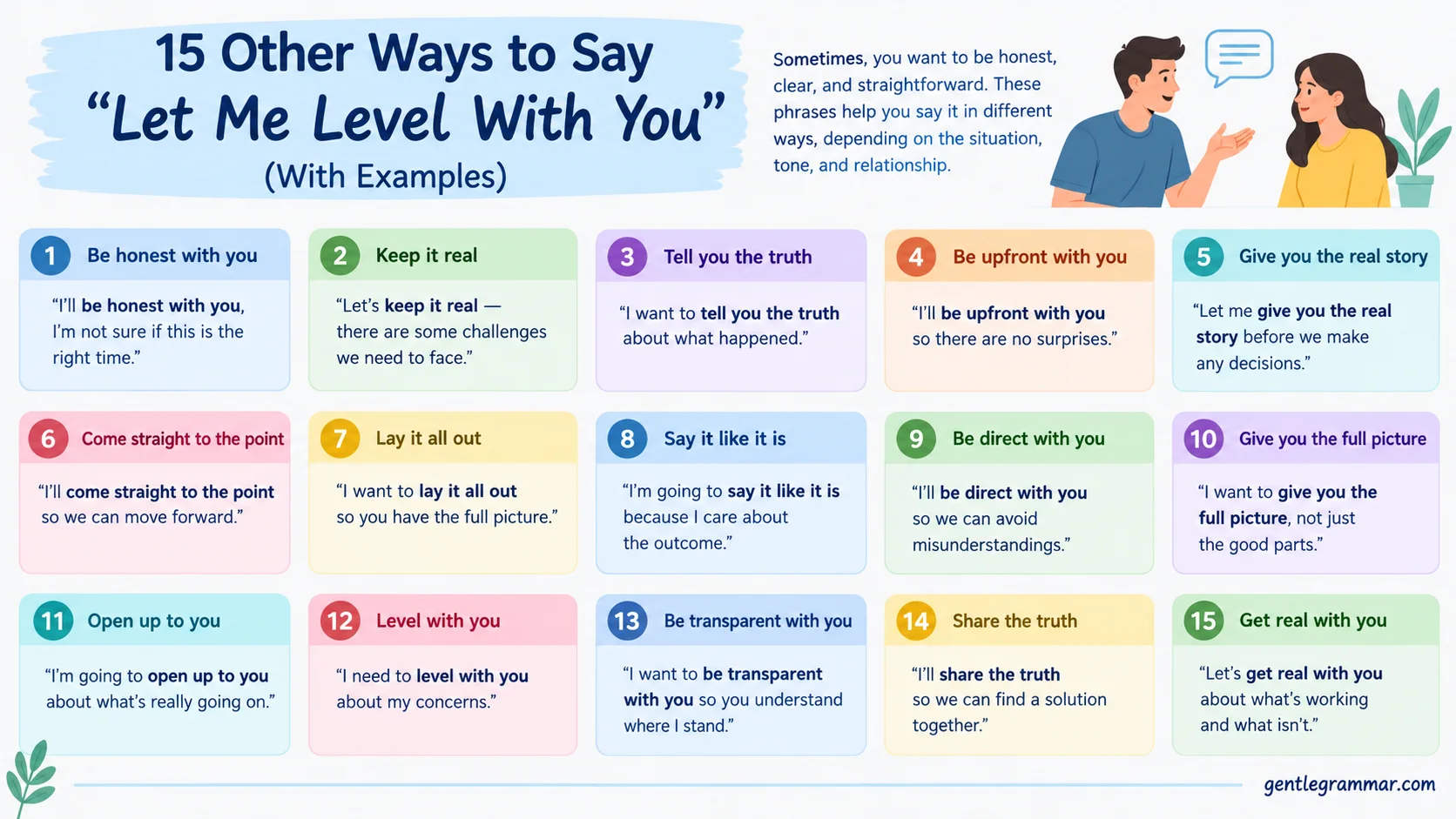
15 Other Ways to Say “Let Me Level With You” (With Examples) helps you find natural expressions for honest and direct conversations.
The phrase can introduce a clear statement, an important fact, or an uncomfortable opinion. For instance, during a team meeting, a manager might tell an employee that a project is falling behind and they need to change the plan or change their approach. It signals an honest conversation about something important or realistic. Depending on the situation, relationship, setting, and tone of voice, the expression may sound confident and encourage openness in the workplace.
However, during a sensitive conversation, it might seem too blunt. People also use it before sharing advice, criticism, an explanation, a straightforward opinion, or a personal concern. Understanding this direct language helps professionals, students, ESL learners, and writers choose the right alternative for their audience. The goal is to communicate in an appropriate and respectful way without being unnecessarily harsh.
What Does “Let Me Level With You” Mean?
“Let Me Level With You” means let me speak honestly and openly with you, usually without hiding important details or pretending everything is fine. It is an informal expression people use before sharing their genuine thoughts, feelings, opinions, or concerns. The word level suggests being on equal terms and communicating frankly rather than misleading someone.
In everyday English, the phrase prepares the listener for a straightforward conversation. For example, someone might say, “Let me level with you: this plan needs more work.” The speaker is signaling that the following statement will be honest, even if it isn’t particularly pleasant. Depending on the delivery, the expression can sound friendly, serious, reassuring, or slightly confrontational.
Common Situations Where “Let Me Level With You” Is Used
People commonly use this expression when they want to move from casual conversation to honest discussion. A friend might say it before giving personal advice, while a family member could use it to discuss a sensitive issue. It also works when someone wants to explain a disagreement or share an opinion without sugarcoating the truth.
In workplace conversations, the phrase can introduce constructive feedback or a difficult observation, although its informal tone may not suit every professional setting. People also use it in text messages and online discussions when they want their words to sound sincere and direct. An alternative can help when the speaker wants to sound more respectful, diplomatic, reassuring, or professional.
Is It Professional or Polite to Say “Let Me Level With You”?
“Let Me Level With You” is generally casual, direct, and conversational. It can be polite when used with genuine respect because it signals that the speaker intends to be truthful rather than misleading. However, the phrase is relatively informal, so it may feel too familiar in formal emails, official documents, or conversations with someone you don’t know well.
In a workplace discussion, it can work between colleagues who have an easy relationship. However, expressions such as “I’d like to be transparent with you” or “To be completely honest” may sound more appropriate when addressing a manager, client, or business partner. The key is to balance honesty with tact so your message feels clear without becoming unnecessarily harsh.
Advantages and Disadvantages of Saying “Let Me Level With You”
Advantages
The biggest advantage of this expression is that it prepares someone for an open and honest conversation. It signals that you’re about to share your genuine opinion, even if the subject is uncomfortable. The phrase also sounds natural in everyday speech and can make a conversation feel personal rather than overly rehearsed. It is particularly useful when you want to build trust through direct communication.
Disadvantages
The phrase can sometimes sound too blunt or informal, especially when discussing sensitive subjects. Some listeners may interpret it as a warning that criticism or bad news is coming. It can also feel unnecessarily dramatic when the following statement is simple or unimportant. In professional or formal communication, more polished wording may help you express the same honesty with greater tact.
Synonyms for “Let Me Level With You”
- Let Me Be Honest With You
- Let Me Be Straight With You
- To Be Frank With You
- Let Me Tell You the Truth
- I’ll Be Completely Honest
- Let Me Speak Candidly
- To Be Upfront With You
- Here’s the Honest Truth
- I Want to Be Transparent With You
- Let Me Give It to You Straight
- Between You and Me
- I Won’t Sugarcoat It
- Let Me Share My Honest Opinion
- Speaking Openly
- I Want to Be Real With You
1. Let Me Be Honest With You
Meaning
“Let Me Be Honest With You” means you’re about to share your genuine thoughts without hiding your feelings or changing the truth to make someone comfortable. It communicates sincerity, openness, and trust.
Definition
A polite, conversational expression used to introduce a truthful opinion or personal observation.
Detailed Explanation
This expression is one of the most natural alternatives when you want to speak sincerely. Unlike “Let Me Level With You,” it places more emphasis on personal honesty than on being straightforward or firm. It can introduce positive feedback, constructive criticism, or an uncomfortable truth. Its meaning depends largely on what follows.
Scenario Examples
Scenario 1: Your friend asks whether you like their new business idea.
Example: “Let me be honest with you. I think you should research the market before investing.”
Scenario 2: A colleague asks for feedback on a presentation.
Example: “Let me be honest with you. The presentation is good, but the introduction needs improvement.”
Scenario 3: Your partner wants to discuss a disagreement.
Example: “Let me be honest with you. I felt hurt by what happened yesterday.”
Best Use
Use this expression in personal conversations, friendly discussions, workplace feedback, and sensitive situations where sincerity matters.
Tone
Tone: Honest, warm, conversational, and sometimes serious.
It sounds approachable while making it clear that you’re sharing your genuine perspective.
2. Let Me Be Straight With You
Meaning
“Let Me Be Straight With You” means you’re going to communicate directly without avoiding the main issue or hiding important details.
Definition
An informal expression used to introduce a direct and straightforward statement.
Detailed Explanation
This expression is slightly more direct than “Let Me Be Honest With You.” It suggests that you don’t want to waste time with vague explanations or unnecessary politeness. People often use it before giving difficult feedback or explaining a problem. It works best when the listener appreciates clear communication.
Scenario Examples
Scenario 1: Your friend keeps ignoring an important responsibility.
Example: “Let me be straight with you. You need to take this situation more seriously.”
Scenario 2: A team member asks whether a project is ready.
Example: “Let me be straight with you. We won’t meet the deadline unless we get additional support.”
Scenario 3: Someone asks whether you enjoyed an event.
Example: “Let me be straight with you. I expected it to be much better.”
Best Use
This phrase works well in casual discussions, workplace conversations, personal advice, and situations requiring clear feedback.
Tone
Tone: Direct, confident, informal, and serious.
It communicates honesty without spending too much time softening the message.
3. To Be Frank With You
Meaning
“To Be Frank With You” means you’re going to express your genuine opinion openly, even if it might not be what the other person wants to hear.
Definition
A conversational expression used to introduce a frank or candid opinion.
Detailed Explanation
This expression emphasizes speaking freely rather than carefully avoiding uncomfortable subjects. It has a slightly more formal or old-fashioned feel than “Let Me Level With You,” although it remains common in conversation. It can sound respectful when delivered calmly, but it may introduce criticism if followed by negative feedback. Choose it when you want to communicate a firm personal opinion.
Scenario Examples
Scenario 1: A friend asks whether they should accept a particular job.
Example: “To be frank with you, I don’t think the salary matches the responsibilities.”
Scenario 2: Your colleague asks about a proposed strategy.
Example: “To be frank with you, I believe we need a more practical approach.”
Scenario 3: Someone asks why you haven’t attended recent gatherings.
Example: “To be frank with you, I’ve needed some time to focus on myself.”
Best Use
Use it in personal discussions, thoughtful feedback, business conversations, and situations where you need to express a firm opinion.
Tone
Tone: Frank, thoughtful, direct, and slightly formal.
It sounds more measured than some casual alternatives, although it can still feel blunt.
4. Let Me Tell You the Truth
Meaning
“Let Me Tell You the Truth” means you want to explain what really happened or share information honestly instead of allowing someone to believe something incorrect.
Definition
A direct expression used to introduce the actual facts or your truthful perspective.
Detailed Explanation
This phrase places particular emphasis on revealing the truth. It can be useful when correcting a misunderstanding, explaining a situation, or addressing something someone has misunderstood. Compared with the original expression, it sounds more focused on truth and facts than on having an open conversation. It can also sound dramatic if the situation isn’t particularly serious.
Scenario Examples
Scenario 1: Your friend believes you deliberately ignored their message.
Example: “Let me tell you the truth. I was dealing with a family emergency and couldn’t respond.”
Scenario 2: A customer misunderstands a delivery delay.
Example: “Let me tell you the truth. Your order was delayed because the supplier missed the shipping deadline.”
Scenario 3: Someone asks why you left a previous job.
Example: “Let me tell you the truth. I wasn’t getting opportunities to develop my skills.”
Best Use
This expression is useful in personal explanations, correcting misunderstandings, customer communication, and serious conversations.
Tone
Tone: Sincere, serious, explanatory, and direct.
It suggests that an important clarification is coming.
5. I’ll Be Completely Honest
Meaning
“I’ll Be Completely Honest” means you’re making a clear commitment to share your genuine thoughts without hiding or exaggerating anything.
Definition
A conversational expression that introduces an open and sincere statement.
Detailed Explanation
This phrase sounds personal and reassuring because it emphasizes your intention to be truthful. Unlike “Let Me Level With You,” it can sound slightly softer and less confrontational. It works especially well when someone has asked for your opinion or needs an honest answer. The word completely adds emphasis, suggesting that you aren’t holding back important details.
Scenario Examples
Scenario 1: Your friend asks whether their new hairstyle suits them.
Example: “I’ll be completely honest. I think the shorter style looks much better on you.”
Scenario 2: A colleague asks whether their proposal is realistic.
Example: “I’ll be completely honest. The budget needs to be revised before we move forward.”
Scenario 3: Someone asks whether you’re comfortable with a decision.
Example: “I’ll be completely honest. I’m still unsure about the timing.”
Best Use
Choose this expression for personal conversations, friendly advice, feedback sessions, and discussions where trust is important.
Tone
Tone: Sincere, reassuring, friendly, and straightforward.
It makes your intention clear without sounding unnecessarily harsh.
6. Let Me Speak Candidly
Meaning
“Let Me Speak Candidly” means you want to discuss something openly and honestly without hiding your actual thoughts.
Definition
A relatively formal expression used to introduce frank and unrestricted communication.
Detailed Explanation
This wording is more polished than the original phrase and works particularly well in professional discussions. It communicates that you’re willing to address an issue directly, even when the subject is uncomfortable. The word candidly emphasizes openness rather than aggression. It can sound slightly formal in everyday conversations, so it’s best reserved for situations where thoughtful, serious communication is appropriate.
Scenario Examples
Scenario 1: A manager discusses a team’s performance.
Example: “Let me speak candidly. Our current results aren’t meeting the expectations we established.”
Scenario 2: A business partner asks for your assessment.
Example: “Let me speak candidly. I think we should reconsider the partnership terms.”
Scenario 3: A student asks a teacher for feedback.
Example: “Let me speak candidly. Your argument is interesting, but the supporting evidence is weak.”
Best Use
Use it in business meetings, formal discussions, professional feedback, and serious conversations.
Tone
Tone: Professional, thoughtful, respectful, and direct.
It gives your message a measured and mature quality.
7. To Be Upfront With You
Meaning
“To Be Upfront With You” means you want to be open about something from the beginning rather than hiding information or allowing misunderstandings.
Definition
An expression used to introduce clear, honest, and transparent communication.
Detailed Explanation
This alternative is especially useful when you want to establish expectations before moving forward. It often communicates honesty about circumstances, limitations, intentions, or possible problems. Unlike the original phrase, it can focus on disclosing important information early rather than simply sharing an opinion. It is particularly natural in professional and personal arrangements.
Scenario Examples
Scenario 1: You’re discussing a freelance project with a potential client.
Example: “To be upfront with you, I won’t be available for weekend revisions.”
Scenario 2: You’re getting to know someone romantically.
Example: “To be upfront with you, I’m not ready for a serious relationship right now.”
Scenario 3: A colleague asks whether a task can be completed today.
Example: “To be upfront with you, I don’t think we can finish it without extending the deadline.”
Best Use
This phrase is appropriate for workplace communication, client discussions, relationships, negotiations, and setting expectations.
Tone
Tone: Transparent, respectful, practical, and confident.
It sounds honest without necessarily suggesting criticism or confrontation.
8. Here’s the Honest Truth
Meaning
“Here’s the Honest Truth” means you’re about to reveal what you genuinely believe or explain the reality of a situation.
Definition
A direct expression used to introduce an important or sincere statement.
Detailed Explanation
This phrase draws attention to the information that follows. It is particularly useful when you want someone to understand the reality of a situation rather than focus on assumptions or wishful thinking. Compared with the original expression, it sounds more emphatic and can carry greater emotional weight. It is effective when the next statement needs attention, but it may feel dramatic in ordinary situations.
Scenario Examples
Scenario 1: Your friend believes success will come without preparation.
Example: “Here’s the honest truth: you need consistent practice if you want to improve.”
Scenario 2: Someone asks whether a difficult situation will resolve quickly.
Example: “Here’s the honest truth: it may take several weeks to sort everything out.”
Scenario 3: A colleague asks about the quality of a report.
Example: “Here’s the honest truth: the report contains useful information, but the analysis is incomplete.”
Best Use
Use this expression in serious conversations, personal advice, difficult explanations, and situations requiring emphasis.
Tone
Tone: Emphatic, serious, honest, and direct.
It prepares the listener for a statement that the speaker considers important.
9. I Want to Be Transparent With You
Meaning
“I Want to Be Transparent With You” means you intend to share relevant information openly so the other person understands the situation clearly.
Definition
A professional expression that communicates openness, honesty, and clarity.
Detailed Explanation
This is one of the strongest alternatives for professional communication. It emphasizes sharing relevant details rather than keeping someone uninformed. While “Let Me Level With You” can introduce a personal opinion, transparency often involves explaining facts, decisions, limitations, or processes. It sounds respectful and measured, making it especially useful when discussing responsibilities or business matters.
Scenario Examples
Scenario 1: A manager explains a change in company procedures.
Example: “I want to be transparent with you about the upcoming changes to our project schedule.”
Scenario 2: A service provider discusses a potential additional charge.
Example: “I want to be transparent with you. The additional customization will increase the final cost.”
Scenario 3: You’re explaining a delay to a customer.
Example: “I want to be transparent with you about the reason your application is taking longer than expected.”
Best Use
This expression works best in professional emails, customer service, business meetings, workplace updates, and important discussions.
Tone
Tone: Professional, respectful, trustworthy, and informative.
It prioritizes clarity and openness over emotional emphasis.
10. Let Me Give It to You Straight
Meaning
“Let Me Give It to You Straight” means you’re going to explain something directly without hiding the facts or making the situation sound better than it is.
Definition
An informal expression used to introduce a blunt and straightforward statement.
Detailed Explanation
This phrase is stronger and more forceful than several other alternatives. It suggests that the speaker intends to avoid excuses, unnecessary explanations, or sugarcoating. It is useful when someone needs a clear answer rather than comforting words. However, its blunt quality can sound insensitive if the listener is already upset or dealing with a difficult situation.
Scenario Examples
Scenario 1: A friend repeatedly misses important deadlines.
Example: “Let me give it to you straight. You won’t achieve your goals unless you become more consistent.”
Scenario 2: A team discusses an unrealistic target.
Example: “Let me give it to you straight. We don’t have enough resources to complete everything this week.”
Scenario 3: Someone asks whether their business is ready to launch.
Example: “Let me give it to you straight. You still need to fix several problems before opening.”
Best Use
Choose this phrase for casual conversations, direct advice, serious feedback, and situations where clarity matters more than softening the message.
Tone
Tone: Blunt, confident, informal, and assertive.
It can sound helpful among close friends but may feel harsh in formal situations.
11. Between You and Me
Meaning
“Between You and Me” introduces information shared privately or confidentially. It can also introduce a personal opinion that the speaker doesn’t intend to share publicly.
Definition
An informal expression used to suggest privacy, discretion, or a confidential conversation.
Detailed Explanation
This expression is related to honest communication, but it isn’t an exact synonym for “Let Me Level With You.” Its main purpose is to suggest that information should stay between the people involved. It can introduce an honest observation, personal opinion, or sensitive detail. Use it carefully because it may imply confidentiality that the other person expects you to respect.
Scenario Examples
Scenario 1: A friend privately shares an opinion about a group decision.
Example: “Between you and me, I don’t think that was the right choice.”
Scenario 2: A colleague discusses an unofficial workplace concern.
Example: “Between you and me, I think the team needs clearer instructions.”
Scenario 3: Two siblings discuss a family disagreement.
Example: “Between you and me, I think Dad was trying to help, even though he handled it badly.”
Best Use
Use it in private conversations, trusted friendships, informal discussions, and sensitive personal situations. Avoid it when you cannot genuinely promise discretion.
Tone
Tone: Personal, confidential, friendly, and informal.
Its focus is privacy rather than straightforwardness alone.
12. I Won’t Sugarcoat It
Meaning
“I Won’t Sugarcoat It” means you won’t make an unpleasant situation sound better or easier than it really is.
Definition
An informal expression used to introduce an unsoftened or blunt assessment.
Detailed Explanation
This phrase is particularly useful when you need to discuss difficult facts or give someone realistic expectations. It communicates that you’re choosing accuracy over comforting language. Compared with the original phrase, it has a stronger emphasis on avoiding softening or disguising negative information. It can be helpful when honesty is necessary, but you should still consider the other person’s feelings.
Scenario Examples
Scenario 1: A friend asks how difficult an upcoming examination will be.
Example: “I won’t sugarcoat it. The final exam is going to be challenging.”
Scenario 2: A manager explains a project’s problems.
Example: “I won’t sugarcoat it. We’re behind schedule and need to make some serious changes.”
Scenario 3: Someone asks whether they need to improve their writing.
Example: “I won’t sugarcoat it. Your ideas are strong, but your grammar needs more attention.”
Best Use
This phrase is suitable for honest feedback, difficult conversations, realistic advice, and informal professional discussions.
Tone
Tone: Blunt, realistic, serious, and straightforward.
It signals that the speaker won’t disguise an uncomfortable reality.
13. Let Me Share My Honest Opinion
Meaning
“Let Me Share My Honest Opinion” means you want to express your personal viewpoint sincerely, without pretending to agree or hiding what you really think.
Definition
A polite expression used to introduce a genuine personal judgment or perspective.
Detailed Explanation
This phrase is especially useful when someone asks what you think about a decision, idea, or situation. Unlike the original expression, it clearly identifies the following statement as a personal opinion rather than an objective fact. That distinction can make disagreements easier to manage because you’re sharing your perspective instead of claiming that your view is the only correct one. It also sounds less confrontational than a blunt statement.
Scenario Examples
Scenario 1: A friend asks for feedback on a clothing choice.
Example: “Let me share my honest opinion. I think the blue jacket suits you better.”
Scenario 2: Your colleague presents a marketing strategy.
Example: “Let me share my honest opinion. We should focus more on customer retention.”
Scenario 3: Someone asks what you think about a proposed family holiday.
Example: “Let me share my honest opinion. I’d prefer somewhere quieter this year.”
Best Use
Use this expression in feedback sessions, group discussions, personal advice, meetings, and friendly conversations.
Tone
Tone: Respectful, thoughtful, sincere, and conversational.
It makes room for different viewpoints without sounding unnecessarily aggressive.
14. Speaking Openly
Meaning
“Speaking Openly” means communicating freely and honestly without hiding important thoughts or concerns.
Definition
A neutral expression describing open and sincere communication.
Detailed Explanation
This expression focuses on the way people communicate rather than introducing a particularly blunt statement. It is useful when discussing sensitive topics, encouraging honest discussion, or explaining that everyone should feel comfortable expressing their views. Unlike the original phrase, it doesn’t always signal that an uncomfortable truth is coming. It can sound more collaborative and less confrontational, especially in professional discussions.
Scenario Examples
Scenario 1: A team leader encourages employees to raise concerns.
Example: “Speaking openly, I think we need more time to test the new system.”
Scenario 2: A friend wants to discuss a relationship problem.
Example: “Speaking openly, I don’t think we’ve been communicating as well as we used to.”
Scenario 3: A group discusses possible improvements to a school project.
Example: “Speaking openly, our presentation would be stronger with more practical examples.”
Best Use
This expression works well in team discussions, personal conversations, reflective writing, meetings, and constructive feedback.
Tone
Tone: Calm, collaborative, thoughtful, and respectful.
It encourages honest communication without necessarily sounding confrontational.
15. I Want to Be Real With You
Meaning
“I Want to Be Real With You” means you want to speak genuinely and openly instead of pretending, exaggerating, or hiding your feelings.
Definition
An informal expression used to introduce a sincere personal statement or honest conversation.
Detailed Explanation
This phrase has a relaxed, personal quality that makes it especially natural among friends and people who know each other well. It emphasizes authenticity and genuine feelings rather than formal honesty. Compared with the original expression, it can sound warmer and more emotionally personal. However, it is very informal and may not be suitable for professional correspondence or formal discussions.
Scenario Examples
Scenario 1: A friend asks why you’ve been distant lately.
Example: “I want to be real with you. I’ve had a lot on my mind recently.”
Scenario 2: Your sibling asks whether you support their decision.
Example: “I want to be real with you. I’m worried you’re making this decision too quickly.”
Scenario 3: Someone asks how you feel about a new relationship.
Example: “I want to be real with you. I like spending time together, but I want to take things slowly.”
Best Use
Choose this phrase for close friendships, personal conversations, relationship discussions, casual messages, and emotional honesty.
Tone
Tone: Warm, authentic, informal, and personal.
It feels natural when you want to build trust through genuine conversation.
FAQs:
1. What is another way to say “Let Me Level With You”?
Some natural alternatives include “Let Me Be Honest With You,” “To Be Frank With You,” “Let Me Be Straight With You,” and “To Be Upfront With You.” Each expression communicates honesty, but the tone varies. Choose one that matches your relationship with the listener and the seriousness of the conversation.
2. What does “Let Me Level With You” mean?
“Let Me Level With You” means I want to speak honestly and openly with you. People use it before sharing a genuine opinion, explaining an uncomfortable situation, or discussing something important without hiding the truth.
3. Is “Let Me Level With You” professional?
It can be appropriate in relaxed workplace conversations, particularly between colleagues who communicate comfortably. However, it sounds informal rather than strictly professional. In formal emails, client discussions, or business meetings, “I Want to Be Transparent With You” is often a more polished choice.
4. What is a more polite way to say “Let Me Level With You”?
“I Want to Be Honest With You” is a polite and natural alternative. You can also say “I’d Like to Share My Perspective” when discussing a sensitive subject. These expressions communicate sincerity without sounding unnecessarily blunt.
5. Which alternative works best in formal communication?
“I Want to Be Transparent With You” is an excellent option for formal and professional communication. It emphasizes openness, clarity, and trust. Another suitable choice is “Let Me Speak Candidly,” particularly when introducing constructive feedback or an important observation.
Conclusion:
Choosing the right words can make an honest conversation easier and more meaningful. Although “Let Me Level With You” communicates sincerity and directness, alternatives such as “To Be Frank With You,” “I Want to Be Transparent With You,” and “Let Me Be Honest With You” offer different levels of formality and emotional warmth. Some expressions work better with close friends, while others are more suitable for professional discussions or sensitive situations.
Remember that honesty doesn’t require harsh language. You can communicate the truth while remaining considerate of another person’s feelings. Before choosing an expression, think about your audience, relationship, and purpose. The best wording is the one that makes your message clear, genuine, and respectful.
